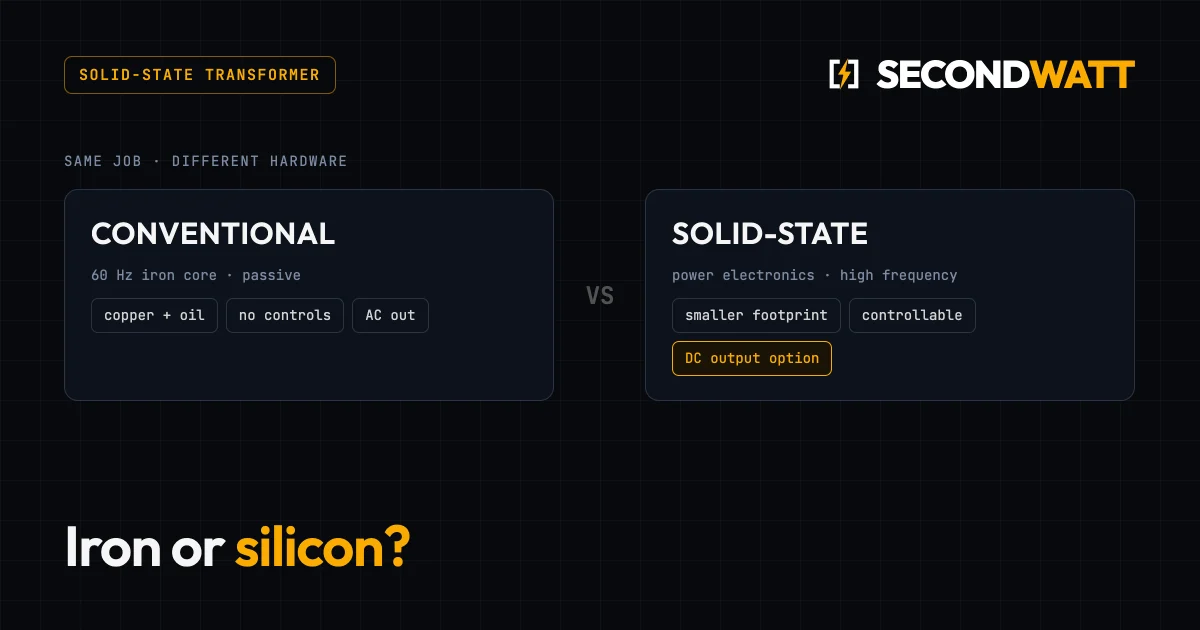
A solid state transformer (SST) does a transformer's job with power electronics. It switches incoming medium-voltage AC at high frequency and passes the power through a small high-frequency transformer for isolation. Then it converts the power to the AC or DC the load needs. Because the conversion is switched, the output can be regulated and delivered as DC; a conventional 60 Hz transformer needs a separate rectifier for that.
Data centers are looking at SSTs because of the 800 V DC architecture that NVIDIA, Google and Microsoft are developing through the Open Compute Project (OCP). In its long-term form, medium-voltage AC converts directly to an 800 V DC bus, and an SST is one way to do it. The SST specification is a first draft, revision 0.3, and the IEEE recommended practice is still a project. For a building energized in 2026 or 2027, the conventional transformer remains the practical choice.
Key Takeaways
- An SST replaces the 60 Hz iron core with switched conversion. Semiconductor stages around a high-frequency transformer provide isolation, regulated output and, in data-center designs, 800 V DC.
- Fault behavior changes protection design. A 10%-impedance transformer can supply 10 times rated current into a fault; OCP's recommended setting is 150% for 150 ms, then the SST may trip.
- An SST is one of two routes for direct MV-to-800 V DC conversion. The other is a transformer-rectifier unit; a separate path converts 480 V AC beside the racks.
- SST efficiency claims include rectification; DOE's minimum covers the transformer alone. DOE requires 99.33% for 2,500 kVA dry-type at ≥96 kV BIL; Eaton claims above 97%, Delta up to 98.5%.
- Standards and field records are still forming. IEEE P3105 and CSA/ANSI C22.2 No. 373 are both in development; ask vendors for test reports, listing route and field hours.
What a solid state transformer is and how it works#
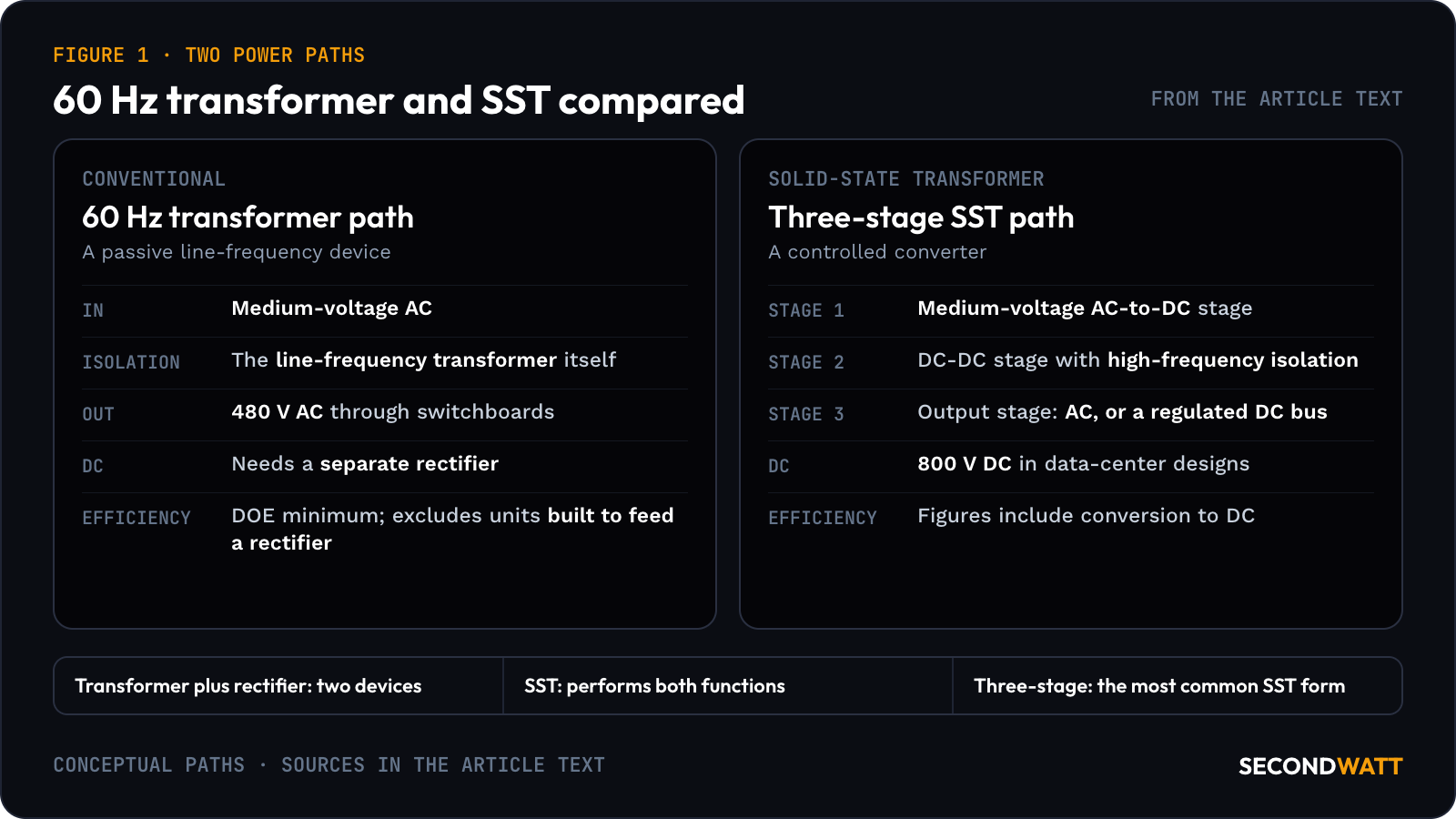
An SST is a power-electronic converter built around a medium- or high-frequency transformer. A 2020 IEEE Access review by Hannan et al. describes how it works. Switching circuits turn low-frequency input power into high-frequency power, and the output stages rebuild the form the load needs.
Designs come in single-stage, two-stage and three-stage topologies. The three-stage form is the most common. It has a medium-voltage AC-to-DC stage, a DC-DC stage that carries the high-frequency isolation, and an output stage. Each added converter brings conduction and switching losses, so three-stage designs give up some efficiency.
The output stage sets the variant: AC for AC loads, or a regulated DC bus for data-center designs. Revision 0.3 of the OCP SST Specification, effective 22 Jun 2026, defines its medium-voltage SST as a megawatt-scale converter that replaces line-frequency medium-voltage transformers and rectifier units. It uses medium- to high-frequency magnetics and wide-bandgap semiconductors such as silicon carbide.
How it differs from a conventional transformer#
A conventional distribution transformer is a passive line-frequency device. An SST is a controlled converter that needs external control to run.
Conventional 60 Hz transformer and solid-state transformer compared (sources per row)#
| Attribute | Conventional dry-type transformer | Solid-state transformer | Source |
|---|---|---|---|
| Isolation stage | The line-frequency transformer itself | Medium- or high-frequency transformer between converter stages | Hannan et al. 2020; OCP rev. 0.3 |
| Operating frequency | 50/60 Hz line frequency throughout | 50/60 Hz input; high frequency inside; AC or DC output | OCP rev. 0.3; Hannan et al. 2020 |
| Controllability | Runs without external control; no converter stage | Voltage regulation, power-flow control, reactive power compensation | Hannan et al. 2020 |
| DC output | Needs a separate rectifier | 800 V DC unipolar, ±1% static tolerance (OCP target) | NC State, Aug 2026; OCP rev. 0.3 |
| Fault-current behavior | 10% impedance supplies 10 times rated current into a short circuit | 150% for 150 ms in constant-current mode, then may trip | TSEWG TP-1, 2008; OCP rev. 0.3 |
| Cooling | Dry-type: ventilated or non-ventilated enclosure | One product: Eaton MVSST, liquid-to-air | UL 1562 scope; Eaton product page |
| Standards and listing | UL 1562 Edition 4; DOE minimums for 60 Hz units with output of 600 V or less, not designed to feed a rectifier | IEEE P3105 project; OCP lists related NFPA, UL and IEEE documents as evolving compliance sources | UL Standards & Engagement; eCFR; IEEE SA |
| Regulatory and field record | Federal efficiency minimums since 2010 for medium-voltage dry-type units | One SST with capacity to handle up to 1 MW, tested on a live utility feeder (reported Aug 2026) | 10 CFR 431.196; NC State, Aug 2026 |
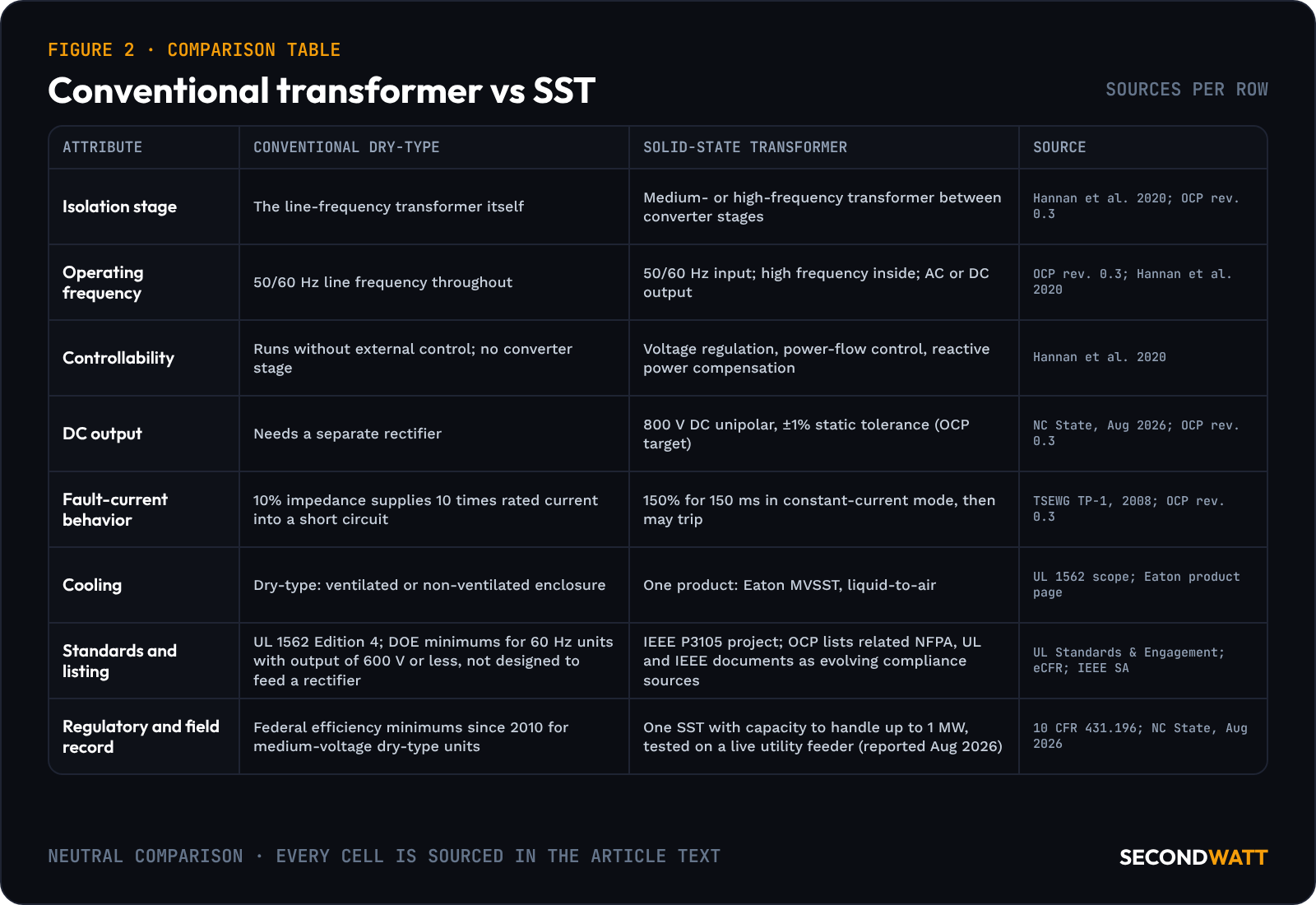
Two rows carry most of the buying decision. Fault current follows impedance: a transformer at 10% impedance can supply 10 times its rated secondary current into a short circuit, according to the 2008 TSEWG TP-1. DC output is the data-center case. One SST does the work of both the transformer and the rectifier, as an NC State University release of 18 Aug 2026 notes.
Why data centers are looking at SSTs now#
An 800 V DC hall forces one early decision: where medium-voltage AC becomes DC. An OCP post of 11 Aug 2026 describes how existing facilities step medium voltage down to 480 V AC and feed AC racks through switchboards and busway.
The OCP post sets out two 800 V DC paths. One keeps the 480 V AC supply and converts it in a side power rack beside the compute racks. The other, which the post calls the long-term architecture, converts medium-voltage AC directly to 800 V DC for the whole data hall. The equipment named for it is "multiple high-density MW scale transformer rectifiers or solid-state transformer skids".
NVIDIA's May 2025 design converted 13.8 kV AC to 800 V DC at the data-center perimeter with industrial-grade rectifiers. At the time, NVIDIA and its partners were studying the capital, operating and safety implications of transformer-based and SST approaches, according to NVIDIA's Technical Blog post of 20 May 2025.
The SST route now has written requirements. The OCP SST Specification rev. 0.3, authored by Google, Microsoft and NVIDIA, defines two units with 50/60 Hz input and 800 V DC output. One takes 13.8 kV and is rated 5 MW DC output; the other takes 34.5 kV and is rated 5 or 10 MW DC output.
98% — the OCP draft's minimum SST efficiency between 50% and 100% utilization, counting power-train loss only (revision 0.3, effective 22 Jun 2026).
Timing decides which path a near-term project can take. In its blog post of 11 August 2026, NVIDIA said its 800 V DC power rack was arriving in the second half of 2026. Its 800 V DC row power center, with capacity of up to 2 MW per row, is expected in 2027. Direct conversion belongs to NVIDIA's facility-scale DC power block, aimed at new facilities, with no date given.
Vendor claims and the DOE efficiency baseline#
In a release of 16 Mar 2026, Delta claims efficiency "as high as 98.5%" for its newly developed SST, which converts medium-voltage AC to 800 V DC. The release gives no load point. Eaton's product page rates its medium-voltage SST at 15 kV class, 12.47 kV nominal input, 50/60 Hz and 2 MW overall load power. Eaton states converter efficiency above 97% at 800 V DC output.
Siemens and Reinhausen are developing a modular SST for grid voltage up to 36 kV with 800 V DC output, according to a Siemens press release of 14 Aug 2026. The announcement gives no efficiency figure. In a release of 24 Mar 2026, Infineon estimates that SSTs are "up to 14 times smaller and 40 times lighter" than conventional transformers. Its footnote bases that on a multi-modular, dual-stage design with a high-frequency transformer.
Microchip's release of 26 May 2026 covers its 3.3 kV silicon carbide modules. It says they cut the number of series-connected devices "by roughly half versus lower-voltage SiC alternatives" on 13.8 kV or 34.5 kV grids.
The US federal baseline covers a narrower unit than an SST replaces. DOE's definition in 10 CFR 431.192, as of 27 Oct 2026, takes in transformers rated for 60 Hz, with input of 34.5 kV or less and output of 600 V or less. It excludes rectifier transformers, those designed with output windings connected to a rectifier. The minimum therefore describes the transformer in today's 480 V AC path.
For medium-voltage dry-type units made from 1 January 2016 to before 23 April 2029, Table 9 of 10 CFR 431.196(c)(2) sets the minimum. Its top three-phase row is 2,500 kVA, at 99.33% for 96 kV BIL or more, measured at 50% of nameplate load. That column matches the OCP draft's 110 kV BIL minimum at 13.8 kV and the 110 kV BIL on Eaton's page.
Loss per 1,000 kW of output at each published efficiency (calculated; boundaries differ by row)#
| Published figure | Efficiency | What it covers | Loss per 1,000 kW output |
|---|---|---|---|
| DOE minimum, 2,500 kVA three-phase dry-type, ≥96 kV BIL | 99.33% at 50% load | Transformer only, AC output | 6.7 kW at the minimum |
| Delta SST, vendor claim (Mar 2026) | Up to 98.5% | MV AC in, 800 V DC output | 15.2 kW or more |
| OCP rev. 0.3 target | At least 98%, 50–100% utilization | Power train only, 800 V DC output | 20.4 kW or less |
| Eaton MVSST, vendor product page | Above 97% | Converter at 800 V DC output | Under 30.9 kW |
| Transformer plus rectifier, NC State's general figure (news release, Aug 2026) | About 96% | Low-voltage DC output, two devices | About 41.7 kW |
Each loss value is 1,000 kW of output × (1 ÷ efficiency − 1). At their published figures, the SST rows lose more than the transformer alone and less than NC State's general transformer-plus-rectifier figure.
Standards, listing and maturity#
IEEE SA lists P3105, Recommended Practice for Design and Integration of Solid State Transformers in Electric Grid, as an active project. Its PAR was approved on 23 September 2021 under the IEEE Power Electronics Society.
The Standards Council of Canada lists CSA/ANSI C22.2 No. 373, Solid State Transformers, as a new CSA Group standard with the status "Open for SDO comment". Its scope covers SSTs with nominal input or output voltage up to 38 kV, installed under the Canadian Electrical Code and NFPA 70. It excludes conventional 50/60 Hz transformers covered by existing standards.
As of 29 October 2026, the IEC webstore and UL's standards catalog listed no published standard titled for SSTs. The OCP draft's compliance list mixes NFPA, UL and IEEE documents it calls "additional related evolving compliance standard source[s]". One is UL 347A, Edition 2, last revised 30 October 2024. It covers enclosed medium-voltage power conversion equipment, such as variable frequency controllers feeding motors, rated above 1,500 V to 38 kV.
The conventional unit's standard, UL 1562, Edition 4, covers dry-type distribution transformers of 601 to 35,000 V and excludes rectifier transformers.
Certification is still ahead. The OCP partners are engaging UL Solutions, NFPA, IEEE and IEC on the safety certifications they call "prerequisites for global deployment", according to the OCP post of 11 Aug 2026. The draft itself leaves load-test profiles, grounding details and short-circuit duration to later revisions.
Field evidence is early. NC State, the New York Power Authority and EPRI tested an SST with capacity to handle up to 1 MW on a live distribution feeder at EPRI's Lenox, Massachusetts laboratory. NC State University reported the test on 18 Aug 2026. The 2020 IEEE Access review found SST reliability "generally low", because most testing had run only for short periods.
Protection, fault current and cooling questions#
Protection coordination starts from the current an SST will deliver into a fault.
150% for 150 ms — the OCP draft's recommended fault-coordination setting in constant-current mode, after which the SST is allowed to trip.
Ask whether breakers set for a transformer's fault current will operate inside that window. Ask for the output current-versus-time curve and the device that clears a DC fault. The OCP partners cite solid-state breakers that clear faults in milliseconds. NVIDIA wrote in May 2025 that innovation was still required to deliver possible gains in overcurrent protection reliability and maintenance.
The upstream side keeps a transformer: the OCP draft assumes a wye medium-voltage secondary, low-resistance or solidly grounded. For the SST's own 13.8 kV input, it asks for 18–40 kA symmetrical short-circuit capability, duration still to be set, and at least 110 kV BIL. Those values go into the coordination study with the medium-voltage switchgear lineup.
The DC side is newer. The draft specifies a floating or high-resistance grounded 800 V bus with insulation monitoring, its detailed design still open. Ask how a ground fault on that bus is detected and cleared.
Limited overvoltage and overcurrent capability means an SST needs extra protection devices compared with a conventional transformer scheme, per the 2020 review. Ask what sits inside the enclosure and what the site must add.
Eaton's MVSST is liquid-to-air cooled and derates 2% per degree Celsius above 40 °C. The OCP draft asks for a design life of 15 years or more, and a supplier derating factor above 40 °C or 1,000 m of elevation. Ask for the derating at the site's ambient temperature and altitude.
In the OCP draft, a permanent module failure leaves the SST in its warning state, still converting power while derated. Control logic blocks a return to normal operation until the unit is serviced and re-provisioned; a separate fault state stops conversion. Ask how long it can run derated and who restores it.
When a conventional transformer is still the buy#
For a 2026–2027 energization date, a conventional transformer feeding 480 V AC has a documented basis. It has a federal efficiency minimum, a UL standard with a published edition and a federal test method. NVIDIA designed its 800 V DC power rack to "slot into existing AC infrastructure", with no changes to the building's electrical system. If that holds, a hall can add 800 V DC racks and still buy a conventional transformer.
Start with load and lead time in the transformer sizing and lead-time guide. Rating and enclosure choices follow from the data-center transformer selection guide. Cast-coil and ventilated construction are compared in the dry-type comparison, and outdoor service in the pad-mount guide.
The transformer category holds the dossiers, including the cast-resin Siemens Energy GEAFOL and Hitachi Energy RESIBLOC and the ventilated Eaton DS-3 and DT-3.
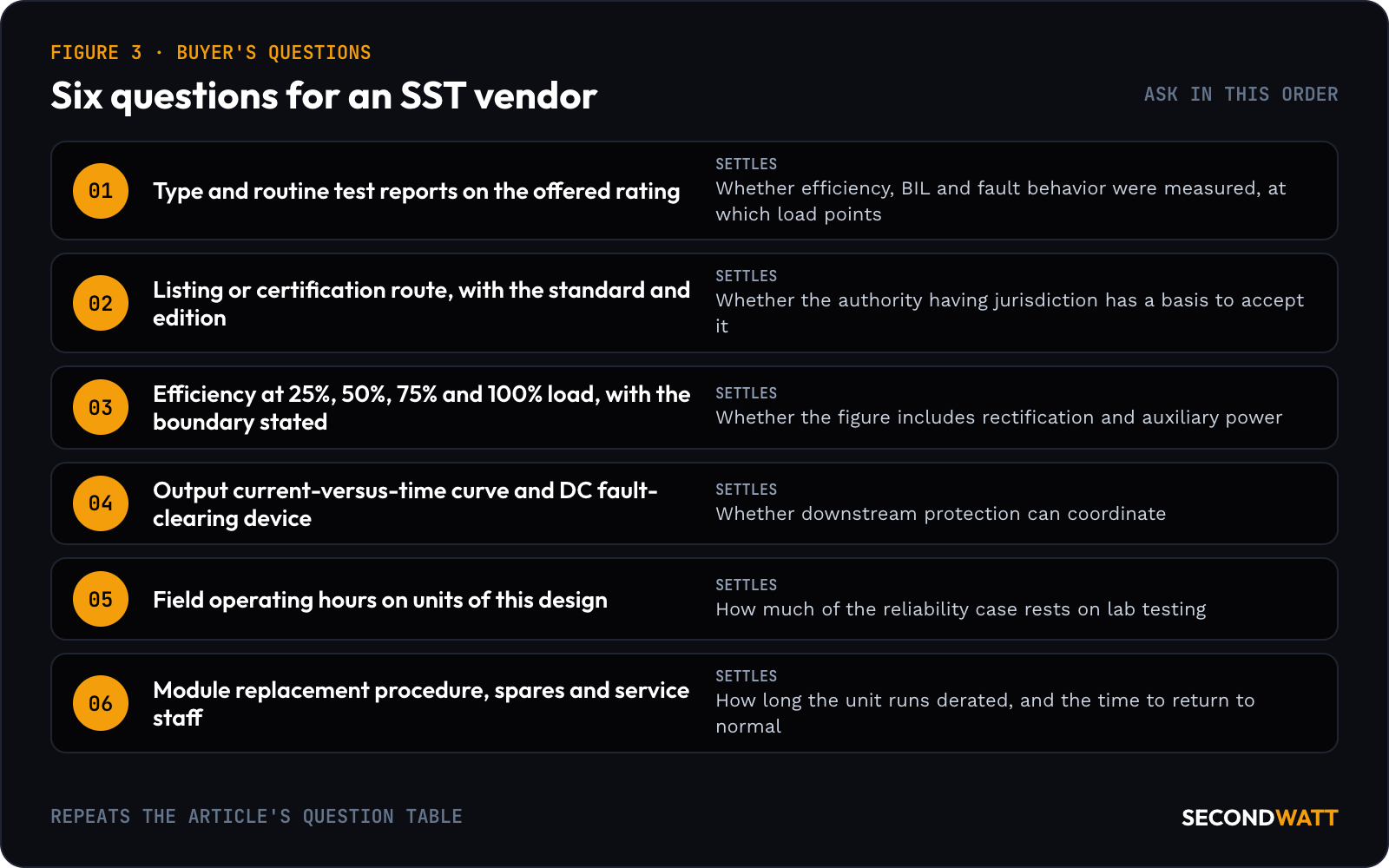
Questions for an SST vendor, in order, and what each answer settles#
| Ask for | What the answer settles |
|---|---|
| Type and routine test reports on the offered rating | Whether efficiency, BIL and fault behavior were measured, at which load points |
| Listing or certification route, with the standard and edition | Whether the authority having jurisdiction has a basis to accept it |
| Efficiency at 25%, 50%, 75% and 100% load, with the boundary stated | Whether the figure includes rectification and auxiliary power |
| Output current-versus-time curve and DC fault-clearing device | Whether downstream protection can coordinate |
| Field operating hours on units of this design | How much of the reliability case rests on lab testing |
| Module replacement procedure, spares and service staff | How long the unit runs derated, and the time to return to normal |
FAQ: solid-state transformers#
Who makes solid-state transformers?#
Eaton publishes a specification page for its 15 kV class MVSST, which it says supports 800 V DC and up to 1,500 V DC data-center architectures. Delta announced a newly developed SST in March 2026, and Siemens with Reinhausen announced joint development in August 2026. Infineon's March 2026 release describes DG Matrix's Interport platform as a multi-port SST. Infineon and Microchip supply silicon carbide devices for SST designs.
Why aren't solid-state transformers widely used yet?#
Cost is the plainest barrier. As of 2020, one estimate cited in the IEEE Access review put the material cost of a 100 kVA SST at five or more times that of an equally rated line-frequency transformer.
Can a solid-state transformer replace a UPS?#
Only with energy storage attached, in the OCP design. Coupled with storage, the medium-voltage SST "could function as a Medium Voltage Uninterruptible Power Supply". In its second low-voltage ride-through range, the SST draws no input current and the storage carries 100% of rated output load. Today's choices are in the UPS topologies guide.
Does an SST work with on-site generation or batteries?#
The OCP draft lists utility supply, fossil-fuel on-site generation and renewable energy as sources. It recommends load acceptance of about 20–50 MW per minute on utility supply and leaves the genset rate to be set, so ask the vendor for tested values. The OCP post also makes the 800 V DC backbone the connection point for optional battery storage, the subject of the BESS sizing guide.
Is a solid-state transformer more efficient than a dry-type transformer?#
On published figures, the dry-type transformer alone is more efficient, and its minimum rises in 2029. Table 10 of 10 CFR 431.196(c)(3) covers three-phase medium-voltage dry-type units at 96 kV BIL or more made on or after 23 April 2029. They must reach 99.40% at 2,500 kVA, 99.40% at 3,750 kVA and 99.39% at 5,000 kVA, at 50% load. A unit ordered now but manufactured after that date falls under that tier.
Weighing an SST against the transformer you know#
SecondWatt publishes equipment research and helps buyers source power equipment; it earns a fee when a sale it arranges closes. If your 800 V DC design is weighing an SST against a conventional transformer, send the voltage, load and energization date through a request for quote.