Data center decommissioning splits into two jobs. One clears the IT equipment and the data on it. The other takes the power and cooling plant out of service: generators and their fuel, UPS systems and batteries, switchgear, transformers, chillers, computer-room air units and fire suppression.
Isolate the plant first. Drain, recover, then remove. Close the records last.
In the US, OSHA rules govern isolation, and EPA rules cover fuel, batteries, refrigerant, fire-suppression agents and PCBs. DOT rules cover lithium battery transport, and California adds an SF6 removal duty. Each rule opens with a test of whether it reaches the site.
Generator sets, switchgear lineups, transformers, UPS frames and chillers can be resold. Buyers of each ask for records tied to the unit's identity, so those records are part of what the owner sells.
Key Takeaways
- Lockout rules divide by hazard and type of work. 29 CFR 1910.147 covers unexpected energization and stored-energy release; electrical hazards follow 1910.333(b)(2); construction follows Part 1926.
- Settle each item's route before the demolition contract is signed. A buyer judges a switchgear lineup as a complete assembly; document condition each time responsibility changes hands.
- Fuel rules start with capacity tests. SPCC exempts facilities with no more than 1,320 US gallons aboveground and 42,000 completely buried; floor-standing basement tanks fall outside the UST rule.
- Buyers ask for records tied to the unit. Hours, starts and test results for generators; dissolved-gas history and PCB basis for transformers; battery history; UN 38.3 summaries for lithium-ion.
- HFC chillers now need a disposal record. Since 1 January 2026, owners of HFC appliances with full charges of 15 lb or more record each disposal, including the refrigerant removed.
What data center decommissioning covers#
The IT half covers servers, storage and network equipment, and its central question is data. Sanitizing that equipment is the subject of NIST SP 800-88 Rev. 2 (September 2025), which assists organizations in setting up a media sanitization program.
The plant half is the electrical and mechanical equipment that kept the IT load running. Its questions are stored energy, fuel and oil, batteries, refrigerant, fire-suppression agents, SF6 and PCBs, and each has its own rule. Scope the two halves separately, and list each plant item by name.
The order of work for the power and cooling plant#
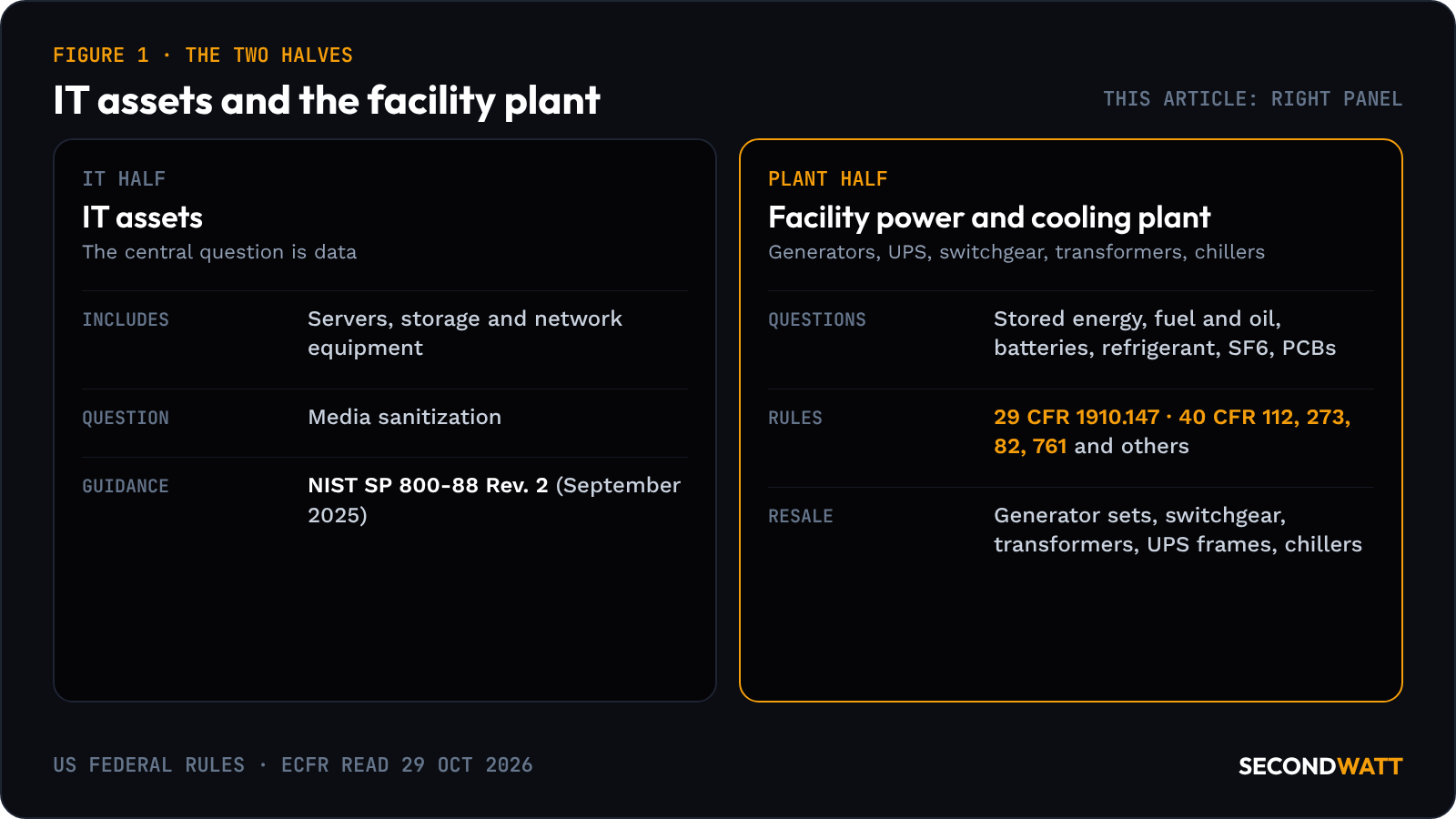
Isolation comes first because draining, gas recovery and removal all put people on the equipment.
Data center decommissioning checklist for the plant: step, equipment and governing rule (US federal unless marked California)#
| Step | What it covers | Governing rule |
|---|---|---|
| 01 Isolate and lock out | Utility service, switchgear, generators, UPS inputs and batteries, chiller and fan drives | 29 CFR 1910.147; 29 CFR 1910.333(b)(2); Part 1926 (1926.417, 1926.850) for construction work |
| 02 Drain | Day tanks, bulk tanks and any underground tanks; transformer oil after sampling | 40 CFR 112 (SPCC); 40 CFR 280.71 (UST closure) |
| 03 Recover | Refrigerant in chillers and DX units; SF6 in gas-insulated gear; fire-suppression agent, recovered on site or sent with the equipment for recovery | 40 CFR 82 Subparts F and H; 40 CFR 84 Subpart C; California 17 CCR 95354 |
| 04 Remove | Batteries, transformers, generator sets, switchgear, chillers | 40 CFR 273; 49 CFR 173.185; 40 CFR 761.2 |
| 05 Record | Plan amendments, closure notices, refrigerant and agent disposal records, SF6 removal records | 40 CFR 112.5; 40 CFR 280.71; 40 CFR 84.106(l); 40 CFR 84.110(g)(3); California 17 CCR 95354(d) |
In general industry, 29 CFR 1910.147 covers servicing and maintenance where unexpected energization, start-up or release of stored energy could injure employees. Its energy sources include electrical, mechanical, hydraulic, pneumatic, chemical and thermal energy. It excludes construction employment, and electrical hazards from work on or near conductors and equipment in electric-utilization installations.
Those electrical hazards fall under Subpart S, where § 1910.331 covers premises wiring in and on buildings. Under 29 CFR 1910.333(b)(2), circuits are disconnected from all electric energy sources, and each disconnecting means gets a lock and a tag, with tag-only and lock-only exceptions. Stored electric energy is released, capacitors are discharged where they could endanger personnel, and a qualified person tests the circuit as deenergized. Procedures that meet 1910.147 also satisfy 1910.333(b)(2) if they address Subpart S electrical hazards and add two of its requirements.
A UPS carries its own source: the battery, which 40 CFR 273.9 defines as a device designed to "receive, store, and deliver electric energy." Its battery disconnect is isolated along with every input feed. NFPA 70E (2027 edition) sets safe work practices for these electrical hazards and assists compliance with OSHA 1910 Subpart S and 1926 Subpart K.
Construction work, which 29 CFR 1910.12 defines as "construction, alteration, and/or repair", falls under Part 1926, where 1910.147 does not apply. Part 1926 carries its own circuit-tagging rule in § 1926.417 and, in Subpart T, the demolition rules. Under 29 CFR 1926.850, service lines are shut off, capped or otherwise controlled outside the building line before demolition starts, and any utility involved is notified. Where hazardous or flammable substances are known or suspected in pipes, tanks or equipment, they are tested and purged first.
Generators and stored fuel#
Under 40 CFR 112.1, facilities that store or use oil need an SPCC Plan if, by location, they could reasonably be expected to discharge oil to navigable waters or adjoining shorelines. A facility is exempt when aboveground oil capacity is 1,320 US gallons or less and completely buried capacity is 42,000 gallons or less. Only aboveground containers of 55 gallons or more count. Completely buried tanks currently subject to all of the technical requirements of Part 280 drop out of the buried total.
The aboveground count reaches past the fuel tanks. According to EPA, oil held in equipment counts toward the 1,320-gallon threshold when the piece of equipment can hold 55 gallons or more. Transformers and circuit breakers are among the examples of oil-filled operational equipment in § 112.2.
Decommissioning can trigger a plan amendment. Under § 112.5(a), an amendment is due when a change materially affects discharge potential, and "commissioning or decommissioning containers" is one of the listed examples. It is prepared within six months and implemented no later than six months after that. A container leaves the count once permanently closed: liquid and sludge removed, lines disconnected and blanked off, valves closed and locked, and a dated sign posted.
Underground tanks follow Part 280. A UST has 10% or more of its volume, including connected underground pipe, beneath the ground. The definitions in 40 CFR 280.12 exclude a tank in a basement, vault or other underground area that sits on or above the floor. Tanks storing fuel solely for emergency generators were once deferred, and § 280.10 now brings them under the rule.
Under 40 CFR 280.71, closure starts with notice to the implementing agency at least 30 days ahead, or within another reasonable period the agency sets. The tank is emptied and cleaned, then removed, filled with an inert solid or closed in place in a manner the agency approves. Before closure is complete, § 280.72 has the owner measure for a release where contamination is most likely.
Air permits for generators come under Clean Air Act programs, and EPA says states, local agencies and approved tribes carry out most of them. A standby-set buyer's full request list is in the used standby generator buyer checklist.
UPS systems and batteries#
Under 40 CFR 273.2, part of the federal universal waste rule, a used battery becomes waste on the date it is discarded, such as when sent for reclamation. An unused one becomes waste when the handler decides to discard it. Batteries that are not yet waste, or are not hazardous waste, sit outside the rule. Section 266.80 lets spent lead-acid batteries be managed instead under 40 CFR 266 Subpart G.
5,000 kg — the universal waste accumulated at any time, counted across all types together, that makes a site a large quantity handler under 40 CFR 273.9.
Below that, a small quantity handler need not notify EPA. A large quantity handler notifies EPA and obtains an identification number before reaching the limit, and records each shipment it sends. Both contain damaged batteries and label them "Universal Waste—Battery(ies)", "Waste Battery(ies)" or "Used Battery(ies)". Under §§ 273.15 and 273.35, both accumulate for no longer than one year, unless the extra time is solely to gather enough for proper recovery, treatment or disposal.
For US transport, 49 CFR 173.185 requires each lithium cell and battery to be of a type proven to meet the UN 38.3 tests. Manufacturers and later distributors of cells and batteries made on or after 1 January 2008 must make a test summary available, so the summary belongs in the resale file.
Lithium batteries carried by motor vehicle for recycling or disposal are excepted from the testing and record-keeping requirements when packed in a strong outer packaging. Damaged or defective ones that could produce dangerous heat, fire or a short circuit travel only by highway, rail or vessel, in specified packaging.
A used-UPS buyer judges the battery's identity and history apart from the cabinet's age, so keep the two records separate (buying a used data center UPS).
Switchgear and SF6#
Air-insulated gear has no insulating gas to recover. Gas-insulated gear may hold SF6, which ABB's SF6 services program describes as a gas used in medium- and high-voltage switchgear for its insulating and arc-quenching properties. Recover the gas before the gear is opened or cut up.
Under 17 CCR 95350(b), set out in CARB's final regulation order, California's SF6 rule applies to owners of gas-insulated equipment that uses covered insulating gas. Section 95354(c)–(d) covers a device taken out of active service to be disposed of, sold or transferred. Since 1 January 2022, such a device must have that gas removed and accounted for within one year, and the amount removed is recorded. A device sold while it stays in place and in operation is "transferred while in use", which sits outside that removal duty.
Federal SF6 reporting under 40 CFR 98 Subpart DD carries no recovery duty. EPA proposed removing it in the Federal Register on 16 September 2025; as of 29 Oct 2026 it remains in the eCFR. It reaches a data center only if the site already reports under Part 98 and its SF6 nameplate capacity, excluding hermetically sealed-pressure equipment, reaches about 23,450 lb: 25,000 t CO2e ÷ (23,500 GWP × 0.1 × 0.000453592 t/lb).
The dates by which California and the EU phase SF6 out of new equipment are in the medium-voltage switchgear guide.
Transformers, oil and PCB status#
Sample the oil before it is drained. The sample answers two questions: PCB status, which decides what can happen to the unit, and condition, which a buyer reads from dissolved-gas results.
2 July 1979 — mineral-oil equipment made before this date, or of unknown date, must be assumed PCB-contaminated until its concentration is established under 40 CFR 761.2.
Under 40 CFR 761.2, concentration is established by testing, or by the manufacturer's label plus service records showing the PCB concentration of every fluid used since manufacture. The stricter assumption for transformers of that age holding 3 lb or more of other fluid, and the PCB classes, are covered in the guide to selling surplus power equipment.
Dissolved-gas results are read against the norms and fault types in IEEE C57.104-2019, the active guide for mineral-oil-immersed transformers. Keep every past result with the unit.
Dry-type transformers hold no insulating liquid, so the oil sample and the fluid PCB question fall away. For liquid-filled units, the used pad-mount transformer checklist separates original records from current condition, so keep both.
Chillers, CRAH units and refrigerant#
Two federal rules cover refrigerant. Anyone servicing, repairing or disposing of appliances that contain class I, class II or non-exempt substitute refrigerants falls under 40 CFR 82 Subpart F. Its appliance definition names the chiller, and each independent circuit counts as a separate appliance.
Disposal is defined broadly, including disassembly to reuse parts and recycling for scrap. Before an appliance other than a small appliance is opened or disposed of, technicians evacuate it to the levels in Table 1 of § 82.156. Knowing venting is prohibited.
HFC appliances carry an added duty under the AIM Act, in § 84.106(l) of 40 CFR 84 Subpart C. From 1 January 2026, owners of appliances with a full charge of 15 lb or more of an HFC, or of a substitute above 53 GWP, keep a three-year record of each disposal. It names the appliance, date, person and the amount and type of refrigerant removed, and a contractor doing the work must supply it.
Computer-room units with their own refrigerant circuit are appliances under the same definitions. A chiller is bought against the duty it must deliver at the new site, the subject of used chillers for GPU data centers, so keep its original selection report.
What has resale value, and the records that prove it#
Settle each item's route before the demolition contract is signed. The PCB assumption, the records each buyer asks for, and the gas and refrigerant rules above sort most items between resale and recycling.
Removal method protects value. Keep a switchgear lineup whole, since a buyer judges the complete assembly and wants documentation for its final configuration (specifying a used switchgear lineup). Record condition when responsibility changes hands, matching the release inspection, shipment inventory and receiving record to the same unit (what a standby-set buyer checks).
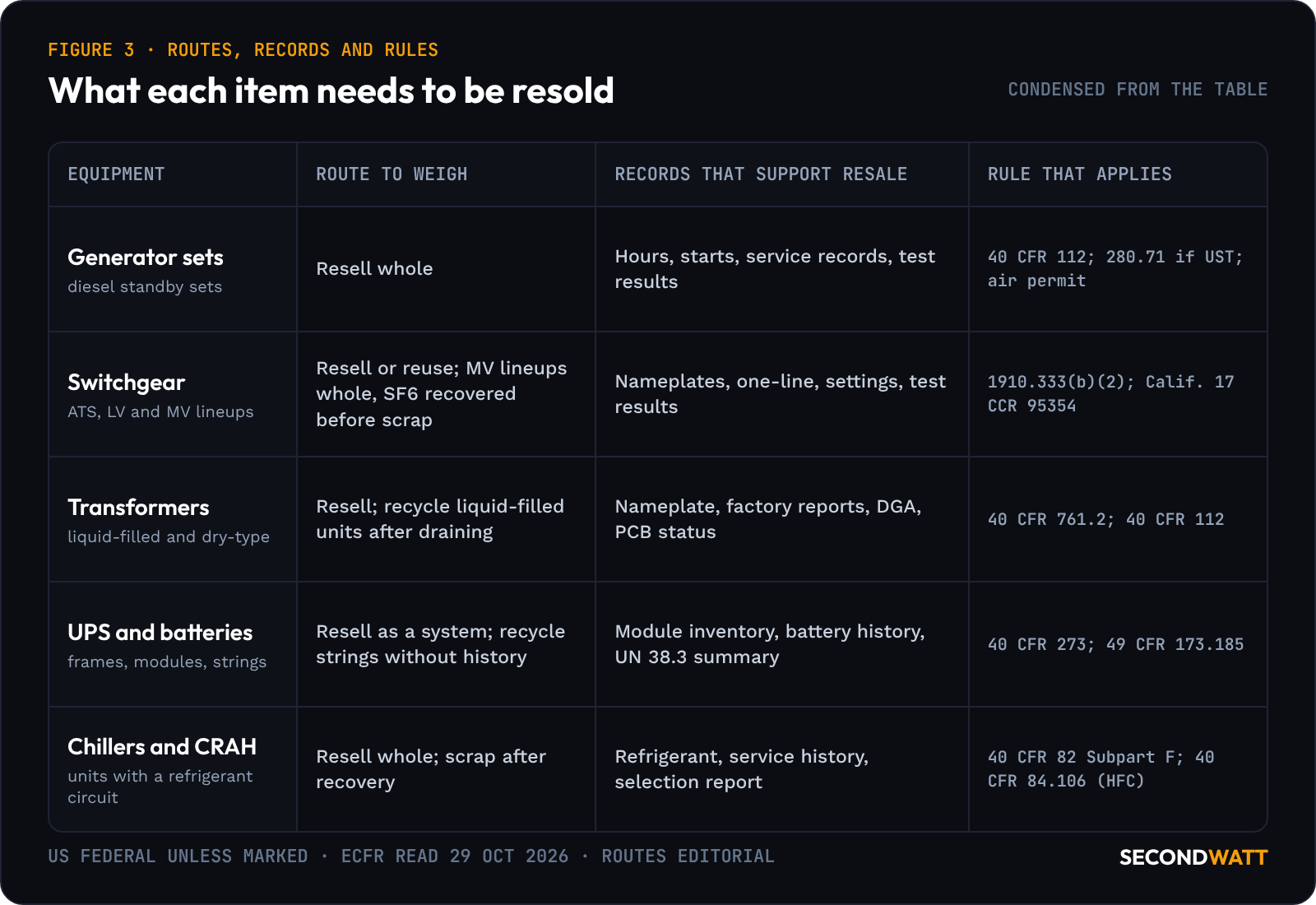
Facility equipment from a retired data center: reuse route, records that support resale, and the rule that applies (regulation cited; US federal unless marked; routes are editorial)#
| Equipment | Routes to weigh | Records that support resale | Rule that applies |
|---|---|---|---|
| Diesel generator sets | Resell whole; recycle if beyond repair | Hours, starts, service records, test results with test conditions | 40 CFR 112 for fuel; 40 CFR 280.71 if fed from a UST; state or local air permit |
| ATS and LV switchgear | Resell or reuse on site | Nameplates; the one-line diagram showing its position | 29 CFR 1910.333(b)(2) at isolation |
| MV switchgear | Resell as a whole lineup; recover SF6 before scrap | Protection study, settings files, functional test results for the final configuration | 29 CFR 1910.333(b)(2) at isolation; California 17 CCR 95354 |
| Liquid-filled transformers | Resell; recycle after draining | Nameplate, connection diagram, factory reports, dissolved-gas history, PCB test or label with service records | 40 CFR 761.2; 40 CFR 112 (oil-filled operational equipment) |
| Dry-type transformers | Resell or reuse | Nameplate, connection diagram, factory reports | 29 CFR 1910.333(b)(2) at isolation |
| UPS frames and modules | Resell as a system; recycle electronics | Frame, module and serial inventory; current single-line; record of module changes | 29 CFR 1910.333(b)(2) for stored energy |
| Batteries | Reuse with full history; otherwise recycle | Manufacturer, model, chemistry, string arrangement, installation dates, storage history; UN 38.3 test summary for lithium-ion | 40 CFR 273, or 266 Subpart G for spent lead-acid; 49 CFR 173.185 |
| Chillers | Resell whole; scrap after recovery | Identity, refrigerant, service history, selection report | 40 CFR 82 Subpart F; 40 CFR 84.106 for HFC units of 15 lb or more |
| CRAH and CRAC units | Resell or recycle | Nameplates; refrigerant type where the unit has a circuit | 40 CFR 82 Subpart F and 84.106 where the unit has a refrigerant circuit |
| Fire suppression | Send agent or equipment to a manufacturer, dealer, distributor or recycler | Recovery records for HFC agents | 40 CFR 82 Subpart H (halon); 40 CFR 84.110 (HFC) |
| PDUs and busway | Reuse or recycle | Nameplates and ratings; one-line position | 29 CFR 1910.333(b)(2) at isolation |
Before listing a unit, match its nameplate to the model dossiers on the hubs for generators, UPS systems, switchgear, transformers and chillers.
FAQ: data center decommissioning#
Should equipment be sold in place or removed first?#
Selling in place moves loading, and on some routes risk, to the buyer. On one online auction route, a lot sells where it sits, the buyer pays loading, and title and risk pass at the auction's close and the buyer's receipt. On one dealer's purchase terms, the dealer removes, loads and transports the unit (how selling channels compare). Removing first gives the owner control of timing but puts draining, recovery and transport on the owner.
Can a generator's air permit move with it?#
The permitting authority at the new site decides. Obtain its applicability determination before assuming the old permit carries over, and put the relocation and refurbishment scope in front of it. The emissions permitting guide for relocated turbines sets out the same step.
Who recovers the refrigerant from a chiller before it is moved?#
A technician who has passed an exam from an approved program under 40 CFR 82.161. Medium-, high- and very high-pressure appliances need Type II, low-pressure appliances Type III, and a Universal technician covers all types. EPA's Section 608 technician certification page says it does not issue the cards itself.
Can the recovered refrigerant be sold?#
Under 40 CFR 84.104(a), recovered HFC refrigerant can be sold or transferred on one of two terms. Either a certified reclaimer has reprocessed it to all of the specifications in appendix A to 40 CFR 82 Subpart F, or it goes solely for reclamation or destruction.
What happens to halon or HFC fire suppression?#
Under 40 CFR 82.270(d), halon equipment goes for halon recovery to a manufacturer, fire equipment dealer or recycler operating to NFPA 10 and NFPA 12A. Fully discharged total-flooding systems, de minimis equipment and ancillary detection components are exempt. HFC agents such as HFC-227ea are regulated under Part 84, and § 84.110 has barred venting them since 1 January 2026. They are recovered before disposal, or left in the equipment and sent to a manufacturer, distributor or fire suppressant recycler; the owner keeps recovery records for three years.
Planning the plant side#
SecondWatt publishes equipment research and helps buyers source power equipment; it earns a fee when a sale it arranges closes. If a retired hall leaves you with generator sets, switchgear or transformers that can run again, the seller page sets out how SecondWatt works with owners. Category pages cover generators, switchgear and transformers.