ABB SafeRing Air ring main unit
Manufacturer: ABB
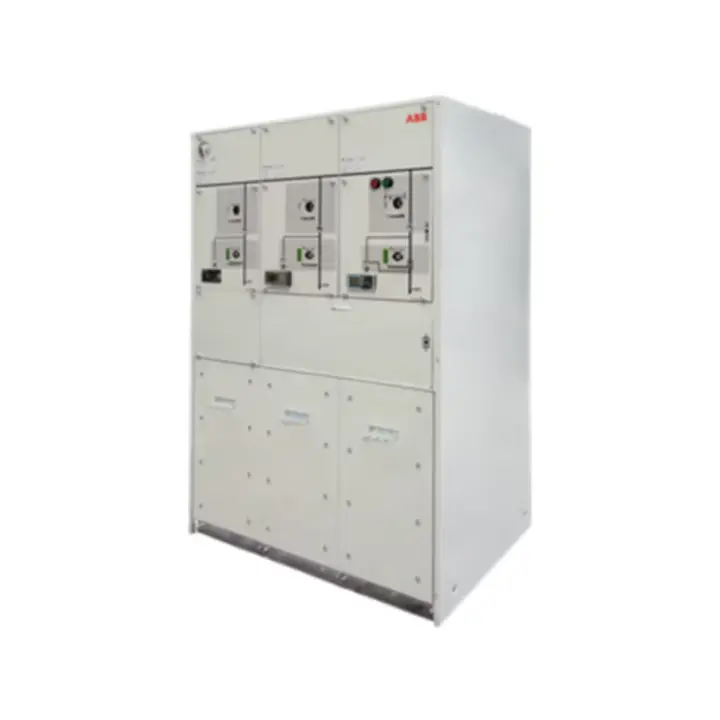
ABB SafeRing Air, the dry-air SF6-free ring main unit that superseded the fluoroketone AirPlus variant.
This model is part of SecondWatt’s switchgear research catalogue. Specifications and price observations are included where supported by sources. Equipment availability and commercial terms require confirmation.
ABB SafeRing Air dossier: dry-air SF6-free ring main unit to 24 kV, AirPlus lineage, F-gas timeline, fleet evidence, and inspection checklist.
The SafeRing AirPlus name is outdated. SafeRing AirPlus was ABB's RMU variant insulated with AirPlus, a fluoroketone (C5) gas mixture developed with 3M carrying a warming potential below 1; the first German order went to SUC Coburg in January 2017. ABB's current SafeRing/SafePlus page lists only SF6 and Air (dry air) variants, with no AirPlus option, so the current product is SafeRing Air and AirPlus is its lineage.
SafeRing Air is the SF6-free ring main unit of the platform: up to 24 kV, 630 A busbar, short-time withstand to 20 kA/3 s at 24 kV, internal arc IAC A FLR 20 kA 1 s per IEC 62271-200, dry-air insulation at zero warming potential, and F-gas Regulation (EU) 2024/573 compliance, in a sealed stainless tank. ABB counts more than 40,000 dry-air functional units in operation, and the current Air catalog is Rev A dated March 2026.
No used SafeRing AirPlus or SafeRing Air unit was listed by any dealer, auction or gray-channel source in August 2026: the product is young, sealed for life, and held by EU utility fleets, so there is no used market to price.
Why it matters
The AirPlus-to-Air rename inside ABB's own portfolio is a case study in SF6-free technology churn: fluoroketone mixtures gave way to plain dry air within a decade. Supplier data that keeps the obsolete AirPlus name misleads buyers, and the 40,000-unit dry-air fleet shows where the whole RMU class is heading before any used market exists.
Who buys it
EU and utility-style buyers replacing SF6 RMUs ahead of the 2026 F-gas cutoff specify SafeRing Air new; Enedis and E.ON framework agreements anchor demand. There is no used channel; buyers of decommissioned SF6 SafeRings inherit gas obligations, not resale value.
Role in the data center
MV ring switching for campus loops in EU-style distribution; relevant to US buyers mainly through imported modular substations and as the SF6-free reference design.
Key specifications
| Voltage ceiling | 24 kV |
|---|---|
| Busbar current | 630 A |
| Short-time withstand | 20 kA / 3 s at 24 kV |
| Internal arc class | IAC A FLR 20 kA 1 s |
| Insulation | dry air (GWP ~0) |
| AirPlus lineage | C5 fluoroketone with 3M; first order Jan 2017 (SUC Coburg) |
| Current variant status | AirPlus delisted; SF6 and Air only |
| Dry-air fleet | 40,000+ units |
Technical summary
Current product: SafeRing Air (dry-air insulation) Voltage: up to 24 kV Busbar: 630 A Short-time withstand: up to 20 kA/3 s at 24 kV Internal arc: IAC A FLR 20 kA 1 s (IEC 62271-200) Insulation warming potential: ~0 (dry air) Compliance: F-gas Regulation (EU) 2024/573 Lineage: AirPlus C5 fluoroketone variant (first order Jan 2017), since delisted Sibling: SafePlus extendible compact switchgear Fleet: 40,000+ dry-air functional units
Major variations
SafeRing configurations are fixed ring-main schemes (load-break, switch-fuse, and breaker ways); SafePlus is the extendible sibling. Insulation eras: SF6 originals, AirPlus C5 fluoroketone (2016-era pilots, since delisted), and current dry-air Air units.
Configurations and options
Configurations are fixed ring-main schemes assembled at the factory from load-break switch, switch-fuse and vacuum circuit-breaker ways, so way count and scheme set the price; the extendible sibling is SafePlus. The nameplate items that decide what a used unit is worth are the insulation medium, the voltage class up to 24 kV, the 630 A busbar, short-time withstand to 20 kA/3 s at 24 kV and internal arc class IAC A FLR 20 kA 1 s. Three insulation eras carry the same family name: original SF6 units, the AirPlus C5 fluoroketone variant piloted from 2016 and since delisted, and current dry-air units. Tender documents written before 2023 will name all three.
Compatibility and dependencies
A sealed welded stainless tank with no field-serviceable interior, so interoperation happens entirely at the terminals: cable boxes, fuse links, busbar couplings to adjacent units and the mechanism interlocks. Construction is to IEC 62271-200 and the internal arc classification IAC A FLR 20 kA 1 s holds only in an installation that reproduces the tested clearances and mounting. Extending an installed ring means matching ABB units of the same generation. Because dry-air insulation carries essentially zero warming potential, a SafeRing Air unit avoids the certified gas handling that an SF6 SafeRing brings to every relocation and to decommissioning.
Pricing and availability
Trend: up Lead time, new: 52-72 weeks (MV secondary class). Lead time, used or refurbished: No used channel exists. Warranty, used: 1-year typical from reconditioning dealers.
Lifecycle and maintenance
Gas-insulated switchgear targets 35-40 year service from sealed-for-life compartments with minimal maintenance: density monitoring, PD surveys, and mechanism service. Sealed tanks cannot be repaired in the field, so gas loss or internal fault usually ends the asset. EU F-gas and CARB rules add end-of-life SF6 recovery and reporting obligations that must be priced into any SF6 unit, while SF6-free designs (clean air, dry air, C4-FN mixtures) remove that liability entirely.
Thermal and emissions profile
Switchgear produces no combustion emissions, and SF6-free designs remove the category's one regulatory exposure: instead of SF6 (GWP 24,300), these units insulate with clean air, dry air, or pure air at GWP below 1 and interrupt in vacuum. That satisfies EU F-gas Regulation 2024/573, which bars new SF6 MV switchgear from the EU market from 2026, and California's CARB phase-out of new SF6 equipment acquisitions from 2025. Buyers avoid gas handling, leak reporting, and end-of-life recovery costs entirely.
Common failure points
- Gas leakage — Density alarms and lockout; insulation margin lost as pressure falls
- Partial discharge in compartments — PD at spacers, particles, or terminations progressing to internal fault
- Operating mechanism — Spring and motor failures on switch and breaker drives
- Cable terminations — Tracking in cable boxes and poorly seated plug-in connectors
- Density monitor drift — False alarms or missed low-gas conditions from drifted gauges
- End-of-life gas liability — SF6 recovery and reporting costs land on the owner at decommissioning
Inspection checklist
Gas density — verify density monitors against nameplate fill (150 kPa class systems); alarm thresholds intact Leak rate — review gas top-up logs; leakage above 0.5% per year fails modern acceptance Gas quality — test SF6 moisture and decomposition before transfer; SO2 presence flags internal arcing F-gas compliance — verify EU 2024/573 and CARB status; new SF6 MV gear is barred from the EU market from 2026 Partial discharge — UHF or acoustic survey per IEC 60270 practice; PD is the dominant latent defect Vacuum interrupters — hipot test breaking units; interruption is vacuum even in gas-insulated designs Mechanism — exercise and verify spring charge; check counters against 10,000-operation class ratings Terminations — inspect cable boxes for tracking; verify stress cones and plug-in connectors seated Enclosure — verify sealed-compartment integrity (IP65 class HV parts), pressure relief, and corrosion Interlocks — verify 3-position switch logic (closed/open/earthed) and padlock provisions Gas handling — confirm certified handling equipment and trained personnel for any gas transfer Monitoring — verify density and PD telemetry channels report correctly to the control system Nameplate — confirm kV class, BIL (75-185 kV in MV GIS), kA rating, and busbar current Standards — IEC 62271-200 (or -203 HV) type-test documentation present and matching configuration Records — gas logs, factory routine tests, and service history; sealed units without logs reprice sharply
Procurement channels
New through ABB and EU utility frameworks (Enedis renewal, E.ON supply agreements). No used unit was listed under either the AirPlus or Air nameplate in August 2026.
Regional notes
An IEC-market ring main unit for European-style 12-24 kV distribution networks, largely 50 Hz, with no ANSI listing and no North American channel of its own; US exposure is generally through imported modular substations. EU Regulation 2024/573 bars new SF6 switchgear at and below 24 kV from 2026, and ABB's EU utility framework agreements, including the Enedis renewal and the E.ON SF6-free supply agreement, are where this product's volume sits. The dry-air build carries no F-gas obligation under either the EU or the California regime.