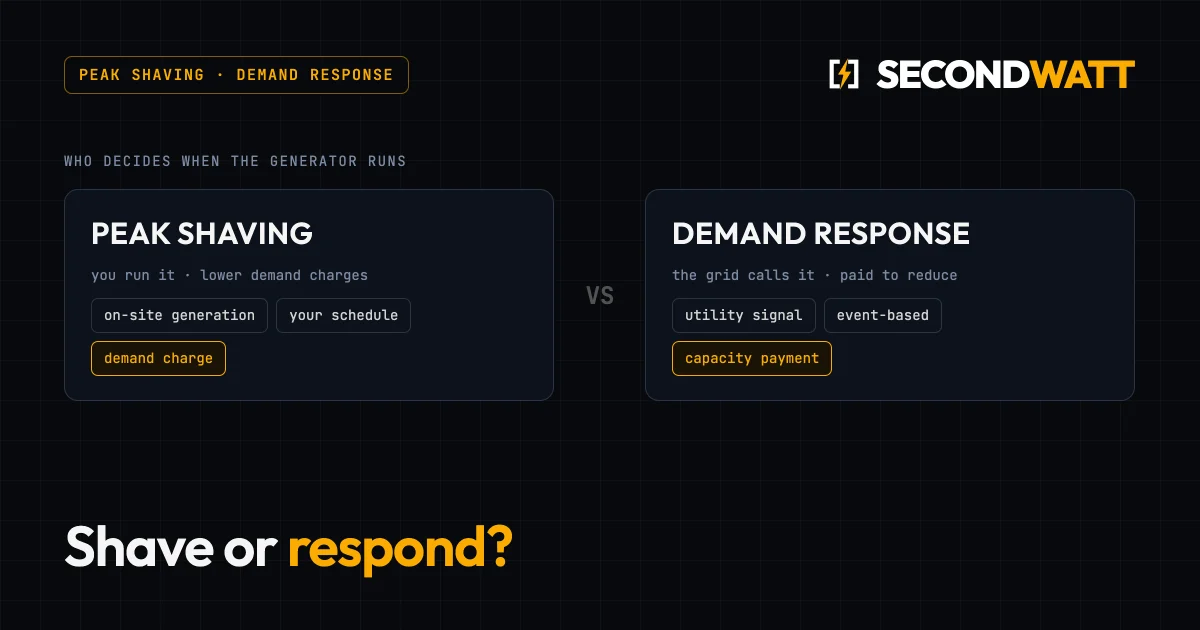
Peak shaving is holding down the highest demand a site's meter records in the hours its tariff bills, so the monthly demand charge falls. A data center can do it three ways: discharge a battery, move flexible load out of the peak window, or run on-site generators. Demand response is a separate idea: a cut in use made in answer to a price or incentive signal from outside the site.
The generator route is the one federal rules restrict. Under 40 CFR Part 60 Subparts IIII and JJJJ and Part 63 Subpart ZZZZ, a stationary emergency engine may run outside emergencies only for maintenance, testing and a few narrow uses. The rule text excludes peak shaving by name. A battery carries no engine-hour rule; an engine that shaves peaks must meet the requirements for non-emergency engines.
So work in order: tariff, then load profile, then asset. The tariff sets what a shaved kilowatt is worth, the profile sets how long it must stay shaved, and the rules decide which asset may do the shaving.
Key Takeaways
- A shaved kilowatt is worth the on-peak demand rate. On Rocky Mountain Power's Utah Schedule 8 that is $186.56 per kW-year in 2026 Power charges, without the Voltage Discount.
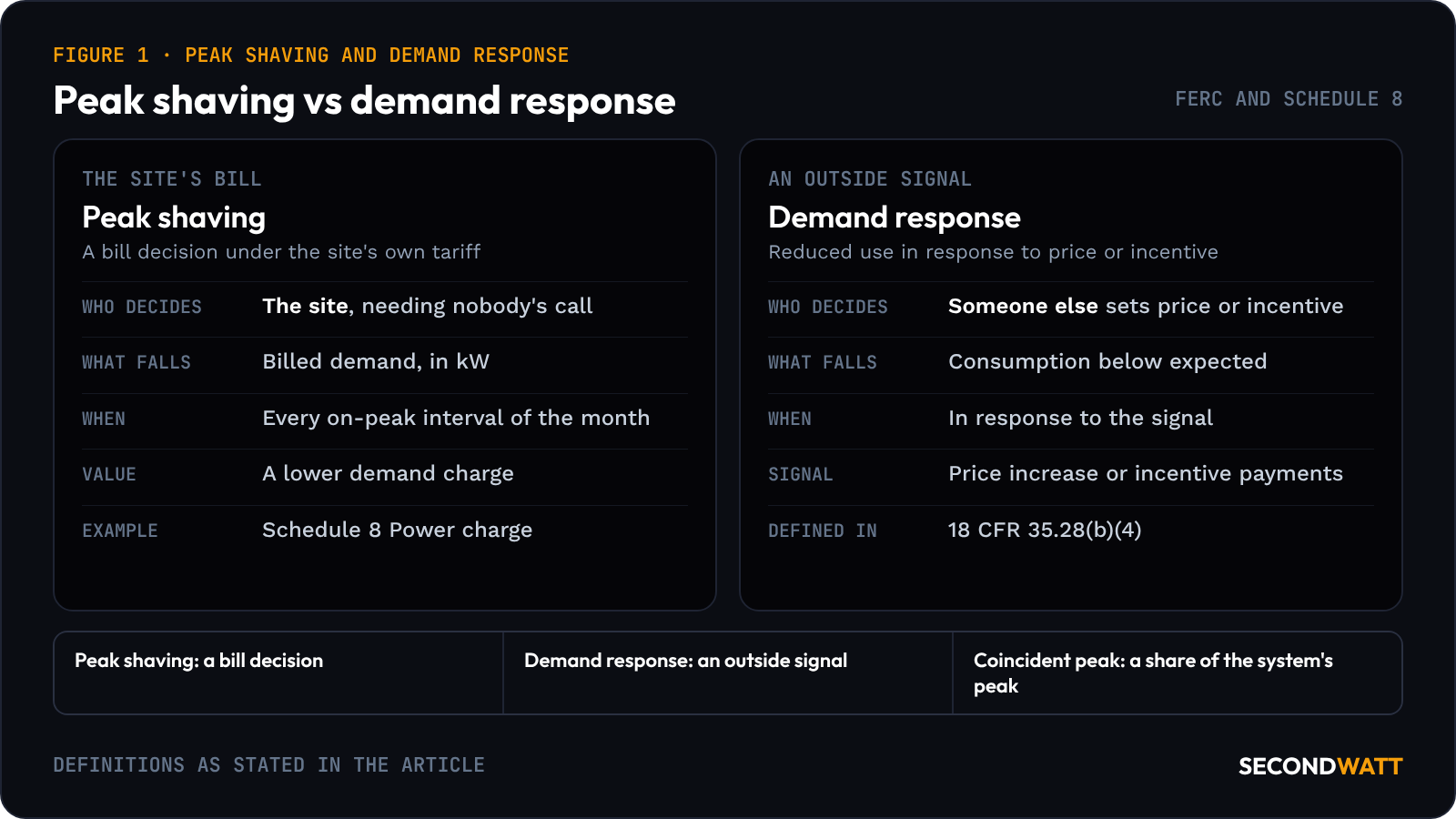
- Peak shaving is a bill decision; demand response answers someone else's signal. FERC defines demand response as cutting use in response to a price increase or incentive payments.
- Federal rules give a stationary emergency engine no peak-shaving hours. It gets 100 hours a year for maintenance and testing; up to 50 may be non-emergency use, never peak shaving.
- An engine run outside those limits loses emergency status. It must meet the non-emergency requirements; a 2007-or-later diesel under 30 L/cyl complies "by purchasing an engine certified to" them.
- The window's length sizes the battery. Stored energy must cover the shaved kW for the whole on-peak window, seven hours on Schedule 8 in summer.
What peak shaving is and how demand charges work#
A demand charge bills the highest power a meter records, in kW, separately from the energy used in kWh. Rocky Mountain Power's Utah Schedule 8, effective 10 Aug 2026, applies to loads that have registered 1,000 kW or more, more than once in the preceding 18-month period. Service is below 46,000 volts.
Schedule 8 bills two demand quantities. Power is the highest 15-minute demand in the month's on-peak hours; Facilities kW is the highest 15-minute demand at any time. On-peak runs 3 pm to 10 pm on non-holiday weekdays from June to September, and 6 am to 9 am plus 6 pm to 10 pm from October to May.
Monthly demand and energy charges in Rocky Mountain Power's Utah Schedule 8 (Sheets 8.1–8.2, effective 10 Aug 2026; on-peak periods from Sheet 8.3, effective 25 Apr 2025)#
| Charge | Measured on | June–September | October–May |
|---|---|---|---|
| Power charge (2026) | Highest 15-minute on-peak demand in the month | $16.84 per kW | $14.90 per kW |
| Facilities charge (2026) | Highest 15-minute demand at any time | $5.15 per kW | $5.15 per kW |
| Energy charge, on-peak | kWh used in on-peak hours | 6.2395¢ per kWh | 5.5217¢ per kWh |
| Energy charge, off-peak | kWh used in all other hours | 3.1714¢ per kWh | 2.8070¢ per kWh |
$16.84 per kW — the June–September on-peak Power rate on Schedule 8 from 10 Aug 2026, billed each month on the single highest 15-minute on-peak interval.
Peak shaving works on the Power charge. Each kW taken off the month's highest on-peak interval cuts that month's bill by the Power rate, provided every other on-peak interval stays at or below the new, lower level. Facilities kW falls only if the highest demand at any hour falls too.
All monthly bills are also adjusted under the utility's Schedule 80. If average power factor drops below 90% lagging, recorded on-peak Power rises by three-quarters of 1% for each 1% below 90%.
Peak shaving vs demand response#
Demand response is a cut in consumption "in response to an increase in the price of electric energy or to incentive payments", in FERC's definition at 18 CFR 35.28(b)(4). The signal comes from outside the site. Peak shaving needs no program, because the site lowers its own billed demand under its own tariff.
Coincident-peak charges are a third case. They tie a charge or obligation to the site's load in the hours the whole system peaks. In PJM, Peak Load Contributions set capacity obligations. Distribution companies allocate them with methods that "typically employ the customer's shares of RTO actual peaks", according to Revision 39 of PJM Manual 19, effective 30 Jun 2026.
PJM identifies the five highest non-holiday weekday RTO unrestricted daily peaks between 1 June and 30 September, the 5CP. Unrestricted load is metered load with PJM's load-drop estimates added back, and the 5CP data are typically released in mid-October.
Cutting a coincident-peak charge means acting on the days that might become system peaks. Cutting a Schedule 8 demand charge means keeping every on-peak interval of the month below the target.
Three ways a data center can shave a peak#
Choosing a peak-shaving route: what limits each and when it fits#
| Route | What limits it | Choose it when |
|---|---|---|
| Battery | Power (kW) and stored energy (kWh) against the window's length | The shaved kW × window hours fits a battery the site can house and fund |
| Load shifting | How much load can move without affecting the IT space | Cooling or other loads can move out of the on-peak window |
| Engine meeting non-emergency requirements | Its emission certification and the site's air permit | The engine meets the non-emergency requirements that apply to it and the permit allows the hours |
| Emergency standby engine | Federal hour limits with no peak-shaving hours | Emergencies, maintenance testing and the narrow local-reliability exception only |
Load shifting can mean cooling setpoints, pre-cooling or thermal storage, within the cooling margin the IT space allows. How on-site generation and storage connect behind the utility meter is covered in the behind-the-meter configurations guide.
Standby generators and the federal hour limits#
Which rule governs an engine depends on its type and dates. Under 40 CFR 60.4200, Subpart IIII covers stationary compression-ignition engines ordered after 11 July 2005 and manufactured after 1 April 2006, other than fire pumps. The order date counts as the start of construction. Under 40 CFR 60.4230, Subpart JJJJ covers spark-ignition engines ordered after 12 June 2006, and for emergency engines above 25 HP, those manufactured from 1 January 2009.
Subpart ZZZZ, the RICE NESHAP, covers stationary engines at major and area sources of hazardous air pollutants. Under 40 CFR 63.6590(c), a new or reconstructed engine at an area source meets it by meeting Subpart IIII or JJJJ. Each subpart makes compliance with its hour section a condition of emergency status (§60.4219 for Subpart IIII), and emergency use includes supplying power when utility supply is interrupted.
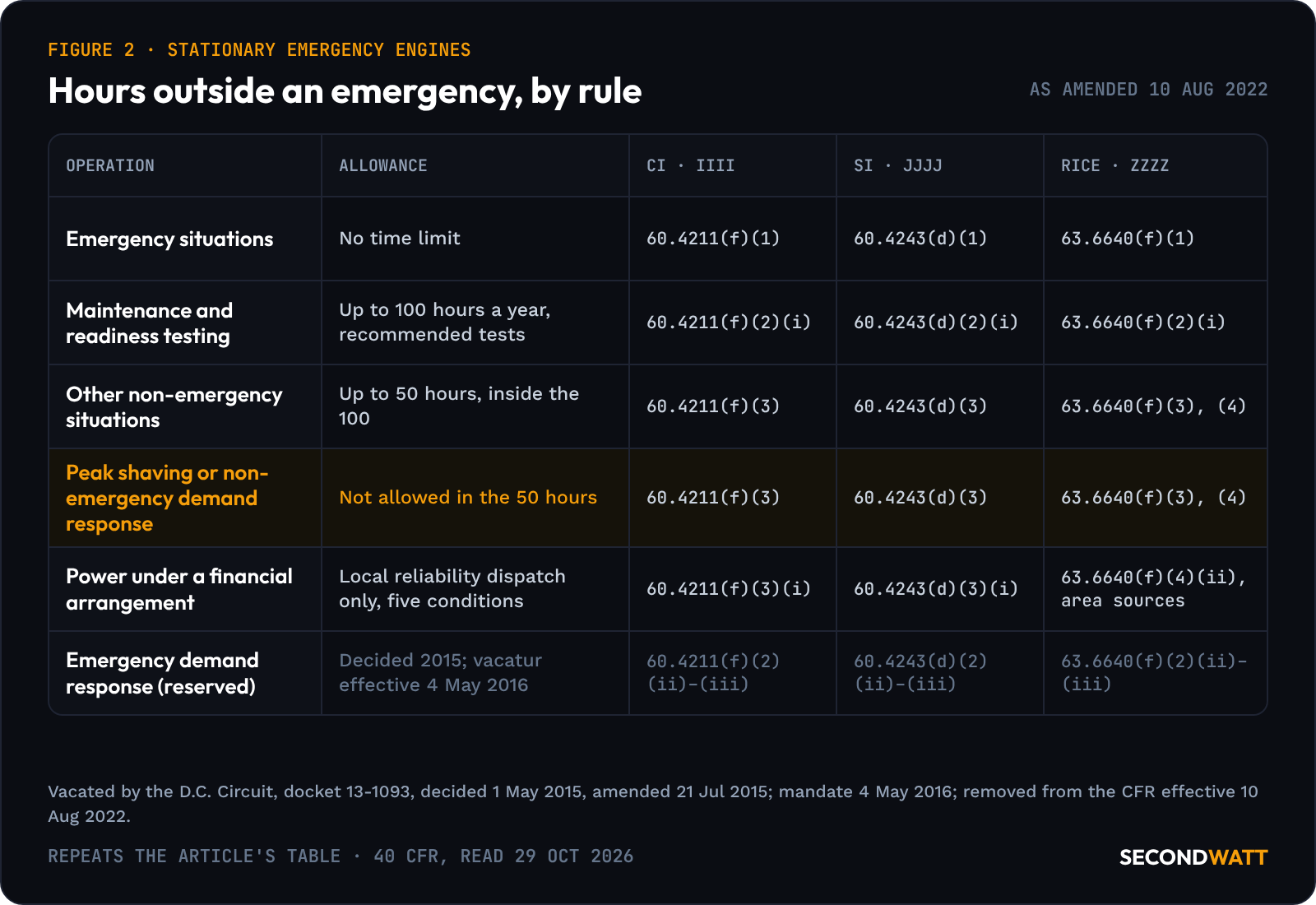
Hours a stationary emergency engine may run outside an emergency (40 CFR as last amended 10 Aug 2022)#
| Operation | Allowance | CI engines, Subpart IIII | SI engines, Subpart JJJJ | RICE NESHAP, Subpart ZZZZ |
|---|---|---|---|---|
| Emergency situations | No time limit | 60.4211(f)(1) | 60.4243(d)(1) | 63.6640(f)(1) |
| Maintenance checks and readiness testing | Up to 100 hours per calendar year, for tests recommended by government, the manufacturer, the vendor, the RTO or the insurer | 60.4211(f)(2)(i) | 60.4243(d)(2)(i) | 63.6640(f)(2)(i) |
| Other non-emergency situations | Up to 50 hours, counted inside the 100 | 60.4211(f)(3) | 60.4243(d)(3) | 63.6640(f)(3) and (4) |
| Peak shaving or non-emergency demand response | Not allowed in the 50 hours | 60.4211(f)(3) | 60.4243(d)(3) | 63.6640(f)(3) and (4) |
| Supplying power under a financial arrangement | Inside the 50 hours, only for local reliability dispatch under the rule's conditions | 60.4211(f)(3)(i) | 60.4243(d)(3)(i) | 63.6640(f)(4)(ii), area sources only |
| Emergency demand response | None: decided 2015, vacatur effective 4 May 2016; paragraphs reserved | 60.4211(f)(2)(ii)–(iii) | 60.4243(d)(2)(ii)–(iii) | 63.6640(f)(2)(ii)–(iii) |
More testing hours need a petition to EPA, unless the owner keeps records showing that federal, state or local standards require them. The financial-arrangement exception needs dispatch by the "local balancing authority or local transmission and distribution system operator" to avert voltage collapse or line overloads. The dispatch must follow NERC, regional, state, utility-commission or local protocols, the power must go only to the facility or the local system, and the owner must record the dispatcher and protocol.
EPA's 2013 rule let emergency engines run up to 100 hours a year for emergency demand response, which the court described as operating "without emissions controls". The triggers were an Energy Emergency Alert Level 2 or a voltage or frequency deviation of 5% or more below standard. The Court of Appeals for the District of Columbia Circuit decided Delaware DNREC v. EPA on 1 May 2015 and amended the opinion on 21 Jul 2015. It held that EPA "acted arbitrarily and capriciously".
The amended opinion reverses §63.6640(f)(2)(ii)–(iii), §60.4211(f)(2)(ii)–(iii) and §60.4243(d)(2)(ii)–(iii); "The rest of the 2013 Rule remains in effect." The vacatur took effect with the court's mandate on 4 May 2016. EPA removed the paragraphs from the CFR effective 10 Aug 2022, in the Federal Register at 87 FR 48603. From the mandate, in EPA's account, engines running for those purposes had to stop or meet the non-emergency standards.
When a generator must be non-emergency#
Running outside the allowances changes the engine's class. It "will not be considered an emergency engine under this subpart and must meet all requirements for non-emergency engines", in the words of §60.4211(f), §60.4243(d) and §63.6640(f).
For diesels, the two classes are certified to different standards. Under §60.4202(a)(2), a 2007-or-later emergency engine under 10 liters per cylinder is certified to Tier 2 or Tier 3 nonroad standards from 50 HP to 3,000 HP. Above 3,000 HP, from model year 2011, it is certified to Tier 2 under §60.4202(b)(2).
A non-emergency engine of that displacement is certified to the Part 1039 nonroad standards listed in §60.4201(a), and above 3,000 HP from model year 2011 under §60.4201(c). The tables in §1039.101 carry the Tier 4 label. Under §60.4201(d) and (e), engines of 10 to 30 liters per cylinder are pointed to Part 1042 marine standards instead.
Under §60.4211(c), owners of 2007-or-later diesels under 30 liters per cylinder comply "by purchasing an engine certified to" the applicable standard. A set certified only to the emergency standards in §60.4202 carries no certification to the non-emergency standards in §60.4201. On the secondary market, ask which standard a set was certified to before treating it as a peak-shaving candidate.
The Tier 4 Final guide covers what those standards demand of a large diesel genset. Two more checks follow: the hour and use conditions in the site's air permit, and the duty the engine will see.
1,771 hours — the engine run time a flat-load site would need in 2026 to hold 500 kW off every Schedule 8 on-peak window (253 non-holiday weekdays × 7 hours, calculated).
At that duty the rating type matters. The prime power rating guide explains how prime and continuous ratings differ from standby; compare candidates in the generator catalog on that basis.
Batteries for peak shaving#
The engine-hour limits come from engine rules, so a peak shaving battery is limited instead by power and stored energy. Power must cover the kW to be shaved; energy must cover that kW for the whole window.
For the same flat load, shaving 500 kW through the seven-hour summer window takes 3,500 kWh a day (500 × 7, calculated). From October to May the longest window is four hours, or 2,000 kWh, with nine off-peak hours between the morning and evening windows for recharging (calculated).
Those are energy figures at the meter. Add the depth-of-discharge, efficiency and aging margins from the battery maker's data before choosing the kWh rating. The BESS sizing guide covers how a data-center battery system is sized in MW and MWh, and the battery category holds the model dossiers.
A worked demand-charge example#
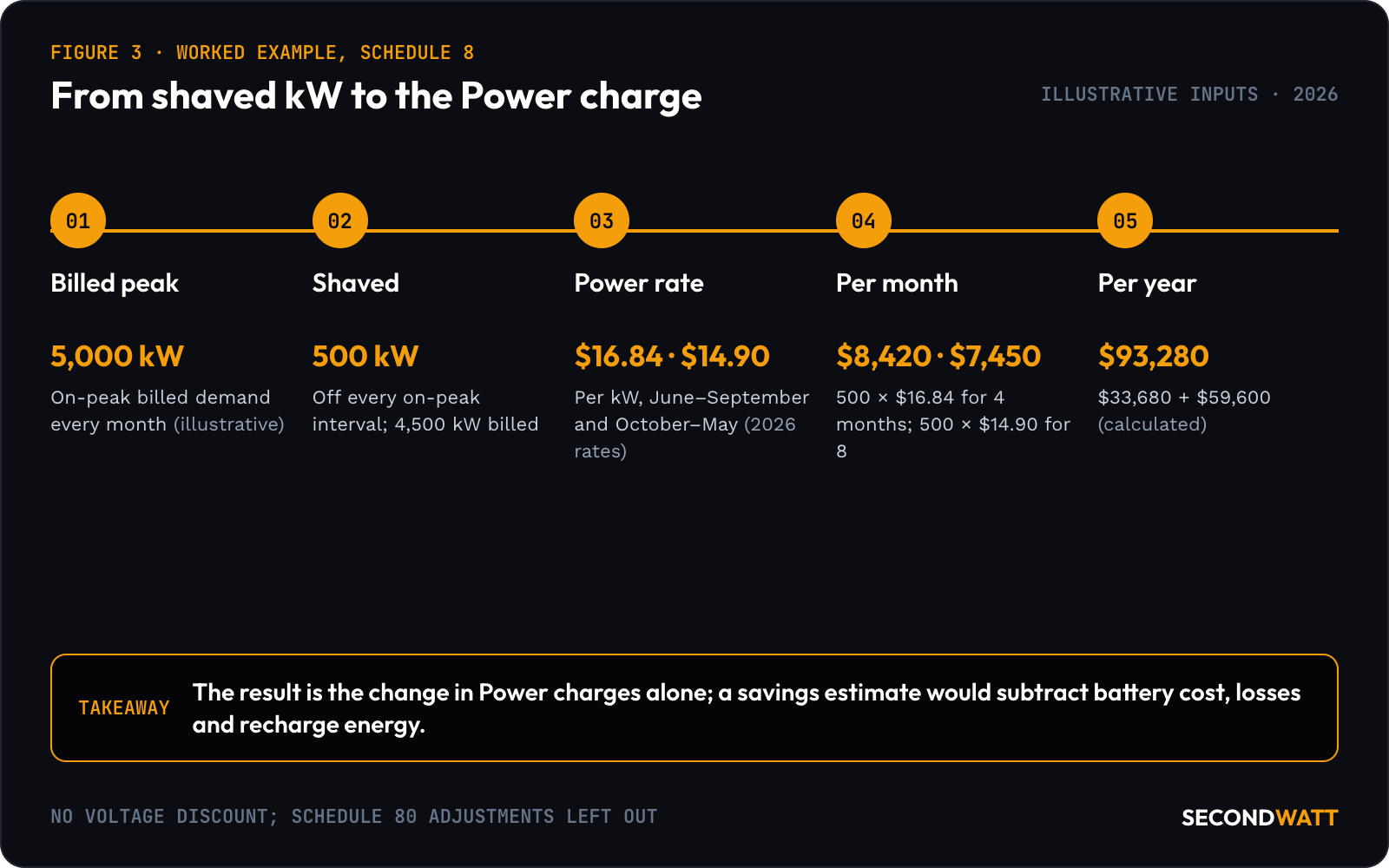
The inputs are illustrative. The site is billed under Schedule 8 with on-peak billed Power of 5,000 kW every month, and a battery removes 500 kW of demand from every on-peak interval. Power factor stays at or above 90%, the Voltage Discount does not apply, and Schedule 80 adjustments are left out. Rates are those in the Schedule 8 sheets effective 10 Aug 2026, applied to a full year.
Illustrative Schedule 8 power-charge arithmetic for 500 kW of demand shaved (2026 rates; calculated)#
| Step | June–September | October–May | Year |
|---|---|---|---|
| Billed on-peak demand, before | 5,000 kW | 5,000 kW | — |
| Billed on-peak demand, after | 4,500 kW | 4,500 kW | — |
| Power rate (2026 $) | $16.84 per kW | $14.90 per kW | — |
| Monthly reduction (2026 $) | 500 × $16.84 = $8,420 | 500 × $14.90 = $7,450 | — |
| Months | 4 | 8 | 12 |
| Reduction in Power charges (2026 $) | $33,680 | $59,600 | $93,280 |
Per kW, a year of these reductions is 4 × $16.84 + 8 × $14.90 = $186.56 in 2026 Power charges (calculated). A customer served from lines of 2,300 volts or higher that provides and maintains all its transformers gets a Voltage Discount of $1.13 per kW of measured on-peak Power (2026). Each shaved kW then also gives up $1.13 of discount. Net rates fall to $15.71 and $13.77 per kW, or $173.00 per kW-year and $86,500 a year for 500 kW of shaved demand (2026 rates, calculated).
The result is the change in Power charges alone. Battery cost, conversion losses and recharge energy at off-peak rates sit outside it, and a savings estimate would subtract them.
Recharging can also raise the Facilities charge, which bills the month's highest 15-minute demand at any time. On the flat 5,000 kW load, spreading the 3,500 kWh summer recharge evenly over the 17 off-peak hours between windows adds about 206 kW of charging load. At $5.15 per kW (2026), that is about $1,060 a month before conversion losses (3,500 ÷ 17 × $5.15, calculated).
FAQ: peak shaving#
Can a data center use its UPS batteries for peak shaving?#
Eaton offers it on its lithium-ion UPSs with added software and controls; its own product description on the EnergyAware page lists "peak shaving to help avoid or reduce demand charges". In that description the operator keeps control, "choosing how much capacity to offer and when", and Eaton names a Power Xpert 9395P as the UPS it adapted.
Ask the UPS maker in writing how much stored energy may be cycled while keeping the ride-through the critical load needs. The UPS and energy storage guide sets ride-through runtime from the generator start time plus a stated margin.
Does peak shaving reduce energy costs?#
It targets demand charges. The kWh the site uses stay on the bill, priced by time of use. A battery moves some of them into off-peak hours and adds its conversion losses, and a generator replaces them with its own fuel.
What is 4CP in ERCOT?#
Under 16 TAC §25.192, effective 20 Dec 2022, 4CP in ERCOT is a distribution provider's average demand at the four June–September monthly system peaks. It bills the next year's transmission service. A PUCT proposal of 9 Jul 2026, Project No. 58000, would replace it with a 12CP method measured in 30-minute intervals.
Can a natural gas generator be used for peak shaving?#
Yes, as a non-emergency engine. Section 60.4243(d) gives an emergency gas engine under Subpart JJJJ the same hour limits as a diesel, so a gas set that shaves peaks must meet the non-emergency requirements. For engines subject to §60.4233(d) or (e), §60.4243(b)(2) of JJJJ also allows a non-certified engine plus compliance testing under §60.4244. Buyer checks for a used gas set are in the used natural gas generator guide.
Is peak shaving worth it for a colocation site?#
It depends on who holds the utility account. Schedule 8 bills service through a single point of delivery, and deliveries at more than one point are "separately metered and billed". The reduction lands on the account holder for that meter, so a tenant should check whether its contract passes demand charges through.
Deciding what shaves the peak#
SecondWatt publishes equipment research and helps buyers source power equipment; it earns a fee when a sale it arranges closes. Start from three inputs: the shaved kW, the window length and the tariff schedule. Send them through a request for quote, adding the engine type and model year for non-emergency engine duty, or the window's kWh for a battery.