Saft Sunica.plus pocket plate nickel-cadmium, 45 to 1,110 Ah across 19 models
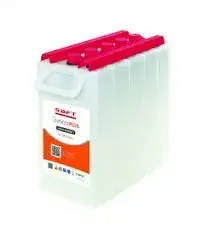
A 20-year pocket plate nickel-cadmium built for solar duty, and quote-only with no public price
This model is part of SecondWatt’s batterie research catalogue. Specifications and price observations are included where supported by sources. Equipment availability and commercial terms require confirmation.
Saft Sunica.plus dossier: pocket plate nickel-cadmium from 45 to 1,110 Ah, a 20-year design life, and why it is a solar rather than a switchgear product.
Sunica.plus is Saft's pocket plate nickel-cadmium block range, and the name is literal: it is built for solar and off-grid duty rather than for switchgear tripping. That distinction matters because Sunica.plus is routinely catalogued as a station battery, when the switchgear and substation product in Saft's own range is Uptimax. A buyer specifying a 125 or 250 volt control bus should be looking at that range instead.
The technology is the opposite trade from lead-acid. Cells are 1.2 volts nominal, span 45 to 1,110 Ah across 19 models, run on a stable alkaline electrolyte that Saft states does not change during charge or discharge, and carry a 20-year design life at roughly 8,000 cycles to 15% depth of discharge. They tolerate minus 50 to plus 70 degrees C at the extremes against a standard band of minus 20 to 50, deliver more than 80% of capacity on a 120-hour discharge at minus 40, and lose only 20% of life at 30 degrees C where Saft claims lead-acid alternatives lose half.
Two facts govern any purchase. Maintenance is real: these are vented cells that gas and need topping, though Saft publishes more than four years between top-ups with an optional automated filling system on larger cells. And there is no public price for any Saft nickel-cadmium range, making this the only quote-only segment in the category and the one tier with no published dollar figure at all.
Why it matters
This is the only stationary battery chemistry whose service life is quoted in decades, which inverts the usual used-equipment logic. A 10-year-old nickel-cadmium string may be half way through its life where a 10-year-old lead-acid string is finished, so calendar age alone is a weak signal and the electrolyte and capacity test records carry the assessment instead.
Who buys it
Off-grid solar, telecom and remote infrastructure operators who need a battery that survives temperature extremes and deep discharge without permanent damage, and who can accept a maintenance regime. The economics work where a lead-acid string would need replacing three times across the same service life.
Role in the data center
None directly. This is an off-grid and solar product; the switchgear and substation control battery in Saft's range is Uptimax, and that is the product a data center or substation buyer needs for a 125 or 250 volt control bus.
Key specifications
| Cell voltage | 1.2 nominal, pocket plate V |
|---|---|
| Capacity range | 45 to 1,110 across 19 models Ah |
| Capacity at the C120 rate | 43 to 1,024 Ah |
| Capacity at the C5 rate | 15.95 to 352 Ah |
| Design life | 20, at about 8,000 cycles to 15% depth of discharge years |
| Charge voltage, 9-cell 12 V system | 13.5 to 14.4 depending on depth of discharge V |
| Operating temperature | minus 20 to 50 standard, minus 50 to 70 tolerated degrees C |
| Low temperature capacity | more than 80% on a 120-hour discharge at minus 40 degrees C |
| Water topping interval | more than 4 years, automated filling optional from 185 Ah |
| Dimensions and weight, SUN 45 | 195 x 113 x 137 mm at 3.2 kg |
| Weight, SUN 1110 | 46.0 kg |
| Standards cited | IEC 62259 and EN 50272-2, with IP2 shock protection |
| Cycle life at 15% depth of discharge | about 8,000 cycles |
Technical summary
Cell voltage: 1.2 V nominal, pocket plate construction with internal gas recombination. Capacity range: 45 to 1,110 Ah across 19 models; 43 to 1,024 Ah at the C120 rate and 15.95 to 352 at C5. Design life: 20 years, with about 8,000 cycles at 15% depth of discharge. Charge voltage: 13.5 to 14.4 V on a 9-cell 12 V system, scaling to 54 to 57.6 V on 36 cells. Operating temperature: minus 20 to 50 degrees C standard, tolerating minus 50 to 70 at the extremes. Low temperature performance: more than 80% of capacity on a 120-hour discharge at minus 40 degrees C. High temperature performance: about 20% life loss at 30 degrees C against a claimed 50% for lead-acid. Water topping: more than 4 years between top-ups, with automated filling optional from 185 Ah upward. Dimensions and weight: SUN 45 at 195 by 113 by 137 mm and 3.2 kg; SUN 1110 at 46.0 kg. Standards: IEC 62259 for pocket plate nickel-cadmium and EN 50272-2 for installation safety.
Major variations
Nineteen models designated SUN 45 through SUN 1110, supplied as blocks that assemble into 12, 24 and 48 volt systems. Saft's other nickel-cadmium stationary ranges are Uptimax for switchgear and substation duty and the SBM, SBH and SBLE block lines, all of which carry current dated documentation. Capacity runs 43 to 1,024 Ah at the C120 rate and 15.95 to 352 Ah at C5.
Configurations and options
Blocks in series to the system voltage, with an optional integral automated water filling system on cells from 185 to 1,110 Ah that removes most of the maintenance objection. A higher-density electrolyte formulation is available for service below minus 20 degrees C. Blocks range from 3.2 kg on the SUN 45 to 46.0 kg on the SUN 1110.
Compatibility and dependencies
A lead-acid charger cannot be reused, because nickel-cadmium float and boost voltages are different and the recommended charge window varies with depth of discharge. The standard cited on the datasheet is IEC 62259 for pocket plate construction rather than IEC 60623, and IEEE 1106 and 1115 govern United States maintenance and sizing without being named on the Saft document.
Pricing and availability
Trend: stable Lead time, new: Quote only; Saft publishes no lead time. Lead time, used or refurbished: No used unit listed as of August 2026.
Lifecycle and maintenance
Vented nickel-cadmium batteries are the long-life option in stationary power, routinely quoted in decades rather than years, and they tolerate deep discharge, freezing and abuse that would destroy a lead-acid string. The trade is maintenance: the cells are vented, they lose water through gassing and need topping with purified water, and the electrolyte carbonates over years of service so that renewal rather than replacement is the mid-life intervention. IEEE 1106 governs installation, maintenance and testing at the same 80% capacity replacement trigger, and IEEE 1115 governs sizing. At a NERC-registered facility the interval obligations are a 6-year capacity test alongside 4-month voltage, electrolyte and ground checks. Cadmium puts these cells under the federal universal waste rule at 40 CFR 273, and vented alkaline cells ship filled under UN2795.
Thermal and emissions profile
A nickel-cadmium battery produces no emissions in service, and its environmental profile is dominated by cadmium, a regulated toxic metal that governs both handling and disposal. Batteries containing cadmium fall under the federal universal waste rules at 40 CFR 273, which is a different regime from the one covering spent lead-acid. The regulatory question is jurisdictional rather than technical. European battery rules restricted cadmium in portable batteries while exempting industrial ones, and whether the 2023 regulation preserved that exemption should be confirmed with counsel before a European transaction. Vented alkaline cells ship filled under UN2795, so freight weight and spill containment govern transport rather than state of charge.
Common failure points
- Electrolyte loss — Vented cells lose water through gassing and capacity falls if topping is neglected
- Carbonation — Electrolyte absorbs carbon dioxide over years, raising resistance and cutting capacity
- Plate degradation — Pocket plate active material degrades slowly and capacity falls below the 80% replacement trigger
- Intercell connections — Corroded or loose links raise string resistance and produce local heating
- Charger mismatch — A lead-acid charger applied to nickel-cadmium will not reach the correct float or boost voltage
- Cadmium disposal — End-of-life handling is regulated and a buyer can be left holding cells no recycler will take
Inspection checklist
Electrolyte level: pocket plate cells are vented and need topping, so check the level marks on 100% of cells rather than a sample. Topping interval: confirm purified water was used and record the interval, because 1 neglected year accelerates carbonation. Carbonation: electrolyte absorbs carbon dioxide across 20 years of service and loses capacity; ask whether it has ever been renewed. Capacity test record: IEEE 1106 governs vented nickel-cadmium testing, with 80% of rated capacity as the replacement trigger. Test interval compliance: a NERC-registered site owes nickel-cadmium a 6-year capacity test and 4-month voltage, electrolyte and ground checks. Cell count and string voltage: confirm the string matches the 125 or 250 VDC control bus it was built for.
Procurement channels
Direct from the manufacturer or its distributors on a quote basis. No public list price exists for any Saft nickel-cadmium range, and no used or surplus Sunica.plus listing appears on any public channel as of August 2026. Used Saft nickel-cadmium listings are dominated by an unrelated aviation battery category, so a search by brand alone returns the wrong product.
Regional notes
French manufacturer under TotalEnergies ownership since 2016, with documentation dated 2023 and 2024 across the nickel-cadmium ranges. Regulatory point to resolve before any European transaction: the previous EU battery directive restricted cadmium in portable batteries while explicitly exempting industrial ones, and the 2023 regulation does not restate that industrial exemption in the same terms, so counsel should confirm it before any European transaction.