East Penn Manufacturing Deka Fahrenheit HT series high-temperature AGM blocks
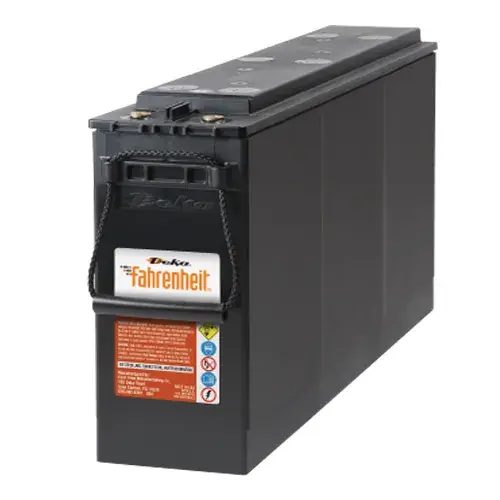
The only stationary AGM line that puts a number on heat, with warranty months falling from 72 to 30 as ambient rises
This model is part of SecondWatt’s batterie research catalogue. Specifications and price observations are included where supported by sources. Equipment availability and commercial terms require confirmation.
East Penn Deka Fahrenheit dossier: high-temperature AGM blocks, published life at 25 and 35 degrees C, warranty scaled to ambient, and inspection guidance.
Fahrenheit is East Penn's dedicated high-ambient-temperature AGM line, separate from the Unigy, HR and Solar ranges, and the whole product thesis is a quantified answer to the problem that governs every lead-acid purchase: heat. Where most manufacturers publish a design life at 25 degrees C and leave the derating to a rule of thumb, East Penn publishes both. The HT7500ET is rated 10 years at 25 degrees C and 5 years at 35, and the HT200ET is rated 12 years at 25.
The warranty carries the same logic and is the most useful document in the line. Cover scales explicitly with operating temperature, from 100% of the full term at 77 degrees F, worth 72 months, down through 60 months at 95 degrees F to 30 months at 114.8. A buyer assessing a used string from an unconditioned cabinet can therefore read the manufacturer's own view of what that heat cost, rather than arguing about it.
Both blocks weigh 151 lb on front-access quarter-inch threaded inserts torqued to 100 inch-pounds, in flame-retardant cases rated UL 94 V-0. Float is 13.50 V per 12 V unit with equalisation at 14.40 for 24 hours and a temperature compensation of 12 millivolts per degree C. East Penn publishes conductance and resistance baselines against four named test instruments, which is the single most practical thing a manufacturer can do for a used-equipment buyer.
Why it matters
Published ohmic baselines against named instruments change what a used inspection can prove. Most manufacturers publish a design life and nothing else, so a buyer measuring internal resistance has no reference to compare against. East Penn gives four, at 2242 millisiemens on one instrument and 2.948, 2.384 and 2.584 milliohms on three others for the HT200ET.
Who buys it
Telecom and utility operators with outdoor or unconditioned cabinets, and data center operators putting batteries somewhere the cooling does not reach. The line exists because standard VRLA product loses half its life for every 8 to 10 degrees C above 25, and Fahrenheit is the answer to sites that cannot fix the ambient.
Role in the data center
Battery strings in unconditioned or partially conditioned spaces, outdoor cabinets and telecom shelters, where the ambient cannot be brought down to the 20 to 25 degree band standard VRLA wants. Warranty months fall from 72 at 77 degrees F to 30 at 114.8.
Key specifications
| Nominal voltage | 12, front access V |
|---|---|
| Capacity, HT200ET at the 8-hour rate | 190 to 1.75 volts per cell Ah |
| Watts per cell, HT7500ET at 15 minutes | 750 to 1.67 volts per cell W |
| Watts per cell, HT7500ET at 1 hour | 287 to 1.60 volts per cell W |
| Design life, HT200ET | 12 at 25 degrees C years |
| Design life, HT7500ET | 10 at 25 degrees C, falling to 5 at 35 years |
| Weight | 151 lb or 68.5 kg |
| Terminal torque | 100 inch-pounds plus or minus 5 |
| Float voltage | 13.50 plus or minus 0.5% per 12 V unit at 77 degrees F V |
| Equalize voltage | 14.40 for 24 hours at 77 degrees F V |
| Temperature compensation | 12 millivolts per degree C per 12 V unit |
| Maximum charge current | 36.4 A on HT200ET, 35.4 A on HT7500ET |
| Ohmic baseline, HT200ET | 2242 mS, or 2.948, 2.384 and 2.584 milliohms by instrument |
| Warranty against temperature | 72 months at 77 degrees F falling to 30 months at 114.8 |
| Listings | UL 1973 with a UL 94 V-0 case above 39% limiting oxygen index |
Technical summary
Nominal voltage: 12 V, front access. Capacity, HT200ET: 190 Ah at the 8-hour rate to 1.75 volts per cell. Watts per cell, HT7500ET: 750 W at 15 minutes and 287 W at 1 hour. Design life: 12 years at 25 degrees C on the HT200ET; 10 years at 25 and 5 years at 35 on the HT7500ET. Weight: 151 lb or 68.5 kg on both blocks. Dimensions: about 24 by 4.97 by 12.74 in. Terminals: front access quarter-inch threaded insert at 100 inch-pounds plus or minus 5. Float and equalize: 13.50 V per 12 V unit; equalize 14.40 V for 24 hours. Temperature compensation: 12 millivolts per degree C per 12 V unit. Maximum charge current: 36.4 A on the HT200ET and 35.4 A on the HT7500ET. Ohmic baselines, HT200ET: 2242 mS, 2.948 milliohms, 2.384 milliohms and 2.584 milliohms by instrument. Listings: UL 1973 for energy storage applications with a UL 94 V-0 flame-retardant case.
Major variations
The Fahrenheit family runs across amp-hour-rated blocks such as the HT200ET and watts-per-cell-rated high-rate blocks such as the HT7500ET, which is why a single price unit does not fit the line. East Penn's other Deka stationary ranges are Unigy and Unigy II, the HR and HRC high-rate series and Deka Solar, none of which carry the high-temperature positioning.
Configurations and options
Front-access blocks in relay racks or cabinets, series-connected to the site bus. The optimal band is 10 to 35 degrees C with an extended range from minus 40 to 40, and equalisation at 14.40 V for 24 hours is the published recovery routine. Temperature compensation runs 12 millivolts per degree C per 12 V unit.
Compatibility and dependencies
Ohmic baselines are published per model and per instrument, so a meaningful test needs the matching instrument rather than a generic reading. East Penn publishes no ohmic baseline for the HT7500ET in its ohmic values table and directs the reader to contact the manufacturer. Charger temperature compensation must be set to 12 millivolts per degree C per block.
Pricing and availability
Published price range: $722 - $1,459 per 12 V block depending on model. Trend: stable No published price series exists. Two marketplace listings carrying Fahrenheit model names are almost certainly mismatched, one priced 15 times below the manufacturer channel and one describing automotive use, and should not be read as Fahrenheit pricing. Lead time, new: Distributor stock at common model numbers; one channel quotes on request. Lead time, used or refurbished: No used or refurbished listing is publicly available as of August 2026.
Lifecycle and maintenance
Valve-regulated lead-acid batteries age on the calendar rather than on cycles, and temperature sets the clock. The industry convention is a design life quoted at 25 degrees C with service life roughly halving for every 8 to 10 degrees C above that, which is why the same block lasts a decade in a conditioned data hall and half that in an unconditioned telecom cabinet. IEEE 1188, whose 2025 edition supersedes the 2005 standard, sets 80% of rated capacity as the replacement trigger. At a NERC-registered facility the obligations are explicit: 4-month voltage and ground checks, 6-month internal resistance checks, 18-month connection checks and a 3-year capacity test, which is the one paper trail that makes a used string assessable at all. Lead-acid recycles near 98% per Battery Council International, and scrap lead at 0.15 to 0.22 USD per pound in late 2025 sets a floor under any block.
Thermal and emissions profile
A battery emits nothing in service. What it carries instead is an end-of-life story with unusually good economics: lead-acid is the most recycled consumer product in the United States, at a rate the Battery Council International puts near 98% across 2020 to 2024 with more than 11 billion pounds of lead recovered. That gives this category something no other data center equipment class has: a commodity-indexed price floor. Lead is roughly 60% of block weight and scrap lead traded at 0.15 to 0.22 dollars per pound in late 2025, so a 132 lb block holds about 12 to 17 dollars of recoverable metal even when it is electrically finished. Spent lead-acid is excluded from the federal universal waste rule and managed under 40 CFR 266 Subpart G.
Common failure points
- Dry-out — A sealed cell loses electrolyte through the valve and capacity falls with no way to top it up
- Thermal runaway — Charging current and cell temperature climb together until the case swells or vents
- Grid corrosion — Positive grid corrodes over calendar time and capacity fades regardless of cycling
- Temperature ageing — Service life roughly halves for every 8 to 10 degrees C above 25, so a hot cabinet destroys a string early
- Post and terminal corrosion — Sulphate creep at the posts raises resistance and heats the connection
- String mismatch — Mixing ages or manufacturers lets one weak block set the capacity of the whole string
Inspection checklist
Manufacture date: read the date code on every block, because a stationary battery is priced on age against a design life quoted at 25 degrees C. Ambient temperature history: service life roughly halves for every 8 to 10 degrees C above 25, so a hot cabinet consumes a 10-year battery in 5. Capacity test record: request the most recent discharge test, since IEEE 1188 sets 80% of rated capacity as the replacement trigger. Test interval compliance: a NERC-registered site owes VRLA a 3-year capacity test, 6-month internal resistance checks and 18-month connection checks. Internal resistance or conductance: compare every cell against the manufacturer baseline and against the string average rather than a generic number. String matching: never mix ages or manufacturers in 1 string, because a single weak block drags the whole string down.
Procurement channels
New stock through solar and battery distributors including Batteryplex, NAZ Solar Electric, C&C Power and Solar Electric Supply, with at least one channel quoting rather than publishing. No used or refurbished listing for this line appears on any public channel as of August 2026, and two marketplace listings carrying Fahrenheit model names appear to be mislabelled and should not be treated as Fahrenheit stock. No published core charge or scrap allowance exists.
Regional notes
Manufactured in Lyon Station, Pennsylvania by a privately held family business founded in 1946. East Penn states no UL 1989, IEC 60896, Telcordia GR-4228 or NEBS listing for this line in its published documentation as of August 2026, which is a narrower listing set than competing telecom product publishes.