NorthStar Blue+ NSB series thin plate pure lead carbon front-terminal blocks
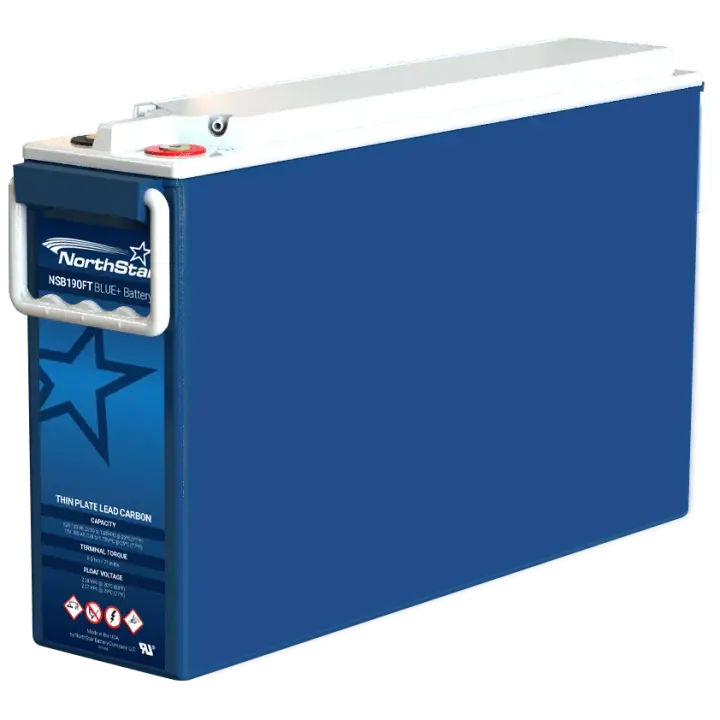
Thin plate pure lead with carbon, and a manufacturer that was bought rather than bankrupted
This model is part of SecondWatt’s batterie research catalogue. Specifications and price observations are included where supported by sources. Equipment availability and commercial terms require confirmation.
NorthStar Blue+ NSB dossier: lead-carbon front-terminal blocks to 200 Ah, the EnerSys acquisition that was not a bankruptcy, pricing and inspection guidance.
Blue+ is the lead-carbon tier of NorthStar's NSB front-terminal telecom family, above the Red and HT Red grades, built on thin plate pure lead construction with carbon additives for partial state of charge duty. The nomenclature is straightforward once decoded: NSB is the family, the number is approximate nameplate capacity in amp-hours at the 10-hour rate, and FT means front terminal. The manufacturer datasheet cross-tabulates NSB100FT, NSB190FT and NSB210FT at 100, 183 and 200 Ah.
The ownership story is widely misreported. NorthStar Battery was not in Chapter 11; the confusion appears to come from Northvolt, an unrelated Swedish lithium company that filed in November 2024. What actually happened is that private equity owner Altor Fund II sold NorthStar outright to EnerSys on 19 September 2019 for 78 million dollars in cash plus 104.5 million in assumed debt. The Springfield, Missouri plants kept running and are now receiving production consolidated from a closing facility in Tijuana.
Published specifications are unusually complete for a telecom block. The NSB190FT is 183 Ah at the 10-hour rate and 180 at the 8-hour, 3.2 milliohms impedance, 3,990 A short circuit current, 132 lb across 22.1 by 4.9 by 12.4 inches, on male M6 terminals at 9.0 newton metres, with a 12-plus year design life at 20 degrees C and listings covering Telcordia SR-4228, IEC 60896, Bellcore GR-63-Core and UN 2800.
Why it matters
The distress narrative around NorthStar is wrong, and it matters for residual value. A buyer who believes the manufacturer is bankrupt discounts for parts and warranty risk the ownership record does not support; the brand is owned by the largest industrial battery manufacturer in the market and its plant is receiving work rather than shedding it.
Who buys it
Telecom carriers and tower operators, plus renewable and hybrid genset installations where partial state of charge cycling would destroy a standard AGM. The lead-carbon construction is claimed to deliver more than three times the cycles of a standard AGM, which is the reason to pay the premium over the Red grade.
Role in the data center
Telecom DC plant and outdoor cabinet backup, plus hybrid genset and renewable installations where the string cycles rather than floats. It is a long-duration amp-hour product rather than a high-rate UPS block.
Key specifications
| Capacity at the 10-hour rate | 100, 183 and 200 across the 100FT, 190FT and 210FT Ah |
|---|---|
| Capacity at the 8-hour rate | 100, 180 and 198 across the same models Ah |
| Float voltage | 2.28 per cell at 68 degrees F, 2.27 at 77 V |
| Impedance at 1 kHz | 5.6, 3.2 and 3.3 across the three models milliohms |
| Short circuit current | 2,210, 3,990 and 3,800 across the three models A |
| Weight | 72, 132 and 139 lb across the three models |
| Dimensions, NSB190FT | 22.1 x 4.9 x 12.4 in (561 x 125 x 316 mm) |
| Terminal type and torque | male M6 at 9.0 newton metres or 80 inch-pounds |
| Design life | more than 12 at 68 degrees F years |
| Operating temperature | minus 40 to 122 degrees F |
| Case flammability | non-halogenated thermally sealed plastic to UL 94 V-0 |
| Listings | Telcordia SR-4228, IEC 60896, Bellcore GR-63-Core, UL approved, UN 2800 |
| Ownership | acquired by EnerSys 2019-09-19 for 78M USD cash plus 104.5M assumed debt |
| Model nomenclature | NSB family, number is approximate 10-hour amp-hours, FT is front terminal |
Technical summary
Nominal voltage: 12 V, front terminal. Capacity: 100, 183 and 200 Ah at the 10-hour rate on the 100FT, 190FT and 210FT. Capacity: 100, 180 and 198 Ah at the 8-hour rate on the same three models. Float voltage: 2.28 volts per cell at 68 degrees F and 2.27 at 77. Impedance at 1 kHz: 5.6 milliohms on the 100FT, 3.2 on the 190FT and 3.3 on the 210FT. Short circuit current: 2,210 A, 3,990 A and 3,800 A respectively. Weight: 72, 132 and 139 lb across the three models. Terminals: male M6 at 9.0 newton metres or 80 inch-pounds. Design life: more than 12 years at 68 degrees F. Operating temperature: minus 40 to 122 degrees F. Case: non-halogenated thermally sealed plastic, flame retardant to UL 94 V-0. Listings: Telcordia SR-4228, IEC 60896, Bellcore GR-63-Core, UL approved and UN 2800 certified.
Major variations
The NSB family is tiered by colour grade rather than by generation. Red is standard thin plate pure lead optimised for 20 to 35 degrees C, HT Red adds a heat-resistant housing rated minus 40 to 65 degrees C with up to 24 months of shelf life, and Blue+ adds carbon to the plate for partial state of charge cycling. A Silver tier also exists; EnerSys publishes no technical differentiator for it as of August 2026.
Configurations and options
Front-terminal blocks in relay racks and outdoor cabinets, series-connected to a minus 48 volt telecom bus. The manufacturer states no maximum charge current limit on these models, which is unusual and is what makes the ultra-fast recharge claim possible in hybrid genset duty. Cases are non-halogenated thermally sealed plastic rated UL 94 V-0.
Compatibility and dependencies
Capacity is quoted at both the 8 and 10-hour rates and resellers sometimes cite a 20-hour figure as well, so an amp-hour number without a rate basis is not comparable. The colour grades are different specifications rather than a product ladder, so substituting Red for Blue+ changes the cycling capability the string was specified for.
Pricing and availability
Published price range: $506 - $906 per 12 V block depending on model and channel. Trend: stable No published price series exists. Two further channels list the line on a request-quote basis with no published number, which is the normal pattern in this category. Lead time, new: Distributor stock, with one channel quoting a month or more on a specific model. Lead time, used or refurbished: No used or refurbished Blue+ listing appears on any public channel as of August 2026, so no used lead time can be quoted.
Lifecycle and maintenance
Valve-regulated lead-acid batteries age on the calendar rather than on cycles, and temperature sets the clock. The industry convention is a design life quoted at 25 degrees C with service life roughly halving for every 8 to 10 degrees C above that, which is why the same block lasts a decade in a conditioned data hall and half that in an unconditioned telecom cabinet. IEEE 1188, whose 2025 edition supersedes the 2005 standard, sets 80% of rated capacity as the replacement trigger. At a NERC-registered facility the obligations are explicit: 4-month voltage and ground checks, 6-month internal resistance checks, 18-month connection checks and a 3-year capacity test, which is the one paper trail that makes a used string assessable at all. Lead-acid recycles near 98% per Battery Council International, and scrap lead at 0.15 to 0.22 USD per pound in late 2025 sets a floor under any block.
Thermal and emissions profile
A battery emits nothing in service. What it carries instead is an end-of-life story with unusually good economics: lead-acid is the most recycled consumer product in the United States, at a rate the Battery Council International puts near 98% across 2020 to 2024 with more than 11 billion pounds of lead recovered. That gives lead-acid batteries something no other data center equipment class has: a commodity-indexed price floor. Lead is roughly 60% of block weight and scrap lead traded at 0.15 to 0.22 dollars per pound in late 2025, so a 132 lb block holds about 12 to 17 dollars of recoverable metal even when it is electrically finished. Spent lead-acid is excluded from the federal universal waste rule and managed under 40 CFR 266 Subpart G.
Common failure points
- Dry-out — A sealed cell loses electrolyte through the valve and capacity falls with no way to top it up
- Thermal runaway — Charging current and cell temperature climb together until the case swells or vents
- Grid corrosion — Positive grid corrodes over calendar time and capacity fades regardless of cycling
- Temperature ageing — Service life roughly halves for every 8 to 10 degrees C above 25, so a hot cabinet destroys a string early
- Post and terminal corrosion — Sulphate creep at the posts raises resistance and heats the connection
- String mismatch — Mixing ages or manufacturers lets one weak block set the capacity of the whole string
Inspection checklist
Manufacture date: read the date code on every block, because a stationary battery is priced on age against a design life quoted at 25 degrees C. Ambient temperature history: service life roughly halves for every 8 to 10 degrees C above 25, so a hot cabinet consumes a 10-year battery in 5. Capacity test record: request the most recent discharge test, since IEEE 1188 sets 80% of rated capacity as the replacement trigger. Test interval compliance: a NERC-registered site owes VRLA a 3-year capacity test, 6-month internal resistance checks and 18-month connection checks. Internal resistance or conductance: compare every cell against the manufacturer baseline and against the string average rather than a generic number. String matching: never mix ages or manufacturers in 1 string, because a single weak block drags the whole string down.
Procurement channels
New stock through battery and solar distributors including Power Storage Solutions, batterysales, OSI Batteries and Alpine Power Systems, with several quoting rather than publishing. No used or refurbished listing for the Blue+ line appears on any public channel as of August 2026, and no core charge or scrap allowance is published, so the scrap floor must be realised through a recycler.
Regional notes
Built in Springfield, Missouri, which EnerSys confirmed in March 2026 is receiving production consolidated from its closing Tijuana facility. The independent northstarbattery.com domain now redirects every path to enersys.com, so parts and documentation lookups start at the EnerSys site rather than the historical brand domain.