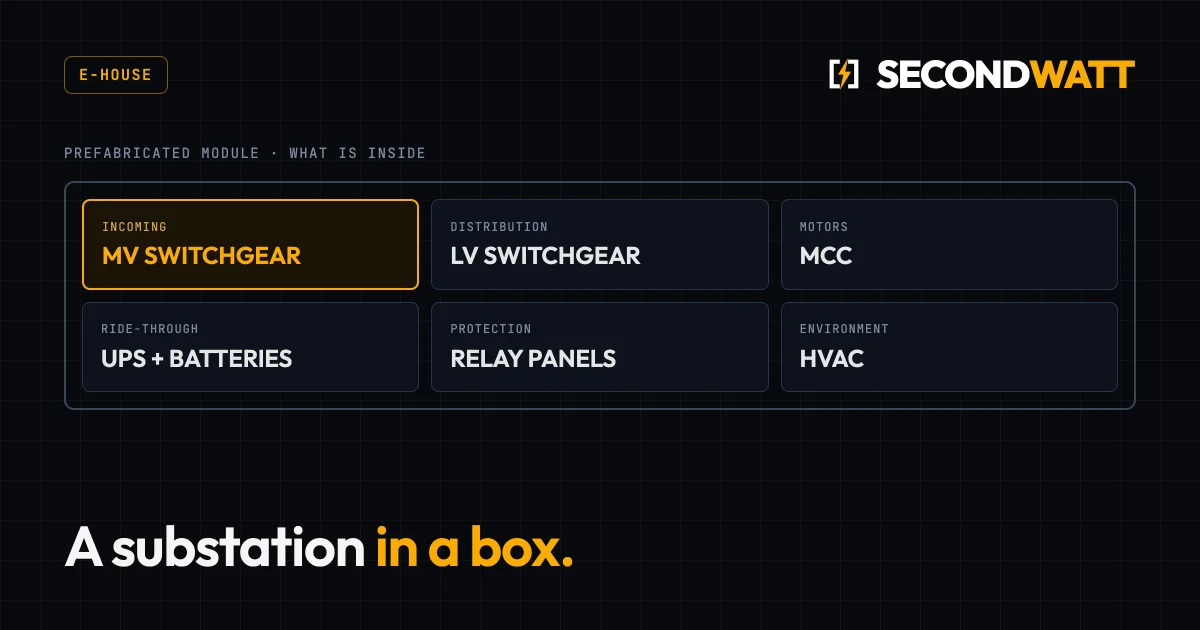
An e-house is the electrical room of a plant, built and tested in a factory and shipped to site as a finished building. Inside sit the site's switchgear, controls and auxiliaries. It is also sold as an electrical house or power distribution center (PDC), and it overlaps with the prefabricated substation.
In a data center or a gas power block, the e-house is where generator or utility power is collected, protected and handed to the site. Buying one well means fixing the one-line, heat load, arc-flash approach, working space and shipping splits before the quote, and knowing which tests stay on site.
Key Takeaways
- The enclosure and the factory test set an e-house apart. A skid lacks the enclosure and environmental control; a built-in room is tested on site.
- On ANSI/IEEE projects, each lineup keeps its own standard. Metal-clad gear is specified to IEEE C37.20.2-2025, low-voltage breaker gear to C37.20.1-2026, and arc-resistance testing to C37.20.7-2024.
- Two factory tests come before shipment. In ABB's process each vendor's equipment passes FAT, then the client witnesses an integrated FAT; schedule savings remain vendor claims.
- In the mtu block (25.18 MWe gross, 60 Hz), the e-house is the scope line. It holds the 15 kV lineup; seller scope ends at its 13.8 kV outgoing terminals.
- Size HVAC on sensible capacity against actual heat load. nVent's 6-ton example rates 49,900 of 71,000 BTU/h as sensible, at 95 °F outdoor and 80 °F return.
What an e-house is#
In ABB's definition for modules up to 40.5 kV, an e-house is "an enclosed, custom designed, tested and prefabricated electrical room with environmental control". Power distribution center (PDC) is a synonym in ABB's US product description.
The enclosure separates an e-house from a skid, and the factory separates it from a built-in electrical room.
E-house, skid and built-in electrical room compared, from ABB and Siemens descriptions#
| E-house | Skid or equipment frame | Built-in electrical room | |
|---|---|---|---|
| Enclosure | Enclosed, with HVAC, fire alarm and security systems (ABB) | Open frame with no enclosure or environmental control (ABB); non-walk-in (Siemens) | The site's own building |
| Where it sits | Stands alone as a walk-in building (Siemens E-House substation) | Indoors in a building, or outdoors free-standing (Siemens) | Inside a conventional building |
| Where the gear is installed and tested | In the factory, before shipment | In the factory, as factory-tested modules (Siemens) | On site, under site conditions (Siemens comparison) |
| Fits when | The gear needs its own conditioned building, in a wide range of climates (ABB) | A conventional building will house the gear anyway (Siemens frames) | The building exists and testing on site is accepted |
What goes inside a power distribution center#
A typical e-house holds medium- and low-voltage switchgear, motor control centers (MCCs), transformers, UPS, HVAC and controls, combining the lists in Schneider Electric's E-House range and ABB's eHouse brochure. In its October 2025 eHouse brochure, ABB combines its own gear "with transformer, DC systems (UPS and battery) and integration partners" to complete the scope.
Typical e-house contents and the standard to specify on North American (ANSI/IEEE) projects, from OEM literature and IEEE pages#
| Item | Role in the e-house | Standard to specify (current edition, 29 Oct 2026) | Item listed by |
|---|---|---|---|
| Medium-voltage metal-clad switchgear | Collects generator output or distributes utility power; 4.76–48.3 kV rated maximum | IEEE C37.20.2-2025 | ABB, Schneider Electric, mtu block dossier |
| Arc-resistant MV and LV gear | Contains an internal arc | Tested to IEEE C37.20.7-2024 (recommended practice) | ABB |
| Low-voltage power circuit breaker switchgear | Distributes at 1,000 V ac and below | IEEE C37.20.1-2026 | ABB |
| Motor control centers and LV distribution | Protect and control motors; feed auxiliaries | Maker's ratings (ABB LV MCCs up to 3,200 A bus) | ABB, Schneider Electric; LV distribution in the mtu block |
| Protection relays and plant controller | Trip breakers on faults; run the plant | Relay maker's documents (SEL-700G and SEL-751 in the mtu block) | ABB, mtu block dossier |
| Transformers | Step voltage down for the plant's own load | Transformer maker's data sheet (a 5.5 MVA station-service unit in the mtu block) | Schneider Electric, mtu block dossier |
| UPS and batteries | Backed-up DC and control power | Maker's data sheet | ABB (with other suppliers), Schneider Electric, Siemens |
| HVAC | Holds room temperature against heat load | Heat-load calculation (nVent Trachte note, Apr 2025) | ABB, Schneider Electric |
| Fire alarm and security | Detection and access control | Integrator's design | ABB |
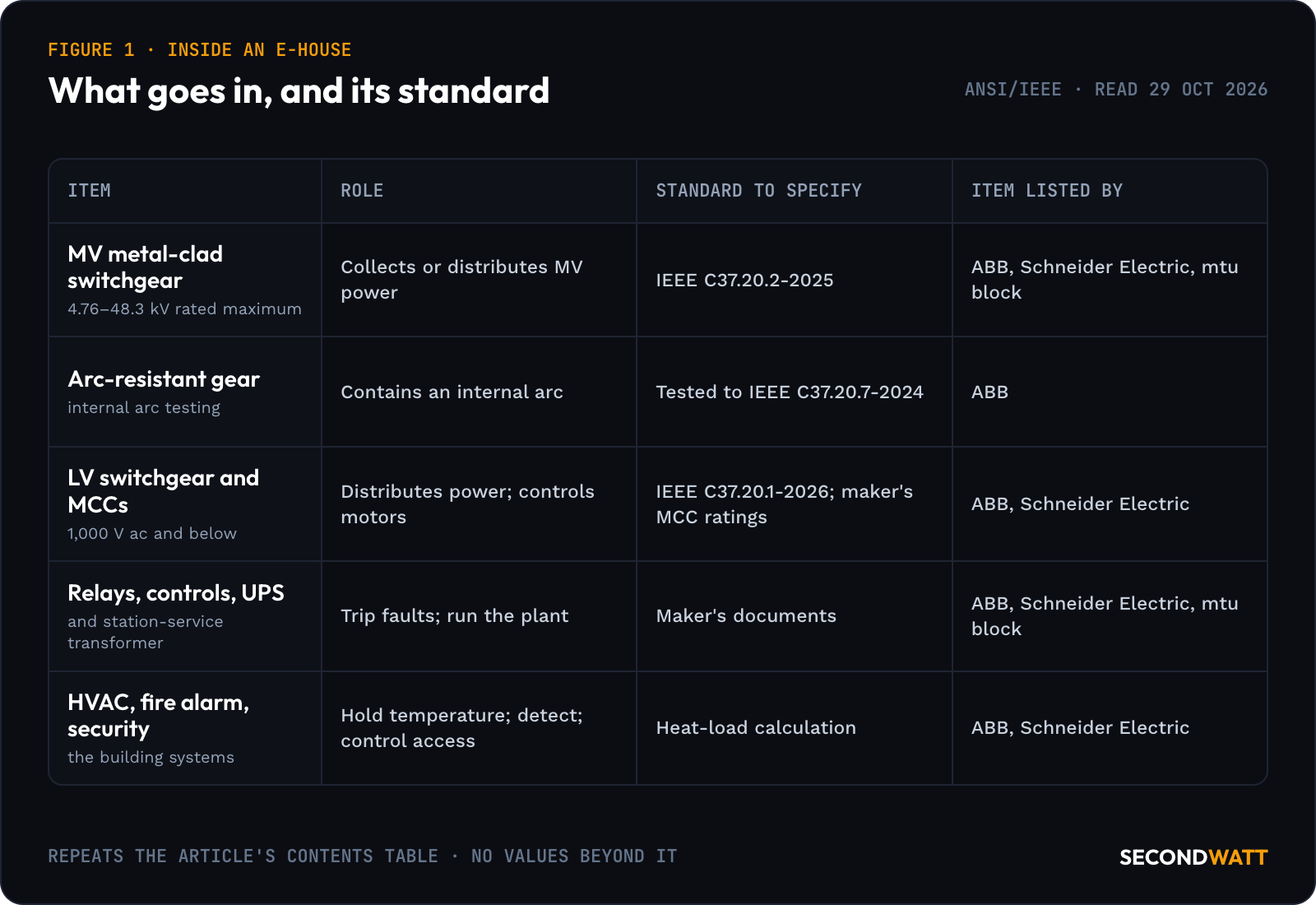
Specify each lineup to its own standard and edition; quoted or used gear may carry design tests to an earlier edition, so ask which. IEEE C37.20.2-2025, published 30 June 2026, supersedes the 2022 edition. IEEE C37.20.1-2026, published 30 July 2026, supersedes the 2015 edition and covers low-voltage breaker gear up to 1,058 V ac rated maximum.
The standard family follows the project. ABB's global eHouse modules are built to IEC standards with internal arc classification IAC AFLR, while its US brochure tests arc-resistant gear to IEEE C37.20.7. That standard's current edition, C37.20.7-2024, is a recommended practice covering switchgear up to 52 kV.
Lineup selection is covered in the medium-voltage switchgear guide and the low-voltage switchgear guide. Dossiers for lineups such as the ABB UniGear ZS1, Siemens NXAIR and Eaton VacClad-W sit in the switchgear category.
Why buyers use e-houses#
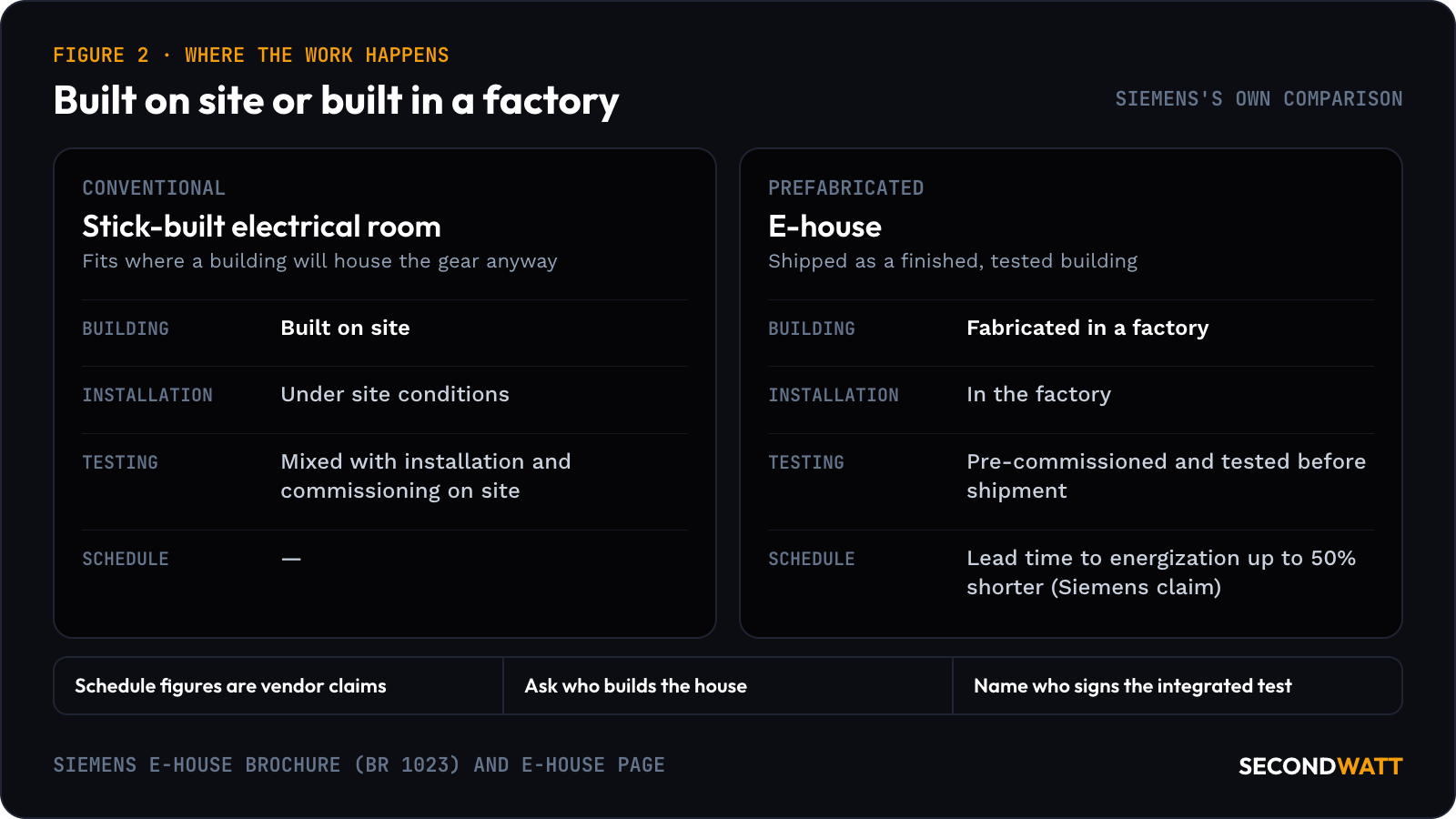
An e-house is fabricated in a factory, then pre-commissioned, tested and cleared of open points before shipment. A conventional substation mixes installation, testing and commissioning on site, as Siemens's E-House brochure compares the two.
The schedule benefits are the makers' own claims. "Parallel design/manufacturing and optimized installation/commissioning can cut lead times by up to 50%" is Siemens's claim for lead time to energization, on its E-House page. Its brochure adds "Up to -80% on-site work".
Ask who builds the house, because one maker describes it two ways. The eHouse is "fully designed, built, and tested by ABB in a controlled factory environment" on ABB's US product page. Yet ABB "does not manufacture or integrate eHouses in-house", per its October 2025 brochure, which uses integration partners. The purchase order should name the integrator, the maker of each lineup and the party that signs the integrated test.
E-houses in data centers and power blocks#
In a gas power block the e-house is the handover point. In the mtu 20V4000 block, ten packaged gensets connect to a 15 kV metal-clad lineup inside an e-house. The same house holds the station-service transformer, the plant controller, the protection relays and low-voltage distribution for the package auxiliaries (the 25 MW mtu block article).
The seller's battery limit is the 13.8 kV outgoing terminals at the e-house; the step-up transformer, interconnection and field cabling are the buyer's (mtu power-block dossier, in the power blocks hub). The block is ten units at 2,518 kWe each, mtu application group 3A (unrestricted heavy duty), 60 Hz, for 25.18 MWe gross at datasheet conditions. The GSU transformer specification guide covers the step-up side.
The lineup as quoted is indoor Type 1 and non-arc-resistant, with a 2,000 A bus, 40 kA bracing and 95 kV BIL. Choosing arc-resistant gear changes the building too. ABB pairs arc-resistant gear with a blast plenum that directs arc energy "to outside the eHouse", and lists paralleling switchgear among eHouse options in the same brochure. The paralleling switchgear guide explains why that gear is specified with the lineup.
At a utility intake, the e-house works as a substation: Siemens's walk-in E-House substation, for distribution system operators and industry, is usually installed elevated. Siemens's data center range runs from room-integrated skids to walk-in containers combining MV, LV, UPS and controls. Its published Compass Datacenters case is a factory-tested skid of 8DJH 36 gas-insulated switchgear and transformers.
Specifying an e-house before the quote#
Fix six inputs before bidders price the house.
E-house specification inputs and their basis in standards and regulations#
| Input | What to state | Basis |
|---|---|---|
| One-line and ratings | Voltage, bus amps, fault level and BIL for each lineup; system grounding | Equipment standards in the contents table; the mtu block's lineup is 13.8 kV, 2,000 A, 40 kA, 95 kV BIL |
| Arc-flash approach | Arc-resistant gear and plenum route, or non-arc-resistant gear; an arc-flash study | IEEE C37.20.7-2024; IEEE 1584-2018; IEEE 1584.1-2022 |
| Heat load | Equipment losses at planned loading and duty cycle; HVAC redundancy | nVent Trachte HVAC note, Apr 2025 |
| Working space and doors | Clear depth by voltage to ground; entrances at each end of long lineups | 29 CFR 1910.303(g) and (h); the electrical code the jurisdiction adopts |
| Structure and site | Wind and seismic loads, elevation, climate | The building code the jurisdiction adopts |
| Shipping and lifting | Module count, split lines, lifting points, connections remade on site | Integrator's transport plan |
The arc-flash study needs its own scope. IEEE 1584-2018 gives models for the arc-flash hazard distance and the incident energy workers could be exposed to. IEEE 1584.1-2022 sets out what the owner should specify for that study's scope and deliverables. Name both in the request.
Heat load follows actual loading. nVent Trachte's April 2025 HVAC sizing note gives an example in which a 2,000 A main caps what ten 1,200 A feeders can dissipate. In the mtu block the 1,200 A breakers are generator incomers, so their currents add on the bus instead.
105–132 A — the current in each 1,200 A generator breaker of the mtu block at 2,518 kWe and 13.8 kV, from 1.0 to 0.8 power factor (calculated).
The arithmetic is 2,518 ÷ (√3 × 13.8 × 1.0) = 105 A, rising to 132 A at 0.8 power factor. Current-dependent losses scale with the square of current, so in each breaker they run near 1% of their value at rated current (0.088² to 0.110²). If one 2,000 A main carries all ten units at 0.8 power factor, it sees about 1,317 A (10 × 131.7 A), 66% of rating, where those losses run near 43% (0.66², calculated). Ask each maker for losses at these currents.
The unit's sensible capacity has to cover the sensible load: equipment heat loss plus environmental load and air exchange. In nVent's example, a 6-ton unit rated 71,000 BTU/h total gives 49,900 BTU/h sensible at 95 °F outdoor and 80 °F return, about 14,600 W (49,900 ÷ 3.41214, calculated). That is a sensible-to-total ratio of 0.70 (49,900 ÷ 71,000), at the low end of the 0.70–0.75 range nVent gives for most units. Redundancy is most often N+1 or 100% in nVent's note.
At US workplaces, OSHA's design safety standards for electric utilization systems (29 CFR 1910.302–1910.308, text as of 29 Oct 2026) cover installations in buildings and on premises, including industrial substations. They exclude utility-controlled generation, transformation, transmission and distribution installations. Under 29 CFR 1910.302, the exclusion covers utility-only buildings, utility property, and outdoor sites held by established rights on private property.
Over 600 V, Table S-2 of 29 CFR 1910.303 sets minimum clear depth by voltage to ground, measured from the enclosure front or opening where parts are enclosed. The mtu block's system is grounded through a zig-zag transformer and neutral grounding resistor. Under 29 CFR 1910.399, "grounded" means connected to the earth, and a grounded circuit's voltage to ground is measured to its grounded point.
7,967 V — the 13.8 kV bus's voltage to ground (13,800 ÷ √3, calculated), which puts the mtu lineup in the 2,501–9,000 V row of Table S-2.
Condition A, 4 ft, is "exposed live parts on one side and no live or grounded parts on the other side". It also covers "exposed live parts on both sides effectively guarded by suitable wood or other insulating material". Grounded parts opposite is Condition B, 5 ft, with concrete, brick and tile walls counted as grounded. Live parts on both sides is Condition C, 6 ft.
Over 600 V, switchboards and control panels wider than 6.0 ft need an entrance at each end, unless exit travel is continuous or work space doubled. That covers installations after 16 April 1981. At 600 V and below, equipment rated 1,200 A or more and over 6.0 ft wide needs the same, for installations after 13 August 2007.
The National Electrical Code, NFPA 70, is in its 2026 edition; ask which edition the jurisdiction enforces before the layout is drawn.
In Siemens's E-House brochure, one chemical-plant reference split seven E-House substations into 90 transportable modules. Ask for the split plan, the lifting points and the connections remade on site.
Factory and site acceptance testing#
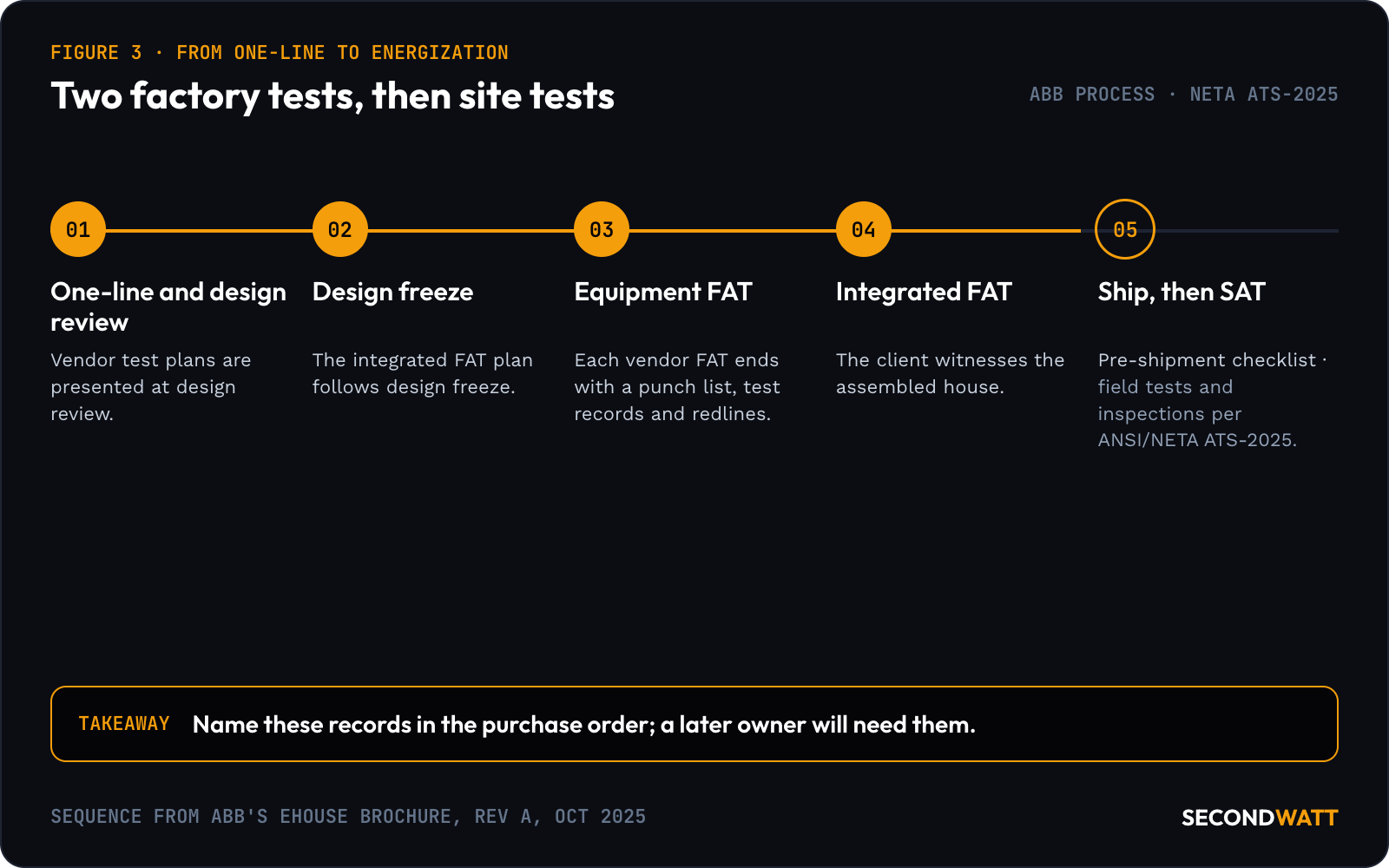
Factory acceptance testing (FAT) happens twice in ABB's published process. Each vendor runs FAT to its approved vendor integration test plan (ITP), presented at design review, and the client is invited to witness. The client then witnesses an integrated FAT (IFAT) of the assembled eHouse, to a plan issued after design freeze.
Each vendor FAT ends with a punch list, internal test records and redline drawings. In ABB's eHouse brochure, every punch item is closed before shipment, which follows a pre-shipment checklist. Name these records in the purchase order; a later owner will need them.
Site acceptance testing (SAT) covers the field connections and first energization. ANSI/NETA ATS-2025 is written for those "assessing the suitability for initial energization" of power equipment, and it specifies field tests and inspections. Name that edition in the commissioning specification.
Buying a used e-house#
A used e-house is judged on its records first: the FAT and IFAT records, closed punch lists, as-built drawings, relay settings files and each lineup's maintenance history. The used medium-voltage switchgear guide sets out checks for the gear inside, and the switchgear maintenance field guide shows what a maintenance record should hold.
Equipment must be approved under 29 CFR 1910.303(a). For custom-made equipment, approval can rest on the maker's test data, which the employer keeps for inspection under 29 CFR 1910.399, so buy the test records with the house.
Re-run the heat-load calculation for the new loading and climate, and compare the new site's code editions with the house's design basis.
FAQ: e-houses#
Is an e-house the same as a prefabricated substation?#
The two overlap. IEC 62271-202:2022 (edition 3.0, published 22 June 2022) covers enclosed prefabricated substations cable-connected to AC networks up to 52 kV. They may be walk-in or non-walk-in, and are designed for outdoor installation at publicly accessible locations. A plant e-house behind a fence is outside that setting, so ask which standard the house was tested to.
Who certifies an e-house for installation?#
At US workplaces covered by OSHA's Subpart S, equipment is acceptable when a nationally recognized testing laboratory lists, labels, certifies or accepts it. Where no laboratory covers that kind of equipment, inspection by a federal, state or local authority enforcing the NEC can serve. The electrical inspection itself follows the NEC edition the jurisdiction adopts.
Can an e-house be relocated to a new site?#
Some are built to move: mobile E-Houses for temporary power distribution are part of Siemens's E-House range. Moving a permanent house needs a lifting plan, a new foundation, working-space and approval checks, and a fresh site acceptance test.
What fire protection goes into an e-house?#
Beyond the fire alarm, ABB offers firewalls and blast-resistant buildings for the most demanding environments, in its eHouse brochure. Siemens's seven-substation chemical-plant reference added overpressure and a Sinorix 1230 fire suppression system for a −28 °C site, in its E-House brochure.
Can one e-house hold gear from several makers?#
Yes. E-houses enclose equipment "from multiple manufacturers", wired together as a system in a factory, in nVent Trachte's description. ABB assigns a dedicated single point of contact to every eHouse project, and its design reviews create the interconnect list. Ask the integrator for that list before design freeze.
Scoping the electrical house#
SecondWatt publishes equipment research and helps buyers source power equipment; it earns a fee when a sale it arranges closes. If you are scoping an e-house for a power block or a data center, send the one-line, the heat-load basis and the shipping limits through a request for quote. Owners of a surplus e-house or lineup can read how SecondWatt works with owners on the switchgear seller page.