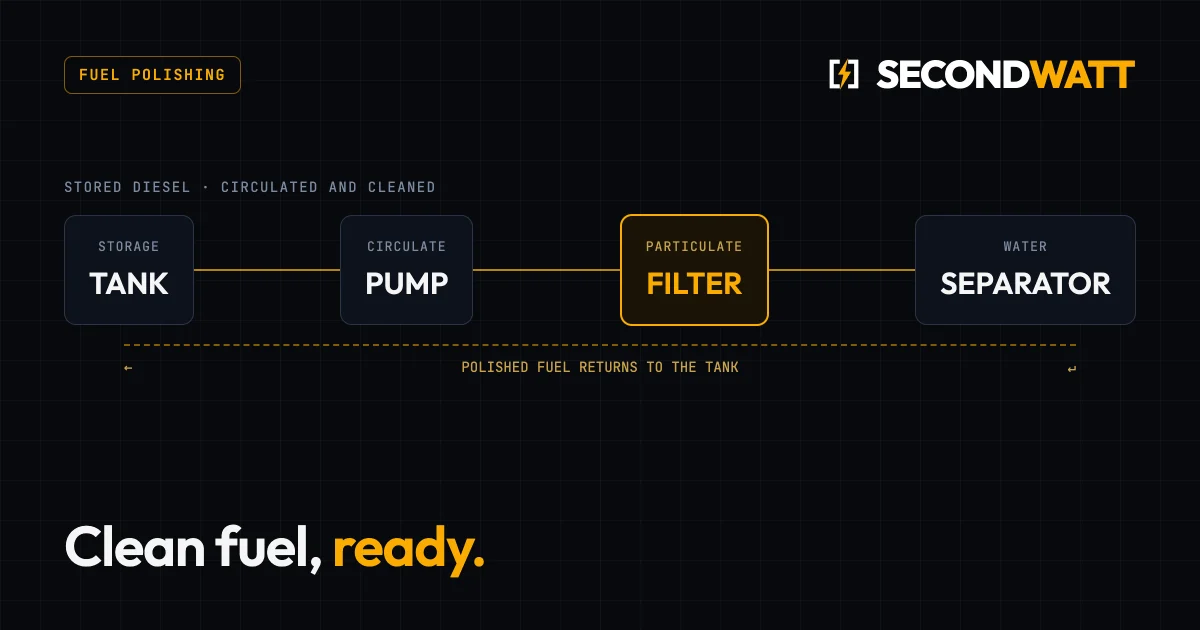
A fuel polishing system is a pump-and-filter loop for stored diesel. It pulls fuel from the bottom of the tank, strips out free water and solids, and returns the cleaned fuel. Standby generators need one because their fuel sits. Cummins bulletin 6511756, revision 12/24 notes that the sets run only for short exercise periods, so fuel stays in the supply tank for long stretches.
Polishing handles water, sediment and the debris of microbial growth, and fuel tests decide whether polishing is enough. A specification for a data center tank names the fuel, the tests and their triggers, the polishing loop, and the tank details that let both work.
Key Takeaways
- A polishing loop removes free water and solids. Both build while standby fuel sits between exercise runs; oxidation is a chemical change the loop cannot reverse, so tests decide.
- Specify biodiesel-free fuel for standby tanks. Cummins recommends B0 #2 S15 diesel; Caterpillar's 3500 and C175 guidance advises against biodiesel for standby. D975 diesel may carry 5% unlabeled.
- If biodiesel turns up, plan on monthly tests. Emptying a 24-hour base tank every three months takes at least 96 full-load hours a year, near the 100-hour US testing limit.
- Size the polisher from tank volume and flow. On a 30,000-gallon tank, 5 gpm means 100 pump hours per pass and 20 gpm means 25.
- A single standby set can exceed SPCC's aboveground exemption. A 24-hour base tank for a 2,000 ekW, 60 Hz standby set needs about 3,200 gallons, against 1,320.
Why stored diesel degrades#
Stored diesel picks up three kinds of contamination, water, microbes and solids, and a fourth problem, oxidation, comes from the fuel itself. Water arrives free, dissolved or emulsified. Dissolved water is invisible until a temperature drop brings it out as cloudy droplets, says DoD's UFM 3-460-03, dated 9 March 2026. The manual covers DoD fuel facilities, diesel included.
Microbes need very little water. Yeast, fungus and bacteria live at the fuel-water interface, and "a puddle in a tank bottom" can support large colonies. They leave a slime on tank walls that clogs filters and drives microbial induced corrosion. Their presence, the DoD manual says, points to poor water stripping and a need for more frequent tank cleaning.
Solids come from rust, scale, sand and airborne dirt. In the DoD manual's account, idle systems can collect water at low points, which leads to corrosion or biological growth and more solids.
Biodiesel content speeds the decline. Typical #2 ULSD holds 0–200 ppm dissolved water, against up to 1,000 ppm for biodiesel, and biodiesel oxidizes faster than ULSD in storage, Cummins says. NREL's 2023 Biodiesel Handling and Use Guide says aging biodiesel loses its oxidation reserve first, then forms peroxides, acids and finally gums.
5% by volume — the most biodiesel ASTM D975 allows in #1 and #2 diesel, with no requirement that the fuel list the percentage, as NREL's guide notes.
So ordinary delivered diesel can carry biodiesel the buyer did not choose.
What degrades stored diesel, what shows it and whether polishing removes it, from DoD's March 2026 UFM 3-460-03 and NREL's 2023 guide#
| Contaminant | Where it sits or what shows it | Does a polishing loop remove it? |
|---|---|---|
| Free water | Tank bottom, low points, separator sumps | Yes: filter separators remove free water |
| Dissolved water | Invisible until a temperature drop clouds the fuel | Only once it comes out of solution as free water |
| Microbial growth | Fuel-water interface; slime on tank walls | Removes the water it needs and loose debris; wall slime needs tank cleaning |
| Solids: rust, scale, sand, dirt | Suspended in fuel; settled at the bottom | Yes: pre-filters and coalescers trap solids |
| Oxidation products | Falling induction period, then rising acid number, then gums | No: a chemical change, found by testing |
What a fuel polishing system does#
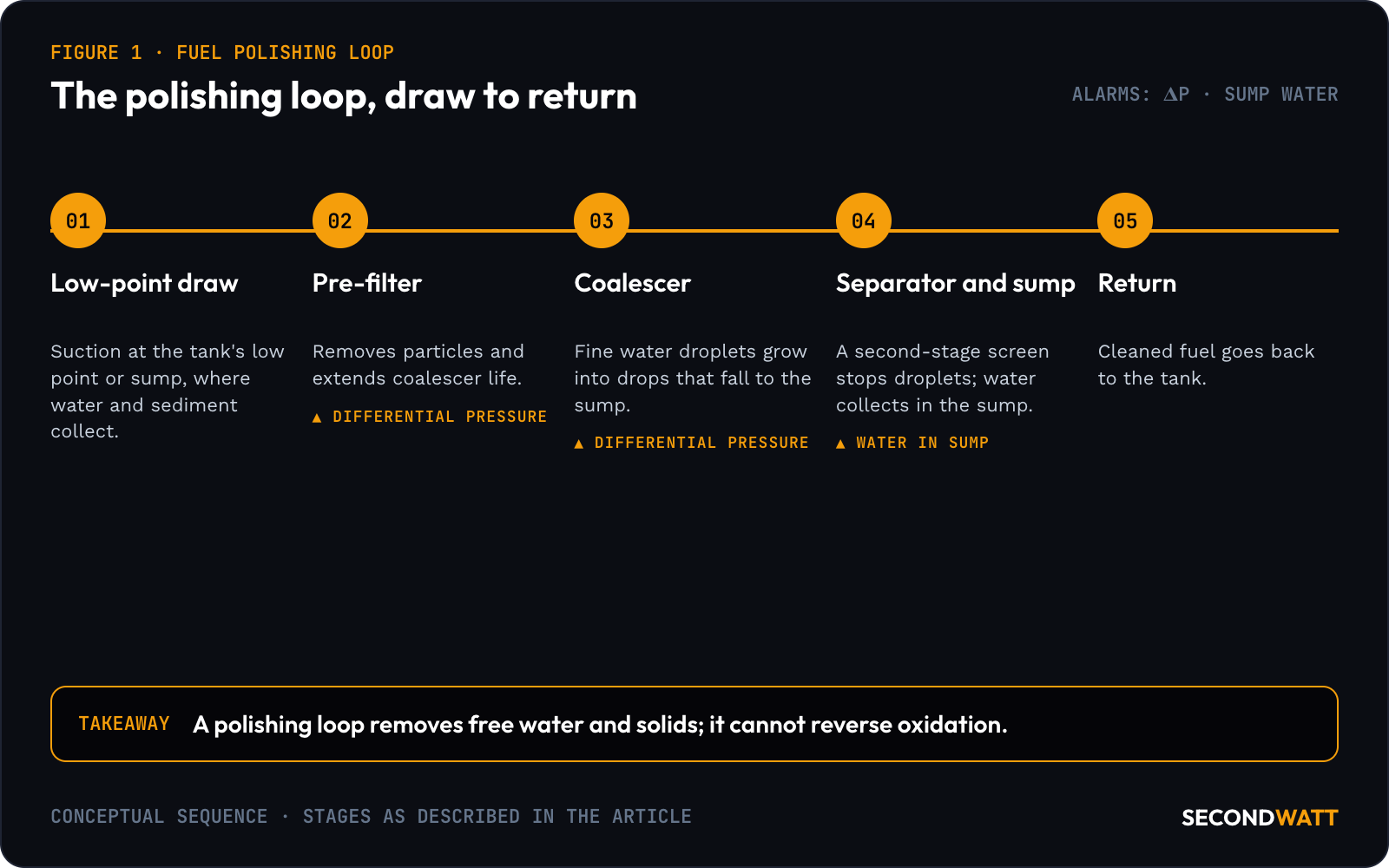
A fuel polishing system takes suction where water and sediment collect. Water is removed through sumps on tanks, filter vessels and low-point drains, which is the DoD manual's defense against microbial growth. The draw belongs at the tank's low point or sump.
Fuel then passes a pre-filter and a filter separator. Pre-filters remove particles and extend coalescer life. In the separator, fine water droplets grow into larger drops in the coalescer cartridges and fall to a water collection sump. A second-stage separator screen stops droplets from leaving, and the cleaned fuel returns to the tank.
Two readings show when the loop needs service. Trapped solids raise the differential pressure across the cartridges, and water builds in the separator sump. The filtration chapter of UFM 3-460-03 adds that a sudden rise in flow or fall in pressure can mean a damaged or torn cartridge.
The same loop comes in three forms. A permanent system is piped to the tank and runs on a timer. A portable unit is wheeled to the tank for a session. A service visit brings the pump, filters and tank-cleaning equipment for a scheduled clean.
What the fuel standards and engine makers ask for#
ASTM D975-26c, the active diesel specification, covers seven grades, from Grade 1-D S15 to Grade 4-D. It prescribes the required properties "at the time and place of delivery", "unless otherwise provided by agreement between the purchaser and the supplier". A buyer can contract for terms beyond the default, such as B0 fuel. ASTM D6469-24 is the guide to microbial contamination, covering its symptoms, detection and control in diesel and other fuels.
Cummins recommends ASTM D975 #2 S15 fuel with no biodiesel (B0) for its generator sets, or unblended EN 15940 paraffinic diesel (HVO). Fuel loaded at commissioning should be tested for biodiesel, and periodically after that. If any biodiesel is found, Cummins's bulletin 6511756 asks that the fuel be used within 3 months of purchase, or tested monthly if it cannot be.
Caterpillar's renewable-fuels FAQ for its 3500 and C175 sets says biodiesel "is not recommended for electric power (EP) standby applications". Standby sets should use no more than 5% of it, because of oxidation stability.
In its August 2021 publication LEXE20433-01, Caterpillar recommends that renewable and alternative fuels meet the latest version of ASTM D975 or another listed specification. "As with all fuels", they must be managed against contamination and water ingress.
Cummins's three-month window is hard to keep on standby duty. Caterpillar's 3516C 60 Hz enclosure can sit on an integral, UL 142-listed base tank. Its data sheet LEHE20856-01, dated 05/24, gives that tank a 24-hour run time at 2.0 eMW standby. Emptying any 24-hour tank every three months takes at least 96 full-load hours a year (24 × 4).
Part-load running takes longer. The 3516C Tier 2 set burns 133.6 gal/h at its 2,000 ekW, 60 Hz standby rating and 104.1 gal/h at 75% load. Those figures come from Caterpillar's data sheet LEHE1376-11, dated 08/26. Its 24-hour tank needs 24 × 133.6 = 3,206 gallons, which lasts 3,206 ÷ 104.1 = 30.8 hours at 75% load: about 123 hours a year if emptied quarterly.
Data sheet LEHE1376-11 labels that Tier 2 set "U.S. EPA Stationary Emergency Use Only". 40 CFR 60.4211(f)(2) lets a US emergency engine under 40 CFR 60 subpart IIII run at most 100 hours a calendar year for maintenance checks and readiness testing. It allows more only by petition to EPA or with records that government standards require it. For a set held to that limit, the practical plans are B0 fuel or, on a Cummins set, the monthly test routine.
Which fuel tests to run, and when#
Biodiesel content is the first result to get, because it decides whether Cummins's monthly routine applies. The Cummins limits below are listed in bulletin 6511756, which cites its service manual 5411406 or ASTM D7467, the specification for B6 to B20 blends. Its current edition is ASTM D7467-23.
Fuel tests for stored generator diesel: what each finds, the method and the frequency source, from standards and OEM documents; ASTM editions as listed active on store.astm.org, EN 15751 and D664 as Cummins names them#
| Test | What it finds | Method | Limit | Frequency and source |
|---|---|---|---|---|
| Biodiesel content | Unlabeled biodiesel in delivered fuel | ASTM D8274-25a | 5% maximum (Cummins 6511756, citing service manual 5411406) | At commissioning, then periodically; monthly if biodiesel is present and fuel is held beyond 3 months (Cummins 6511756) |
| Water | Water content, in ppm | ASTM D6304-25 | 200 ppm maximum (Cummins 6511756, citing service manual 5411406) | Monthly in the biodiesel case (Cummins 6511756) |
| Water and sediment | Free water and sediment suspended in the fuel | ASTM D2709-22 | 0.05% by volume (Cummins 6511756, citing ASTM D7467) | Monthly in the biodiesel case (Cummins 6511756) |
| Oxidation stability | Remaining oxidation reserve | EN 15751 | 6 hours minimum (Cummins 6511756, citing ASTM D7467) | Monthly in the biodiesel case (Cummins 6511756); at regular intervals for long storage of biodiesel blends (NREL guide) |
| Acid number | Acids formed as fuel oxidizes | ASTM D664 | 0.3 mg KOH/g maximum (Cummins 6511756, citing ASTM D7467) | Monthly in the biodiesel case (Cummins 6511756); at regular intervals for long storage of biodiesel blends (NREL guide) |
| Microbial contamination | Growth at the fuel-water interface | Guided by ASTM D6469-24 | No limit stated | Sample standing tanks "on a regular basis" (NREL guide) |
| Free water at drains | Water settled in tank and filter sumps | Open sump drains and check | Any free water | Daily when systems operate (UFM 3-460-03, DoD facilities) |
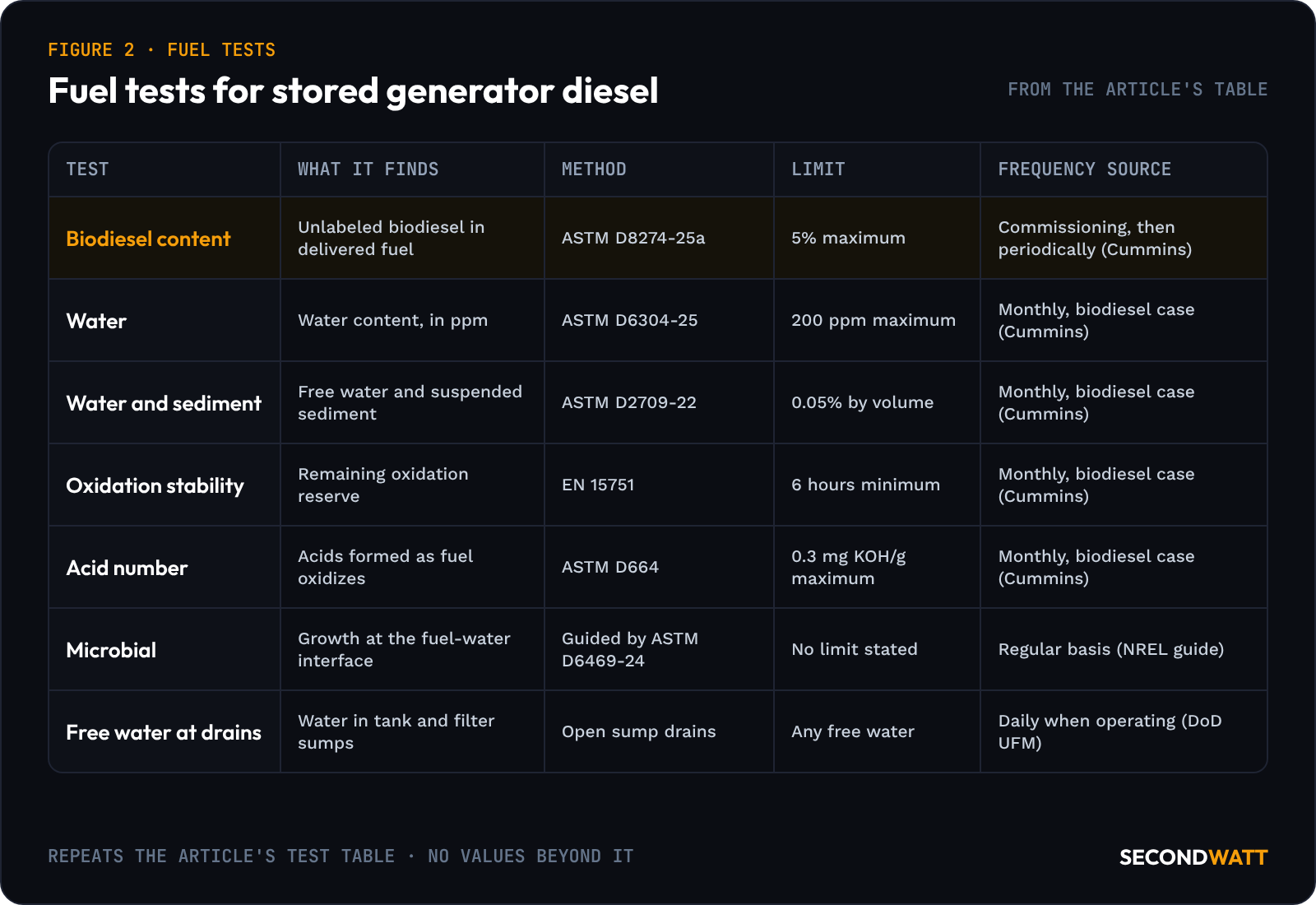
ASTM D2709-22 measures free water and sediment by centrifuge in middle distillates such as D975 Grades 1-D and 2-D. ASTM D6304-25 is the coulometric Karl Fischer method for water. ASTM D975 includes no stability test for #1 or #2 diesel, NREL's 2023 guide notes. The same analysis can still be applied to fuel with up to 5% biodiesel.
Sizing and specifying a permanent system#
Turnover is the sizing figure: hours per pass equal tank volume divided by polisher flow. At 10 gpm the polisher moves 600 gal/h, so a 30,000-gallon tank takes 30,000 ÷ 600 = 50 hours per pass. Running 8 hours a day, that is 50 ÷ 8 = 6.25 days per pass. Higher flow shortens each pass, and the filter housings and separator must be rated for the chosen flow.
Example polisher run time per pass for a 30,000-gallon bulk tank (illustrative tank and flows; hours = tank volume ÷ hourly flow)#
| Polisher flow | Flow per hour | Hours per pass | Share of a 168-hour week |
|---|---|---|---|
| 5 gpm | 300 gal/h | 100 h | 60% |
| 10 gpm | 600 gal/h | 50 h | 30% |
| 20 gpm | 1,200 gal/h | 25 h | 15% |
The same arithmetic covers base tanks: at 5 gpm, the 3,206-gallon base tank above takes 3,206 ÷ 300 = 10.7 hours per pass. For scale, the 30,000-gallon example holds about 225 full-load hours for one 2,000 ekW standby, 60 Hz 3516C (30,000 ÷ 133.6 = 224.6). Emptying it every quarter would take about 898 full-load hours a year (224.6 × 4), nearly nine times the 100-hour limit.
The table below is a first-pass specification sheet. Cost follows the same rows: the number and size of tanks, the flow, the filter stages, the controls, and the fuel's condition when polishing starts.
First-pass fuel polishing specification: item, what to specify and its basis (rows marked "specify" are owner decisions)#
| Item | What to specify | Basis |
|---|---|---|
| Governing standard | The NFPA 110 edition adopted by the authority having jurisdiction (current edition 2025) | NFPA 110, Standard for Emergency and Standby Power Systems |
| Fuel | B0 #2 S15 under ASTM D975, written into the supply agreement | Cummins 6511756; ASTM D975-26c delivery clause |
| Tests and triggers | Biodiesel content at commissioning, then periodically; monthly set per the test table if biodiesel is confirmed | Cummins 6511756; test table above |
| Draw point | Suction at the tank's low point or sump | DoD UFM 3-460-03 (water removal through sumps and low-point drains) |
| Filter stages | Pre-filter, then filter separator with coalescer, separator stage and water sump | DoD UFM 3-460-03; micron ratings and water-separation data: specify from the maker's data sheet |
| Alarms | High differential pressure and separator-sump water, wired to the BMS; pump fault | Alarms: specify. DoD practice is daily: monitor and chart differential pressure, open drains by hand; automatic water drains are generally removed (UFM 3-460-03) |
| Flow and hours per pass | Flow such that tank volume ÷ flow fits the owner's pass interval | Arithmetic above; pass interval: specify |
| Sumps and drains | Low-point drains on bulk tank, base or day tank and piping; drain-check interval per the test table | DoD UFM 3-460-03 |
| Pre-filter cartridges | Change at the lower of maker's limit or 20 psid, after 24 months, or when fuel is visibly dirty | DoD UFM 3-460-03, 3-6.1.1(d) |
| Coalescer cartridges | Change every 36 months, or sooner if differential pressure requires | DoD UFM 3-460-03, 3-6.2.1(e) |
Tank design, fuel storage and SPCC#
A tank built to let water reach one point makes polishing work. A sump or low point gives water somewhere to collect and the polisher somewhere to draw from.
The tank listing belongs in the specification. UL Solutions says UL 142 sets construction and performance criteria for steel atmospheric tanks that store stable flammable and combustible liquids. UL 2085 adds stricter fire and impact protection and requires built-in secondary containment.
The run-time target comes from the facility's design basis; the data center generator procurement guide covers generator count and redundancy. Fuel choice changes the volume that target needs. For its 3500 and C175 sets, Caterpillar puts volumetric consumption about 5% higher on HVO and says tank sizing "may need to be considered". Holding the same hours on HVO in the 30,000-gallon example needs 30,000 × 1.05 = 31,500 gallons.
40 CFR 112.1, the US EPA's spill prevention rule, applies to owners or operators of non-transportation-related facilities that store or use oil. The section has been unchanged since 3 January 2017. The test is whether, due to its location, the facility could reasonably be expected to discharge oil in harmful quantities to navigable waters or adjoining shorelines. Geography decides, such as proximity to water, land contour and drainage; dikes and other containment are excluded.
The rule reaches oil in any aboveground container, and in any container used for standby, seasonal or temporary storage or not otherwise permanently closed. A facility is exempt only if two capacity tests both hold. The first is completely buried capacity of 42,000 US gallons or less, excluding buried tanks subject to all the technical requirements of part 280 or an approved state program under part 281.
1,320 US gallons — the aggregate aboveground capacity at or below which the second test holds, counting only containers of 55 gallons or more, under 40 CFR 112.1(d)(2)(ii).
One standby set can cross that line. The 24-hour 3516C base tank needs 3,206 gallons at full load, about 2.4 times 1,320, so the site fails the second test and the discharge test decides. For a covered facility that began operating after 10 November 2011, 40 CFR 112.3 requires an SPCC Plan prepared and implemented before operations begin.
Polishing a used generator's fuel system#
A used set and its base tank arrive with fuel of unknown age and history, and idle systems are where water and corrosion build. Open every low-point drain on the tank, the day tank and the piping before sampling. Then run the commissioning tests in the table, starting with biodiesel content, and polish or replace the fuel before acceptance. The used 2 MW standby generator checklist covers the rest of the inspection.
Changing fuel grade can stir up the old system. In the DoD manual, loosened scale or rust "can continue to appear in the product for several weeks" after a grade change. DoD answers with more frequent sampling and strainer cleaning. Budget for extra filter changes after a relocated tank is refilled with a different grade.
The engine's own fuel system needs the same attention. Cummins bulletin 6511756 says degradation "can take place in the fuel system as well as the fuel tank", and recommends exercising the set on fuel that meets its requirements. The engine maker decides which fuel guidance applies: a Cat 3516E falls under Caterpillar's and a Cummins QSK60 under Cummins's. For an mtu 16V4000, ask the seller for mtu's fuel requirements by document number.
FAQ: fuel polishing#
How often should diesel fuel be polished?#
Polishing follows a finding: water at a sump drain, a rising water and sediment result, or climbing filter differential pressure. A permanent loop on a timer should also complete a full tank pass within the owner's chosen interval, and the sizing table shows how flow sets that.
How long can diesel fuel be stored for a standby generator?#
Under UFM 3-460-03, DoD components must not order B20 where storage would exceed three months. NREL's guide is less strict, expecting B20 that meets the specification minimum to retain quality for up to 1 year in clean, dry storage. HVO's shelf life is similar to or longer than diesel's, at more than 12 months, in Caterpillar's 3500 and C175 guidance; for B0 diesel, test results decide.
Do fuel additives extend storage life?#
Only as prevention. For biodiesel and its blends, NREL's guide says, antioxidants slow oxidation when added early, close to production, and cannot correct fuel that has already degraded. Biocides work in the water phase and are recommended where biological growth has been a problem, but the water behind the growth still has to be controlled.
Can a generator's day tank be polished?#
Yes, and it belongs in the scope. Cummins bulletin 6511756 notes that poor-quality or degraded biodiesel fuel can circulate through the engine's fuel system and sit there between exercise runs. Draw from the day tank's low point as for the bulk tank, and agree polisher connection points on a skid-built base tank with the generator maker.
Does renewable diesel change the polishing plan?#
Mostly no. Caterpillar's 3500 and C175 FAQ says HVO can typically be conditioned like diesel, and Cat fuel filters work with it. It sheds water more easily, so the water separator may need emptying more often. The diesel generator procurement guide covers fuel choice alongside emissions tiers.
Keeping standby fuel usable#
SecondWatt publishes equipment research and helps buyers source power equipment; it earns a fee when a sale it arranges closes. If you are specifying a standby plant and its fuel system, send the generator models, tank volumes and fuel type through a request for quote. The generator category, the 2 MW standby comparison and the 1.5 MW diesel guide cover the sets the fuel feeds.