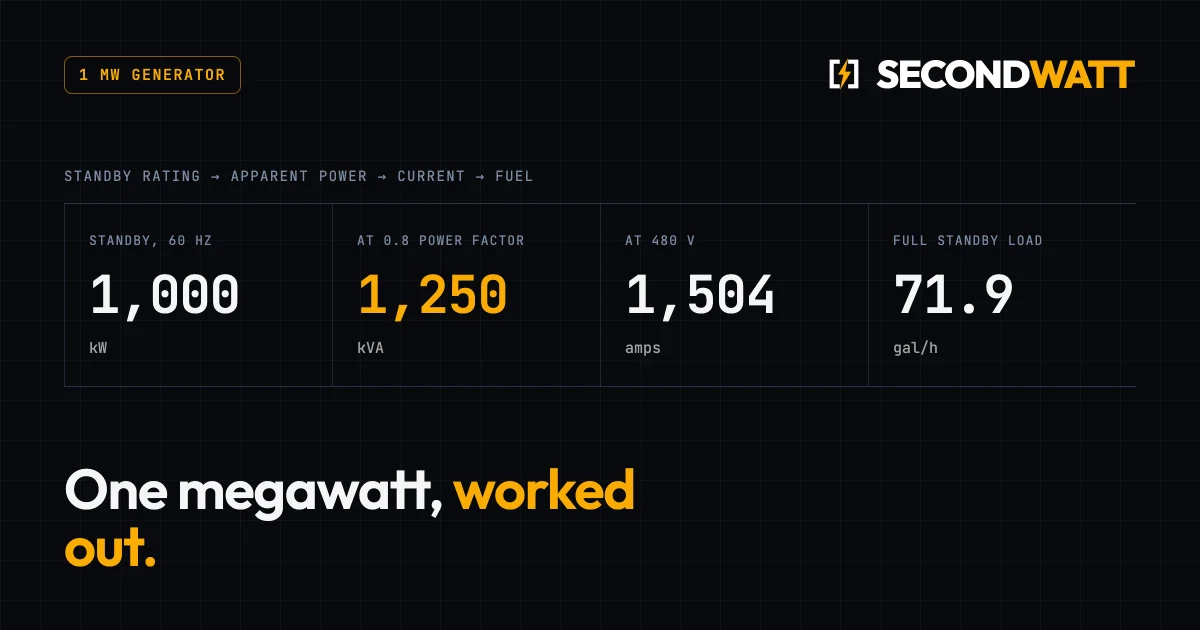
A 1 MW generator is a set rated 1,000 kW, and on current diesel sheets that figure is the standby rating at 60 Hz. Prime ratings on the same Cat, Rehlko (at 480 V) and mtu sets are 900–910 kW. At 0.8 power factor, 1,000 kW standby is 1,250 kVA, or about 1,504 A at 480 V.
The choice turns on four things: the rating the quote uses, the voltage, the fuel, and whether the engine is certified for emergency or non-emergency use.
Key Takeaways
- The data center rating differs by maker. At 60 Hz, Rehlko's KD1000 rating equals standby, mtu's DS1000 lists 900 kWe, and Cat ties its rating to C32B prime, 910 ekW.
- At 480 V, 1,000 kW standby carries about 1,504 A. At 0.8 power factor that is 1,250 kVA; at 4,160 V the same set carries about 173 A.
- Full standby load burns about 71–73 gal/h on current Tier 2 sheets. At Cat's 71.9 gal/h, the C32B's listed 2,000-gallon sub-base tank holds about 27.8 hours.
- Every EPA-certified 1,000 kW standby diesel sheet here is Tier 2, the emergency standard at this size. A new engine for non-emergency duty must meet Tier 4 generator-set limits instead.
- Cat's G3512 gas set reaches 1,000 ekW standby, 60 Hz, with non-emergency certification. Designed for low-pressure gas, it is listed at 12,500 kg dry against the C32B's 6,668 kg.
Standby, prime and data center ratings at 1 MW#
Cat's May 2026 sheet LEHE1209-08 gives the C32B package four 60 Hz ratings: 1,000 ekW standby, 1,000 ekW mission critical, 910 ekW prime and 830 ekW continuous.
Each definition assumes an average load: 70% of rating for standby and prime, 85% for mission critical and 70–100% for continuous.
On mtu's March 2026 standby sheet 231073, the 16V2000 DS1000 standby rating allows an average load factor up to 85%, with no overload. On 1,000 kWe standby that is 850 kW of average load, the same as Cat's mission critical term and 150 kW above its standby term (850 − 700). The prime power rating explainer covers the definitions.
Data center ratings differ by maker. Rehlko's February 2026 sheet G5-580 sets the KD1000's Data Center Continuous rating equal to standby. The mtu Data Center Continuous sheet lists 900 kWe at 60 Hz, with unlimited hours and an average load factor up to 100%. Cat ties ISO 8528-1 Data Center Power to the C32B's prime rating.
The 1,000 kW diesel generator sets you will meet#
Four makers' sheets show a 1,000 kW standby diesel set at 60 Hz. The generator category holds the dossiers.
1 MW-class diesel generator sets at 60 Hz: ratings, engine and EPA certification (OEM sheets, revision noted)#
| Set (document, revision) | Standby | Prime | Other rating | Engine and displacement | Engine power on the sheet | EPA certification on the sheet |
|---|---|---|---|---|---|---|
| Cat C32B (LEHE1209-08, 05/26) | 1,000 ekW / 1,250 kVA | 910 ekW | 1,000 ekW mission critical; 830 ekW continuous | Cat C32, 32.1 L | Not listed | Emergency stationary (Tier 2) |
| Rehlko KD1000 (G5-580, 2/26) | 975–1,000 kW standby; 1,000 kW / 1,250 kVA at 277/480 V | 810–900 kW prime; 900 kW at 277/480 V | Data Center Continuous same as standby | Rehlko KD27V12, 12-V, 27 L | 1,114 kWm maximum at rated rpm | Tier 2, stationary emergency |
| mtu 16V2000 DS1000 (231073 and 231072, 2026-03) | 1,000 kWe / 1,250 kVA | 900 kWe / 1,125 kVA | 900 kWe Data Center Continuous | mtu 16V2000G86S, 16-V, 35.7 L | 1,371 kWm maximum (standby sheet) | Tier 2; SCAQMD |
| Cummins QST30-G5 engine (GDSS137-RevA, 01/08) | 1,000 kWe / 1,250 kVA typical set output | 910 kWe typical set output | 752 kWe base (COP) | Cummins QST30, V-12, 30.5 L | 1,112 kWm gross at standby | Stationary emergency, Tier 2 |
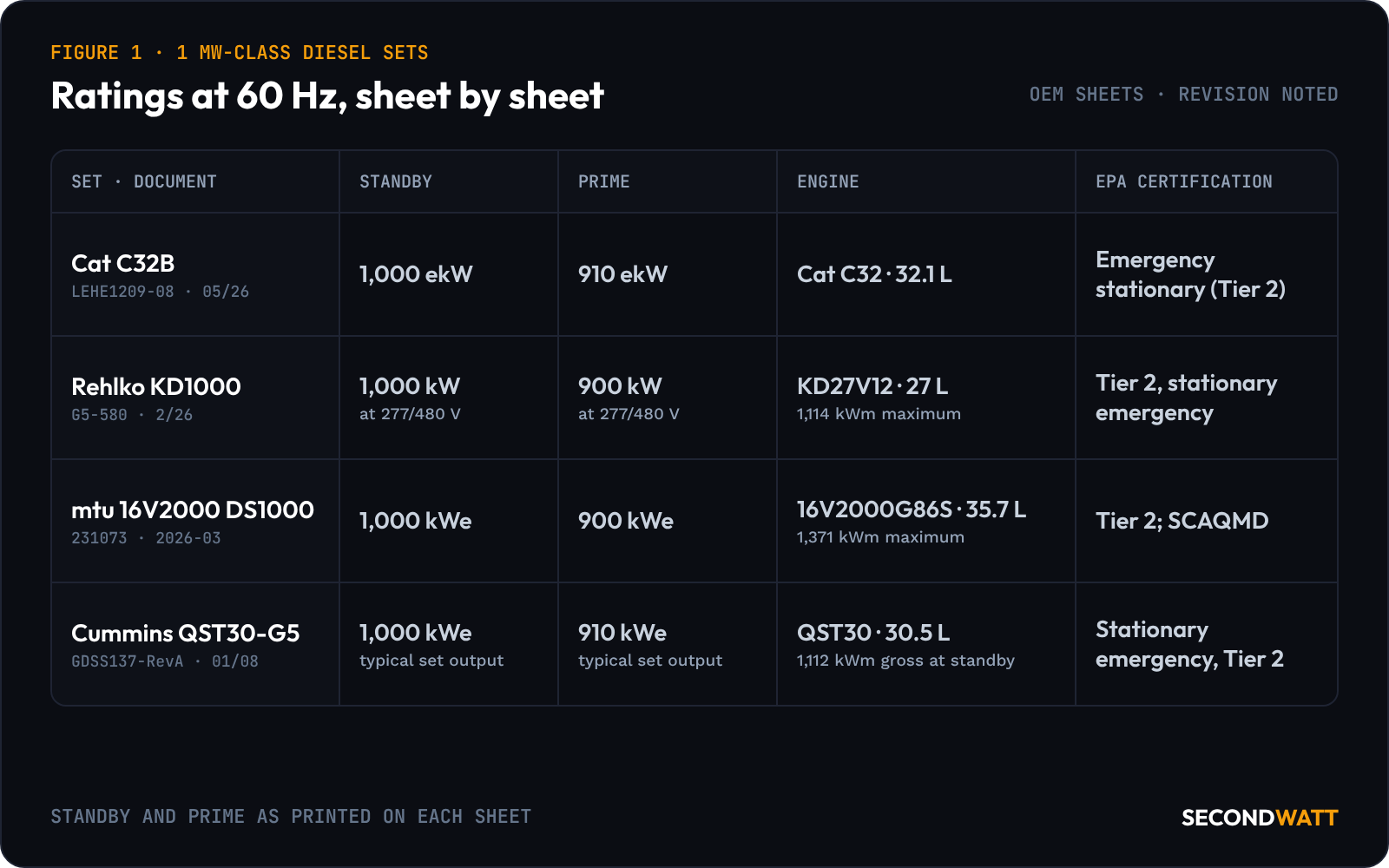
Ratings follow alternator and temperature rise. On the KD1000, the KH04070TO4D alternator at 120/208 V gives 900 kW prime at 125 °C rise but 810 kW at 105 °C. At 277/480 V it gives 900 kW at both. The Cummins row is a 2008 engine sheet with typical set outputs, so ask for the current set sheet behind any QST30 quote; the QST30 dossier summarizes the set.
Cat publishes the same C32B ratings in two versions. On sheet LEHE1209-08, the Tier 2 emergency set burns 272.1 L/h at full standby load. The Low Fuel Consumption set, whose May 2026 sheet LEHE1210-07 lists no EPA certification, burns 262.7 L/h. The certified version uses about 3.6% more fuel (272.1 ÷ 262.7 = 1.036).
Cat's 3512C product page rates the set at 1,500 ekW standby and 1,360 ekW prime at 60 Hz. The Cat C32 dossier and 3512C dossier cover both engines. The 1.5 MW specification guide covers larger sets.
Converting 1,000 kW to kVA and amps#
A 1,000 kW standby set at 0.8 power factor delivers 1,000 ÷ 0.8 = 1,250 kVA. Line current is I = kVA × 1,000 ÷ (√3 × V), so the voltage sets the current every conductor downstream must carry.
1,000 kW standby at 0.8 power factor: line current at three voltages, 60 Hz (calculated; OEM sheet values beside them)#
| Voltage, three-phase | Apparent power | Current, calculated | Current printed on the sheet |
|---|---|---|---|
| 208 V | 1,250 kVA | 3,469.7 A | 3,470 A (mtu DS1000; Rehlko KD1000) |
| 480 V | 1,250 kVA | 1,503.5 A | 1,504 A (mtu DS1000; Rehlko KD1000) |
| 4,160 V | 1,250 kVA | 173.5 A | 173 A (mtu DS1000) |
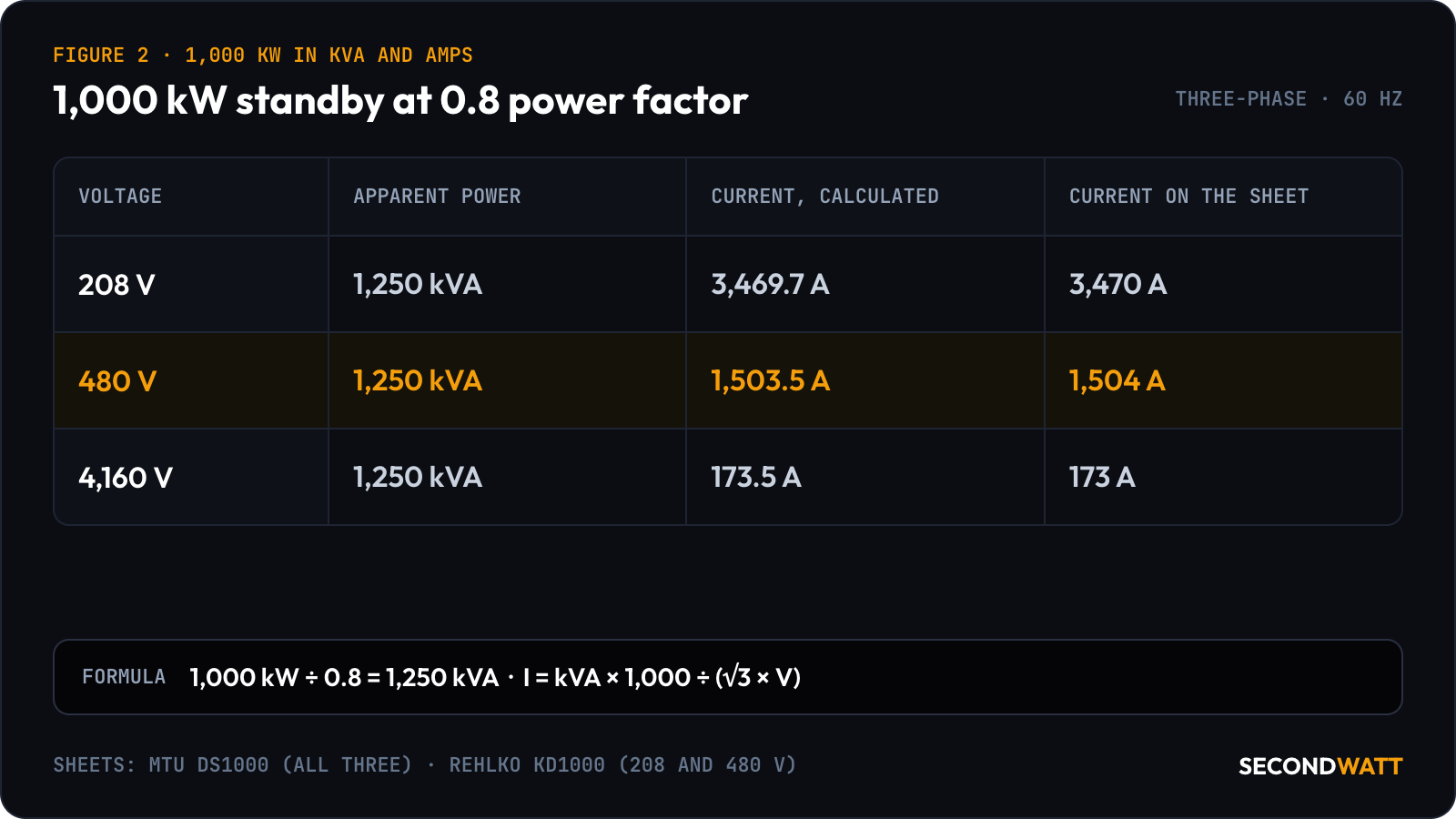
At 208 V the current is about 2.3 times the 480 V figure: 3,470 A through the breakers, transfer switch and cables at full standby load. The transfer switch sizing guide sets out the method, and the low-voltage switchgear guide covers the gear at 480 V.
1,504 A — the line current of a 1,000 kW standby set at 0.8 power factor, 480 V and 60 Hz, as calculated and as printed in the mtu DS1000 and Rehlko KD1000 rating tables.
1 MW generator fuel consumption and tank hours#
Three current Tier 2 sheets report fuel by load.
Fuel consumption of three 1,000 kW standby diesel sets at 60 Hz, L/h (gal/h) (OEM sheets, revision noted)#
| Load on the standby rating | Cat C32B, Tier 2 (LEHE1209-08) | Rehlko KD1000 (G5-580) | mtu 16V2000 DS1000 (231073) |
|---|---|---|---|
| 25% | 82.6 (21.8) | 84 (22.2) | Not listed |
| 50% | 144.7 (38.2) | 146 (38.6) | 146 (38) |
| 75% | 213.4 (56.4) | 209 (55.3) | 211 (56) |
| 100% | 272.1 (71.9) | 269 (70.9) | 276 (73) |
Only Cat states a fuel basis: 35° API gravity and a lower heating value of 42,780 kJ/kg. Without a common basis, the 2.6% spread at full load (276 ÷ 269) is approximate.
Over 24 hours at full standby load, the Cat C32B burns 272.1 × 24 = 6,530 L. At 3.78541 L per US gallon, that is 6,530 ÷ 3.78541 = about 1,725 gallons.
Worked example: run hours from the Cat C32B sub-base tank options (illustrative; calculated from LEHE1209-08)#
| Listed tank capacity | Hours at 100% (71.9 gal/h) | Hours at 75% (56.4 gal/h) | Hours at 50% (38.2 gal/h) |
|---|---|---|---|
| 1,000 gal (3,785 L) | 13.9 | 17.7 | 26.2 |
| 2,000 gal (7,571 L) | 27.8 | 35.5 | 52.4 |
| 3,600 gal (13,627 L) | 50.1 | 63.8 | 94.2 |
Each figure divides the listed tank capacity by the sheet's fuel rate, so ask the packager for the usable capacity.
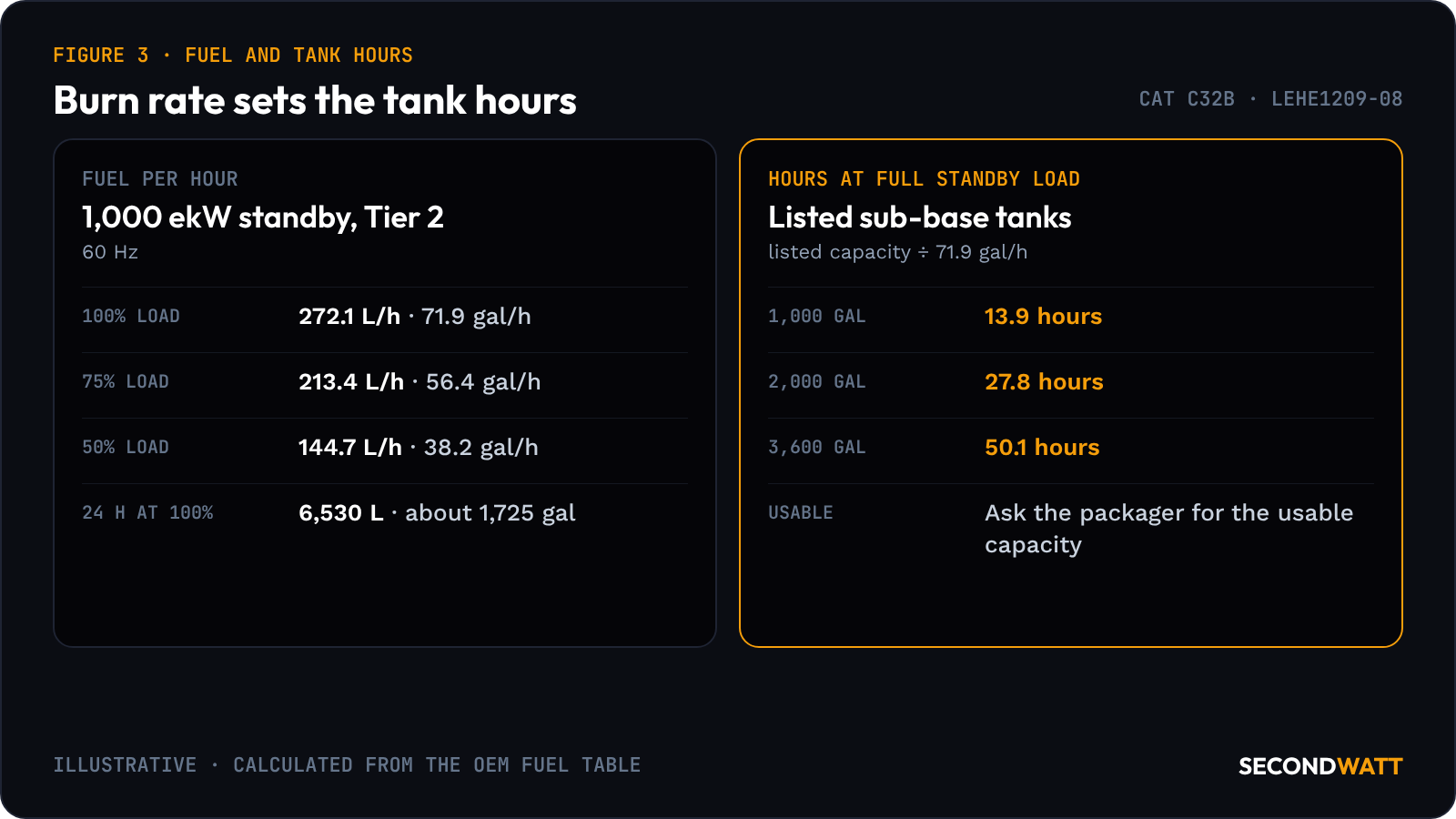
71.9 gal/h — the full-standby-load fuel use of Cat's Tier 2 C32B at 1,000 ekW and 60 Hz, or about 1,725 gallons over 24 hours.
Emissions: emergency or non-emergency use#
In the US, 40 CFR part 60 subpart IIII covers owners and operators of stationary compression-ignition (diesel) engines ordered after 11 July 2005 and made after 1 April 2006. Fire pump engines follow their own dates, and 40 CFR 60.4200 sets out both. The order date counts as the start of construction.
Under § 60.4211(f), an emergency engine has no time limit in emergencies, and up to 100 hours a calendar year for maintenance checks and readiness testing. Those tests must be recommended by federal, state or local government, the manufacturer, the vendor, the regional transmission organization or equivalent balancing authority and transmission operator, or the engine's insurer. Extra testing hours need a petition to EPA, unless records show federal, state or local standards require them.
Up to 50 of those hours may be non-emergency operation. Except as § 60.4211(f)(3)(i) provides, they "cannot be used for peak shaving or non-emergency demand response, or to generate income for a facility to an electric grid or otherwise supply power as part of a financial arrangement with another entity". That paragraph permits such supply only when all five of its conditions hold, the first being dispatch by the local balancing authority or local transmission and distribution system operator.
Run any other way, the engine is not considered an emergency engine under subpart IIII and "must meet all requirements for non-emergency engines". The 500 kW standby guide walks through the same use test.
Standards follow model year and maximum engine power, which 40 CFR 1039.140 defines as the maximum brake power point on the engine's nominal power curve. A 1,000 kWe standby set needs more than 1,000 kW of engine output, so its engine sits above 560 kW.
The emergency route covers model-year 2007 and later engines rated up to 2,237 kW maximum engine power and under 10 liters per cylinder, fire pumps excluded. The listed engines sit inside it: 1,112–1,371 kWm and 2.2–2.7 L per cylinder (C32: 32.1 ÷ 12 = 2.7). Under § 60.4205(b) and § 60.4202(a)(2), they must meet Tier 2 or Tier 3 standards for the same rated power.
In appendix I to part 1039, the Tier 3 table ends at the 130–560 kW rated-power band. Above 560 kW the only row is Tier 2, from model year 2006: 6.4 g/kW-hr NOx plus NMHC, 3.5 CO and 0.20 PM.
Non-emergency engines of model year 2007 and later under the same power and displacement limits follow § 60.4204(b) and § 60.4201(a). They must meet the part 1039 standards for their model year and maximum engine power. After model year 2014 those are Tier 4 at every engine power; power only selects the row of limits.
In Table 1 of § 1039.101, the engine of a 1,000 kWe standby set falls in the row for generator sets above 560 kW: 0.67 g/kW-hr NOx, 0.19 NMHC, 0.03 PM and 3.5 CO. After 31 December 2016, § 60.4208(f) bars owners from installing a non-emergency engine of 560 kW or more maximum engine power that misses the 2015 model-year requirements.
From model year 2011, manufacturers must permanently label each new emergency engine rated 130 kW or more that meets the emergency standards but not all the non-emergency ones. Under § 60.4210(f) and Table 5, the label states stationary emergency use only. The Tier 4 Final guide covers aftertreatment.
1 MW natural gas generator or diesel#
Cat's May 2024 sheet LEXE1482-06 rates the G3512 with Fast Response at 1,000 ekW standby and continuous, at 0.8 power factor and 60 Hz. Cat states it meets EPA stationary non-emergency standards, for emergency and non-emergency use. Cummins' C1000N6 on the lean-burn QSK60G is listed at 1,000 kW standby, 60 Hz, with both EPA stationary uses among its emission levels.
Stationary spark-ignition engines fall under 40 CFR part 60 subpart JJJJ instead of subpart IIII, within the dates and engine powers § 60.4230(a) sets.
Cat's G3512 sheet says the set accepts 100% block load in one step and facilitates compliance with NFPA 110 Type 10 starting and loading requirements.
Cat's G3512 standby rating assumes 100% average output, against 70% on the diesel C32B. The gas set's cooling is offered to 43 °C ambient, against 50 °C for the C32B.
Cat's G3512 page says the set is designed for a low-pressure gaseous fuel supply and lists natural gas or a hydrogen blend up to 5%. It burns 10.29 MJ per ekW-hr at full load (heating-value basis not stated), about 10.3 GJ an hour at 1,000 ekW. With no stored fuel on site, run time depends on the gas supply.
The used natural gas generator checks and the gas turbine and gas engine comparison cover the trade-offs, and the G3512 dossier and QSK60G dossier summarize each engine.
Footprint, enclosure and sound#
Listed lengths of the three 1,000 kW standby diesel sets run from 4,165 to 5,093 mm, across different configurations. On Cat's own reference drawings, the G3512 gas set is 1,846 mm longer than the C32B and 1.87 times its dry weight.
Dimensions and weights of 1,000 kW standby sets at 60 Hz as listed (OEM sheets; not for installation)#
| Set and document | Configuration | Length × width × height | Weight as listed |
|---|---|---|---|
| Cat C32B (LEHE1209-08) | Package as drawn | 4,165 × 1,684 × 2,162 mm | 6,668 kg dry |
| Rehlko KD1000 (G5-580) | Radiator model, maximum | 4,224 × 1,986 × 2,200 mm | 8,083 kg wet, maximum |
| mtu 16V2000 DS1000 (231073) | Open power unit, 480 V drawing | 5,093 × 2,292 × 2,477 mm | 8,525 kg, estimate |
| Cat G3512 Fast Response, gas (LEXE1482-06) | Package as drawn | 6,011 × 2,809 × 2,671 mm | 12,500 kg dry |
The C32B sheet lists weather-protective and sound-attenuated enclosures. Rehlko offers two sound-level enclosure and tank packages; on the KD1000, an enclosure with an enclosed silencer reduces ambient temperature capability by 5 °C.
The open mtu DS1000 measures 95.1 dB(A) at 7 m at full standby load, tested to ISO 8528-10 with infinite exhaust. Rehlko lists 96 dB(A) at 7 m for the open KD1000 at rated load, with no test method stated.
Paralleling, rental and used sets#
Two 1 MW sets give N+1 for a load one set can carry, and the redundancy guide sets out the configurations. The C32B and G3512 sheets list paralleling switchgear and controls as options. On the KD1000, the APM603 controller parallels up to eight sets on an isolated bus with kW and kVAR load sharing, with other APM603 controllers only. The paralleling switchgear guide covers the gear.
Under § 60.4200(e), a diesel set acting as a temporary replacement unit, a rental included, needs nothing else from subpart IIII if two conditions hold. It must stay at the stationary source under a year and be properly certified to the nonroad standards that would apply to it. The bridge power guide covers temporary supply, and the docking station explainer covers the connection point.
A used set is bought on its records: the EPA label, model year, emissions data sheet, alternator data and service log. Under § 60.4209(a), an emergency engine that does not meet the non-emergency standards needs a non-resettable hour meter installed before startup. Moving an engine from one existing location to a new one takes it outside the § 60.4208 install deadlines.
The used 2 MW standby checklist sets out inspection steps; the 2 MW standby comparison covers the next size.
FAQ: 1 MW standby generators#
What can a 1 MW generator power?#
It depends on the running load against the rating's average-load term. For example, 600 kW of IT load, 250 kW of cooling and 50 kW of controls and lighting total 900 kW. That is 90% of a 1,000 kW standby rating: above Cat's 70% standby average and the 85% of mtu's standby and Cat's mission critical terms. A load like that points to a larger set or a second unit.
How much does a 1 MW generator cost?#
It depends on the build. Emissions certification, voltage, enclosure, tank and alternator each move the quote, so compare like builds. SecondWatt's pricing index gives capacity-band pricing for generators, built from public price points.
Can a 1 MW standby set generate at medium voltage?#
Yes, on some sheets. The mtu DS1000 rating table includes 4,160 V. Cat lists 2,400 V and 4,160 V output voltages for the C32B, and options up to 13,800 V for the G3512 gas set. The Rehlko KD1000 sheet stops at 600 V.
How many hours a year can a 1 MW standby set run?#
It depends on the rating and, for an emergency engine, on subpart IIII's use limits. Cat's standby and mission critical definitions give typical operation of 200 hours a year and maximum expected use of 500. Prime ratings carry unlimited hours on the Cat, Rehlko and mtu sheets, as do Cat's continuous and mtu's Data Center Continuous ratings.
How large a motor can a 1 MW standby set start?#
It depends on the alternator and the voltage dip allowed. At 480 V and a 35% dip, Rehlko lists peak motor-starting kVA of 3,774, 4,193 and 4,612 across the KD1000's three alternators. The mtu DS1000 lists 2,475 skVA at 480 V and a 30% dip. The dip limits differ, so the two sheets do not compare directly.
Choosing the set#
SecondWatt publishes equipment research and helps buyers source power equipment; it earns a fee when a sale it arranges closes. If you are sourcing a 1 MW set, send the rating type, voltage, fuel, emissions use and largest load step through a request for quote. Owners with a set to place can start at the generator seller page.