A generator circuit breaker (GCB) is the breaker between a power-plant generator's terminals and its step-up transformer. It connects the unit to the grid, isolates it, and interrupts faults fed from either side. Generator-fed fault current can carry enough DC offset to delay its current zeros, which breakers tested only to IEC 62271-100 are not required to interrupt.
Siemens lists what one adds: auxiliaries that stay supplied when the breaker opens, synchronizing on the generator side of the step-up transformer, and quick interruption of faults from either side. For a buyer, the GCB is part of the switchgear scope that decides how the plant starts, connects and trips. On a used turbine package, whether the breaker is included and documented changes the electrical scope.
Key Takeaways
- A GCB clears faults from both sides. It interrupts grid-fed current arriving through the step-up transformer and current fed by the generator itself, each with its own rating.
- Generator-fed faults can delay current zeros. In a 139-station survey, generator-source asymmetry generally exceeded 100%, and passed 150% on some gas turbine generators up to 300 MVA.
- A GCB lets auxiliaries stay supplied with the unit offline. Siemens lists uninterrupted auxiliary supply with the GCB open, and synchronizing by one switching operation on the GSU's generator side.
- One symmetrical rating hides two duties. Siemens rates its 3AH36 at up to 110 kA symmetrical: 144 kA asymmetrical from the system side, 230 kA from the generator side.
- Used packages need scope and records first. Confirm the GCB is in the package, which standard its type tests cite, and what its operation counter and monitoring show.
What a generator circuit breaker does#
A generator circuit breaker sits on the generator leads, between the machine and its generator step-up (GSU) transformer. Siemens's 2025 HB3 catalog says the breaker connects the generator to the step-up transformer and interrupts generator-source and system-source faults. In a 2018 PCIC Europe paper, ABB product managers Brandt and Ferruccio call the generator and the GSU the most important electrical components to protect in a power plant.
The standard for these breakers is IEC/IEEE 62271-37-013:2021, edition 2.0, published 19 October 2021; the current copy is a 2025-06 corrected version. According to the IEC webstore, it applies to three-phase AC high-voltage generator circuit breakers, indoor or outdoor, at 50 Hz and 60 Hz. It covers systems above 1 kV and up to 38 kV. It replaced the 2015 first edition, which was converted from IEEE C37.013-1997 (R2008).
Breakers for home standby and portable generators are a different product, outside this article's scope.
Why generator duty is different#
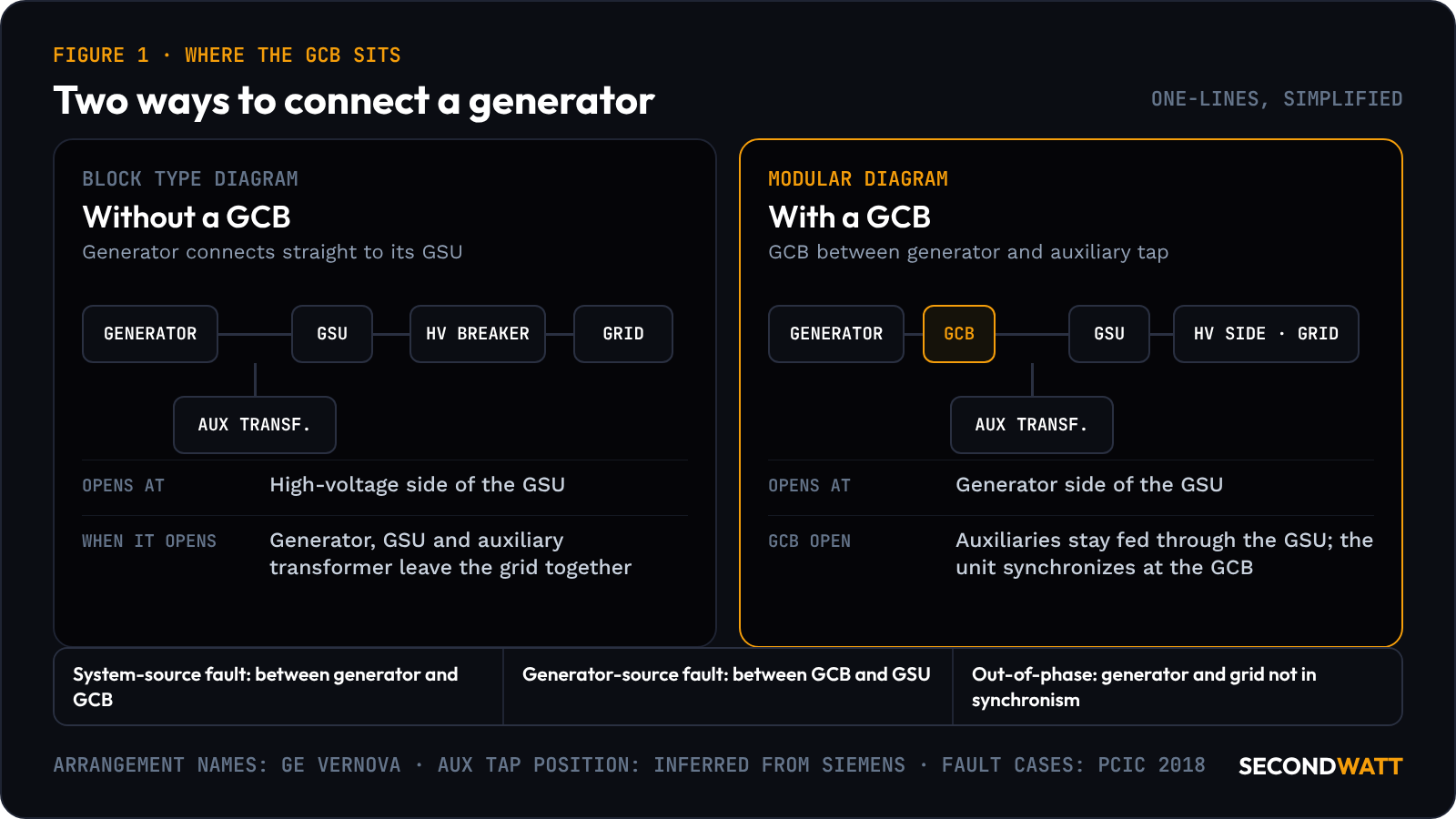
The PCIC paper sets out three kinds of fault a GCB has to clear. A system-source fault sits between the generator and the GCB and is fed by the grid through the GSU. A generator-source fault sits between the GCB and the GSU and is fed by the generator alone. The third is an out-of-phase fault.
System-source current carries a long DC time constant. The same paper gives 133 ms in the 2015 edition of IEC/IEEE 62271-37-013, against 45 ms for distribution breakers under IEC 62271-100. A longer time constant means more asymmetry when the contacts part.
Generator-source current behaves differently, as Palazzo and Delfanti explain in a 2013 IPST paper. Its AC component decays with the machine's subtransient and transient time constants, while its DC component decays with the armature time constant. When the AC part decays faster, the DC component can exceed the AC peak, and the current stops crossing zero on time. That is a delayed current zero, and the PCIC paper notes that the 2015 edition requires a GCB to break even when one occurs.
The IPST 2013 paper surveyed 139 power stations with generators from 16 MVA to 2,002 MVA. Generator-source asymmetry was generally above 100%, and only 7% of generators stayed below it. The breaking current from the generator was usually lower than from the grid, though 9% of generators showed the reverse.
150% — the degree of asymmetry generator-source fault current can exceed on gas turbine generators rated up to 300 MVA, in that 139-station survey.
The authors attribute those values mainly to the long armature time constant and relatively short subtransient time constants of those generators.
The voltage after interruption is also steep, as Palazzo and co-authors set out in a 2015 IPST paper. Under IEEE C37.013-1997 (R2008), the transient recovery voltage (TRV) can rise at up to 6.0 kV/µs after a system-source fault and 2.2 kV/µs after a generator-source fault. Siemens's HB3 catalog states that rates of rise can be up to 10 times higher in the generator breaker standard than in IEC 62271-100.
Out-of-phase switching is the last duty. It happens when the generator and the grid are not in synchronism at the moment the GCB operates. IPST 2015 notes that synchronizing at up to 180° electrical might occur, though the standards it cites cover 90°. The PCIC paper gives the 2015 edition's out-of-phase breaking current as 50% of the system-source rating, against 25% of the rated short-circuit current for IEC 62271-100 breakers.
Where the GCB sits#
GE Vernova's generator circuit breakers page contrasts a "modular diagram" that uses a GCB with a "block type diagram" solution. With no GCB, the generator connects straight to its GSU, so it follows that the nearest breaker able to disconnect the unit is on the high-voltage side. If a unit auxiliary transformer is tapped from the generator leads, opening that breaker separates generator, GSU and auxiliary transformer from the grid together.
Siemens's listed benefit, auxiliaries that stay supplied with the GCB open, implies that the auxiliary tap sits between the GCB and the GSU. On that arrangement, the auxiliary transformer and the GSU stay connected to the grid when the GCB opens. The GSU transformer specification guide covers how auxiliary and station service transformers split the plant load.
Shared transformers change the fault duty. With a three-winding GSU, a fault between one generator and its GCB picks up the other generator's contribution. Where two generators share one two-winding GSU, the IPST 2013 paper notes that both the AC component and the asymmetry that GCB must interrupt can reach very high values. The IEC webstore says the 2021 edition added requirements for plants with several generators on one step-up transformer.
What a GCB changes in operation#
The first change is auxiliary power. Siemens's HB3 catalog lists "uninterrupted supply of the auxiliary systems" when the GCB is open after a fault or for maintenance. GE Vernova lists "easier operation particularly regarding the transfer of auxiliaries" among the modular diagram's advantages. With the tap between GCB and GSU, that supply comes from the grid through the GSU while the generator is offline, which shapes the start-up power and load acceptance plan.
The second is synchronizing. Siemens notes that with a GCB, the unit connects through one switching operation on the generator side of the GSU. The IPST 2013 paper gives the main causes of out-of-phase closing as wiring errors when voltage transformers and synchronizing equipment are connected at commissioning or maintenance. Inadequate synchronizer settings, such as a wrong GCB closing time, and manual synchronizing can also produce them.
For engine plants, synchronizing and load-sharing controls are covered in the paralleling switchgear guide.
The third is fault isolation. Siemens lists fast interruption of generator-source faults to protect the GSU and auxiliary transformer, and of system-source faults to protect the generator. GE Vernova lists "increased protection especially for the power transformer".
On Siemens's vacuum GCBs, the HB3 catalog states, protection relays trip the breaker through shunt releases. If the breaker then fails to clear the fault, GE's 2013 Multilin G60 brochure says the relay's breaker failure element can send trips to upstream breakers.
Ratings to specify#
A GCB is specified by generator duty, and each rating traces back to the generator, the GSU or the grid.
Generator circuit breaker ratings: what each means, its source and an OEM example (GE Vernova FKG2S brochure GEA-N50091 R002; Siemens HB3 catalog 2025; Hitachi Energy HEC 10 page)#
| Rating | What it means | Where the value comes from | OEM example (vendor figure) |
|---|---|---|---|
| Rated maximum voltage | Highest system voltage the breaker is rated for | Generator voltage; the standard covers above 1 kV to 38 kV | FKG2S: 24 kV |
| Rated normal current | Current carried continuously at the stated ambient | Generator rated current, with its ambient basis | FKG2S: up to 9,500 A at 40 °C ambient air |
| System-source breaking current | Grid-fed fault between generator and GCB | Grid and GSU data | 3AH36: up to 110 kA, 60% DC component |
| Generator-source breaking current and class | Generator-fed fault between GCB and GSU | Generator reactances and time constants | 3AH36: up to 110 kA symmetrical, Class G2, 130% DC component |
| Transient recovery voltage | Voltage across the open contacts after interruption | Generator and GSU characteristics; capacitors modify it | Plant-specific (GenCB TRV calculator) |
| Out-of-phase breaking current | Interruption with generator and grid out of synchronism | Synchronizing conditions | FKG2S: 31.5 kA |
| Making and peak withstand current | Peak current when closing into a fault | Follows the short-circuit rating | FKG2S: 173 kA peak; 3AH36: 302 kA making |
| Short-time withstand and duration | Fault current carried while closed | Fault study | FKG2S: 63 kA for 3 s |
| Insulation level | Power-frequency and lightning impulse withstand | Voltage class | FKG2S: 60 kV and 125 kV peak |
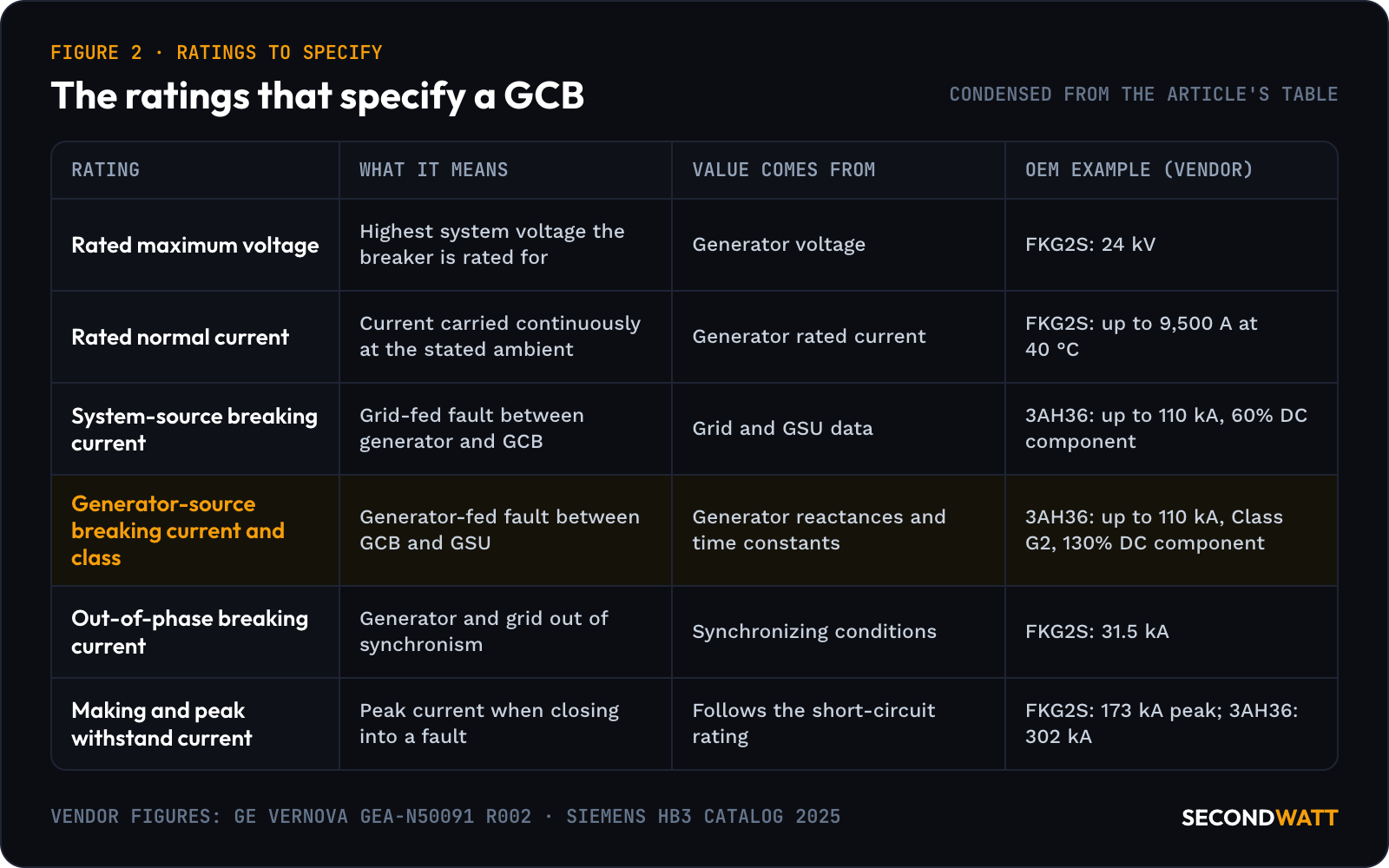
The TRV row follows from the machine and transformer: the IPST 2013 paper notes that their characteristics dictate the prospective waveform. According to the IEC webstore, the 2021 edition added a "GenCB TRV calculator" for the effect of capacitors on the TRV in out-of-phase and load current switching. The Class G2 row means a generator-source rating at 130% asymmetry when the contacts part, as Hitachi Energy's HEC 10 page defines it.
One symmetrical number is not enough. On the 3AH36 sheet, up to 110 kA symmetrical becomes 144 kA asymmetrical on the system side and 230 kA on the generator side. That is 144 ÷ 110 = 1.31 against 230 ÷ 110 = 2.09, so the generator-side current is 230 ÷ 144 = 1.6 times the system-side one.
Other vendor ratios sit at the 2015 edition's figures as the PCIC paper reports them. GE Vernova's out-of-phase ratings are 31.5 ÷ 63 = 50% on the FKG2S and 40 ÷ 80 = 50% on the 17.5 kV FKG2M. Its peak withstand is 173 ÷ 63 = 2.75 and 220 ÷ 80 = 2.75 times the breaking current. Siemens's making current is 302 ÷ 110 = 2.75 times, against the 2015 edition's factor of 2.74.
Continuous current follows from the generator rating. Worked example: a hypothetical 13.8 kV generator rated 100 MVA carries 100,000 kVA ÷ (√3 × 13.8 kV) = 4,184 A at rated output. Siemens's GMSG-GCB page rates the breaker, a 15 kV drawout vacuum GCB for machines rated 10 MW to 80 MW, at up to 4,000 A fan-cooled. That is 184 A short, while Hitachi Energy's HVR-63XS, a retrofit breaker rated up to 6,300 A, covers it on its stated rating.
4,184 A — the rated current of a hypothetical 100 MVA, 13.8 kV generator, above the GMSG-GCB's 4,000 A fan-cooled rating.
The vendor still runs the duty check. Siemens asks for the generator data sheet with its reactances and time constants, the transformer rating and impedance, any auxiliary transformer and motors, and the single-line diagram. It then calculates short-circuit currents to IEC 60909 and IEC/IEEE 62271-37-013.
Vacuum and SF6 generator breakers#
Both interrupting technologies are type-tested for generator duty, and the vendors split along them. Hitachi Energy describes its GCB portfolio as SF6 technology, and each GE Vernova brochure cited here lists SF6. Siemens builds its range around vacuum interrupters and markets it as SF6-free.
OEM generator circuit breaker ranges, vendor figures (Hitachi Energy product pages; GE Vernova brochures GEA-N50091 R002 and GEA-N50132 R001; Siemens HB3 catalog 2025 and product pages)#
| OEM and type | Interrupting medium | Short-circuit rating | Continuous current | Voltage | Plant or unit size, as the OEM states it |
|---|---|---|---|---|---|
| Hitachi Energy portfolio | SF6 | 63–300 kA | 6,300 A to over 50,000 A | By type | All plant types |
| Hitachi Energy HVS-63S | SF6 | 63 kA | Up to 7,150 A / 6,900 A | 24 kV | Up to 200 MW (OEM's stated rating) |
| Hitachi Energy HECS | SF6 (portfolio) | 80, 100, 130 kA | Up to 23,000 A (50 Hz), 21,700 A (60 Hz) | 23–25.3 kV | Up to 800 MW (OEM's stated rating) |
| Hitachi Energy HEC 10 | SF6 (portfolio) | 170, 210 kA | Up to 29,000 A | 31.5–33 kV | Up to 1,500 MW (OEM's stated rating) |
| GE Vernova FKG2S | SF6 | 63 kA | Up to 9,500 A | 24 kV | 50–150 MW (OEM's stated rating) |
| GE Vernova FKGA8 | SF6 arcing chamber, main contacts in air | Up to 250 kA (50 Hz), 210 kA (60 Hz) | Up to 30,000 A, natural cooling (50 Hz) | 33 kV | From 600 MW (OEM's stated rating; alternatives proposed per plant) |
| Siemens HB3 (3AH36) | Vacuum | Up to 110 kA | Up to 13,500 A | Up to 24 kV | Up to 400 MW (OEM's stated rating) |
| Siemens GMSG-GCB | Vacuum | 63 kA short-time withstand | Up to 4,000 A fan-cooled | 15 kV | Machines rated 10–80 MW |
The ranges come from Hitachi Energy's GCB page, its HECS and HVS-63S pages, GE Vernova's FKG2S and FKGA8 brochures, and Siemens's HB3 page. Across these three vendors, SF6 types reach higher ratings: up to 300 kA from Hitachi Energy, against 110 kA for Siemens's vacuum HB3.
The design difference shows up in maintenance. GE Vernova's FKGA8 keeps SF6 in the arcing chamber only, with the main contacts in air. Hitachi Energy states 5.1 kg of SF6 for three poles of the HVS-63S, with leakage under 0.1% a year. Siemens states its sealed vacuum interrupters need no gas handling, no pressure monitoring and no contact-erosion monitoring.
The PCIC authors describe vacuum interrupters with transverse magnetic field contacts as a design able to interrupt generator-source faults up to 50 kA at 15 kV.
Generator breakers in used turbine packages#
Start with scope. GE Vernova supplies GCBs from bare breakers without enclosure to systems with disconnector, earthing switch, starting switch and instrument transformers. Hitachi Energy's HECS system includes the breaker, disconnector, capacitors and control cubicle, with further components as options. Ask which of these parts the package includes, and set that against the package ratings and the installed-scope cost of the gas turbine.
Then ask for the nameplate and the type-test reports, and note which standard they cite. Hitachi Energy's HECS and HVR-63 pages state type tests to IEEE C37.013, while its HEC 10 page and GE Vernova's brochures cite IEC/IEEE 62271-37-013. The PCIC paper lists IEEE C37.013 as superseded or inactive after October 2015. Siemens states its switchgear complies with the standards applicable at the time of type tests.
Ask for the operation counter, the fault-interruption history and the maintenance records. GE Vernova's FKGA8 brochure notes that contact resistance measurement alone is not reliable evidence of contact health, citing the latest standard. Some designs record their own wear. The HVR-63 has a built-in contact erosion indicator, and Hitachi Energy's GMS600 monitor logs events and estimates the time to the next overhaul.
For SF6 designs, ask for the gas density readings against the vendor's limits. The FKG2S is rated at 850 kPa absolute at 20 °C, with a 710 kPa minimum, and monitored by densimeter. Check control and protection integration: trip, close and interlock wiring to the relay and turbine controls. A breaker selected for one generator and GSU also needs the vendor's duty check against the new plant's data.
FAQ: generator circuit breakers#
Is a generator circuit breaker the same as the main breaker on a generator?#
Not on a low-voltage set. IEC/IEEE 62271-37-013 covers breakers on systems above 1 kV, so a 480 V set's main breaker falls outside it and belongs to low-voltage switchgear. A medium-voltage generator can use a breaker tested to the standard.
Can medium-voltage switchgear breakers serve as generator breakers?#
Only if they are tested for generator duty. The PCIC paper notes that adapting a breaker tested only to IEC 62271-100 usually means excluding some faults, such as out-of-phase. It can also mean delaying the trip until the DC component decays, or adding RC elements to tame the TRV.
Siemens's GMSG-GCB shows the other route: it shares its design with Siemens's standard non-generator breakers and meets IEEE C37.013. The general lineup decisions sit in the medium-voltage switchgear guide.
Do small gas turbine and engine plants use GCBs?#
It depends on generator voltage and size. Siemens's GMSG-GCB covers machines rated 10 MW to 80 MW at 15 kV, and GE Vernova's FKG2S brochure starts at plants rated 50 MW. For an aeroderivative such as the GE LM6000, compare the generator's MVA, voltage and fault study against those ranges.
What does a generator protection relay protect against?#
It protects the generator from internal faults and abnormal operation. GE's Multilin G60 lists stator differential, 100% stator ground, field ground and loss of excitation. It also covers out-of-step, reverse or low forward power, overexcitation, unbalance, accidental energization and synchronism check. GE states the G60's protection elements comply with IEEE C37.102.
How long do generator circuit breakers last?#
The vendors state endurance in operations and years. Hitachi Energy states up to 20,000 no-load close-open operations or 20 years between main overhauls for the HECS, and 20 years or 10,000 operations for the HVS-63S. Siemens rates its 3AH36 at 20,000 mechanical operating cycles, 10,000 at rated current and up to 30 at 100% fault current. The PCIC paper reports that the 2015 edition set mechanical endurance classes of 1,000 operations (M1) and 3,000 (M2).
Specifying the generator connection#
SecondWatt publishes equipment research and helps buyers source power equipment; it earns a fee when a sale it arranges closes. Buyers scoping a turbine plant's generator breaker can send the generator and GSU data with an equipment request. Owners of a turbine package with its GCB can sell gas turbines through SecondWatt.