Kohler PD-Series paralleling switchgear (PD-2000/3000/4000)
Manufacturer: Kohler
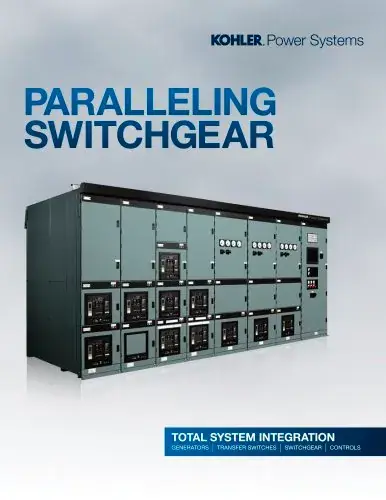
Kohler PD-Series paralleling switchgear under Rehlko, with an OEM service program built around controls obsolescence
This model is part of SecondWatt’s switchgear research catalogue. Specifications and price observations are included where supported by sources. Equipment availability and commercial terms require confirmation.
Kohler (Rehlko) PD-Series dossier: LV generator paralleling switchgear, OEM-documented PLC/HMI obsolescence and retrofit path, inspection checklist.
The PD-Series is Kohler's low-voltage generator paralleling switchgear line, now sold under Rehlko, the independent company Kohler Energy became after its 2024 separation, with power systems marketed at powersystems.rehlko.com. Lineups integrate generator and tie breakers, synchronizing, and load management for multi-genset standby plants.
Rehlko's own switchgear service brochure is unusually candid about the category's core problem: PLC and HMI obsolescence on aging lineups, and the retrofit path that replaces controls in place with sequence re-verification and load testing. That is authoritative OEM confirmation of a 15-20-year controls lifecycle.
The practical guidance for buyers is identical: value the iron, assume the controls are a retrofit project, and demand PLC program backups and settings files with any used plant.
Why it matters
Rehlko publishes what most OEMs leave implicit: paralleling switchgear dies of controls obsolescence, not worn copper.
Who buys it
Owners of Kohler/Rehlko genset plants in healthcare, commercial, and industrial facilities buy PD-Series new and modernization services for aging lineups. Used-market buyers acquiring whole plants inherit PD lineups and should price controls retrofit into the acquisition.
Role in the data center
Generator plant paralleling and load management for Kohler and Rehlko standby fleets in healthcare, commercial and industrial critical facilities, sitting between the generator terminals and the emergency distribution bus. It is the layer that sequences start, synchronizing and load pickup, and its controls vintage is what decides whether an inherited plant can be recommissioned as found.
Key specifications
| Product line | PD-Series LV paralleling switchgear |
|---|---|
| Owner | Rehlko (ex-Kohler Energy, 2024) |
| Core functions | breakers, synchronizing, load management |
| Documented failure driver | PLC/HMI obsolescence |
| Retrofit path | controls replacement + re-verification + load test |
| Service program | OEM switchgear service (G12-542) |
| Used listings | none priced in open channels |
| Class lead time | 45-90 weeks (engineered switchgear) |
| Tiers | PD-2000, PD-3000 and PD-4000 |
| Retrofit warranty | 1-2 years typical on OEM controls modernization |
Technical summary
Line: PD-Series LV paralleling switchgear (PD-2000/3000/4000 tiers). Functions: generator and tie breakers, synchronizing, load management. Owner: Rehlko (Kohler Energy separated 2024). Service: OEM switchgear service program with PLC/HMI retrofit path. Documented risk: PLC and HMI obsolescence on aging lineups. Retrofit scope: controls replacement, sequence re-verification, load testing. Application: NFPA 110 standby plants with paralleled gensets. Used market: no open priced lineup listings.
Major variations
PD-2000, PD-3000 and PD-4000 scale by plant complexity and generator count, and within a tier configurations vary by transfer scheme, distribution scope and how much of the plant's load management the lineup carries. Controls generation is the axis that actually decides service posture, because Rehlko's own switchgear service brochure documents PLC and HMI obsolescence as the recurring failure driver. Post-2024 OEM literature sits on powersystems.rehlko.com under the Rehlko name, while nameplates still read Kohler.
Configurations and options
PD-2000, PD-3000 and PD-4000 scale by plant complexity and generator count, and within a tier price is set by the number of generator and tie breakers, the breaker frames and their interrupting ratings, the bus continuous rating, the transfer scheme, and how much of the plant's load management the lineup carries rather than the building system. Controls content is the item that ages: Rehlko's switchgear service brochure G12-542 documents PLC and HMI obsolescence as the recurring driver and describes a retrofit that replaces controls in place with sequence re-verification and load testing, warranted one to two years.
Compatibility and dependencies
The lineup depends on the generator sets it parallels, on breakers whose close and trip circuits it drives, and on the emergency distribution bus downstream, which has to match on continuous rating and short-circuit withstand with the paralleled generator contribution included. Its own controls are the fragile dependency: Rehlko's switchgear service brochure documents control hardware turning over on a shorter cycle than the 30-plus-year bus and breakers, so program files, protection settings and as-built drawings should be a condition of any purchase. After any controls change the start-to-load sequence has to be re-verified against NFPA 110 and load tested, which is what makes a controls retrofit a commissioning project rather than a parts swap.
Pricing and availability
Trend: rising Lead time, new: 45-90 weeks (engineered switchgear class). Lead time, used or refurbished: Dealer/service channel; no open used market. Warranty, used: 1-year typical from reconditioning dealers.
Lifecycle and maintenance
Paralleling switchgear iron lasts 30+ years but its control systems turn over every 15-20: PLCs, HMIs, and network hardware go obsolete long before bus and breakers wear out. OEM modernization programs (Kohler switchgear service, ASCO, Eaton, Russelectric) replace controls in place with sequence re-verification and load testing, typically warranted 1-2 years. A used lineup's value concentrates in its breakers and bus; controls should be assumed a retrofit cost unless current.
Thermal and emissions profile
Switchgear produces no combustion emissions; the regulatory profile is electrical safety and materials. NFPA 70B became a standard in its 2023 edition, making maintenance programs mandatory rather than recommended, and arc-flash rules (NFPA 70E) govern work practices. LV air-insulated gear carries no F-gas exposure, and construction standards (UL 891, UL 1558, IEEE C37.20.1) plus arc-resistant options under IEEE C37.20.7 define the safety envelope buyers should verify.
Common failure points
- PLC and HMI obsolescence — Discontinued controllers and dead touchscreens risk weeks of downtime
- Program and settings loss — No PLC backup means no recovery after controller failure
- Control power systems — Failed batteries and chargers disable the entire paralleling function
- Breaker mechanisms — Sticky electrically-operated breakers miss the paralleling window
- Synchronizer drift — Out-of-window closures stress generators and trip protection
- Sensing and CT wiring — Bad CT/PT inputs corrupt load share and metering
Inspection checklist
Controls vintage: identify PLC generation and firmware; controllers older than 15 years risk obsolescence downtime. PLC redundancy: verify dual-master architecture; fail one controller and confirm bumpless transfer. HMI: verify touchscreen, alarm history, and event logs; displays are common 10-15 year failures. Synchronizer: test sync-check phase, voltage, and frequency windows against settings. Breakers: exercise every generator and tie breaker; 5-cycle class closing required for paralleling duty. Load add/shed: test priority sequencing through all programmed stages (typically 8). Protection: injection-test generator and feeder relays; verify device 32 reverse-power and 25 sync elements. Transfer modes: test open transition and any closed-transition mode; verify the 100 ms utility-parallel limit.
Procurement channels
Rehlko power systems distributors supply new lineups, and the OEM switchgear service program handles controls retrofits with sequence re-verification and load testing. For an aging lineup the realistic transaction is a controls modernization quote rather than a surplus purchase.
Regional notes
North American engineered practice: 60 Hz standby lineups applied under NFPA 110 and NEC Article 700, sold and serviced through Rehlko power systems distributors. The branding matters for finding support, because Kohler Energy became Rehlko when it separated in 2024 and the power systems literature now sits under the Rehlko name while the switchgear itself is still sold under the Kohler brand. Ratings are project-specified rather than catalogue-published, so nothing transfers between installations on a model number alone.