A heat recovery steam generator, or HRSG, is a heat exchanger that uses the hot exhaust of a gas turbine to make steam. That steam can drive a steam turbine for more electricity from the same fuel, which makes the plant a combined cycle. It can also serve an industrial process or a heating load.
For a buyer, the HRSG shapes how much a gas turbine plant produces per unit of fuel, how quickly it can start and how much cycling it can take. A used HRSG is a boiler with a service history, so its inspection, chemistry and code records matter as much as its rating.
Key Takeaways
- An HRSG turns gas turbine exhaust heat into steam. The steam drives a steam turbine in a combined cycle or serves a process; duct burners can add more steam.
- A bottoming cycle adds output from about the same fuel. GE Vernova's 7E.03 rises from 90 to 140 MW net (ISO, 60 Hz) in a 1x1 combined cycle: 55.6% more.
- Cycling wears HRSG pressure parts; thick drums slow starts. GE Vernova sees fatigue cracks on high-pressure headers behind cycling turbines; IST says heating thick-walled drums and their water lengthens starts.
- A used HRSG is judged on its records. Start counts, inspection reports, flow-accelerated corrosion history, chemistry logs and boiler code documents show how its pressure parts were built and used.
- Construction shapes the move. Integral-drum units (turbines up to about 50 MW output) can ship the boiler bank whole; larger units need a field-connected drum at much higher erection cost.
What an HRSG is#
In Mitsubishi Power's description, an HRSG recovers heat from a gas turbine's exhaust in the form of steam, which then powers a steam turbine. The exhaust carries plenty to recover. Section 3 of the EPA CHP Partnership's March 2015 Catalog of CHP Technologies says the exhaust runs up to 800 to 900°F on smaller industrial turbines. It runs up to 1,100°F on some new large utility machines and aeroderivative turbines.
Section 3.4.2 of the same catalog says that heat is generally 60 to 70% of the fuel energy entering the turbine. The HRSG can send its steam to a steam turbine, to a process, or to both.
The steam turbine generator is the second half of the bottoming cycle. Most US combined-cycle power blocks give each gas and steam turbine its own generator. EIA reported on 25 April 2022 that about 13 GW of US combined-cycle capacity runs single-shaft, with both turbines on one generator. The most common US arrangement is two gas turbines feeding one steam turbine, a 2x1.
EPA draws the line between the two uses. A plant that turns all of its HRSG steam into electricity is a combined cycle. It counts as combined heat and power only when the heat serves an end use.
How an HRSG works#
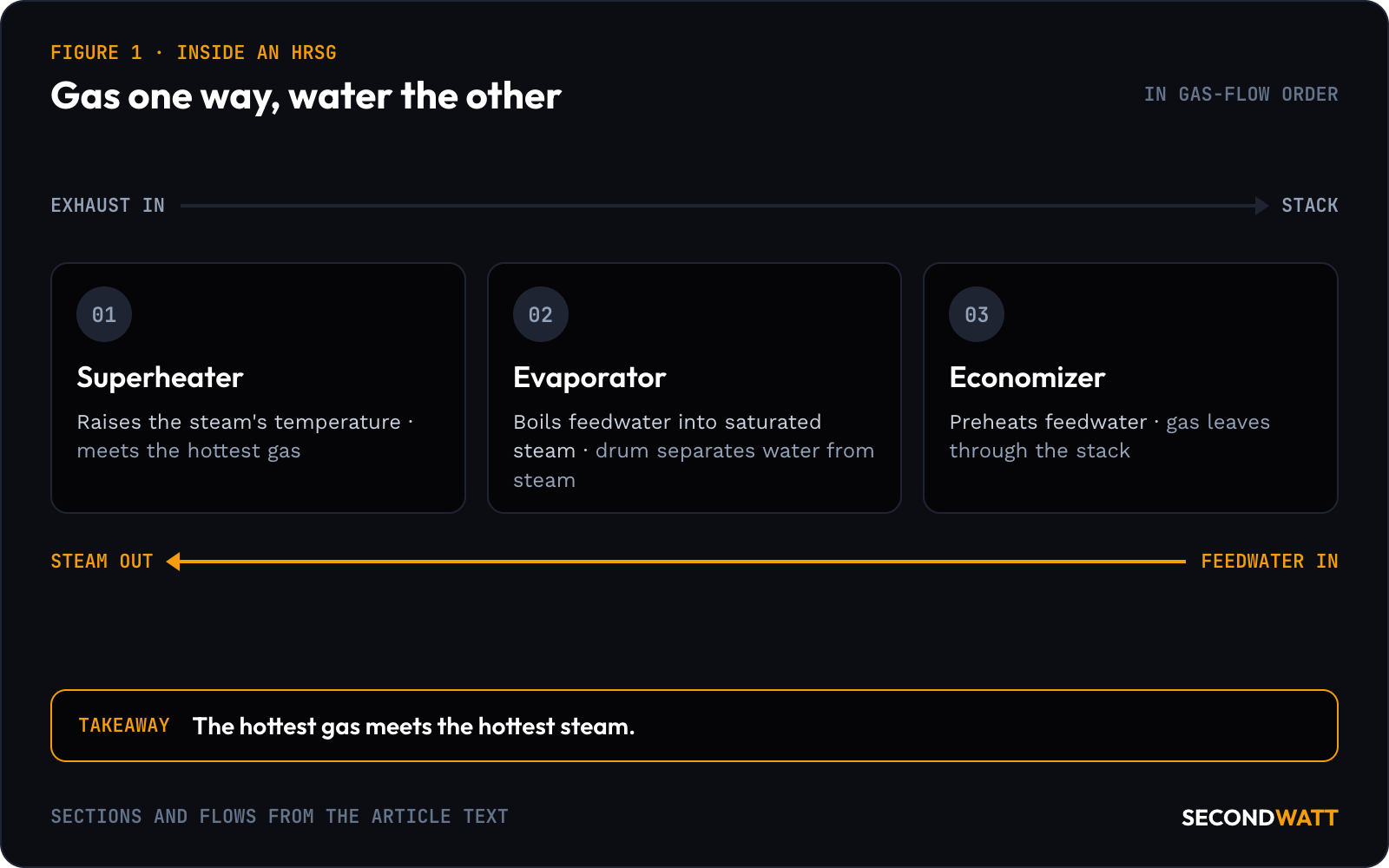
HRSG maker Innovative Steam Technologies (IST) lays out the basics in a 2002 workshop paper. The basic HRSG has three heat exchangers: an economizer, an evaporator and a superheater. Water and steam run inside finned tubes, with the exhaust outside them.
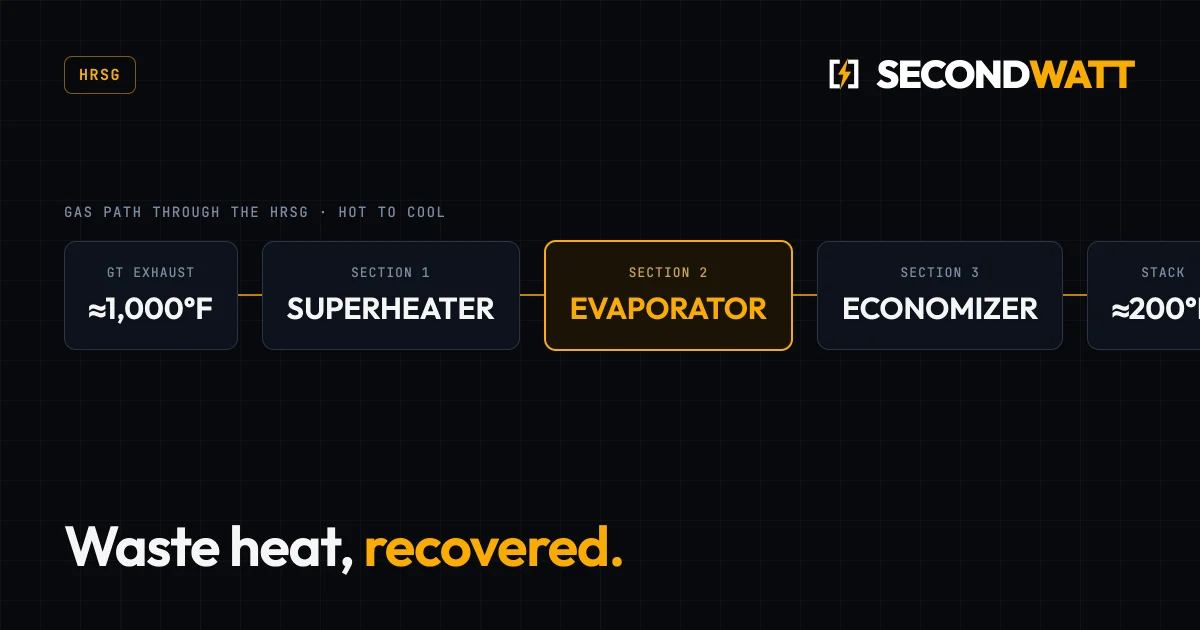
The sections sit in descending fluid temperature along the gas path. Exhaust meets the superheater first, then the evaporator, then the economizer before it leaves through the stack. Feedwater travels the other way, so the hottest gas meets the hottest steam. The design aim is to keep the gas and water temperature lines as nearly parallel as possible.
Each section has one job. The economizer preheats feedwater, the evaporator boils it into saturated steam, and the superheater raises that steam's temperature. In a drum unit, cyclones or screens in the steam drum separate water from steam, and only dry steam goes on to the superheater.
Boiling sets a floor. Gas leaving an evaporator cannot fall below the steam's saturation temperature, so a single pressure level leaves heat in the exhaust. Adding pressure levels, each with a lower saturation temperature, lets the stack temperature drop further, IST explains.
Large combined-cycle units can add a reheater as well. Mitsubishi Power's triple-pressure HRSGs at JERA's Kawasaki station entered operation in 2016. The company says they deliver high-pressure steam at 602°C and 15.4 MPa, with a reheater outlet of 602°C.
HRSG designs and duct firing#
On its HRSG page, GE Vernova calls the horizontal drum HRSG the most popular type: gas flows horizontally across vertical tubes, with natural circulation. Its vertical drum design runs gas vertically across horizontal tubes and suits tight sites and heavy fuel oil.
A once-through steam generator replaces the drum with a continuous tube in which preheating, boiling and superheating occur. IST notes that it needs no steam drums, level controls, blowdown or recirculation systems.
HRSG design choices: what each changes and what to ask, from OEM product pages and IST, EPA and EIA documents#
| Design choice | What it changes | Question for the seller |
|---|---|---|
| Horizontal gas path, drum, natural circulation | Vertical tubes, circulation by density difference; GE Vernova's most popular type | Will it fit the new site, and which module option suits the cranes there? |
| Vertical gas path | Smaller footprint; forced-circulation designs add a circulation pump and drain naturally | What is the circulation pumps' service record? |
| Drum vs once-through | Once-through drops the high-pressure drum and continuous blowdown, leaving no thick-walled drum to heat at start-up; GE Vernova cites more flexibility and daily cycling for its design | How many hot, warm and cold starts has it seen, and which polisher does the design call for? |
| Duct burners | More steam at low turbine load or in summer, at the cost of fuel, maintenance, emissions and fuel efficiency | How many fired hours, and does the air permit cover the burners? |
| Bypass stack and damper | Lets the turbine run simple cycle in a combined-cycle plant | What state are the damper and its seals in? |
| SCR and CO catalyst | Emissions control installed inside the HRSG | When were the catalysts last replaced or tested? |
Duct burners fire extra fuel into the turbine exhaust. Exhaust is typically about 15% oxygen, enough to support that combustion. In Section 3.4.2 of EPA's catalog, firing can lift the gas temperature entering the HRSG to as much as 2,800°F and raise steam output more than fourfold. IST notes that duct firing can easily double the steam of an unfired unit, with design costs such as costlier superheater tube and fin material and a longer inlet duct.
An unfired HRSG responds only to the turbine's exhaust, in EPA's description. Burners let a plant raise steam production at reduced turbine load or across a wider range of ambient conditions, especially in summer. The costs include fuel, maintenance, higher emissions and lower fuel efficiency, according to an EIA article of 15 June 2022.
75% — the share of US combined-cycle capacity, 208 of 278 GW, with duct burners between the gas turbine and steam turbine, as EIA reported in June 2022.
What the HRSG adds to a turbine plant#
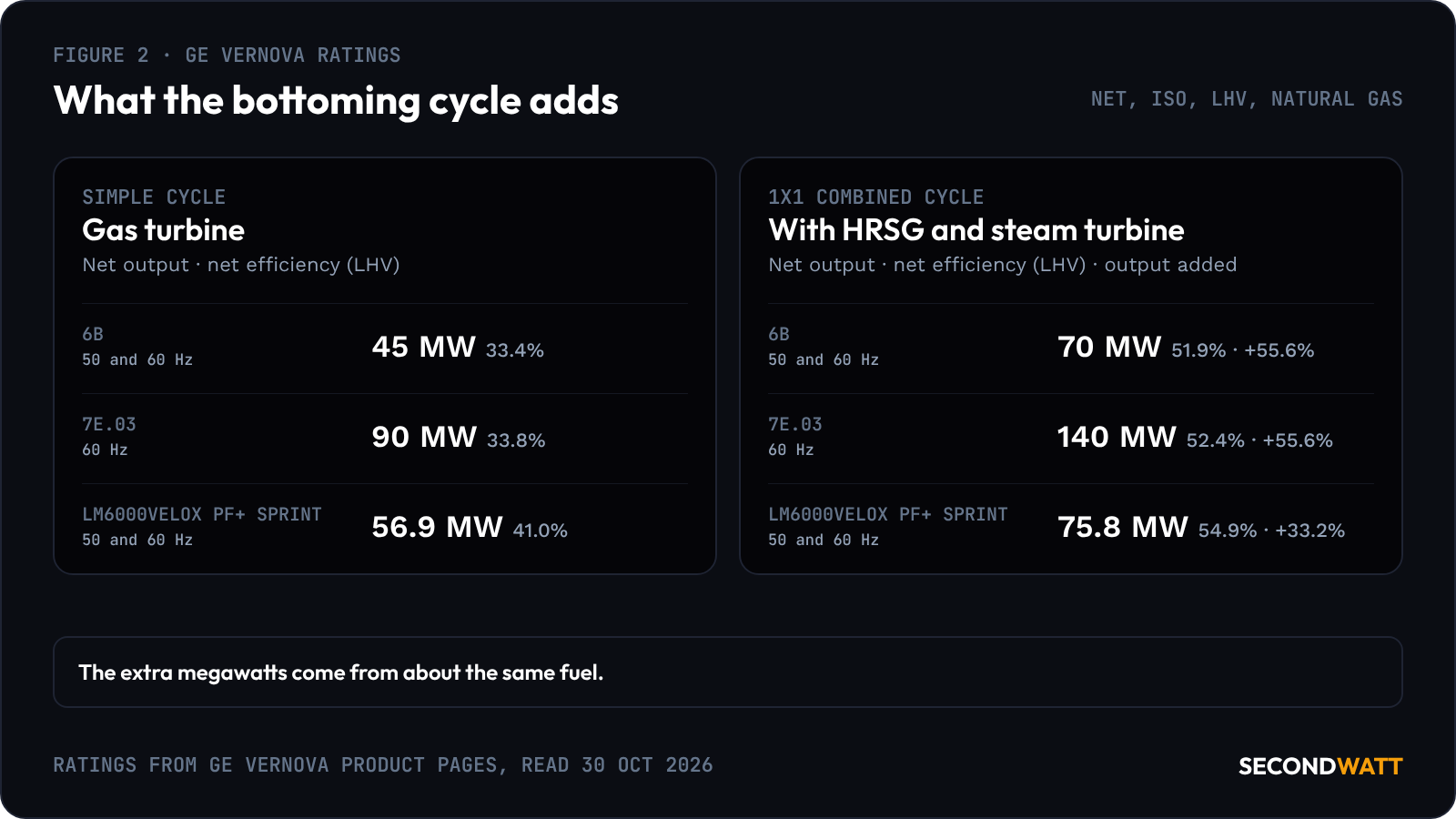
GE Vernova publishes simple-cycle and combined-cycle ratings for each model on one basis: net output, net efficiency and heat rate on LHV, at ISO conditions on natural gas. The combined-cycle column below is the 1x1 rating, one gas turbine with one HRSG and one steam turbine.
Simple-cycle vs 1x1 combined-cycle ratings, net, LHV, ISO, natural gas, from GE Vernova product pages#
| Model and frequency on the page | Basis | Simple cycle | 1x1 combined cycle | Output added |
|---|---|---|---|---|
| 6B, 50 and 60 Hz | ISO net | 45 MW, 33.4%, 10,216 Btu/kWh | 70 MW, 51.9%, 6,578 Btu/kWh | 55.6% |
| 7E.03, 60 Hz | ISO net | 90 MW, 33.8%, 10,107 Btu/kWh | 140 MW, 52.4%, 6,514 Btu/kWh | 55.6% |
| 9E.03, 50 Hz | ISO net | 132 MW, 34.3%, 9,960 Btu/kWh | 205 MW, 53.1%, 6,421 Btu/kWh | 55.3% |
| LM6000VELOX PF+ Sprint, 50 and 60 Hz | ISO net | 56.9 MW, 41.0%, 8,328 Btu/kWh | 75.8 MW, 54.9%, 6,218 Btu/kWh | 33.2% |
Each row comes from that model's GE Vernova page: 6B, 7E, 9E and LM6000. The LM6000 ratings include inlet and exhaust losses and exclude balance-of-plant equipment, as its page notes.
The gain is the added output over the simple-cycle rating, within each model:
6B: (70 − 45) ÷ 45 = 55.6%. 7E.03: (140 − 90) ÷ 90 = 55.6%. 9E.03: (205 − 132) ÷ 132 = 55.3%. LM6000VELOX PF+ Sprint: (75.8 − 56.9) ÷ 56.9 = 33.2%.
The extra megawatts come from about the same fuel. Output times heat rate gives the fuel heat input. For the 7E.03, 90 MW × 10,107 Btu/kWh is about 910 MMBtu/h (LHV), and 140 MW net output × 6,514 Btu/kWh is about 912 MMBtu/h. All four models agree within about half a percent.
55.6% — the output a 1x1 combined cycle adds to GE Vernova's 7E.03, from 90 MW to 140 MW net at ISO conditions on natural gas, 60 Hz.
The aeroderivative's smaller gain matches its higher simple-cycle efficiency. The LM6000VELOX PF+ Sprint converts 41.0% of its fuel energy (LHV) to net power in simple cycle, leaving 59.0% unconverted. The 7E.03 leaves 66.2% at 33.8%.
Heat rate also drives fuel cost per MWh. At 6,514 Btu/kWh, the 7E.03 combined cycle burns about 36% less fuel per MWh than the simple-cycle 7E.03 at 10,107 Btu/kWh: 1 − 6,514 ÷ 10,107 = 35.6%. Whether that saving pays for an HRSG and steam turbine is the simple-cycle vs combined-cycle decision.
Cycling, start time and HRSG life#
Rapid starts, frequent shutdowns and part-load running all take a toll on an HRSG. On its HRSG services page, GE Vernova says cycling shortens pressure-part life and can accelerate wear on control valves and desuperheaters. The most common problems it sees behind cycling turbines are fatigue cracks and weld failures on pressure parts, especially high-pressure superheater and reheater headers and manifolds.
EPRI reaches the same place from the tube side. HRSG tube failures are often caused by thermal stress or thermal shock from cyclic operation, or by flow-accelerated corrosion. Many premature failures, EPRI's March 2007 report 1012762 adds, occur along finned tubes or where tubes join the upper or lower headers.
The combined cycle also starts more slowly. GE Vernova's 7E page lists a hot start of 23 minutes for the 7E.03 in simple cycle and 35 minutes in a 1x1 combined cycle, 12 minutes longer. In IST's account, most start-up time goes into heating metal and evaporator water, so forced and natural circulation differ little in cold-start time. IST credits once-through units' faster starts to having no thick-walled pressure vessels or drum water to heat.
GE Vernova's remedy is to reduce the strain range between starts: turn cold starts into warm starts, and control the turbine's temperature ramp rate and peak. GE Vernova's HRSG engineered solutions page adds that keeping metal warm during shutdowns, with steam sparging or a stack damper, helps reduce stress and life consumption.
Design matters too. GE Vernova says its single-row harps at the hot end produce up to three times less stress than multi-row harps. It also says more turbine turndown needs to be evaluated against the potential increase in thermal gradients and fatigue in the HRSG. That trade-off shapes part-load operation on a combined cycle.
Buying a used HRSG#
An HRSG's records are the inputs to any estimate of how much life its pressure parts have used. GE Vernova assesses that life by counting hot, warm and cold starts since commercial operation and yearly base-load and part-load hours. It then calculates stresses on critical parts such as superheater and reheater headers.
Chemistry is the other half. Water and steam cycle chemistry and turbine cycling are the most common contributors to HRSG waterside failures, in GE Vernova's experience. On GE Vernova's HRSG site services page, a visual inspection is typically annual. A detailed one usually runs alongside a major turbine outage, which typically comes every four to five years.
Flow-accelerated corrosion deserves its own line in the review. EPRI identifies it as a main corrosion mechanism in HRSG metallurgy and a safety concern. In a 2015 EPRI success story, LG&E and KU upgraded low-pressure and kettle boiler sections of their first HRSG from carbon steel to P11, which loses metal 34 times more slowly. Make-up water quality ties into the plant's water budget.
Records to request for a used HRSG, from GE Vernova service pages, EPRI, and National Board and ASME pages#
| Record | What it shows | Who issues it |
|---|---|---|
| Start and load history | Hot, warm and cold starts; base-load and part-load hours | Plant operator, or a life-monitoring system |
| Annual and major inspection reports | Repair scope found at each outage | OEM or inspection contractor |
| Remaining-life and metallurgical assessments | Remaining serviceable life of steam tubing; dissimilar metal weld condition | OEM or engineering lab |
| Flow-accelerated corrosion monitoring | Where FAC has been found and any alloy upgrades | Plant operator or contractor |
| Water chemistry logs | Cycle chemistry held over the unit's life | Plant operator |
| ASME Certification Mark and designator stamped on the unit | Built in accordance with the applicable ASME code section | Applied by the ASME certificate holder |
| ASME manufacturer's data reports and National Board number | Construction to the ASME Code, inspected by a National Board Commissioned Inspector | Original manufacturer; registered with the National Board |
| Repair and alteration records | Work done on pressure parts after construction | Repair organization, such as an R certificate holder |
National Board registration indicates an item was built to the ASME Boiler and Pressure Vessel Code and inspected by a National Board Commissioned Inspector. Copies of manufacturers' data reports can be ordered from the National Board with the original manufacturer's name and the National Board number.
The stamp on the unit is the other code record. ASME's certification page says products stamped with the ASME Certification Mark by ASME certificate holders are in accordance with the applicable code section. For Section I, the S designator covers power boilers and A their assembly.
Moving an HRSG#
How an HRSG was built shapes how it can move. GE Vernova offers harp bundles, modules, C-frames and fully assembled units, matched to crane availability, water access and site labor costs. Mitsubishi Power lists harp, block and modular construction methods.
Size changes the job. In IST's 2002 description, integral-drum HRSGs are supplied for gas turbines with output of about 50 MW and lower, and the boiler bank can ship as one piece. Above 50 MW, a separate drum typically goes to site and is connected in the field. Their supply prices are lower, but erection costs are much higher because of the interconnecting piping.
The turbine behind it matters too. If a turbine upgrade puts more energy into the HRSG, modifications may be needed to stay compliant with the boiler code and local regulations. GE Vernova's engineered solutions page names feedwater control valves, desuperheaters and safety valves as the parts that typically change.
The National Board Inspection Code (NBIC) sets rules for installing, inspecting, repairing and altering inservice pressure equipment; its 2025 edition is current. Its four parts cover installation, inspection, repairs and alterations, and pressure relief devices. The National Board says most US and Canadian jurisdictions have adopted the NBIC into law.
The National Board's R Certificate of Authorization covers the repair and alteration of boilers, pressure vessels and other pressure-retaining items. Holders must keep an inspection agreement with an Authorized Inspection Agency. If the move involves repairs or alterations to pressure parts, ask whether the contractor holds one. The turbine side of the move is in the relocation scope guide.
FAQ: heat recovery steam generators#
Can an HRSG be added to an existing simple-cycle turbine?#
Yes. Kawasaki Heavy Industries, for one, offers "add-on" conversions that add an HRSG and a steam turbine generator to open-cycle stations. Its references, listed on its add-on page, include two GE Frame 9E units converted at Gelugor, Malaysia.
Does an HRSG need a steam turbine?#
No. Its steam can serve an industrial process instead. GE Vernova says the 6B's exhaust, 289 MMBtu/h at 549°C, can raise steam up to 110 bar for industrial use without supplementary firing. Its 7E case study at Air Liquide's Bayport site lists 300 MW of electricity and more than 1,300 tons of steam per hour.
What happens to the HRSG if the gas turbine trips?#
It depends on whether the HRSG has fresh-air firing. Where steam is critical, a forced-draft fan can feed air to the duct burners after a trip. IST puts an automatic switchover at about 60 seconds, against up to five minutes by hand.
How long does an HRSG last?#
It depends on duty. On its HRSG upgrades page, GE Vernova puts the typical design life of HRSG pressure parts at 25 to 30 years. Operating outside the original specification, especially with cycling, uses that life faster.
Is an HRSG regulated as a boiler?#
ASME's power boiler code covers it. ASME's 2019 BPVC brochure describes Section I, Rules for Construction of Power Boilers, as providing "requirements for all methods of construction" of power, electric and miniature boilers and of several other types, heat recovery steam generators among them, "to be used in stationary service." The same brochure says the code has been incorporated into the laws of state and local US jurisdictions and all Canadian provinces. The current edition of Section I is 2025.
Sourcing an HRSG or a bottoming cycle#
SecondWatt publishes equipment research and helps buyers source power equipment; it earns a fee when a sale it arranges closes. Buyers weighing a bottoming cycle can request equipment with the turbine model, steam conditions and records they need. Owners selling a turbine with its HRSG can start at sell gas turbines.