Transformer lead times are long because demand rose faster than factories, electrical steel supply and skilled labor could follow. Distribution transformers have eased: a two-year wait in 2024 fell to an estimated 30 weeks by Q2 2025, in Wood Mackenzie figures reported by CRS. Pad-mounts were still lengthening in mid-2025, and large substation and generator step-up (GSU) transformers still take years.
For a data center buyer, the practical answer is to plan the energization schedule around the transformer. Fix its specification early, keep it close to a standard design, and plan a bridge unit if the permanent one cannot arrive in time.
Key Takeaways
- The class sets the wait. GSUs averaged 144 weeks in Wood Mackenzie's Q2 2025 survey, as POWER reported it; distribution units took up to two years in 2024, NREL found.
- Demand outran steel, labor and factory slots. Grain-oriented electrical steel, scarce skilled workers and fixed build slots limit supply while demand has climbed since 2019.
- New plants are dated announcements. Hitachi Energy, Siemens Energy, Prolec GE and Virginia Transformer announced US capacity; a later report put Siemens Energy's first production a year later.
- Standard specifications can shorten factory time. Simpler connections, taps and arrangements could cut cycle time 5–8%, Prolec GE estimates; approved component alternates improved its utility lead times.
- A bridge unit is judged on its records. Ask for its manufacture date and PCB result, in-service gas trend, factory test report and nameplate fit before energizing it.
Where transformer lead times stand#
Each row keeps its publisher's measure: an average, a range, a maximum or an estimate. The weeks column converts at 52 weeks a year so the rows share one unit; compare rows only on the same measure.
Published transformer lead times by class (publisher, date, basis; weeks calculated)#
| Class and scope | Publisher (date) | Basis as published | Lead time | Weeks (calculated) |
|---|---|---|---|---|
| Distribution | DOE Assistant Secretary, Office of Electricity (webinar, 5 Mar 2026) | Lead time, 2019 and 2024 | 3–6 months in 2019; 1–2 years or longer in 2024 | 13–26; 52–104+ |
| Distribution | NREL (Feb 2024) | Lead times utilities report, upper end | Up to 2 years, a fourfold rise on pre-2022 | Up to 104 |
| Distribution | CRS report R48933 (23 Apr 2026), reporting Wood Mackenzie (Jul 2025) | Wait time, estimate | 30 weeks by Q2 2025 | 30 |
| Large power, 100 MVA and above | DOE report to Congress (Jul 2024) | Commonly quoted; maximum | 36 months; up to 60 months | 156; 260 |
| Large substation power and GSU | Wood Mackenzie (2 Apr 2024) | Range | 80–210 weeks | 80–210 |
| Large GSU and power | Wood Mackenzie (28 Oct 2024) | Longest average | Close to three years | About 156 |
| Large transformers for substations and generators | DOE Assistant Secretary, Office of Electricity (webinar, 5 Mar 2026) | Upper range, growing | Growing from three to as much as four years | 156–208 |
| Power transformers | POWER (2 Jan 2026), reporting Wood Mackenzie's Q2 2025 survey | Average | 128 weeks | 128 |
| GSU | POWER (2 Jan 2026), reporting Wood Mackenzie's Q2 2025 survey | Average | 144 weeks | 144 |
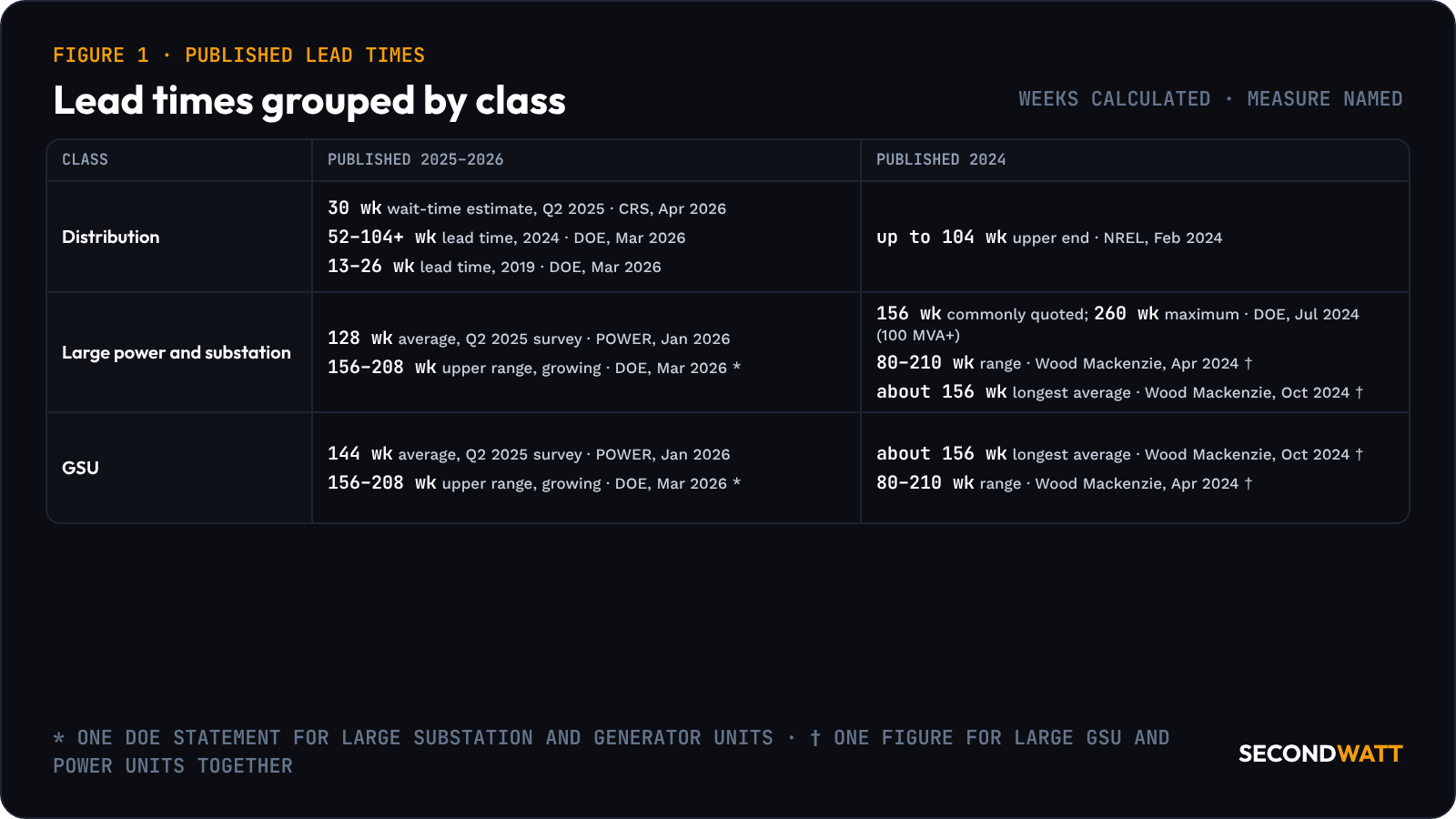
Every row leaves the start point open, so a quoted lead time may run from order or from drawing approval.
DOE's July 2024 report to Congress says that before the COVID-19 pandemic, a large transformer could be ordered with a lead time of less than a year.
Why the transformer shortage stretched lead times#
Demand rose first, and faster for power transformers than for distribution units, on Wood Mackenzie's August 2025 estimate. NREL's February 2024 report traces expected distribution demand to electrification, renewable growth, aging equipment, more severe weather and utility reliability spending.
116% — the rise in US power transformer demand since 2019, against 41% for distribution transformers, in Wood Mackenzie's August 2025 estimate.
Materials are the first supply limit. Grain-oriented electrical steel (GOES) is the core material, and its domestic production "is a major weak link in the LPT supply chain". DOE reached that view in 2022 and repeated it in its July 2024 report on large power transformers (LPTs). Most GOES used in US LPT manufacture is not produced domestically, and NREL lists GOES, aluminum and copper shortages among the causes for distribution units.
Labor is the second. DOE's July 2024 report cites a 2020 Commerce Department survey of large-transformer component makers. In it, 89% of respondents reported difficulty finding qualified or experienced workers. They named welding, coil winding and transformer testing as training needs.
Factory capacity is the third. A plant has a fixed number of build slots, each usable for a large unit, a smaller transformer or a core refurbishment. Capacity grows mainly through new facilities, which take one to three years to build. DOE's July 2024 report adds that winding machines or core tables can take one to two years to obtain.
New factories and the DOE rule in 2026#
Factories are being added on dated schedules. By October 2024, Wood Mackenzie counted 25 transmission and distribution equipment makers that had announced at least 50 new production facilities and expansions worldwide. About half of the investment was aimed at the US market. That count covers grid equipment in general; the table below lists US transformer plants.
Announced US transformer factory additions (company or state statements, with dates)#
| Company | Announced | What was announced | Timing stated |
|---|---|---|---|
| Siemens Energy | 14 Feb 2024 | First Siemens Energy transformer plant in the US, Charlotte, North Carolina | Release: first transformers "early 2026". Later update: production expected early 2027 (POWER, Jan 2026) |
| Prolec GE | 14 May 2025 | New medium power transformer line in Goldsboro, North Carolina, adding a projected 200 units a year | Plans to double Goldsboro capacity by 2030 (company statement) |
| Hitachi Energy | 4 Sep 2025 | New large power transformer facility in South Boston, Virginia | Not stated in the release |
| Virginia Transformer, announced by the Georgia governor's office | 20 Nov 2025 | Expansion of its Rincon, Georgia plant, which builds 30–500 MVA units at up to 525 kV | Construction expected to begin January 2026 (release of 20 Nov 2025) |
Each is a capacity statement by the company or its state host; delivery dates come only from a supplier's quote. Start dates also move, as the later Siemens Energy update shows.
The DOE efficiency standards for distribution transformers are a final US rule. The rule, 89 FR 29834, was published on 22 April 2024 and took effect on 8 July 2024. It requires compliance for units manufactured on or after 23 April 2029. The efficiency tables in 10 CFR 431.196 are keyed to the manufacture date. A unit built earlier is held to the table for its own build date.
Coverage follows the definition in 10 CFR 431.192, which has listed exclusions. It covers units with an input of 34.5 kV or less, an output of 600 V or less and a 60 Hz rating: 10–5,000 kVA liquid-immersed or 15–5,000 kVA dry-type. By that test, a 2,500 kVA liquid-immersed pad-mount feeding 480 V from a 13.8 kV line at 60 Hz is covered unless an exclusion applies. A substation or GSU unit with an output above 600 V is outside it.
On 15 June 2026 DOE published a request for information on how the 2029 standards interact with domestic manufacturing capacity and supply chain resilience; comments closed on 15 July 2026. It asks for data on lead times, order backlogs and supplier qualification timelines, and whether the standards cause special hardship, including redesign to comply by 2029. A request for information only gathers data, and the compliance date stands as of 29 October 2026.
The request follows a 20 April 2026 Presidential Determination under the Defense Production Act. It found grid infrastructure supply chains essential to national defense and names transformers and electrical core steel as covered resources.
Lead time by class and specification#
Large units take longest because each is designed for its site. In DOE's July 2024 report, LPTs are usually custom-built, with site-specific voltages and with impedance and safety equipment that vary by jurisdiction. Impedance is especially hard to standardize. Large GSU and power transformers "need to be custom designed to project requirements", in Wood Mackenzie's October 2024 analysis.
Distribution units suffer from variety. Ten design attributes, including system voltage, winding configuration and kVA rating, yield about 80,000 possible configurations, an Oak Ridge National Laboratory speaker told a March 2026 DOE webinar. That spread "creates a manufacturing quagmire that is clearly resulting in long lead times", the head of DOE's Office of Electricity said there.
Components set part of the date. Special-purpose lightning arresters, secondary breakers, fuses, dual-voltage and low-break switches were still causing lead-time problems in March 2026, in Prolec GE's account at the same webinar. Simpler voltage connections, taps and arrangements, and single rather than dual voltage, could cut cycle time by 5–8%, by Prolec GE's estimate.
Testing needs factory floor too. DOE's July 2024 report notes that large-transformer plants build smaller substation and distribution units in the same facilities. More test space could ease manufacturing bottlenecks, it adds.
What buyers can do#
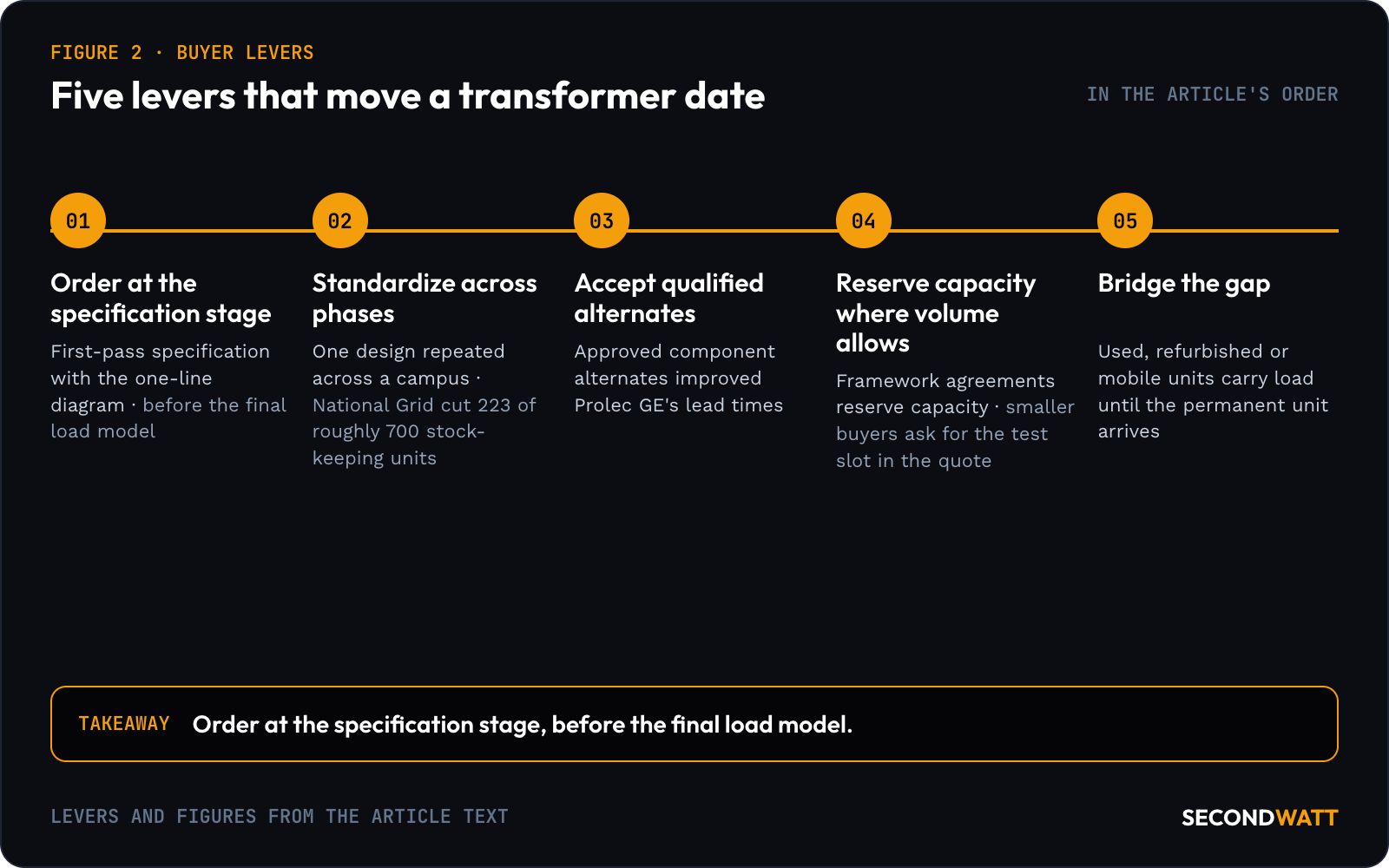
Five levers move a transformer date, in roughly the order a project meets them.
Order at the specification stage: utilities now treat early transformer and switchgear procurement as a competitive lever, and EPC firms report locking in equipment earlier than ever, in POWER's January 2026 reporting. Release a first-pass specification with the one-line diagram, before the final load model. The transformer sizing guide covers the load math, and the GSU specification guide covers the step-up unit for on-site generation. The turbine or engine behind a GSU runs on its own order calendar, set out in the turbine backlog report.
Standardize across phases: one design repeated across a campus leaves the factory fewer variants to build. Utilities "must embrace standardization to unlock manufacturing efficiencies", a Wood Mackenzie analyst said in August 2025. On the factory side, fewer machine changeovers raise productivity, a WEG speaker told the March 2026 DOE webinar.
32% — the share of its roughly 700 distribution transformer stock-keeping units that National Grid had cut by March 2026, 223 in all, as it told the same webinar.
Accept qualified alternates. A DOE working group compiled an interchangeability matrix of critical components and alternative manufacturers. At Prolec GE, large utility customers approved a wider variety of certain components, and its lead times improved.
Reserve capacity where volume allows. Hitachi Energy's July 2025 framework agreement with the German utility E.ON reserves manufacturing capacity for power and distribution transformers. That is a long-term, utility-scale deal; a buyer of a few units can still ask for the factory test slot in the quote.
Bridge the gap. Used, refurbished and mobile units can carry load until the permanent unit arrives; the next section sets out the checks. The transformers hub lists the classes, from three-phase pad-mounts to liquid-filled substation units and GSUs.
Used, refurbished and mobile units as a bridge#
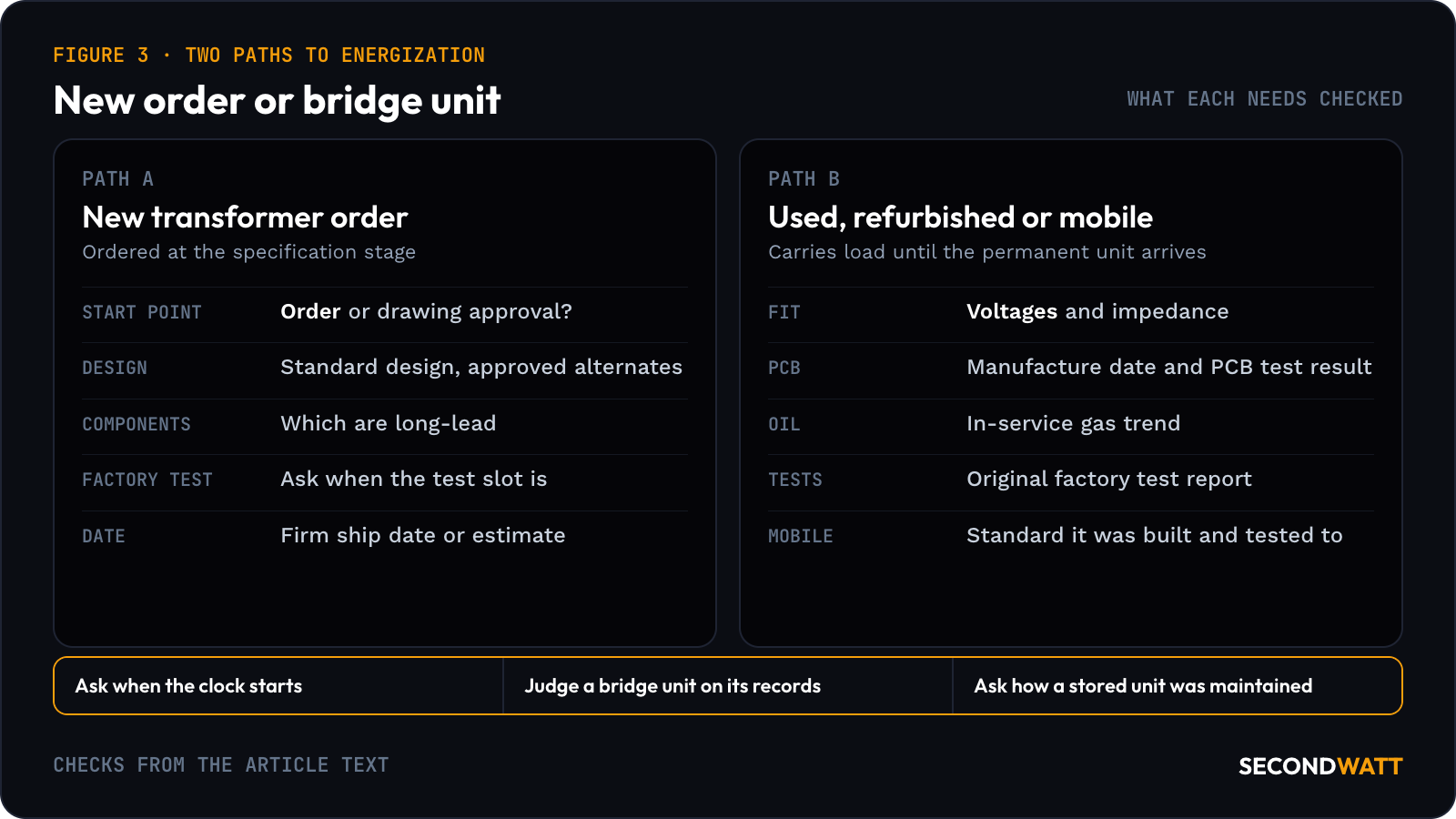
Fit comes first. Transformers with the same high- and low-side voltages but different impedances may not be interchangeable, DOE's July 2024 report notes. The used pad-mount compatibility checklist sets out the nameplate, connection and impedance review.
PCB status is a records question governed by a US EPA rule, 40 CFR 761.2. Mineral-oil equipment made before 2 July 1979 without an established PCB concentration must be assumed PCB-contaminated, at 50 to under 500 ppm. Equipment made after that date may be assumed non-PCB, and an unknown date means the contaminated assumption applies. Ask for the manufacture date and a PCB test result.
Oil history shows condition: the Bureau of Reclamation's FIST 3-30, from October 2000, calls dissolved gas analysis (DGA) "by far the most important tool for determining the health of a transformer". Each result must be compared with earlier ones to see trends, and a sample drawn after the unit was de-energized and cooled is unreliable. A stored unit's useful record is the trend from its service years. IEEE C57.104-2019 is the active guide for interpreting those gases in mineral-oil units.
Ask for the original factory test report for the serial number, made to the test-code edition in force when the unit was built. The test code, IEEE C57.12.90, covers ratio, polarity, losses, impedance, dielectric and temperature tests. Its current edition is 2026.
Mobile substations serve "interim grid connections and temporary power supplies", in Hitachi Energy's own description on its mobile substations page. IEEE C57.12.00-2021, the general-requirements standard for liquid-immersed units, lists mobile transformers among its exclusions. Ask which standard a mobile unit was built and tested to. The WEG and Delta Star mobile substation pages give the families.
Questions to put to a transformer supplier#
Contract remedies for a missed date belong in the purchase agreement and with counsel.
Supplier questions on a transformer quote and why each matters#
| Question | Why it matters |
|---|---|
| Is the date a firm ship date or an estimate, and does it run from order or from drawing approval? | Published lead times leave the start point unstated |
| How long will drawing approval take on each side? | If the clock starts at approval, review time adds directly to delivery |
| When is the factory test slot, and can we witness it? | Test floor is shared with other work (see the specification section) |
| Which components are long-lead, and which alternates will you accept? | Several special components were still lagging in March 2026 |
| Which specification items add time, and what would a standard design save? | Simpler designs can shorten cycle time (see the specification section) |
| How long is the quote valid, and what would move the date? | Sets how long the offer, including its date, stands |
FAQ: transformer lead times#
How long does a pad-mount transformer take to deliver?#
Ask for a quoted date on the three-phase pad-mount line itself; the pad-mount transformer guide covers the equipment. POWER reported on 2 January 2026 that pad-mount lead times rose quarter-on-quarter in Q2 2025, even as distribution availability improved overall. Distribution figures also blend unlike units. Most are small split-phase pole-mounts under 50 kVA by count, while larger three-phase pad-mounts carry more of the capacity, a National Laboratory of the Rockies (formerly NREL) researcher told the March 2026 DOE webinar.
Does the DOE efficiency rule affect lead times?#
DOE set the 2024 rule to limit that risk. It adopted levels expected to need significantly less amorphous material than proposed, and gave two more years to comply. That choice allows manufacturers "considerable flexibility to meet standards without near-term supply chain impacts", in the words of DOE's April 2024 rule, 89 FR 29834.
Can the utility supply the transformer instead?#
Sometimes; it depends on the service voltage and the utility's rules, so ask the utility early which side owns each transformer. Under MidAmerican Energy's Electric Service Manual (effective 1 September 2023), a new primary-metered customer must furnish, own, maintain and operate all transformers beyond the first point of attachment. MidAmerican serves parts of Iowa, Illinois, South Dakota and Nebraska. Large commercial and industrial customers own about 20% of US distribution transformers by count, on historical estimates NREL cites.
Are used transformers a safe bridge?#
They can be when the records hold up and the unit was maintained in storage. DOE's July 2024 report says spare large transformers "have many of the maintenance requirements of in-service transformers". Ask how a stored unit was maintained, and ask for its maintenance log. The data center transformers guide covers where each class sits on a campus.
Planning around the wait#
SecondWatt publishes equipment research and helps buyers source power equipment; it earns a fee when a sale it arranges closes. If you have an energization date to protect, send the class, kVA or MVA rating, voltages and that date through a request for quote, for a new, used or mobile unit. If you own surplus transformers with their test reports and oil history, the seller page sets out how SecondWatt works with owners.