Baker Hughes Frame 5/2E (MS5002E) Gas Turbines for Sale
Manufacturer: Baker Hughes
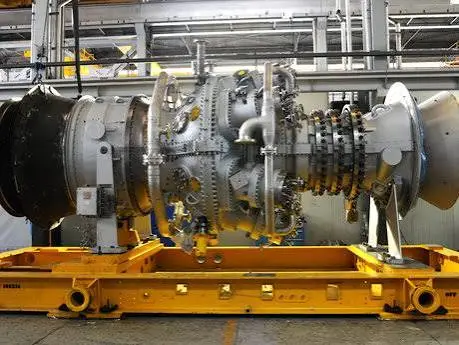
32.8 MWe two-shaft industrial gas turbine at 35.8% with a DLN2.5 combustor rated 9-15 ppm NOx; not the single-shaft MS5001 Frame 5.
This model is part of SecondWatt’s gas turbine research catalogue. Specifications and price observations are included where supported by sources. Equipment availability and commercial terms require confirmation.
Baker Hughes Frame 5/2E (MS5002E) gas turbine: 32.8 MWe at 35.8%, two-shaft design, DLN2.5 at 9-15 ppm NOx, inspection intervals and package data.
The Frame 5/2E (MS5002E) is Baker Hughes' two-shaft industrial gas turbine rated 32.8 MWe and 35.8% at the generator terminals for 50 or 60 Hz power generation and 33.8 MW (45,300 hp) at 37% for mechanical drive, at ISO conditions. Baker Hughes describes its component lineage: an axial compressor scaled from the GE10, a DLN2 F-class combustor run at a de-rated firing temperature, a low-pressure turbine from the PGT25+ and a high-pressure turbine from the Frame 5/2D.
The 11-stage compressor reaches a 17.3 pressure ratio. A two-stage high-pressure turbine drives the compressor, and a two-stage low-pressure power turbine drives the load through a gearbox at 1,500 or 1,800 rpm for power generation. The DLN2.5 combustion system has six cans and is rated 9-15 ppm NOx. Hot-gas-path and major inspections fall at 24,000 and 48,000 hours, or 32,000 and 64,000 hours on an extended plan with a lower firing temperature.
The name causes confusion. The single-shaft MS5001 family, including Baker Hughes' Frame 5/1PA, and the mechanical-drive Frame 5/2C and 5/2D are different machines; the 5/2E is the generator-capable two-shaft design. Baker Hughes reports more than 60 units sold, 46 installed and more than 800,000 operating hours.
Why it matters
The Frame 5/2E is the most efficient Frame machine Baker Hughes publishes for power generation, at 35.8% at the generator terminals, with dry low NOx at 9-15 ppm and no water injection. Assessment: it competes on block size with 33-38 MW aeroderivatives such as the LM2500+G4 and SGT-A35, trading a smaller installed base for heavy-duty construction and longer inspection intervals than Baker Hughes' LM2500 ratings.
Who buys it
Industrial operators with combined heat and power loads, refineries, petrochemical and fertilizer plants, pipeline and gas-storage operators using the mechanical-drive version, and power developers looking for a 33 MW industrial frame with dry low NOx. Baker Hughes cites a European combined heat and power plant producing 30 MWe and 50 t/h of steam and more than 150 MW delivered in Asia-Pacific fertilizer cogeneration.
Role in the data center
Assessment: a 33 MW behind-the-meter block, about five units per 150 MW phase plus N+1 spares, with dry low NOx and a 518 C exhaust for combined-cycle or cooling steam. Baker Hughes' public data-center orders name the NovaLT16 and Frame 5, not the Frame 5/2E, as of October 2026. Baker Hughes publishes no start-to-load time for the 5/2E.
Key specifications
| Power-generation output, ISO, at generator terminals | 32.8 MWe |
|---|---|
| Power-generation efficiency, ISO | 35.8 % |
| Power-generation heat rate, LHV (calculated from 35.8%) | 9531 Btu/kWh |
| Mechanical-drive shaft output, ISO | 33.8 (45,300) MW (hp) |
| Mechanical-drive efficiency, ISO | 37 % |
| NOx | 9-15 ppm |
| Exhaust temperature | 518 C |
| Power-generation output speed, geared | 1,500 / 1,800 rpm |
| Mechanical-drive speed (overview, 2026) | 5741 rpm |
| Mechanical-drive speed (product page) | 5714 rpm |
| Compressor stages / pressure ratio | 11 / 17.3 stages / ratio |
| Turbine stages, high-pressure + low-pressure | 2 + 2 stages |
| Combustion system | DLN2.5, 6 cans type |
| Hot-gas-path inspection (standard / lower firing temperature) | 24,000 / 32,000 hours |
| Major inspection (standard / lower firing temperature) | 48,000 / 64,000 hours |
| Gas-turbine skid, L x W x H / weight (power generation) | 12.95 x 4.4 x 4.4 m / 96,500 kg m / kg |
| Gearbox and generator skid, L x W x H / weight | 9.0 x 3.5 x 7.5 m / 125,000 kg m / kg |
| Fuel envelope: methane / ethane or propane / hydrogen / nitrogen equivalent | 70-100 / <=25 / <=5 / <=30 % |
| Combined heat and power reference: power and steam | 30 MWe and 50 t/h MWe / t/h steam |
| Installed base | 60+ sold, 46 installed, 800,000+ operating hours units / hours |
Technical summary
Baker Hughes rates the Frame 5/2E at 32.8 MWe and 35.8% at the generator terminals and 33.8 MW (45,300 hp) at 37% for mechanical drive, at ISO conditions (natural gas, 15 C, sea level, 60% relative humidity, no inlet or exhaust losses, average gearbox and generator efficiency for power generation). NOx is 9-15 ppm and exhaust temperature 518 C. The 11-stage compressor has a 17.3 pressure ratio; the high-pressure and low-pressure turbines each have two stages, and the DLN2.5 system six cans. Power-generation output speed is 1,500 or 1,800 rpm through the gearbox. The gas-turbine skid measures 12.95 x 4.4 x 4.4 m and 96,500 kg and the gearbox and generator skid 9.0 x 3.5 x 7.5 m and 125,000 kg. Heat rate calculated from 35.8% is about 9,531 Btu/kWh LHV.
Major variations
Baker Hughes sells the Frame 5/2E in power-generation (32.8 MWe, geared for 50 or 60 Hz) and mechanical-drive (33.8 MW shaft) packages. Two firing-temperature ratings are offered: the standard rating with 24,000 and 48,000-hour inspections and a de-rated firing temperature with 32,000 and 64,000-hour inspections at reduced power. Related Baker Hughes Frame 5 machines are different products: the Frame 5/1PA is the single-shaft MS5001PA (25.5-26.6 MWe), and the Frame 5/2C and 5/2D are two-shaft mechanical-drive turbines with no published generator rating.
Configurations and options
The power-generation package is a gas-turbine skid plus a gearbox-and-generator skid; the mechanical-drive package pairs the gas-turbine skid with a driven-compressor skid. Options that change price or lead time are the extended-interval firing-temperature rating, the NOx level within the 9-15 ppm range, generator frame and voltage, 50 or 60 Hz gearing and heat recovery for combined heat and power.
Compatibility and dependencies
Baker Hughes publishes the fuel envelope as 70-100% methane, up to 25% ethane or propane, up to 5% hydrogen and up to 30% nitrogen equivalent; fuel outside it needs Baker Hughes approval. The gearbox and generator set frequency and voltage. The two skids weigh 96,500 kg and 125,000 kg, which sets lifting and foundation requirements, and the 518 C exhaust suits a heat recovery steam generator.
Planning price band
Modelled planning estimate: $0.60M–$1.76M/MW · $600–$1,760/kW · $19.68M–$57.73M per unit (Frame 5/2E (ISO, generator terminals), 32.8 MW; New OEM; very low confidence; gt-planning-v3, as of 2026-11-03). Private market information available. Not a quote or an observed sale price. New OEM gas turbine generator package, equipment scope. Inclusions and delivery terms vary by offer and are subject to confirmation. Not a project budget: EPC, BOP, installation and financing sit outside this band.
Current heavy-duty frame at 33 MWe priced as new equipment. Private market information available.
What drives the price
Power-generation versus mechanical-drive package; the standard or extended-interval rating; generator, gearbox and voltage selection; heat recovery scope; service agreement terms; the delivery slot; and, for used units, hours, starts, inspection status and whether the unit was built for generator drive.
Lifecycle and maintenance
Baker Hughes rates hot-gas-path inspection at 24,000 hours and major inspection at 48,000 hours on the standard rating, or 32,000 and 64,000 hours with a lower firing temperature and power. Baker Hughes reports more than 60 units sold, 46 installed and more than 800,000 operating hours. Baker Hughes does not publish an MTBF figure for the Frame 5/2E as of October 2026, and with 46 installed units the independent parts and repair market is small; confirm Baker Hughes service support for any offered unit.
Thermal and emissions profile
The DLN2.5 combustion system uses six cans derived from F-class technology at a de-rated firing temperature. Baker Hughes rates NOx at 9-15 ppm in its datasheet and describes single-digit NOx from 50% to 100% load in its product-page text, without water injection. Hydrogen is limited to 5% of the fuel per the published fuel envelope.
Common failure points
- DLN2.5 combustor cans and transition pieces — Cracking, distress or combustion dynamics
- High-pressure turbine stages — Coating loss, oxidation or cracking at the hot-gas-path inspection
- Low-pressure turbine and variable nozzles — Nozzle actuation wear or blade distress
- Load gearbox — Tooth wear, bearing distress or rising vibration
- Generator — Insulation ageing
Frame 5/2E, 5/1PA, 5/2C and 5/2D: identify the machine
- Baker Hughes builds four machines with "Frame 5" in the name. The 5/2E (MS5002E) is a two-shaft turbine rated 32.8 MWe for power generation. The 5/1PA is the single-shaft MS5001PA at 25.5-26.6 MWe. The 5/2C and 5/2D are two-shaft mechanical-drive turbines with no published generator rating.
- Confirm the designation from the nameplate, and confirm a power-generation package rather than a converted compressor driver.
Ratings and inspection plans
- Baker Hughes rates the 5/2E at 32.8 MWe and 35.8% at the generator terminals, ISO conditions, assuming average gearbox and generator efficiency. Request site-corrected output.
- Two inspection plans exist: 24,000 and 48,000 hours at the standard firing temperature, or 32,000 and 64,000 hours at a lower firing temperature and power. Ask which plan an offered rating assumes.
Emissions and fuel
- The DLN2.5 combustor is rated 9-15 ppm NOx without water injection. The published fuel envelope allows up to 5% hydrogen; Baker Hughes states up to 100% hydrogen capability for the NovaLT16. A new US installation falls in the medium band of NSPS Subpart KKKKa (15 ppm at high utilization, 25 ppm at low utilization).
Compare offers on
- Equipment identity — Model and build standard, serial numbers, generator and gearbox identity, controls platform and packager.
- Rating basis — ISO rating at generator terminals versus site-corrected output at the project's ambient, elevation and inlet and exhaust losses.
- Combustion and fuel — DLE NOx level, gas-only or dual fuel, fuel composition limits and the hydrogen case the combustor is guaranteed for.
- Included scope — Turbine and auxiliary skid, generator and gearbox, filter house and ventilation, controls, fuel system, enclosure and spares.
- Service and delivery — Service agreement, warranty holder, factory slot, test scope and delivery terms.
- Costs outside the offer — Step-up transformer, switchgear, interconnection, gas compression, heat recovery, civil works, permits and commissioning.
Seller checklist
- Nameplate photographs for turbine, gearbox and generator with model, build standard and serial numbers
- Operating hours, fired starts and trip history
- Hot-gas-path and major inspection reports with dates and findings
- Borescope reports and images
- Combustor configuration, fuel-system scope and any emissions test data
- Controls platform, software licences and drawings
- Generator test results and gearbox inspection records
- Service agreement status and transferability
- Preservation and storage records for stored units
- Included and excluded scope list with spares inventory
What sets the value
Value rests on records: MS5002E nameplates and serial numbers, package type, operating hours and starts, hot-gas-path and major inspection reports with the interval plan used, DLN2.5 tuning and emissions tests, gearbox and generator test records, and Baker Hughes service history.
Is the Frame 5/2E the same as a GE Frame 5?
No. The Frame 5/2E (MS5002E) is a two-shaft turbine that Baker Hughes rates at 32.8 MWe. The single-shaft MS5001 family, including Baker Hughes' Frame 5/1PA at 25.5-26.6 MWe, is a different machine, and the Frame 5/2C and 5/2D are mechanical-drive turbines.
What are the Frame 5/2E inspection intervals?
Baker Hughes rates hot-gas-path inspection at 24,000 hours and major inspection at 48,000 hours, or 32,000 and 64,000 hours with a lower firing temperature and power.
How much hydrogen can a Frame 5/2E burn?
Baker Hughes' published fuel envelope allows up to 5% hydrogen, with 70-100% methane, up to 25% ethane or propane and up to 30% nitrogen equivalent.
What should a Frame 5/2E sourcing request include?
Site conditions, required net output and number of units, frequency and voltage, gas composition and pressure, heat recovery needs, operating duty, and target delivery and operating dates.
Inspection checklist
Confirm the MS5002E designation and serial numbers from the nameplates, and that the unit is a power-generation package rather than a mechanical-drive conversion. Obtain operating hours, fired starts, trips and fuel history. Review hot-gas-path and major inspection records against the interval plan the unit runs under. Check the DLN2.5 combustor tuning records and emissions tests. Review gearbox and generator records and vibration trends, and verify controls software and Baker Hughes service support before payment.
Procurement channels
New units come from Baker Hughes. Assessment: with more than 60 units sold and 46 installed per Baker Hughes, used Frame 5/2E units are uncommon, and offers labelled "Frame 5" or "MS5002" on the secondary market are more often MS5001 or mechanical-drive MS5002C/D units, so confirm the designation.
Regional notes
Packages are offered for 50 and 60 Hz through the gearbox and generator. Baker Hughes cites a Russian pipeline application with a -55 C minimum operating ambient. In the United States a new Frame 5/2E falls in the medium band of NSPS Subpart KKKKa (about 313 MMBtu/h LHV at ISO, calculated).
Content owner: Gary Martin, SecondWatt