Westinghouse W251 Gas Turbines for Sale
Manufacturer: Westinghouse
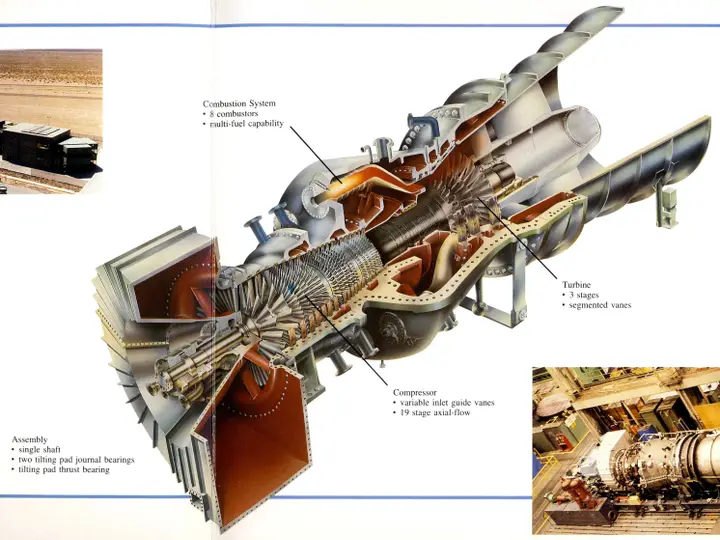
Geared heavy-duty gas turbine first sold in 1967: A-series units near 20 MW, B11 and B12 rated 49.5 MW ISO for 50 or 60 Hz.
This model is part of SecondWatt’s gas turbine research catalogue. Specifications and price observations are included where supported by sources. Equipment availability and commercial terms require confirmation.
Westinghouse W251 gas turbine guide: A- and B-series ratings, 49.5 MW B11/B12 ISO specs, history, OEM support, NSPS rules and used-market price evidence.
The W251 is a single-shaft, axial-flow heavy-duty gas turbine that Westinghouse first sold in 1967. It drives its generator through a main reduction gear, so one engine design serves 50 Hz and 60 Hz systems. Per Forecast International's archived 2002 report, the first three units were ECONOPAC packages for Detroit Edison rated 18.5 MW each, and later development raised the rating to 49.5 MW for the W251B11A (50 Hz) and W251B12A (60 Hz).
The family spans two generations. The A-series (W251 and W251A) sits near 20 MW; the RICHES/UCF Westinghouse archive gives the W251A a nominal 20 MW and describes it as the first W251 with cooled first-stage vanes. The B-series runs from the W251B, listed at a nominal 40,000 kW in Westinghouse's 1983 cogeneration brochure, through the B10 built at Westinghouse Canada in Hamilton, Ontario, to the B12 that Westinghouse Canada announced in 1989. Licensees built the same design as the Fiat (later FiatAvio) TG20 and the Mitsubishi MW251, and Canadian-built units carry the CW251 prefix. Forecast International counted about 410 W251-family machines through 2001 across all builders; the RICHES/UCF archive cites about 230 units sold by Westinghouse.
Westinghouse's power generation business passed to Siemens AG in 1998. EthosEnergy states that it holds the intellectual property and is the OEM for the Fiat TG20/W251/M251 line up to the B8. A listing that says only "W251" or "Westinghouse 251" does not identify the generation on offer; the series suffix on the nameplate determines output, combustor, parts and support.
Why it matters
Assessment: among 40-50 MW heavy-duty frames on the secondary market, the W251's geared drive lets one machine serve 50 or 60 Hz. Forecast International describes the B-series as able to run on a wide range of gaseous and liquid fuels and in dual-fuel mode, and its 514-520 C exhaust suits heat recovery. Against that, its ISO efficiency of about 32.7% (calculated from 11,014 kJ/kWh LHV) trails the 41.0% that GE Vernova publishes for the LM6000VELOX PF+ SPRINT.
Who buys it
Industrial operators with process steam loads, independent power producers, utilities adding or replacing peaking capacity, and power-barge and island-grid operators buy W251 units. Existing W251 owners buy complete units and major assemblies for spares and life extension. Behind-the-meter data-center developers evaluate B-series units where an available 40-50 MW machine matters more than heat rate.
Role in the data center
Assessment: a behind-the-meter block of about 20 MW (A-series) or 41-49.5 MW (B-series) feeding medium-voltage distribution, with several units per campus phase and N+1 sparing across units. An existing W251 can be a route to capacity where new-build slots are distant. The costs are fuel (about 25% more fuel per MWh than an LM6000VELOX PF+ SPRINT on published LHV figures), permitting, and support through EthosEnergy and independent shops. Black-start equipment was an option, not a standard feature, so confirm it per unit.
Key specifications
| ISO output, W251B11A (50 Hz) / W251B12A (60 Hz), continuous, no inlet or exhaust losses (Forecast International 2002) | 49500 kW |
|---|---|
| Heat rate, W251B11A / B12A, ISO (Forecast International 2002) | 11024 kJ/kWh |
| Plant net power, W251B12 ECONOPAC base rating, ISO, natural gas, no injection (Forecast International 2002) | 49.2-49.5 MW |
| Plant heat rate, W251B12 ECONOPAC, LHV (Forecast International 2002) | 11014 kJ/kWh |
| Efficiency, W251B12 ECONOPAC, LHV (calculated from 11,014 kJ/kWh) | 32.7 % |
| Pressure ratio, W251B12 (family range 11:1 to 15.3:1) | 15.3 ratio (x:1) |
| Air mass flow, W251B12 | 174.6 kg/s |
| Exhaust temperature, W251B11A / B12A, ISO (Forecast International 2002) | 514 C |
| Exhaust flow / temperature, W251B12 ECONOPAC (Forecast International 2002) | 175 / 520 kg/s / C |
| Compressor stages, B11/B12 | 18 or 19 axial stages |
| Turbine stages, B11/B12 | 3 axial stages |
| Combustor baskets, B11/B12 | 8 baskets |
| Rotor speed, 19-stage unit | 5425 rpm (approx.) |
| Generator drive speed through main reduction gear | 3,600 (60 Hz) / 3,000 (50 Hz) rpm |
| Engine dimensions, L x W x H | 9.5 x 3.7 x 4.1 m |
| Engine weight | 80 metric tons |
| ECONOPAC package area, B12 | 33.83 x 10.06 x 7.93 m |
| Output, TG20B11/12 built by FiatAvio, ISO (Forecast International 2002) | 49177 kW |
| Output, W251B at sea level, 59 F, natural gas (Westinghouse 1983 brochure; nominal rating 40,000 kW) | 41420 kW |
| Heat rate, W251B, LHV (Westinghouse 1983 brochure) | 10825 Btu/kWh |
| Exhaust flow / temperature, W251B (Westinghouse 1983 brochure) | 1,263,300 / 940 lb/hr / F |
| Net plant power, first W251B12 (Electricity Today, January 1991) | 46.5 MW |
| Net heat rate / exhaust flow / exhaust temperature, W251B12 (Electricity Today, January 1991) | 11,080 / 169 / 523 kJ/kWh / kg/s / C |
| Output, early W251 ECONOPACs for Detroit Edison, 1967 | 18.5 MW |
| Nominal rating, W251A | 20 MW |
Technical summary
Forecast International's archived 2002 report rates the W251B11A (50 Hz) and W251B12A (60 Hz) at 49,500 kW continuous output at ISO conditions with no inlet or exhaust losses on natural gas, at 11,024 kJ/kWh, a 15.3:1 pressure ratio, 174.6 kg/s air flow and 514 C exhaust. The same report gives the B12 ECONOPAC plant base rating as 49.2-49.5 MW net at 11,014 kJ/kWh LHV, with 175 kg/s exhaust flow at 520 C. The B11/B12 has 18 or 19 axial compressor stages, three turbine stages and eight combustor baskets; the rotor turns at about 5,425 rpm and the main gear delivers 3,600 rpm for 60 Hz or 3,000 rpm for 50 Hz. Westinghouse's 1983 brochure lists the earlier W251B at 41,420 kW and 10,825 Btu/kWh LHV at sea level and 59 F. The engine measures about 9.5 x 3.7 x 4.1 m and weighs about 80 metric tons.
Major variations
W251 (1967): first units, 18.5 MW ECONOPACs. W251A: nominal 20 MW, first with cooled first-stage vanes. W251B: available for mechanical drive from 1973; 40,000 kW nominal in the 1983 brochure. W251B8: the configuration Doosan Turbo describes as current, and the upper limit of EthosEnergy's stated OEM scope. W251B9: three units for the Godavari project in India (1996 photograph, RICHES/UCF). W251B10: built at Hamilton from about 1985 to 1998; 41.2-41.4 MW for early machines per Forecast International. W251B11A (50 Hz) and B12A (60 Hz): 49.5 MW; the first B12 entered service in March 1991 at 46.5 MW. Licensee names: TG20 (Fiat/FiatAvio), MW251 and MW252 (Mitsubishi), CW251 (Westinghouse Canada). AA and AG suffixes also appear in secondary-market listings for 1970s A-series ECONO-PAC units; confirm their ratings from the nameplate.
Configurations and options
The standard Westinghouse scope was the ECONOPAC: a factory-assembled, skid-mounted gas turbine, generator and exciter with starting package, mechanical and electrical auxiliary skids, inlet filtration, exhaust stack and silencer, and enclosures. ECONOPACs were offered in simple cycle, in PACE combined-cycle plants and on power barges, including 48 MW single-B10 and 96 MW twin-B10 barges built at Sabah Shipyards. Options listed by Forecast International include dual-fuel systems, water or steam injection, a dry low NOx combustor, cooling packages and black-start capability. B11/B12 units shipped with Westinghouse Powerlogic II controls, and PLC-based control retrofits are offered for older units.
Compatibility and dependencies
The main reduction gear and generator set the output frequency: 3,000 rpm for 50 Hz or 3,600 rpm for 60 Hz. Confirm generator voltage, step-up transformer and protection against the receiving system. Fuel gas pressure and composition must match the fuel system and combustor; liquid fuel needs forwarding equipment. Water or steam injection needs treated water, while a dry low NOx combustor avoids it. A complete B12 ECONOPAC covers about 33.8 x 10.1 x 7.9 m, and the engine alone weighs about 80 metric tons, which sets crane, transport and foundation requirements. Older mechanical, hydraulic or pneumatic fuel regulation may need a controls retrofit before return to service.
Planning price band
Modelled planning estimate: $0.11M–$0.55M/MW · $105–$550/kW · $5.2M–$27.23M per unit (W251B12A (60 Hz, ISO continuous), 49.5 MW; Used or refurbished, serviceable; very low confidence; gt-planning-v3, as of 2026-11-03). Not a quote or an observed sale price. Gas turbine generator-set package. Included auxiliaries, controls, emissions equipment (SCR), warranty and delivery terms vary by unit and are subject to confirmation. Not a project budget: BOP, installation and financing sit outside this band.
Legacy frame, secondary market only.
What drives the price
Series and rating (a 20 MW A-series set and a 49.5 MW B-series set are different purchases); hours and starts since the last hot-gas-path and major inspection; rotor life consumed; package completeness (gear, generator, controls, switchgear, auxiliaries, enclosures); controls and fuel-system condition, including any pending retrofit; whether the unit is assembled and tested or dismantled and stored; frequency and voltage match; and dismantling, transport and commissioning scope.
Lifecycle and maintenance
Siemens Energy and EthosEnergy do not publish W251 inspection intervals or MTBF figures on their public pages as of October 2026; intervals come from the unit's maintenance manual and service agreement. Westinghouse's 1983 brochure lists the maintenance features: horizontally split casings, individually removable compressor and turbine blading, combustors, transitions and first-stage vanes removable with the cover in place, and borescope access. A 48 MW W251B11/12 barge unit offered in December 2018 had about 30,000 operating hours and a completed full hot-gas-path inspection, per Marine Log. EthosEnergy states that it manufactures and repairs combustion, hot gas path, compressor and rotor parts for mature Westinghouse units and offers rotor end-of-life solutions.
Thermal and emissions profile
The B11/B12 combustor uses eight baskets with dual nozzles and twin igniters. Forecast International records provision for water or steam injection and an available dry low NOx combustor, and notes that dry low NOx let operators avoid a water treatment plant. Westinghouse's successors do not publish NOx values for W251 combustors as of October 2026, so the installed combustor, injection system, fuel and tuning of the specific unit set its emissions. A January 1991 Electricity Today article described the B12 as able to burn low-Btu gas, residual liquid fuels and most crude oils without derating.
Common failure points
- Compressor blades and diaphragms — Fouling, pitting, erosion, impact damage and diaphragm cracking
- Turbine rows 1-4 vanes, blades and ring segments — Oxidation, coating loss, cracking, impact damage and rubs
- Combustion baskets and transition pieces — Cracking, distortion and abnormal exhaust temperature spread
- Rotor — Life consumed against design limits on units of this age
- Controls and fuel regulation — Obsolete mechanical, hydraulic or pneumatic fuel regulators and unsupported control hardware
- Generator stator insulation — Insulation ageing in older air-cooled generators
- Main reduction gear and bearings — Tooth wear, bearing distress and rising vibration
- Stored or dismantled units — Corrosion and missing parts after long storage
W251 A-series, B-series and licensee builds: identify the offered machine
- Keep the family name, series suffix, generator frequency and installed upgrades as separate fields. The A-series (W251, W251A) sits near 20 MW; the B-series runs from about 40 MW (W251B, 1983 brochure) to 49.5 MW (W251B11A and B12A, Forecast International 2002). A listing titled "W251" or "Westinghouse 251" does not say which one is offered.
- Licensee and regional builds use other names for the same design: TG20 for Fiat and FiatAvio, MW251 for Mitsubishi Heavy Industries and CW251 for Westinghouse Canada. EthosEnergy lists its OEM scope as the TG20/W251/M251 line to the B8; confirm the support source for B10, B11 and B12 units with the service provider.
- Confirm the nameplate designation, serial number, build year and builder before applying any rating.
Rating basis and site output
- Forecast International's 49,500 kW rating for the W251B11A and B12A is continuous output at ISO conditions with no inlet or exhaust losses on natural gas. Request performance for the offered unit at the site's ambient temperature, elevation, fuel and inlet and exhaust losses, and identify auxiliary loads and the measurement point.
- A NEMA-style or nameplate rating is a different basis from ISO; keep the basis attached to every figure used in a comparison.
- The B11 designation is the 50 Hz machine and the B12 the 60 Hz machine per Forecast International; the main gear and generator fitted to a specific unit set its frequency, at 3,000 rpm for 50 Hz or 3,600 rpm for 60 Hz.
Buying a used, refurbished or dismantled W251
- A refurbished W251 needs a documented work scope: which assemblies were opened, repaired or replaced, who did the work, what tests followed and which warranty applies. Separate completed work from work proposed as part of the sale.
- Hours and starts vary widely: a 48 MW W251B11/12 barge unit offered in December 2018 had about 30,000 operating hours and a completed full hot-gas-path inspection, per Marine Log. A warehoused or dismantled unit adds repair, reassembly and recommissioning to the schedule and budget.
- Confirm where rotors, hot-section parts and controls support will come from. EthosEnergy states it is the OEM for the W251 to the B8; Doosan Turbo, Petrotech and Arnold Group publish W251 repair, controls and generator offerings.
Fuel, emissions and permits for a relocated W251
- Forecast International describes the B-series as able to burn a wide range of gaseous and liquid fuels and to run dual fuel, with provision for water or steam injection and an available dry low NOx combustor. Westinghouse's successors do not publish NOx values for W251 combustors as of October 2026, so obtain an emissions guarantee or test data for the specific unit.
- Under 40 CFR 60.14(e)(6), relocation or change in ownership alone is not a modification. A W251 that is modified or reconstructed after December 13, 2024 falls under NSPS Subpart KKKKa, where EPA's January 2026 final rule sets 42 ppm NOx for modified or reconstructed natural-gas turbines between 20 and 850 MMBtu/h. The receiving state's permit sets the site limit.
Compare offers on
- Equipment identity — Series suffix (A-series or B8-B12), serial numbers, build year, builder, gear and generator identity, package supplier.
- Condition — Fired hours, starts, hot-gas-path and major inspection records, borescope findings, rotor life and proposed work.
- Installed systems — Fuel system (gas, distillate or dual fuel), water or steam injection, dry low NOx combustor, and the controls platform with software licences.
- Included scope — Turbine, reduction gear, generator, exciter, starting package, auxiliaries, inlet and exhaust systems, switchgear, enclosures and spares.
- Commercial basis — Currency, per-unit or lot price, quotation date, validity, location and delivery responsibilities.
- Costs outside the offer — Repairs, reassembly, dismantling, transport, step-up transformers, interconnection, permits and commissioning.
Seller checklist
- Nameplate photographs for turbine, gear and generator showing the series suffix and serial numbers
- Operating hours, fired starts and trip history
- Latest hot-gas-path and major inspection reports with dates and findings
- Compressor and turbine borescope reports and images
- Rotor life records and any life-extension work
- Generator test results: insulation resistance, polarization index and partial discharge
- Controls platform, software licences and drawings
- Fuel system and combustor configuration, with any emissions test data
- Preservation, dismantling and storage records for stored units
- Included and excluded scope list with spares inventory
What sets the value
Value rests on documentation. Provide nameplate photographs showing the series suffix and serial numbers, operating hours and fired starts, the latest hot-gas-path and major inspection reports, borescope images, rotor life records, generator test results, the controls platform and licences, the fuel and combustor configuration with any emissions test data, preservation records for stored units, and a complete list of included and excluded scope.
How much power does a W251 produce?
It depends on the series. The first W251 ECONOPACs of 1967 were rated 18.5 MW and the W251A a nominal 20 MW. Westinghouse's 1983 brochure lists the W251B at 41,420 kW, early W251B10 machines are rated 41.2-41.4 MW, and Forecast International rates the W251B11A (50 Hz) and B12A (60 Hz) at 49,500 kW at ISO conditions with no inlet or exhaust losses. Site output is lower than ISO in hot or high locations.
Is "W251G" a Westinghouse designation?
The designations in Forecast International's 2002 report and the RICHES/UCF Westinghouse archive are W251, W251A, W251B and B10 through B12, with TG20, MW251 and CW251 for licensee and Canadian builds, and EthosEnergy lists its OEM scope as TG20/W251/M251 to the B8. The G-class name in the Westinghouse lineage belongs to the much larger 501G. Reconcile any "W251G" description with the nameplate and serial number before comparing output or price.
Can a W251 run at both 50 Hz and 60 Hz?
The W251 drives its generator through a main reduction gear, so the same engine design serves both: 3,000 rpm at the generator for 50 Hz and 3,600 rpm for 60 Hz. The B11A is the 50 Hz machine and the B12A the 60 Hz machine. The gear and generator installed on a particular unit set its frequency.
Who supports the W251 today?
Westinghouse's power generation business passed to Siemens AG in 1998 and is now part of Siemens Energy, which does not list the W251 among its current products as of October 2026. EthosEnergy states it holds the intellectual property and is the OEM for the Fiat TG20/W251/M251 line to the B8, and supplies parts, repairs and rotor life extension. Doosan Turbo, Petrotech and Arnold Group publish W251 repair, controls and generator offerings.
How does a W251's fuel use compare with an LM6000?
Forecast International gives the W251B12 ECONOPAC 11,014 kJ/kWh LHV, about 10,440 Btu/kWh, and GE Vernova publishes 8,328 Btu/kWh LHV for the LM6000VELOX PF+ SPRINT. On those figures the W251 uses about 25% more fuel per MWh (calculated). The two ratings use different boundaries and eras, so use the comparison to size the fuel difference, not to rank specific units.
What should a W251 sourcing request include?
Site location and ambient conditions, required net output, frequency and voltage, fuel type and pressure, water availability, operating duty, whether A-series or B-series units are acceptable, preferred condition, package scope and target delivery and operating dates. Include any existing offer or equipment schedule to be compared.
Inspection checklist
Confirm the series suffix, serial number and build year from the turbine, gear and generator nameplates. Obtain operating hours, fired starts and trip history. Review the latest hot-gas-path and major inspection reports and compressor and turbine borescope images. Check combustion baskets, transition pieces and fuel nozzles, and whether dry low NOx hardware is installed and complete. Request rotor life records. Review generator insulation tests, gear inspection records and vibration trends. Identify the controls platform, software licences and trip-test records. For stored or dismantled units, obtain preservation, dismantling and parts-inventory records. Agree acceptance criteria and responsibility for open findings before payment.
Procurement channels
Siemens Energy, which acquired Westinghouse's power generation business in 1998, does not list the W251 among its current products as of October 2026. EthosEnergy states it is the OEM for the TG20/W251/M251 line to the B8 and supplies parts, repairs and rotor life extension. Doosan Turbo (hot-section and combustion repair), Petrotech (PLC control retrofits) and Arnold Group (generator insulation) publish W251 service offerings. Complete units trade on the secondary market through equipment dealers and online marketplaces as used or refurbished packages, power barges or dismantled units.
Regional notes
The geared drive lets the same engine serve 50 Hz (W251B11A) and 60 Hz (W251B12A) markets. Per Forecast International, about 105 W251 systems were installed in the United States and more than 300 elsewhere in over 25 countries, including Saudi Arabia (20+), Japan (10+), Indonesia, Ecuador, Brazil and Colombia. Mitsubishi-built MW251s went to Bangladesh, India, Japan, Kuwait, Nigeria and Pakistan, and Forecast International projected that most W251-family production after 2002 would be FiatAvio TG20 units for 50 Hz installations. In the United States, the federal NSPS that applies depends on construction, modification or reconstruction date, and the receiving state's permit sets site limits.
Content owner: Gary Martin, SecondWatt