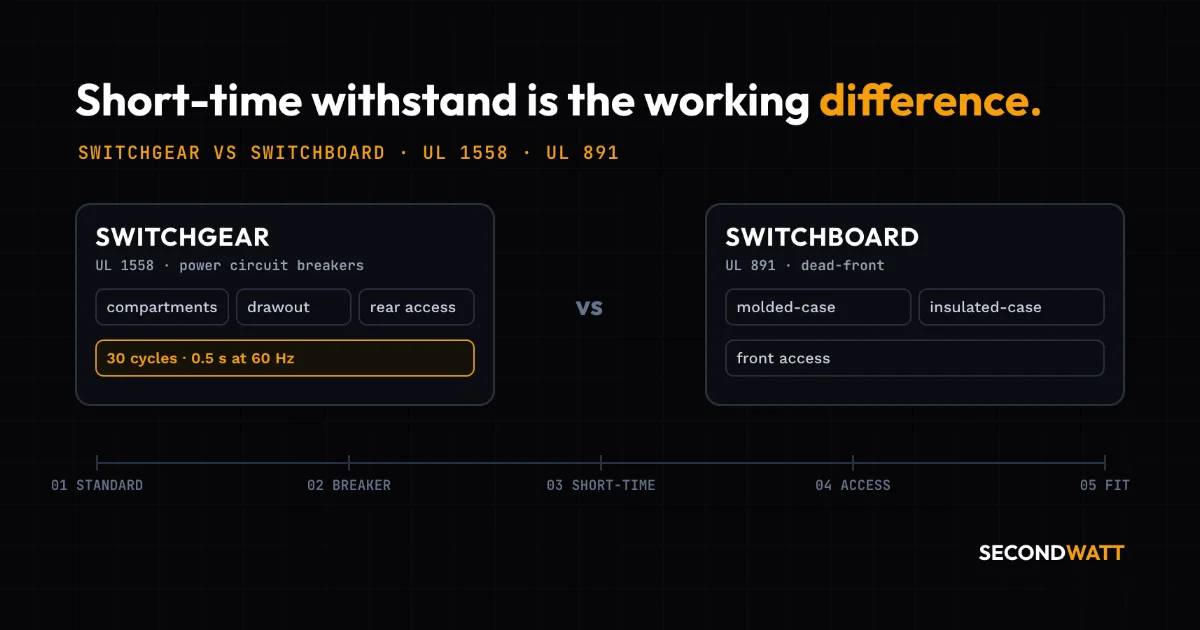
Switchgear vs switchboard comes down to how long the equipment can carry a fault and how it is built to do so. Low-voltage switchgear is a metal-enclosed lineup of power circuit breakers in individual compartments, built to UL 1558 and IEEE C37.20.1. A switchboard is a dead-front assembly built to UL 891, most often with molded-case or insulated-case breakers.
That difference shapes the job each one does in a data center or generator plant. On Eaton's figures, switchgear breakers can withstand a fault for up to 30 cycles so a downstream device clears it first. Switchboards trade that withstand for a smaller footprint and front access, and panelboards sit below both. Model pages for these lineups sit under the switchgear hub.
Key Takeaways
- Switchgear and switchboards are listed to different UL standards. Switchgear follows UL 1558 and IEEE C37.20.1; UL 891's published scope excludes switchboards with short-time current ratings.
- Short-time withstand is the working difference. Eaton gives switchgear up to 30 cycles and switchboards three or four, so switchgear holds 7.5 to 10 times as long.
- At minimum depth, Eaton's switchgear is three times as deep as a switchboard. Eaton gives 54 against 18 inches; Siemens' SB switchboards are front-access only.
- Panelboards sit below both. Built to UL 67, they split a feed into branch circuits; Eaton limits their main to 1,200 A, against switchboard bussing up to 6,000 A.
- A used lineup starts with its label. Its standard and short-circuit rating should suit the new site; Magnum DS lists up to 200,000 A rear-access, 85,000 A front-access arc-resistant.
Switchgear vs switchboard: the short answer#
UL Standards & Engagement's scope for UL 1558 covers switchgear assemblies containing "low-voltage power circuit breakers, other interrupting devices, switches" and related equipment. IEEE C37.20.1-2026 places those breakers "in individual metal compartments". Eaton states that switchgear uses power circuit breakers tested to UL 1066.
A switchboard, in the terms of UL 891's scope, is a dead-front switchboard nominally rated at 1,000 V or less. Eaton's switchgear vs switchboards fundamentals page describes molded-case breakers as the most common switchboard device, with insulated-case breakers typically applied as the main. Power circuit breakers can sit in a switchboard too: NEMA's switchboard standard lists them alongside molded-case breakers.
What separates the two is the assembly: its standard, its compartments and how long the structure must withstand a fault. The low-voltage switchgear guide covers switchgear construction in more depth.
The standards behind each#
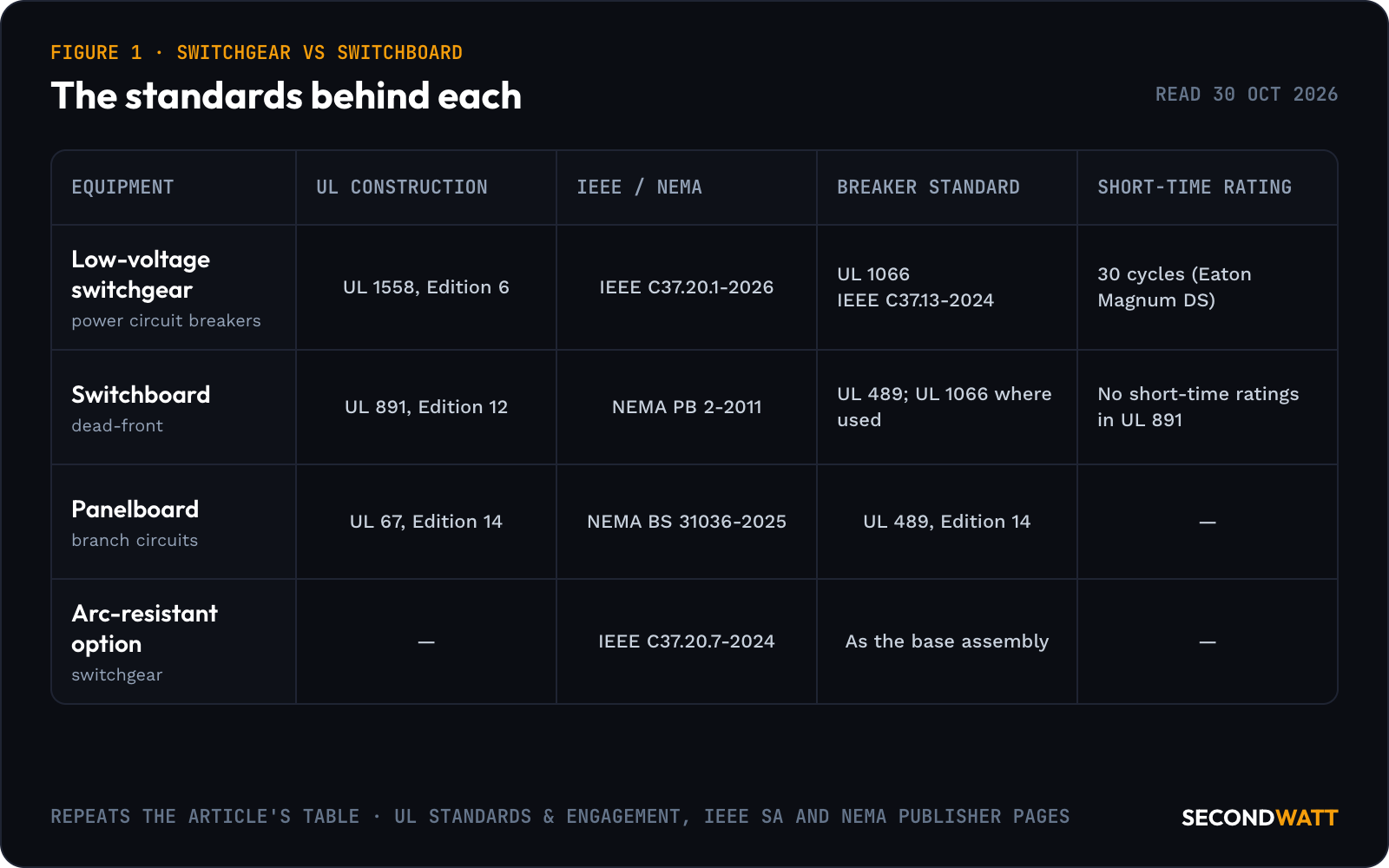
Each assembly has a construction standard, and each breaker inside it has its own. The table lists the current editions on each publisher's page.
Construction and breaker standards for low-voltage assemblies, with editions and status as listed on UL Standards & Engagement, IEEE SA and NEMA publisher pages#
| Equipment | Construction standard (edition, status) | Breaker standard (edition) | Scope as the publisher states it |
|---|---|---|---|
| Low-voltage switchgear | UL 1558, Edition 6 (published 2 Apr 2025, revised 26 Jun 2026, active); IEEE C37.20.1-2026 (active) | UL 1066, Edition 5 (2022, active); IEEE C37.13-2024 (active) | Metal-enclosed power circuit breaker switchgear, 1,000 V ac nominal or less, 1,058 V ac maximum |
| Switchboard | UL 891, Edition 12 (published 19 Jul 2019, revised 21 Mar 2025, active); NEMA PB 2-2011 (most recent) | UL 489, Edition 14 (2025, active); UL 1066 where power breakers are used | Dead-front switchboards, 1,000 V nominal or less, up to 200,000 A available short-circuit current; excludes short-time current ratings |
| Panelboard | UL 67, Edition 14 (published 31 Jul 2026, active); NEMA BS 31036-2025 (most recent) | UL 489, Edition 14 (2025, active) | Panelboards whose primary function is control and protection of electrical circuits |
| Arc-resistant switchgear (option) | IEEE C37.20.7-2024, a recommended practice (active) | As the base assembly | Testing switchgear rated up to 52 kV for internal arcing faults |
Edition 5 of UL 1066 covers power circuit breakers for "circuit breaker enclosures, switchboards (switchgear), panelboards, and the like" and "does not apply to molded-case circuit breakers". Edition 14 of UL 489 covers molded-case breakers and switches rated 1,000 V ac, 1,500 V dc and 6,000 A or less. It excludes low-voltage power circuit breakers.
NEMA PB 2-2011 covers floor-mounted deadfront switchboards rated 6,000 A or less and 600 V or less, according to the NEMA Standards Store. Eaton's comparison page still describes UL 1558 as addressing equipment under 635 V and UL 891 under 600 V. The current UL scopes quoted above reach the 1,000 V class.
200,000 A — the upper limit of available short-circuit current in UL 891's published scope (Edition 12), which covers switchboards on circuits of not more than 200,000 A.
Power, insulated-case and molded-case breakers#
Power breakers are 100%-rated devices, tested in the enclosure and fully maintainable, in Eaton's description, and their instantaneous trip can be shut off. Molded-case and insulated-case breakers trip with no intentional time delay.
Molded-case breakers are sealed and not maintainable. Eaton notes they are typically applied at 80% of their continuous current rating when installed in equipment. Insulated-case breakers are tested to UL 489 as well and rated at 80% or 100%. Eaton calls them somewhat maintainable, with some replaceable parts.
Eaton's Magnum DS switchgear shows the switchgear side. Eaton rates it at up to 600 V, with a main bus of 1,600 A to 10,000 A and breakers up to 6,000 A. Eaton's Magnum DS product page lists its short-circuit withstand at up to 200,000 A. Eaton lists its short-time withstand separately, at 30 cycles, and the standards as C37.20.1, C37.51, UL 1558 and UL 1066.
On the switchboard side, Eaton's Magnum circuit breakers page calls the Magnum SB breakers "insulated-case power circuit breakers designed for the performance and economic requirements of UL 891". Eaton offers the Magnum line in fixed and drawout versions.
Other makers split the same frame across standards. ABB lists its SACE Emax 2 E6.2 frame to UL 1066 at up to 6,000 A, with breaking capacity up to 100 kA and 100 kA short-time withstand. Its IEC version of the E6.2 reaches 6,300 A, according to ABB Electrification's U.S. SACE Emax 2 page.
Short-time withstand can sit below breaking capacity on smaller frames. ABB's UL 1066 E1.2 lists 50 kA short-time against breaking capacity up to 65 kA, so 50 ÷ 65 ≈ 77%. The E2.2 lists 85 kA against up to 100 kA (85%), and the E4.2 and E6.2 list 100 kA against 100 kA.
Siemens' 17 July 2023 press release names three 3WA series: 3WA1 for IEC, 3WA2 for UL 489 and 3WA3 for UL 1066 plus IEC. It gives the UL series rated currents of 800 A to 5,000 A. Siemens' 3WA product page describes the SENTRON 3WA as built to IEC 60947-2 and UL 1066. A breaker's family name alone does not settle which standard it carries.
Short-time ratings and selective coordination#
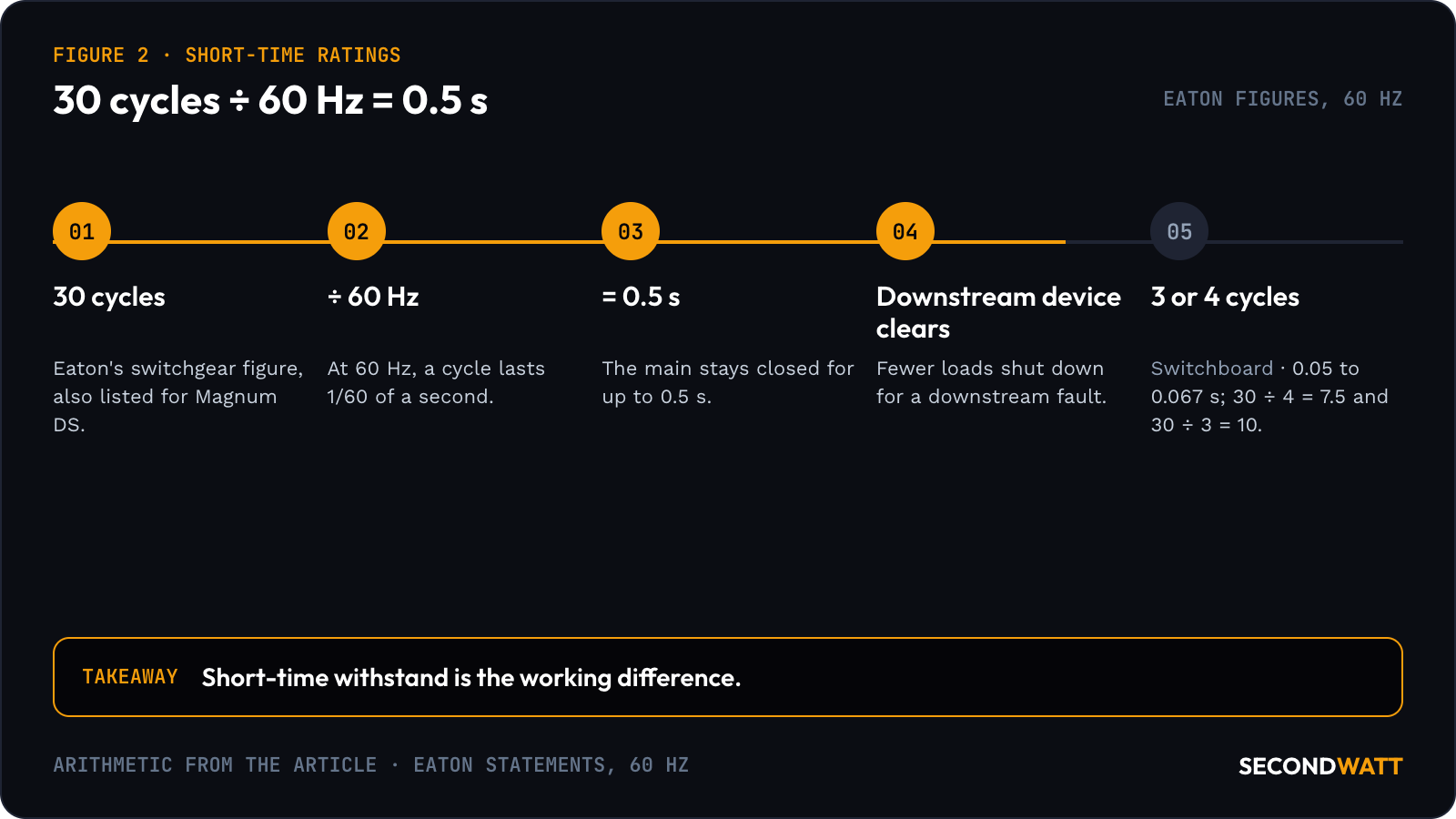
Switchgear can "withstand or operate through a fault" for up to 30 cycles, in Eaton's words, so the main stays closed while a downstream device clears it. That avoids "shutting down more loads than needed for downstream faults." Eaton puts switchboards at full current for up to three or four cycles.
At 60 Hz a cycle lasts 1/60 of a second, so both Eaton class statements convert on the same basis:
30 cycles ÷ 60 Hz = 0.5 s (switchgear); 3 ÷ 60 = 0.05 s and 4 ÷ 60 ≈ 0.067 s (switchboard); 30 ÷ 4 = 7.5 and 30 ÷ 3 = 10.
The switchgear withstand therefore lasts 7.5 to 10 times as long as the switchboard figure.
30 cycles — the short-time withstand Eaton lists for its Magnum DS switchgear, which is 0.5 seconds at 60 Hz.
The assembly standard sets the boundary. UL 891's scope states that its requirements "do not cover switchboards with short-time current ratings." A switchboard that needs a short-time current rating on the assembly therefore sits outside UL 891.
Breakers add coordination tools of their own. Eaton says zone-selective interlocking on Magnum breakers allows "downstream overcurrent devices to clear local faults." Eaton's panelboard fundamentals page says the company also builds fusible lighting panelboards for very high fault currents and sites "where a need to meet NEC Selective Coordination requirements exist".
NFPA's NFPA 70 page lists the 2026 edition as current. A coordination study should name the edition the local authority enforces. Transfer equipment sizing is covered in the ATS sizing guide.
Access, compartments and maintenance#
Switchgear separates its parts. Eaton states that switchgear requires barriers between breakers and between breakers and the bus bars, lugs and control wiring. Switchboards do not require internal barriers, and their molded-case breakers are group mounted.
A switchboard can be compartmented too. Eaton's Pow-R-Line I compartmentalized distribution switchboard mounts each device in its own compartment and section. It is built under UL 891 and NEMA PB-2, at 400 A to 4,000 A and up to 600 V ac.
That construction sets the size. Eaton gives switchgear a height of 96 inches, a minimum depth of 54 inches and a standard depth of 72 inches, with rear access standard. Switchboards are 90 inches tall with a minimum depth of 18 inches, and front access is standard.
Worked on those Eaton figures, a minimum-depth switchgear section is 36 inches deeper than a minimum-depth switchboard: 54 − 18 = 36, and 54 ÷ 18 = 3. At the standard 72-inch depth, the gap grows to 72 − 18 = 54 inches.
Siemens draws the same line. Its SB front-connected switchboards are rated 400 A to 6,000 A to UL 891 and NEMA PB-2, with front-only access and bus bracing up to 200 kA. Its Type WL rear-connected switchgear keeps controls at the front and cable terminations at the rear.
Drawout is the maintenance payoff. Eaton says switchgear lets a crew remove, check, maintain and test devices without removing load cables. All its switchgear breakers are drawout and need a breaker lifting device.
Arc-resistant construction is tested under IEEE C37.20.7-2024. Eaton's comparison table marks arc-resistant ratings as an option for switchgear and not for switchboards. Siemens classifies its Type WL arc-resistant switchgear to the 2007 edition, for internal arcing currents up to 100 kA at 508 V for 500 ms. Upkeep schedules sit in the switchgear maintenance guide.
Where panelboards fit#
A panelboard divides a power feed into branch circuits, with a breaker or fuse for each circuit in a common enclosure. Eaton states that its panelboards are designed to UL 67 and NEMA Standard PB1. Edition 14 of UL 67 covers panelboards whose primary function is "control and protection of electrical circuits".
The NEMA Standards Store lists NEMA BS 31036-2025, Panelboards, as its most recent panelboard publication. It covers panelboards at 1,000 V and less, with mains of 1,600 A and less and branch circuits of 1,200 A and less.
The switchboard vs panelboard line comes down to size and mounting. Eaton describes panelboards as typically flush or surface mounted, limited to a 1,200 A main and applied at up to 600 V. Switchboards, on the same page, are free-standing and front connected, with up to 6,000 A bussing and overcurrent devices up to 5,000 A.
Eaton's panelboards page lists Pow-R-Line Xpert 1X and 2X lighting and appliance panelboards and Xpert 3X and 4X power distribution panelboards. The Eaton Pow-R-Line page covers both its panelboards and switchboards.
Which one for a data center or generator plant#
The pattern Eaton describes runs top to bottom. Switchgear is often used at the main service entrance, switchboards distribute to large loads or panelboards, and panelboards feed branch circuits. In smaller facilities, Eaton adds, the switchboard may itself be the service entrance.
Where each fits in a data center or generator plant, as Eaton frames it in its application and product pages#
| Application | Eaton's fit | Why | Source |
|---|---|---|---|
| Main service entrance | Switchgear | Often used at the main service entrance; data centers are among its typical settings | Eaton switchgear vs switchboards page |
| Service entrance of a smaller facility | Switchboard | May be fed directly from the utility as a "service entrance" switchboard | Eaton switchboard fundamentals |
| Utility and generator mains with automatic transfer | Switchgear | ATC-900 controller for main-main, main-generator or generator-generator Magnum DS lineups; a PLC for automatic main-tie-main transfer | Eaton Magnum DS page |
| Distribution to large loads and to panelboards | Switchboard | Fed from an upstream switchgear breaker in large commercial or industrial facilities | Eaton switchboard fundamentals |
| Feeders where breaker swaps must be quick | Drawout molded-case switchboard | Often applied in critical applications such as data centers to reduce downtime when replacing a breaker | Eaton switchboard fundamentals |
| Hookup point for a mobile generator | Generator quick connect switchboard | Designed for safe and fast connection of a mobile generator | Eaton switchboard fundamentals |
| Branch circuits with per-circuit metering | Panelboard | Branch circuit monitoring is often found in data center and industrial applications | Eaton panelboard fundamentals |
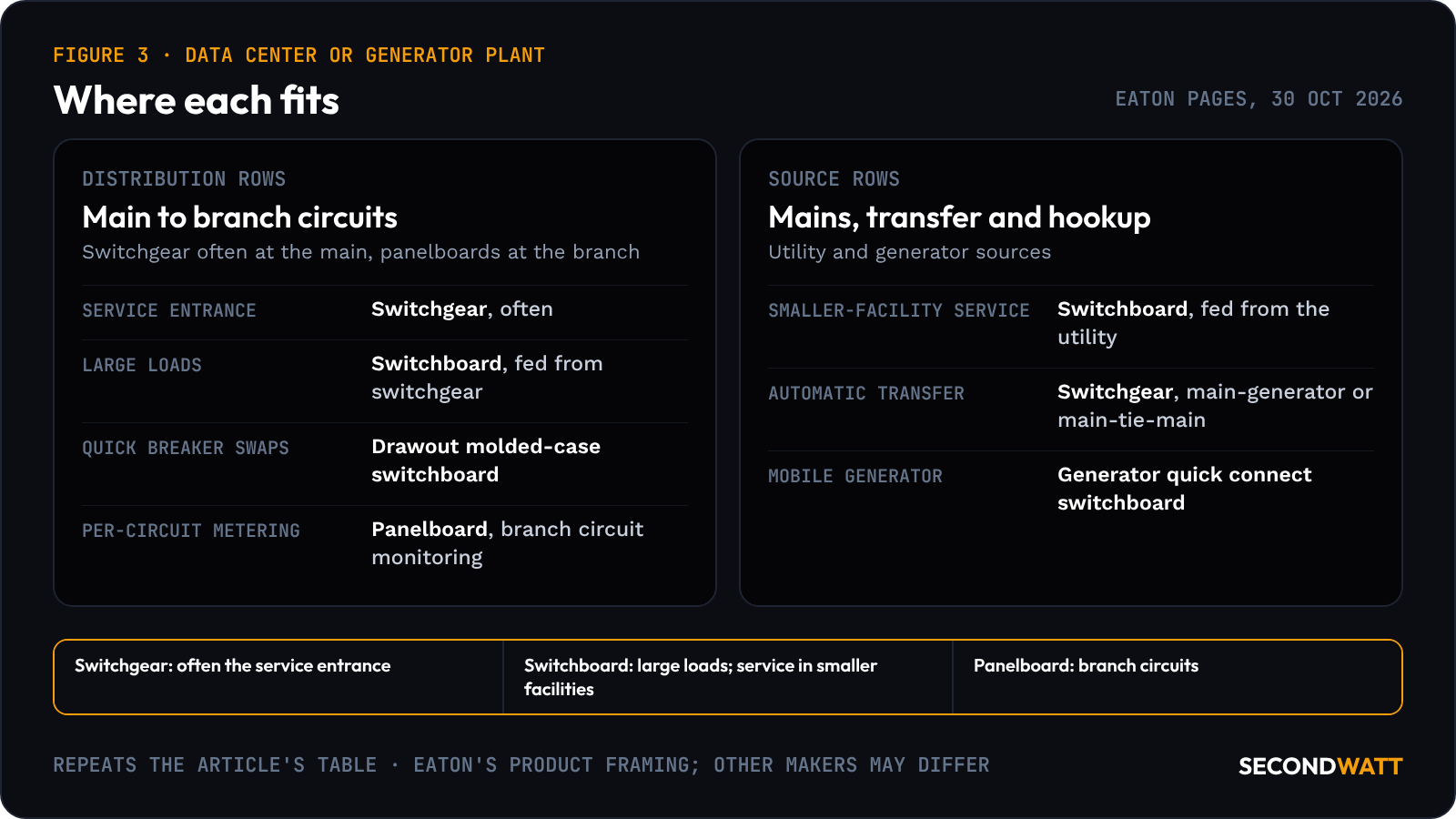
The table follows Eaton's product framing, and other makers may draw the lines differently. Eaton also names data centers among the places switchboards are generally used. Paralleling several generator sets on one bus is covered in the paralleling switchgear guide.
Gear above the 1,000 V class belongs to medium-voltage switchgear, a separate subject.
Buying a used lineup#
Start with the listing label. It should name UL 1558 or UL 891, and that standard settles which construction and short-time rules the lineup was built to.
Next, read the short-circuit rating for that exact lineup, against the new site's available fault current. One Eaton family shows why a family name is not enough. Rear-access Magnum DS lists short-circuit withstand up to 200,000 A, while the front-access arc-resistant version lists up to 85,000 A.
Then check the breaker type and trip-unit generation. Eaton's November 2023 Digitrip 1150 manual says the trip units are for use only in Magnum and Magnum DS breakers. Its Magnum PXR switchgear builds on the Magnum DS platform with Power Xpert Release trip units.
Product status matters for spares. Eaton's product pages mark both Pow-R-Line I and Pow-R-Line C discontinued. The Pow-R-Line C page gives up to 6,000 A in its summary and 400 A to 5,000 A in its ratings table, with interrupting ratings up to 200 kAIC. Finally, ask for test and maintenance records; the used medium-voltage switchgear guide shows how to specify a lineup around them.
FAQ: switchgear vs switchboard#
Does a switchboard cost less than switchgear?#
It depends on the lineup. Eaton credits switchboards with higher power density and a smaller footprint, and says a facility switchboard can combine a transformer and panelboard to cut cost and space. Figures by voltage class are in the switchgear pricing guide.
Can a switchboard have drawout breakers?#
Yes, in some designs. According to its switchboard fundamentals page, Eaton offers drawout molded-case switchboards. Its Pow-R-Line XD switchboard takes power breakers of the kind found in switchgear. The XD design needs rear access to barriered cable compartments. On its SB switchboards page, Siemens says its IPS switchboard supports faster breaker replacement.
Where do UL 891 and UL 1558 draw their scope limits?#
UL 891 excludes theater preset and dimmer boards, live-front boards, railway control or electrification boards and boards built only to receive motor control center units. UL 1558 covers equipment for ordinary locations under the National Electrical Code. It is written to supplement IEEE C37.20.1 and ANSI C37.51.
Is low-voltage switchgear always rear-accessible?#
No. Eaton lists front-access and arc-resistant constructions as options to its standard rear-access design. Its front-access arc-resistant Magnum DS can mount against a wall, with front power terminations, a 54-inch depth and a 1,600 A to 6,000 A main bus. Siemens also lists front-connected low-voltage switchgear among its low-voltage switchgear variants.
Is an insulated-case breaker a power circuit breaker?#
It depends on the standard it is listed to. Eaton's comparison page says insulated-case breakers are tested to UL 489, the molded-case standard. Eaton still calls Magnum SB "insulated-case power circuit breakers." The nameplate standard decides which rules apply.
Specifying the lineup#
SecondWatt publishes equipment research and helps buyers source power equipment; it earns a fee when a sale it arranges closes. Buyers can describe the switchgear, switchboard or panelboard lineup they need through a request for equipment. Owners of surplus low-voltage gear can start at sell switchgear.