
Selective catalytic reduction (SCR) cuts nitrogen oxides (NOx) in the exhaust of gas turbines, gas engines and diesel gensets. A reagent, ammonia or urea that breaks down into ammonia, is injected into the exhaust ahead of a catalyst. On the catalyst, the NOx and ammonia react to form nitrogen and water vapor.
For a buyer, SCR is more than a box in the exhaust duct. The prime mover's exhaust temperature decides where the catalyst sits, and the NOx removed sets how much reagent the site stores. On a used gas engine or turbine, the catalyst's age and test history decide what its emissions figures are worth.
Key Takeaways
- Engine SCR can cut NOx 80 to 90 percent, per EPA. Commercial coal-, oil- and gas-fired SCR systems are often designed for over 90 percent.
- Exhaust temperature decides where the catalyst goes. Most commercial metal-oxide catalysts work at 480–800°F; simple-cycle turbine exhaust runs 850–1,000°F, per EPA, and needs a high-temperature catalyst.
- SCR can pair with an oxidation catalyst. mtu's gas-genset EGAT adds a downstream oxidation catalyst for CO and formaldehyde; mtu rates both up to 21,000 hours at 90 percent conversion.
- Urea follows the NOx removed. At EPA's typical 0.525 mole per mole removed, each pound of NOx (as NO2) takes about 0.69 lb of urea, or 2.1 lb of DEF.
- A used unit's catalyst age matters. Ammonia slip rises as catalyst activity falls; it nears permit levels, typically 2 to 10 ppm, only late in catalyst life, per EPA.
What selective catalytic reduction is#
Selective catalytic reduction is a post-combustion NOx control. The SCR chapter of EPA's Air Pollution Control Cost Manual, Section 4, Chapter 2 in the June 2019 revision of the Seventh Edition, describes how it works. A nitrogen-based reagent reacts selectively with NOx within a specific temperature range. It does so in the presence of the catalyst and oxygen.
One mole of ammonia removes one mole of nitric oxide (NO), and two moles remove one mole of nitrogen dioxide (NO2). Because 90 to 95 percent of combustion NOx is NO, the same chapter says about one mole of ammonia removes one mole of NOx.
According to the EPA chapter, more than 1,000 SCR systems have been installed in the US on sources including boilers, process heaters, gas turbines and internal combustion engines. SCR retrofits include more than 650 combined-cycle gas turbines. Commercial coal-, oil- and gas-fired systems are often designed for over 90 percent NOx removal. The reduction may be less than 90 percent when SCR follows other NOx controls.
The EPA chapter says base metals such as vanadium, titanium and tungsten arrived in the late 1970s and cut catalyst cost. Zeolites followed for high-temperature service. Mitsubishi Power offers plate and honeycomb catalysts and says it has supplied more than 1,400 SCR plants and catalyst units worldwide.
How an SCR system works#
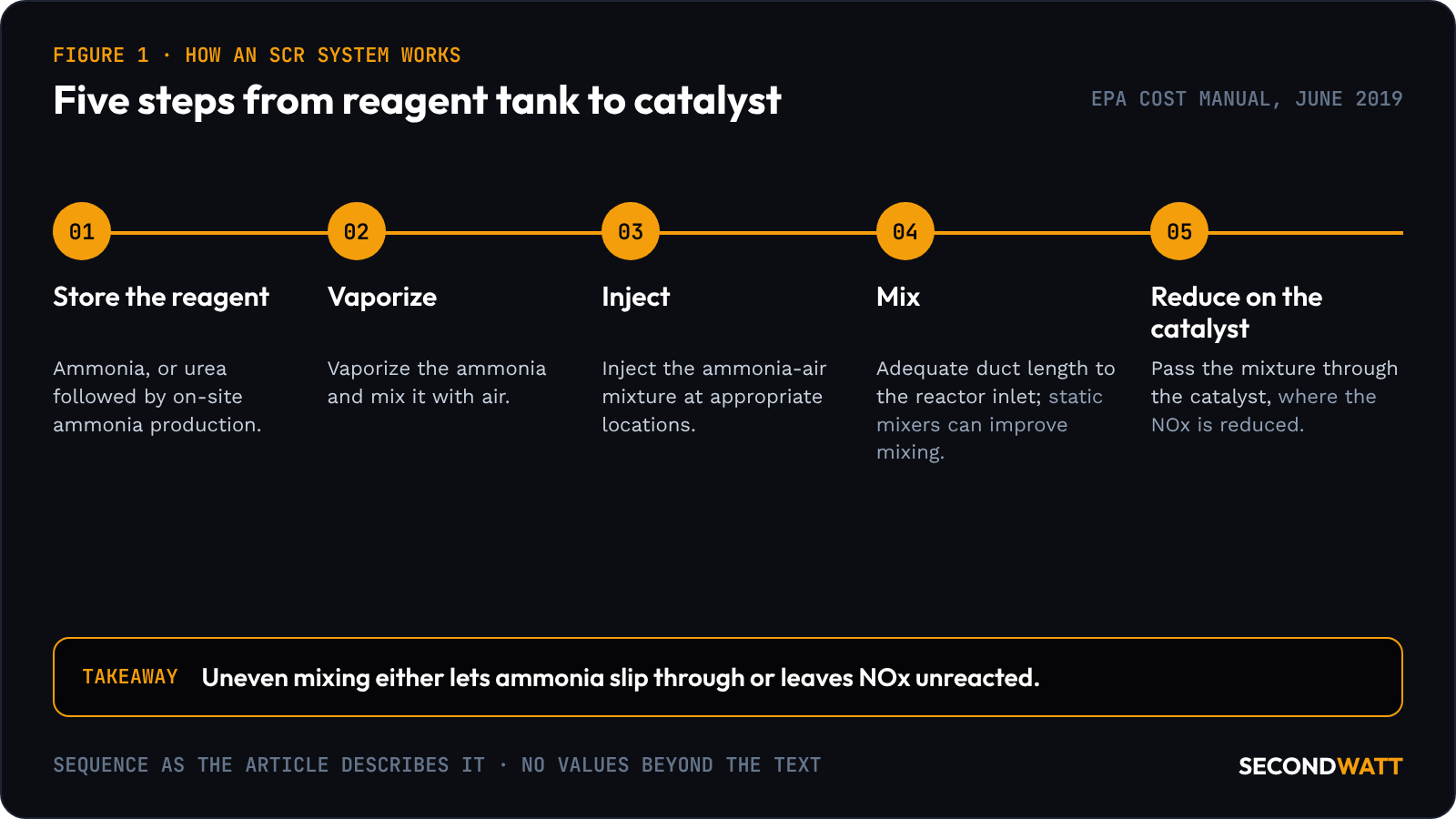
Per the EPA chapter, an SCR system runs in five basic steps:
- Receive and store the reagent: ammonia, or urea followed by on-site ammonia production.
- Vaporize the ammonia and mix it with air.
- Inject the ammonia-air mixture at appropriate locations.
- Mix the reagent with the exhaust gas.
- Pass the mixture through the catalyst, where the NOx is reduced.
The EPA chapter says SCR designs must leave adequate duct length between the injection point and the reactor inlet. Static mixers upstream of the reactor are one way to improve mixing. Section 3 of the March 2015 EPA CHP Catalog notes that uneven mixing either lets ammonia slip through or leaves NOx unreacted.
mtu describes its diesel engine systems in a 19 May 2014 article, "How does Selective Catalytic Reduction work?" Urea solution is metered into the exhaust and turns into ammonia within a fraction of a second. The control sets the dose from engine parameters such as operating temperature and speed.
Under federal rules, 40 CFR part 60 Subpart KKKKa covers stationary combustion turbines that commenced construction, modification or reconstruction after 13 December 2024. It applies at a base load rating of at least 10 MMBtu/h, not counting heat input from duct burners or fuel preheaters. Section 60.4310a excludes some units.
For turbines subject to its NOx standard, § 60.4333a(c) requires a NOx continuous emissions monitoring system (CEMS) for continuous compliance. Its two exceptions cover only turbines without post-combustion controls. Under § 60.4333a(g) of 40 CFR 60 Subpart KKKKa, a turbine electing the mass-based standard may instead use the appendix E method of part 75.
Temperature windows by prime mover#
According to the EPA chapter, most commercial metal-oxide catalysts operate at 480 to 800°F (250 to 430°C), with peak NOx removal at 700 to 750°F. Below the window, the reaction slows and ammonia slips through. Above it, nitrous oxide formation rises and the catalyst sinters and loses activity.
Exhaust temperature by prime mover against the catalyst window (OEM pages and documents as listed; EPA Cost Manual SCR chapter, June 2019, and EPA CHP Catalog, March 2015, for placement)#
| Prime mover | Exhaust temperature and its basis (OEM document) | Where SCR sits, as sources state |
|---|---|---|
| LM6000PF+ aeroderivative gas turbine | 496°C (925°F) on Baker Hughes' LM6000PF+ page; power generation 50/60 Hz, 52.5 MWe at generator terminals, inlet at 15°C, 60% relative humidity and 101.3 kPa, no inlet or exhaust losses, standard natural gas | Simple cycle: directly at the turbine exhaust with a high-temperature catalyst such as zeolite. Combined cycle: typically inside the HRSG, between superheater and evaporator, per EPA |
| Ansaldo AE64.3A heavy-duty gas turbine | 580°C (1,076°F) GT exhaust temperature at 215 kg/s GT exhaust mass flow; 78 MW gross GT power output; "ISO performance" table on Ansaldo's AE64.3A product page | As above for simple and combined cycle, per EPA |
| mtu 20V4000 GS L64 lean-burn gas engine | Not stated in mtu's Series 4000 gas brochure, which rates exhaust heat with cooling to 120°C. EPA's lean-burn example in Table 2-2 of the CHP Catalog, Section 2, a 3,326 kW baseload electric capacity engine at 1,500 rpm: 721°F (383°C) | mtu's EGAT system for its gas gensets: an SCR catalyst with an oxidation catalyst downstream, per mtu's EGAT brochure |
| Cat 3516E diesel genset | 493.0°C (919.3°F) on Cat data sheet LEHE1351-12 (08/26); 2,750 ekW standby, 60 Hz column; the row names no load point | The sheet lists EPA Tier 2 emergency stationary emissions and no SCR; in 2014, mtu said it would use SCR on genset engines with power output above 560 kW to meet Tier 4 final |
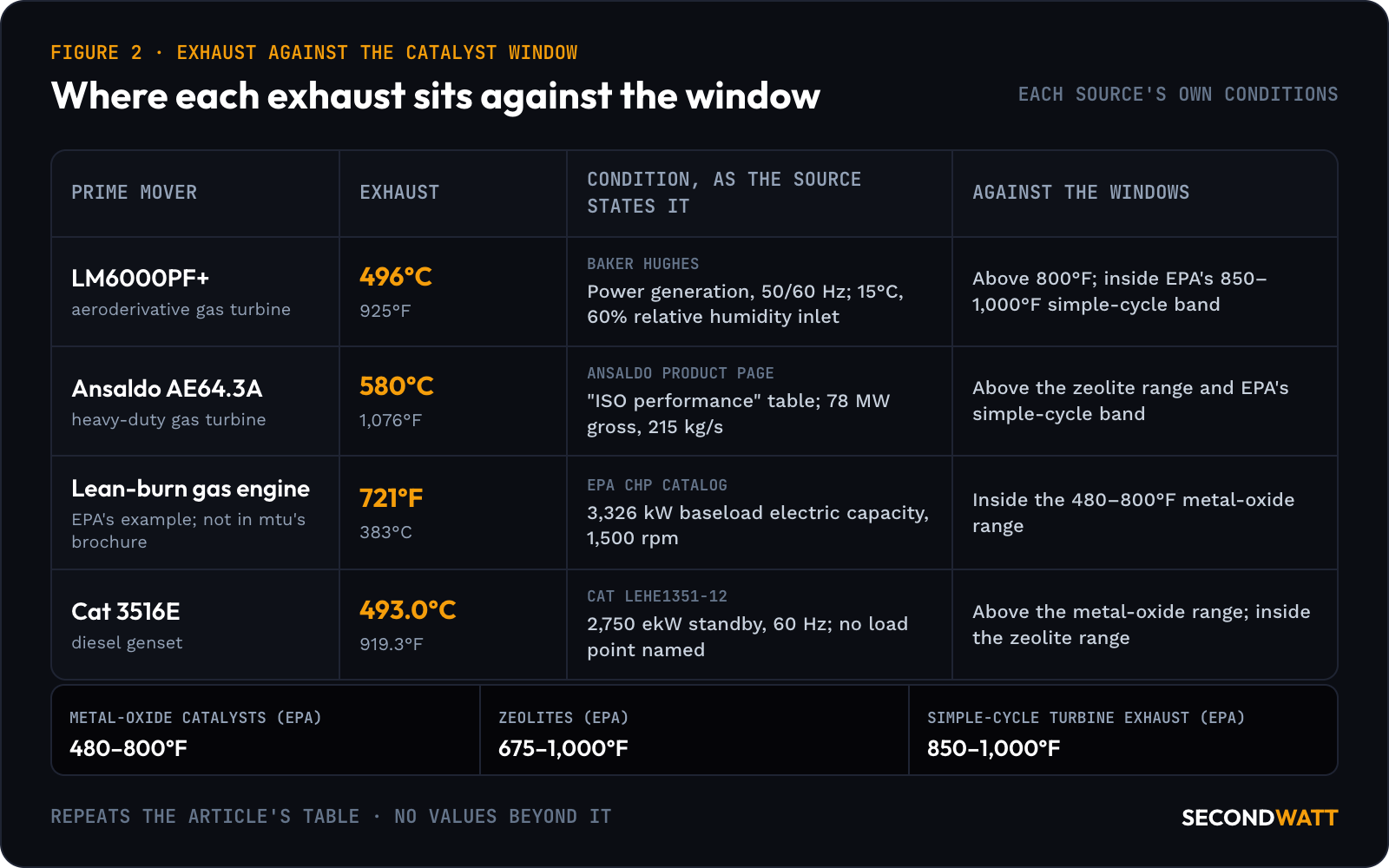
496°C — the LM6000PF+ exhaust temperature Baker Hughes lists in power-generation configuration at 15°C, 60% relative-humidity inlet conditions, inside the 850–1,000°F (450–540°C) band EPA gives for simple-cycle turbine exhaust.
Both turbines exhaust well above 800°F, so a simple-cycle unit needs a high-temperature catalyst at the turbine exit, per the EPA chapter. The same chapter says zeolites cover 675 to 1,000°F. The AE64.3A's 580°C (1,076°F) is above the top of both that range and EPA's simple-cycle band.
In a typical combined-cycle design, the SCR sits in a cavity between the superheater and evaporator, where the gas is within the base-metal range, and most new HRSGs include that cavity. The HRSG guide and the simple-cycle vs combined-cycle comparison cover that layout. The EPA chapter adds that pressure loss across the catalyst is of greater concern on turbines, which rely on air flow.
EPA's 721°F lean-burn example falls inside the metal-oxide range. The Cat 3516E's 493.0°C (919.3°F) is above it and inside the zeolite range. The same sheet lists 472.7°C (882.9°F) at the 2,500 ekW prime rating, 60 Hz, so the figure depends on the rating column.
Urea, ammonia and what the site stores#
Anhydrous ammonia is nearly pure, stored under pressure and classed as a hazardous material. Aqueous ammonia is usually about 29 percent ammonia in water, sometimes 19 percent. Urea is converted to ammonia, either in an on-site production system or in the hot exhaust. The EPA chapter and Section 2 of the CHP Catalog describe these reagents.
By the EPA chapter's account, anhydrous ammonia typically has the lowest capital and operating cost, before site-dependent permitting and risk management. Urea systems carry the highest capital cost, and aqueous ammonia tends to carry the highest operating cost, mainly for transport.
Per Table 2.2 of the EPA chapter, ammonia goes in a steel tank rated for at least 250 psig for anhydrous ammonia or 25 psig for aqueous. The chapter says tanks may be sized for 3 to 30 days, with the high end the conservative choice. Some locations may not require permits for aqueous ammonia below 28 percent.
Under federal accident-prevention rules, Table 1 to 40 CFR 68.130 sets a threshold quantity of 10,000 lb for anhydrous ammonia. For ammonia at a concentration of 20 percent or greater, the threshold is 20,000 lb. 40 CFR part 68 applies to an owner or operator of a stationary source with more than a threshold quantity of a regulated substance in a process. Whether a process holds more than a threshold quantity is determined under § 68.115, and § 68.10 sets the compliance dates and exceptions.
EPA's RMP guidance on concentration qualifiers, updated 26 June 2026, says only the ammonia's own weight in a solution counts toward the threshold. More than 100,000 lb of a 20 percent solution holds more than 20,000 lb of ammonia. A solution below the listed 20 percent need not be considered. The 19 percent solution some SCRs use falls below that listing.
mtu says its diesel SCR systems use a 32.5 percent solution of extra-pure urea in de-ionized water, sold in Europe as AdBlue and kept in a separate tank. CF Industries' diesel exhaust fluid (DEF) is 32.5 percent urea by weight, per version 2.1 of its DEF safety data sheet, dated 4 June 2024. Its May 2022 DEF specification allows 31.8 to 33.2 percent urea and states the fluid meets ISO 22241-1.
Reagent use, worked#
This SecondWatt illustration estimates a year of urea for one lean-burn gas engine from published inputs; it is not an OEM or permit figure.
Inputs:
- Output: mtu 20V4000 GS L64 FNER, 2,521 kW electrical output at 60 Hz, maximum load, power factor 1.0, per mtu's Series 4000 natural gas brochure, Edition 01/21.
- Hours: 8,000 a year, an assumption for continuous duty.
- Engine-out NOx: 1.8 lb/MWh, EPA's class figure: the low level advanced lean-burn natural gas engines can reach before treatment. Section 2 of EPA's CHP Catalog gives a typical uncontrolled range for lean-burn gas engines of 1.5 to 6.0 lb/MWh. Neither is an mtu figure.
- Removal: 90 percent, the top of EPA's 80 to 90 percent for engine SCR, also from Section 2.
- Ratio: 0.525 mol of urea per mol of NOx removed, the typical value for urea in EPA's SCR chapter; 1.05 for ammonia.
- Molar masses: NO2 46.005 and urea 60.056, from IUPAC CIAAW's 2024 abridged atomic weights.
- DEF: 32.5 percent urea at 9.0909 lb per US gallon, per the CF Industries safety data sheet.
Worked example:
2,521 kW electrical output × 8,000 h = 20,168 MWh
20,168 MWh × 1.8 lb/MWh = 36,302 lb of NOx, about 18.2 short tons
36,302 lb × 0.90 = 32,672 lb removed; 32,672 ÷ 46.005 = 710.2 lb-mol
710.2 lb-mol × 0.525 × 60.056 = 22,392 lb of urea
22,392 ÷ 0.325 = 68,898 lb of DEF; 68,898 ÷ 9.0909 = about 7,580 US gallons (28,700 L)
That is about 0.95 gallons per running hour, or 22.7 gallons per 24 running hours. At 6.0 lb/MWh, the same chain gives about 25,260 gallons. Per pound of NOx removed (as NO2), it takes about 0.685 lb of urea, or 2.11 lb of DEF.
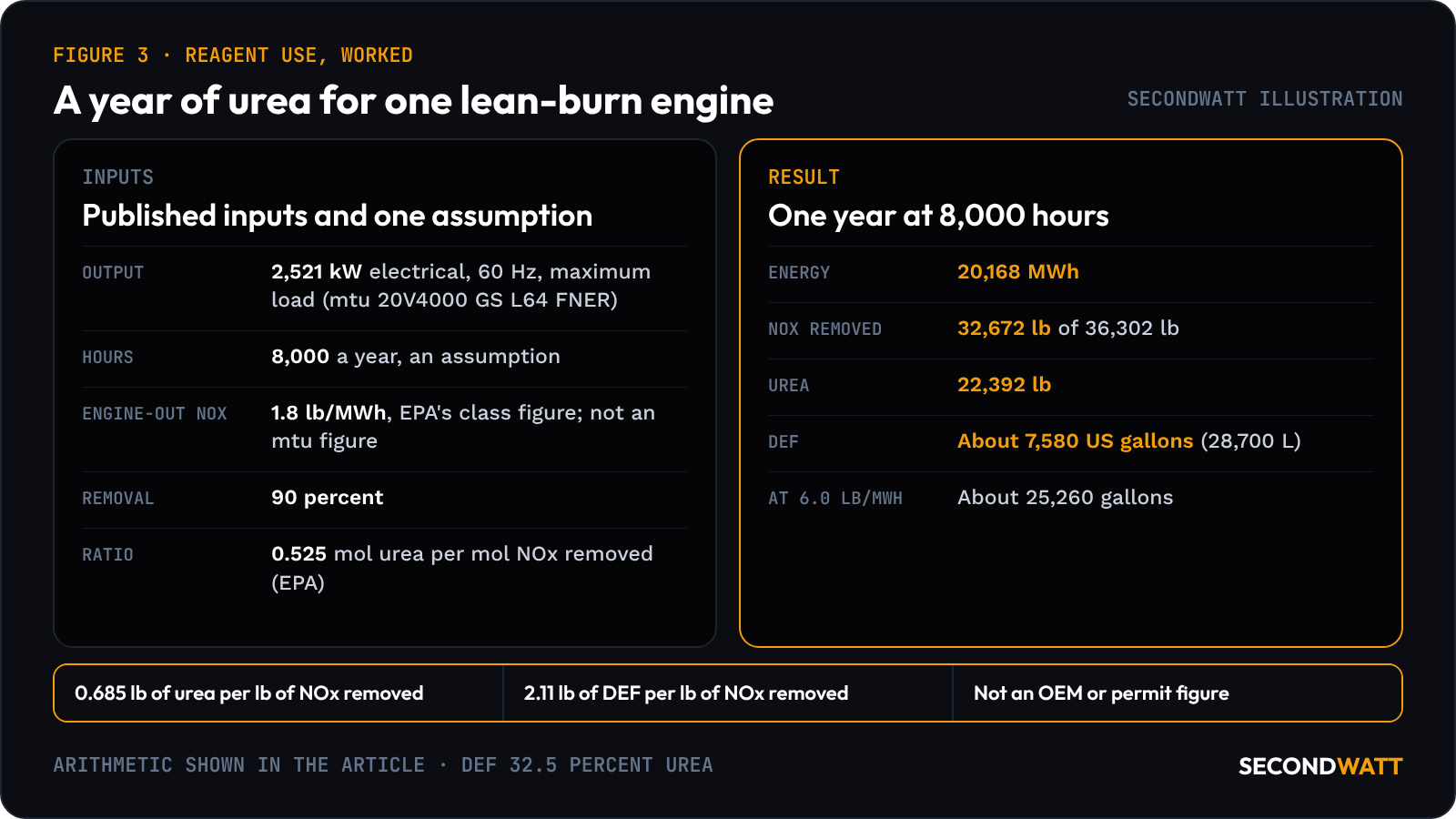
1.05 moles — the ammonia per mole of NOx removed in a typical SCR system, in EPA's Cost Manual SCR chapter (June 2019); with urea, the typical value is 0.525.
The two EPA ratios use different bases. Section 2 of the CHP Catalog says 80 to 90 percent reduction on engines requires about 0.9 to 1.0 mole of ammonia per mole of NOx at the reactor inlet. The SCR chapter's 1.05 is per mole of NOx removed, and its near one-to-one relationship holds to about 85 percent reduction. Above that, more reagent is needed, so a 90 percent design may use more than this estimate.
Oxidation catalysts and ammonia slip#
On lean-burn engines, SCR gives no typical carbon monoxide (CO) reduction, per EPA's CHP catalog. An oxidation catalyst, usually a precious metal, oxidizes CO and hydrocarbons to carbon dioxide and water without a reagent. On lean-burn gas engines, Table 2-10 of the catalog's Section 2 gives about 95 percent CO and non-methane hydrocarbon reduction from an oxidation catalyst. On gas turbines, Section 3 gives about 90 percent CO and 85 to 90 percent formaldehyde.
On engines, the two can come as a set: an SCR catalyst followed by an oxidation catalyst for CO and formaldehyde, in mtu's EGAT system. In its EGAT brochure, Edition 01/22, mtu says EGAT enables compliance with 100 mg/Nm³ NOx, 250 mg/Nm³ CO and 10 mg/Nm³ ammonia at 5% O2, dry. That claim covers typically tuned mtu engines up to 21,000 operating hours.
Table 1 to 40 CFR 60 Subpart JJJJ has a row for non-emergency spark-ignition natural gas engines with a maximum engine power of 500 HP or more, other than lean-burn engines of 500 to under 1,350 HP. For those manufactured from 1 July 2010, it lists 2.0 g/HP-hr or 270 ppmvd CO and 0.7 g/HP-hr or 60 ppmvd VOC, at 15% O2. Owners and operators of non-certified engines may choose either unit, per footnote a. Footnote d excludes formaldehyde from VOC.
Ammonia slip, the reagent that passes through unreacted, rises as catalyst activity falls. Systems designed close to theoretical stoichiometry with adequate catalyst volume hold it below about 2 ppm. Operating permits typically allow 2 to 10 ppm, and the EPA chapter says slip nears that level only late in catalyst life. At the maximum design or permitted level, the catalyst or a catalyst layer must be cleaned, rejuvenated or regenerated, or new catalyst installed.
What to check on a package or a used unit#
A used unit's emissions figures describe it when tested; its records show whether they still hold.
Documents to request for an SCR-equipped unit (EPA Cost Manual SCR chapter, June 2019; eCFR Subparts JJJJ and KKKKa and Part 68; mtu and Cat documents)#
| Item | Document to ask for | Why it matters |
|---|---|---|
| Catalyst install date and operating hours | Catalyst purchase guarantee, supplier records and replacement history | Catalyst life is usually specified at purchase, per EPA; mtu rates its EGAT catalysts up to 21,000 hours at 90% conversion |
| Last performance test | Stack test report with load and date | Under JJJJ § 60.4243(b)(2)(ii), an owner or operator who bought a non-certified spark-ignition engine above 500 HP must test initially, then every 8,760 hours or 3 years, whichever comes first |
| NOx monitoring records | CEMS data, or the parameter monitoring plan | KKKKa turbines with post-combustion controls cannot use the two non-CEMS exceptions in § 60.4333a(c) |
| Ammonia slip trend | Slip readings or outlet ammonia tests over time | Rising slip signals a catalyst near the end of its life |
| Annual inspection | Catalyst sample analysis and injection-grid tuning records | EPA describes annual catalyst sampling for activity and pressure drop |
| Reagent system | Tank data plates, reagent type and strength, dosing controls | Reagent type and strength decide which Part 68 listing, if any, applies |
| Outlet guarantee | OEM or packager emissions data sheet for the site | Emissions data on Cat's sheet must not be used for permitting |
That testing rule covers a purchased non-certified engine whose owner or operator shows compliance with § 60.4233(d) or (e), and it also requires a maintenance plan and records. Ask for every test report since installation.
In the seller's scope for the ten-unit mtu 20V4000 gas power block, each engine-generator carries its own SCR unit and oxidation catalyst, as SecondWatt's block article records. The used gas generator checklist covers the engine side, and the power blocks category covers packaged plants.
FAQ: selective catalytic reduction#
Do gas turbines need SCR?#
It depends on the permit limit against the combustor's own NOx. Section 3 of EPA's CHP Catalog says most manufacturers offer dry low-NOx combustion at 15 to 25 ppm on natural gas, and adding SCR can bring NOx to 1.5 to 5 ppm. Baker Hughes lists the LM6000PF+ at under 25 ppm. The turbine permitting guide covers how limits are set.
How much urea solution does a diesel SCR system use?#
About 5 to 7 percent of fuel consumption on mtu's diesel SCR systems, by mtu's figure. The Tier 4 cost article covers sets that need it.
How long does an SCR catalyst last?#
Typically more than 32,000 operating hours on oil and natural gas, per the EPA chapter, against the 8,000 to 24,000 hours vendors typically guarantee on coal-fired boilers. For oil- and gas-fired units, the chapter's cost method assumes 40,000 hours, and some gas-fired units have reported up to 60,000.
Why does ammonia slip matter?#
The EPA chapter says ammonia in the flue gas causes problems that include health effects, stack-plume visibility and ammonium sulfate formation. Its Table 2.2 gives ammonia a 35 ppm short-term exposure limit and a pungent odor at 5 ppm or more.
Can SCR be added to an existing generator?#
It can, where space and exhaust temperature allow. Where an older HRSG lacks the cavity, a low-temperature SCR may go after it. The EPA chapter says high-temperature simple-cycle SCRs are generally not retrofitted between a turbine and its HRSG. In its EGAT brochure, mtu says the system for gas gensets "can be integrated in all manner of existing installations."
Sourcing generation with emissions control#
SecondWatt publishes equipment research and helps buyers source power equipment; it earns a fee when a sale it arranges closes. If you are buying an engine or turbine that must meet a NOx limit, send a request with the permit limits, site and duty, so offers can be compared with their catalyst and test records. If you own a unit with SCR, the seller page explains how SecondWatt works with owners.