
A grounding transformer creates a neutral point on a three-phase system that has none, such as a delta-connected or ungrounded wye system. That neutral is then connected to ground, directly or through a neutral grounding resistor, so a ground fault has a defined path back to the source. Protection can then detect the fault, and the resistor can limit its current.
For an owner adding generation to a delta-connected system, or a buyer reading a generator block's scope, this is the piece that sets how ground faults are detected and limited. The two most common designs are the zig-zag and the grounded wye-delta, and both are rated by the neutral current they carry and for how long. The transformers hub lists the transformer models SecondWatt tracks, and the data center transformers guide covers the units they sit beside.
Key Takeaways
- Zig-zag and wye-delta units reach the same result differently. A zig-zag is an autotransformer with no secondary; a wye-delta grounds its wye winding and typically leaves its delta externally unconnected.
- Neutral current, its duration and system voltage set the rating. Little or no current flows in normal service, so Hammond says grounding transformers are not sized by kVA.
- An assumed 400 A for 10 seconds at 13.8 kV is about 3,187 kVA of three-phase short-time duty. That is 7,967.4 V line to neutral times 400 A.
- A delta generator-side winding gives the generator bus no neutral. Prolec lists delta low-voltage windings from 13.2 kV through 25 kV as typical for its standard step-up transformers.
- The mtu 20V4000 block's seller scope includes a zig-zag grounding transformer. It has a neutral grounding resistor branch; reconciling the two ratings is an engineering item to close before purchase.
What a grounding transformer does#
Post Glover's 2012 technical document NG112-06 defines a grounding transformer as a transformer used to provide a neutral point for grounding purposes.
In Hammond Power Solutions' August 2020 technical bulletin, it does four jobs. It holds the system neutral at or near ground potential and supplies ground-fault current during line-to-ground faults. It limits transient overvoltages when re-striking ground faults occur, and it allows phase-to-neutral loads to connect.
In normal service it does very little. Both designs present high impedance to normal three-phase current, so only a small magnetizing current flows. Under a line-to-ground fault, NG112-06 explains, the same windings give zero-sequence current a low-impedance path back through the neutral to the source.
Grounding the new neutral through a neutral grounding resistor (NGR) is more common than grounding it directly, says Post Glover's 2015 zig-zag sheet GT110-08. Choosing and sizing that resistor belongs to the neutral grounding resistor article.
Zig-zag and wye-delta grounding transformers#
The table compares the two designs point by point, from Post Glover's descriptions unless another maker is named.
Zig-zag and grounded wye-delta grounding transformers compared, based on OEM technical documents#
| Point of comparison | Zig-zag | Grounded wye-delta | Source |
|---|---|---|---|
| Construction | Three-phase, dry-type, air-cooled autotransformer with no secondary; two identical windings per phase, wound in opposite directions | Wye-connected primary on the system; delta-connected secondary, connected to no external circuit in Post Glover's design | NG112-06, pages 13–14 |
| Neutral and resistor | The windings' wye point, grounded directly or through an NGR | The wye primary's neutral terminal, grounded directly or through an NGR. An alternate design grounds it directly and puts a loading resistor across a broken delta, selected like a high-resistance NGR but reduced by the square of the turns ratio | NG112-06, pages 13–14 |
| What limits ground-fault current | The fault's resistance, the NGR and the zig-zag's small reactance | The delta is a closed series circuit, so fault current sees only the transformer's leakage reactance | NG112-06, pages 13–14 |
| Voltage rating | Rated at the system voltage; saturation level normally 1.5 times rated phase-to-phase voltage | Primary rating should equal or exceed the system's line-to-line voltage | GT110-08; NG112-06, pages 13–14 |
| Why it is chosen | The more commonly used type; in Hammond's bulletin, the most common design, offering "the best combination of flexibility, size and cost" | Chosen for utility and generator applications partly because its delta can supply a small station-service or control load (Rex) | NG112-06, page 13; Hammond; Rex |
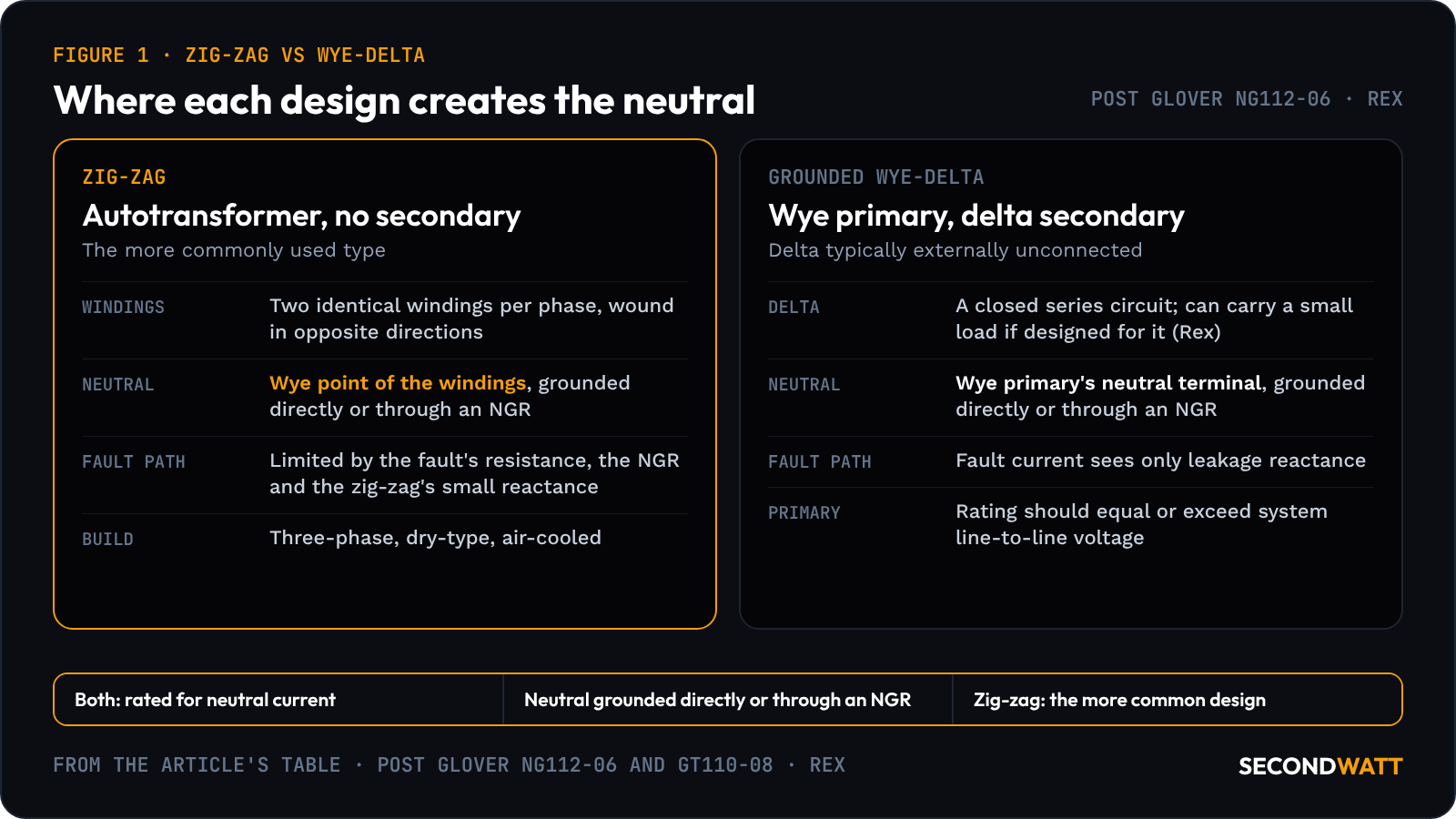
Both connections are built in voltage classes up to 46 kV (250 kV BIL), at 60 Hz with 50 Hz optional, in the Rex Power Magnetics grounding transformer range.
A zig-zag is more effective for grounding than a wye-type transformer because it has less internal winding impedance to ground, as C. Sankaran explains in a July 2000 EC&M article. Why a delta winding carries zero-sequence current yet offers no neutral is covered in delta vs wye transformer connections.
How grounding transformers are rated#
The IEEE standard for these devices is C57.32-2015, Requirements, Terminology, and Test Procedures for Neutral Grounding Devices. Its scope covers devices that control the ground current or the potentials to ground of an AC system: grounding transformers, ground-fault neutralizers, resistors, reactors, or combinations of these. It superseded IEEE 32-1972 and carries amendment C57.32a-2020. IEEE SA's C57.32-2015 page lists the standard as inactive-reserved since 26 March 2026, with draft standard PC57.32 as a current project.
Continuous neutral current comes first. In Post Glover's NG112-06, both main types are rated continuously for a specific neutral current at rated phase-to-neutral voltage, within the insulation class's temperature rise. A zig-zag built to GT110-08 has class B insulation up to 2,400 V line to neutral, class H above, and a continuous rating for the system's charging current. In Hammond's bulletin, the trip limit serves as the continuous rating: a perfectly balanced system carries no neutral current, but systems are designed to trip at a higher limit.
Short-time current and its duration come next. NG112-06's glossary defines a short-time rating, for a grounding device, as a rated time of ten minutes or less. With an NGR, the same document says, the zig-zag's current and time rating should be the same as the resistor's. Short-time neutral current ratings of 2, 5, 10 and 30 seconds sit beside continuous ratings in Rex's range.
Zero-sequence impedance sets how much the transformer itself adds to the fault path. It is stated in ohms per phase in Hammond's bulletin, and in percent or ohms per phase, with an X0/R0 ratio, in its data collection template. Hammond gives the voltage rating as the system voltage, with a BIL.
kVA sits outside that list. Hammond notes that during normal operation little to no current flows through the windings, so grounding transformers are not sized by kVA. Under a fault the current rises substantially, but only for a few cycles to a few seconds, depending on the monitoring and interrupting methods used.
Short-time duty for a 13.8 kV system, worked#
Short-time duty is the line-to-neutral voltage times the rated neutral current, held for the rated time. That product is the conventional short-time kVA, "used in IEEE C57.32 and on the nameplate," in the words of Rex, which rates its grounding transformers by neutral current and duration.
On Acutran's grounding transformers page, the same product sizes a continuously rated single-phase neutral grounding transformer, and a short-time unit comes out smaller.
Worked example, SecondWatt calculation. The system is 13.8 kV, the block export voltage discussed in the next section. The neutral current and duration are assumptions: 400 A for 10 seconds. That is the rating Post Glover's NG112-06 calls typical for low-resistance grounding resistors, which it says are commonly found on medium- and high-voltage systems.
Line-to-neutral voltage: 13,800 V ÷ 1.7320508 = 7,967.4 V.
Three-phase short-time duty: 7,967.4 V × 400 A = about 3,187 kVA, for 10 seconds.
Rex's own worked example, 200 A on a 13.8 kV bus for 10 seconds, gives 1,593 kVA, about half this figure. In it, each phase leg carries a third of the neutral current as zero-sequence current, at line-to-neutral voltage. Per phase leg here: 400 A ÷ 3 = 133.33 A, and 7,967.4 V × 133.33 A = about 1,062.3 kVA; three legs give the same 3,187 kVA.
The continuous side is far smaller.
3% — the minimum continuous rating, as a share of the short-duration fault current, that Hammond's rule of thumb sets for a grounding transformer whose continuous rating is not known.
Applied here, 0.03 × 400 A = 12 A. On the same voltage, 7,967.4 V × 12 A is about 95.6 kVA, so the short-time duty is about 33.3 times the continuous one.
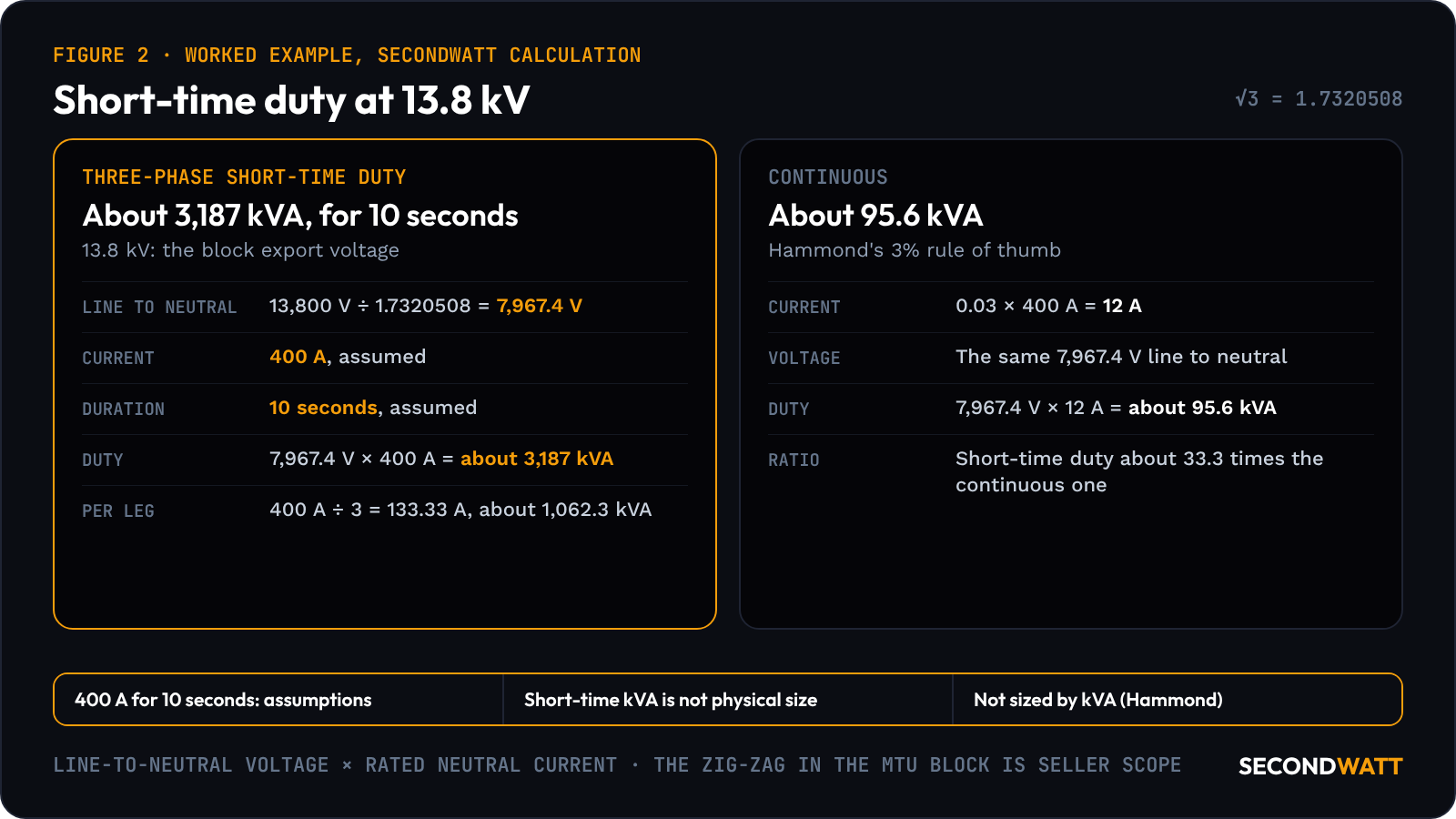
Rex notes that a short-time kVA is not the transformer's physical size: a winding that carries it only for seconds has an equivalent continuous rating that is a small fraction of it. A 10-second rating also assumes a protective relay clears the fault within 10 seconds, as Post Glover's NG112-06 describes the rating for NGRs.
Why generator blocks and E-houses include one#
Typical GSU configurations, in Prolec's description, use a delta-connected low-voltage winding on the generator side and wye-connected high-voltage windings toward the transmission lines. The GE Prolec GSU dossier covers that product.
13.2 kV through 25 kV — the delta-connected low-voltage range Prolec lists as typical for its standard GSU transformers, against 69 kV through 765 kV wye on the high side.
A delta winding offers no neutral, so a grounded generator-side bus takes its reference from a generator neutral or a grounding transformer. The GSU specification article shows one YNd1 unit with its delta side ungrounded. Hammond calls grounding transformers "a critical component" in installations "especially where power generation through solar, wind or traditional generators occurs." Many US utilities require renewable power providers (wind, solar, hydro) to install them at their tie point to provide a ground reference, Acutran's zig-zag page says.
The mtu 20V4000 gas power block shows the arrangement in a seller's scope. Its ten mtu 20V4000 GS units feed a 15 kV metal-clad lineup. The seller's battery limit is the 13.8 kV outgoing terminals at the E-house, and the step-up transformer beyond it is buyer scope. From the seller's documents, SecondWatt's mtu 20V4000 block article records: "A zig-zag grounding transformer with a neutral grounding resistor branch sets the system grounding."
The block article's scope matrix puts the zig-zag grounding transformer and neutral grounding resistor in the seller's scope, as recorded in the power-block dossier. The rating is still open: the same article lists reconciling the grounding transformer and NGR rating as an engineering item to close before purchase, because it "sets ground-fault current and relay coordination." The E-house article reads the same lineup for working clearances, which follow its voltage to ground.
Protection and used-unit checks#
Ground-fault functions carry their own ANSI device numbers. GE's 2013 brochure for the F60 feeder relay lists 50G ground instantaneous overcurrent, 51G ground time overcurrent, 59N neutral overvoltage and 87G restricted ground fault. The ANSI device numbers article explains how the suffixes read on a one-line diagram.
A zig-zag should have protection of its own: short-circuit protection on each of its three line connections, drawn as HRC fuses in Post Glover's GT110-08 diagram. Integrated current transformers, ground fault relays and disconnect switches are options on Acutran's zig-zag units.
Generator relays can carry ground elements too. In the mtu block, each 13.8 kV generator breaker has SEL-700G protection. In SEL's description on its SEL-700G page, the relay's neutral current input can protect solidly grounded or resistance-grounded machines. The block's generator and main protection relays sit in the E-house with that lineup; the medium-voltage switchgear article covers such lineups, and the switchgear hub lists the models SecondWatt tracks.
On a used unit, start with the nameplate: it should state "rated neutral current, rated time, continuous neutral current and system voltage," which Rex calls what matters to the purchaser. Match those, with the connection, BIL and zero-sequence impedance, to the new system. Then check it against the NGR it will serve, and ask for the factory test report.
Specifying a grounding transformer#
Ten parameters must be known to specify a grounding transformer in Hammond's list, and its template adds several more. With Post Glover's, Rex's and Acutran's items, the list runs:
- System voltage, line to line, with BIL and frequency.
- Connection: zig-zag autotransformer or wye-delta; for a wye-delta, any delta load and delta voltage.
- Continuous neutral current, total or per phase, rated for the system's charging current.
- Short-time neutral current and its duration in seconds, matched to the NGR.
- Zero-sequence impedance in percent or ohms per phase, with the X0/R0 ratio.
- Whether a resistor sits at the neutral terminal, and its value.
- Insulation class, temperature rise and winding material, copper or aluminum.
- Enclosure type, such as Type 3R, 3R-Enhanced or non-ventilated, with ambient temperature and other environmental concerns.
- CTs and relaying: a neutral current transformer, ground-fault relays and short-circuit protection on each line connection.
- Tests: factory tests to IEEE 32's latest revision and field acceptance tests before energization.
US installation rules sit in NFPA 70, the National Electrical Code, whose current edition NFPA lists as 2026 on its NFPA 70 page.
FAQ: grounding transformers#
What is the difference between a grounding transformer and an NGR?#
The grounding transformer creates the neutral; the NGR between that neutral and ground limits the fault current. In the 13.8 kV example, the same line-to-neutral voltage and 400 A give the transformer about 3,187 kVA of short-time duty, and the NGR article's worked example gives the resistor 3.19 MW for the rated time. A source with a usable neutral can take the resistor directly.
Can a zig-zag transformer carry load?#
On a three-wire ungrounded system it may; on a high-resistance grounded system it cannot. Sankaran's EC&M article says a zig-zag connection may supply single-phase line-to-neutral loads on a three-wire ungrounded system. It adds that zig-zag units installed near loads that produce large triplen harmonic currents can trap them. With high-resistance grounding, NG112-06 notes, the neutral rises to line-to-neutral voltage above ground during a fault, so it cannot serve loads such as single-phase lighting.
What changes when a wye-delta's delta carries load?#
The rating basis changes. Rex says the unit must then carry the auxiliary kVA continuously and the short-time fault duty on top of it, with the two stated separately on the order. The delta is not typically used to supply auxiliary power, although it can power control equipment when designed for that purpose, in Rex's words. A delta load and a delta voltage are fields on Hammond's template when that connection is specified.
Do generators need a grounding transformer?#
A generator with its wye neutral brought out can be grounded at that neutral. Acutran's single-phase neutral grounding transformer connects between that wye connection and ground, with a resistor, for high-resistance grounding. That standard application is normally designed to limit line-to-ground fault current to below 15 A for generators rated up to 14,400 V. A delta or ungrounded wye system often needs its neutral ground path from a grounding transformer, typically a zig-zag or autotransformer in Hammond's supply.
How is a grounding transformer tested?#
Factory tests follow the latest revisions of IEEE-32 in Post Glover's GT110-08 zig-zag specification. For field testing, ANSI/NETA ATS-2025 specifies tests and inspections for assessing the suitability of power equipment for initial energization. NETA's MTS-2023 covers maintenance testing for continued service.
Sourcing grounding equipment#
SecondWatt publishes equipment research and helps buyers source power equipment; it earns a fee when a sale it arranges closes. Buyers matching a grounding transformer to a generator block or switchgear lineup can request equipment with the connection, voltage and neutral current ratings listed. Owners of grounding or distribution transformers can sell transformers.