
An interconnection queue is the line of requests a grid operator or utility studies before anything new connects to the grid. Each request waits for studies of what the grid needs, then for the upgrades those studies identify. A data center can face two lines: the generator queue, where power plants wait, and the utility's process for connecting a large load.
The two lines move on different rules and different clocks. Generator queues now run for years, and most requests in them end in withdrawal. For a buyer, the practical question is which arrives first: the grid connection, or an on-site plant built on gas turbines or engine blocks.
Key Takeaways
- Most queued capacity withdraws. Of capacity requesting interconnection in 2000–2020, 13% had reached commercial operation by the end of 2025 and 75% had withdrawn.
- Request-to-operation time has nearly tripled since 2008. The median project built in 2025 took 61 months from interconnection request to commercial operation, against 22 months in 2008.
- New GS-5 customers in Virginia commit for 14 years. Dominion customers signing from 2027 (at least 25 MW and 75% load factor) also carry 85% distribution and transmission minimums.
- Non-export plants can stay out of the transmission queue in PG&E's territory. There, CPUC-jurisdictional non-export generating facilities interconnect under Rule 21 instead of applying to CAISO.
- Supplier dates undercut the queue median, on unlike bases. The mtu block's completion, per SecondWatt's block article, falls 17–18 months from November 2026, against a 61-month 2025 request-to-operation median.
What an interconnection queue is#
Transmission providers require proposed generation and storage plants to go through a series of studies before they can be built. The studies establish what grid upgrades may be needed, then estimate and assign their costs. Lawrence Berkeley National Laboratory (LBNL) defines the queue in its June 2026 report, Queued Up: 2026 Edition, as the projects that have applied and started this process.
The studies end in an interconnection agreement, a contract between the ISO or utility and the generation owner that sets operating terms and cost responsibilities. Most proposed projects withdraw, and they can do so at any point in the process. Many of those that sign an agreement are built and reach commercial operation.
Loads queue separately. Only resources that supply the transmission grid are in LBNL's queue data; large loads have separate queues, which the report excludes. A data center's own connection request therefore sits in a different line from the power plants that might serve it.
Generator queues and load requests are different#
A data center buyer can meet both processes on one project: a load request for the campus, and a generator request if on-site plant will connect to the grid. The table sets them side by side.
Generator interconnection vs large-load connection, from FERC, CAISO and Virginia SCC sources#
| Item | Generator interconnection | Large-load connection |
|---|---|---|
| Who studies it | Transmission provider (ISO, RTO or utility) | The serving utility, through its load interconnection process |
| Governing rules | Order No. 2023 at FERC-jurisdictional providers, as each implements it through compliance filings | Utility tariffs approved by the state or local regulator; NERC and other industry standards |
| Money up front | Study deposit sized on MW; a commercial readiness deposit at each study | Set by tariff; Dominion's GS-5 collateral is $1.5 million (2025 order, nominal) per MW for new customers signing from 2027, reducible by up to 70% on credit |
| Typical studies | Cluster study (150 days under the rule), then a facilities study | The utility's load process; in California, forecast large loads enter CAISO transmission planning |
| What the owner controls | Site control, readiness, size of the request, withdrawal timing | Contracted demand, ramp schedule, site readiness and flexibility offered |
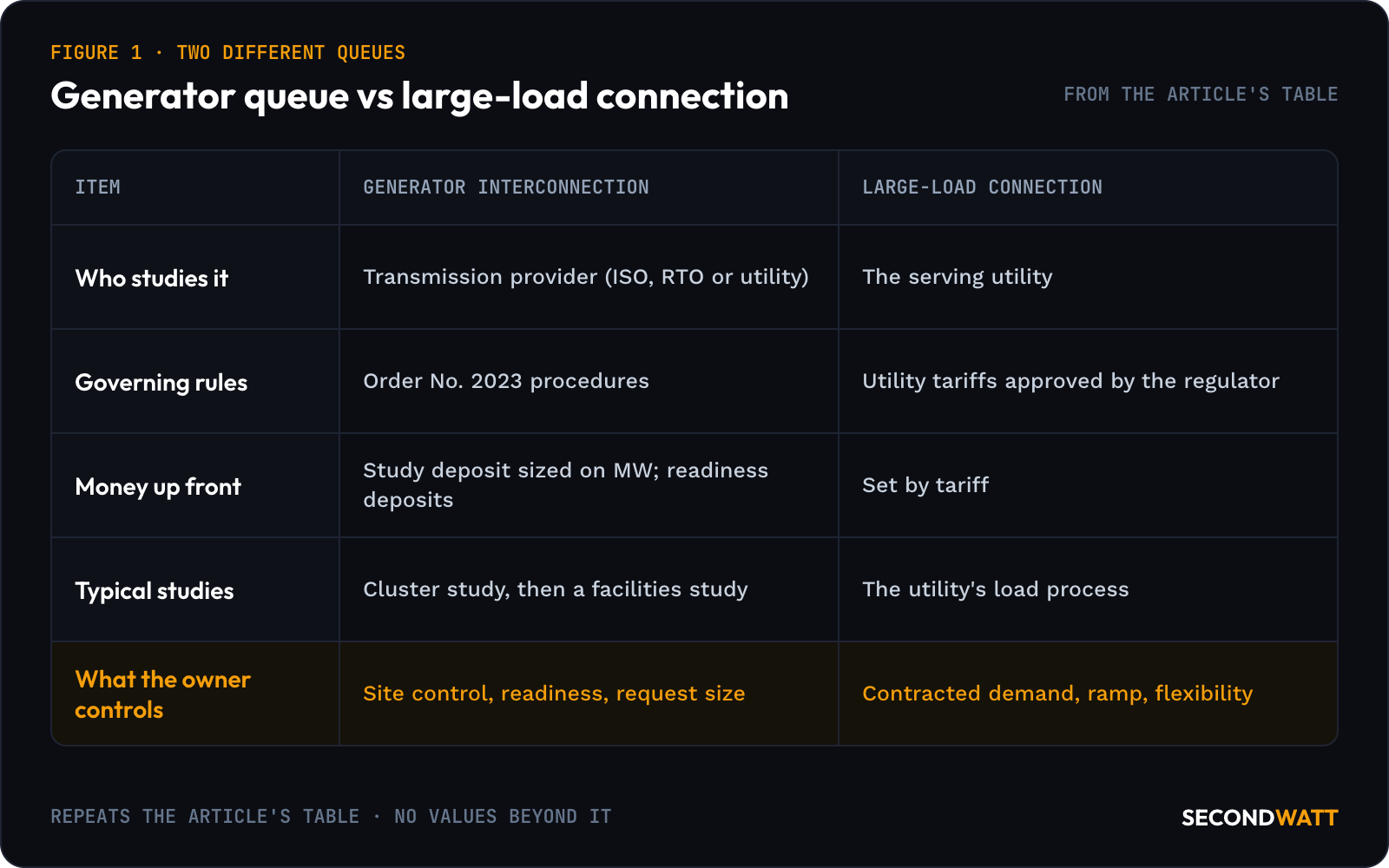
The generator column follows FERC's explainer on Order No. 2023.
In California, a load customer submits its request to the utility, according to a CAISO large-load information session on 5 February 2026. Study costs, retail rates and potential cost recovery follow the utility's tariff, approved by the local regulatory authority, in many cases the CPUC. CAISO is studying 4.5 GW of data centers in its current 2025–2026 transmission plan, the presentation adds.
The table's bottom row is the useful one. A generator developer controls its readiness and the size of its request. A data center controls the demand it contracts for and how fast it ramps, and on Dominion's GS-5 schedule in Virginia those choices carry minimum charges from 2027.
Why the queue takes years#
About 2,061 GW of generation and storage was actively seeking interconnection at the end of 2025, according to LBNL's Queued Up: 2026 Edition: 1,312 GW of generation and 749 GW of storage. Active natural gas capacity rose 86% in 2025, to 253 GW.
Request-to-operation times have trended up, although the median declined slightly in 2025. Projects built in 2008 took a median 22 months from interconnection request to commercial operation, and those built in 2015 took 36 months. In-service dates were available for 73% of operational projects.
61 months — the median time from interconnection request to commercial operation for projects built in 2025, in the regions with data, according to LBNL's Queued Up: 2026 Edition.
About 19% of projects, and 13% of capacity, that requested interconnection from 2000 to 2020 had reached commercial operation by the end of 2025. Of that capacity, 75% had withdrawn and 10% was still active. More than 750 GW withdrew in 2025, while about 600 GW of new requests arrived.
FERC issued Order No. 2023 on 28 July 2023 to reduce interconnection backlogs at the transmission providers it regulates, and it took effect on 6 November 2023. It replaces first-come, first-served serial studies with first-ready, first-served cluster studies.
Interconnection customers must show 90% site control at the request and 100% when they sign the facilities study agreement. Under limited circumstances, where regulatory limits may prohibit site control, a deposit can stand in. FERC's explainer says a withdrawal penalty applies when a withdrawal has a material impact on the cost or timing of requests with an equal or lower queue position. During the transition, customers already in the queue could choose, depending on their request's progress, a transitional study or withdrawal without penalty.
Order No. 2023-A, issued 21 March 2024, revised or clarified parts of the rule. Providers implement both through compliance filings that FERC approves. Most of LBNL's data pre-date that implementation, and LBNL judges it too early to measure the full effect.
How utilities handle large data center loads#
State commissions have begun writing terms for very large loads into utility tariffs; Virginia is one example. Dominion must implement Rate Schedule GS-5 from 1 January 2027. The requirement comes from the State Corporation Commission's final order of 25 November 2025 in Dominion's 2025 biennial review, Case No. PUR-2025-00058. The class covers customers with a measured or contracted demand of 25 MW or more on a contiguous site, and a measured or expected load factor of at least 75%.
For customers taking initial service and signing an electric service agreement on or after 1 January 2027, the contract term is 14 years. It may include a load ramp of up to four years, with a minimum annual ramp of 20%. If such a customer ceases operations or defaults during the term, it pays an exit fee covering the remaining minimum charges, subject to capacity reassignment.
The class's minimum charges are 85% of contracted demand for distribution and for transmission, and 60% for generation, with exemptions for some legacy customers and for necessary and planned maintenance.
Collateral adds an up-front commitment. For the same new customers, the order approves $1.5 million per MW (nominal 2025 dollars), reducible by up to 70% on the customer's established credit. One-fourteenth of the requirement is released each year of the contract term. Worked example at the 25 MW class threshold (measured or contracted demand), in the order's nominal 2025 dollars:
- Collateral: 25 MW demand × $1.5 million (2025) per MW = $37.5 million (2025). With the full 70% reduction, $37.5 million (2025) × 0.30 = $11.25 million (2025).
- Yearly release: $37.5 million (2025) ÷ 14 = about $2.68 million (2025), or $11.25 million (2025) ÷ 14 = about $0.80 million (2025).
- Minimums on 25 MW of contracted demand: 25 MW × 0.85 = 21.25 MW for distribution and for transmission, and 25 MW × 0.60 = 15 MW for generation.
Dominion also had to file its new large-load interconnection queue process in a separate proceeding by 2 February 2026, under the same order.
On 9 July 2025, the Public Utilities Commission of Ohio ordered AEP Ohio to file new tariffs applying to data centers, in Case No. 24-508-EL-ATA. A finding and order approving AEP Ohio's final tariffs followed on 23 July 2025. The case docket shows rehearing applications denied on 3 September 2025 and a notice of appeal to the Supreme Court of Ohio filed on 3 November 2025.
A federal track runs alongside. On 18 June 2026, FERC issued show cause orders on large loads to all six regional grid operators (PJM, MISO, SPP, CAISO, ISO-NE and NYISO) and their transmission owners. Each had 60 days to show why its current tariffs remain just and reasonable, or to file changes. FERC describes the orders as advancing the directives of the Secretary of Energy's advance notice of proposed rulemaking, which the RM26-4 guide covers.
Where on-site generation fits#
The trigger for a generator request depends on the connection and on export. Sheet 15 of PG&E's Electric Rule 21, effective 17 April 2025, shows where one utility draws the line. Generating facilities seeking interconnection with PG&E's transmission system apply to CAISO, under the CAISO tariff. Two groups are excepted: certain net-metering and net-billing facilities of 1 MW or less, and facilities that neither export to the grid nor sell any exports.
Non-export facilities subject to CPUC jurisdiction interconnect under Rule 21 itself, on the distribution or the transmission system. So a CPUC-jurisdictional non-export plant there still connects through PG&E.
PJM draws its line in a tariff definition, described in FERC's order of 18 June 2026 in Docket EL25-49-002. Behind-the-meter generation there delivers energy to load without using the transmission system. It may use distribution facilities only if their owner or lessee has consented and that consent has been demonstrated to PJM's satisfaction.
Two portions are excluded: capacity designated as a Generation Capacity Resource, and, in any hour, output sold to another entity for use elsewhere or into PJM's energy market. FERC's order of 18 December 2025 found PJM's retail behind-the-meter netting rules no longer just and reasonable and directed PJM to revise them.
FERC's fact sheet on Docket EL25-49-000 says that December order also directed PJM to set transparent rules for serving data centers and other large loads co-located with generators. PJM was to clarify in its tariff that a customer serving co-located load with a newly interconnecting generator may request interconnection service below the generator's maximum facility output. The June 2026 order set aside parts of the December order and directed a further compliance filing. The behind-the-meter guide compares the configurations in detail.
The queue against on-site equipment dates#
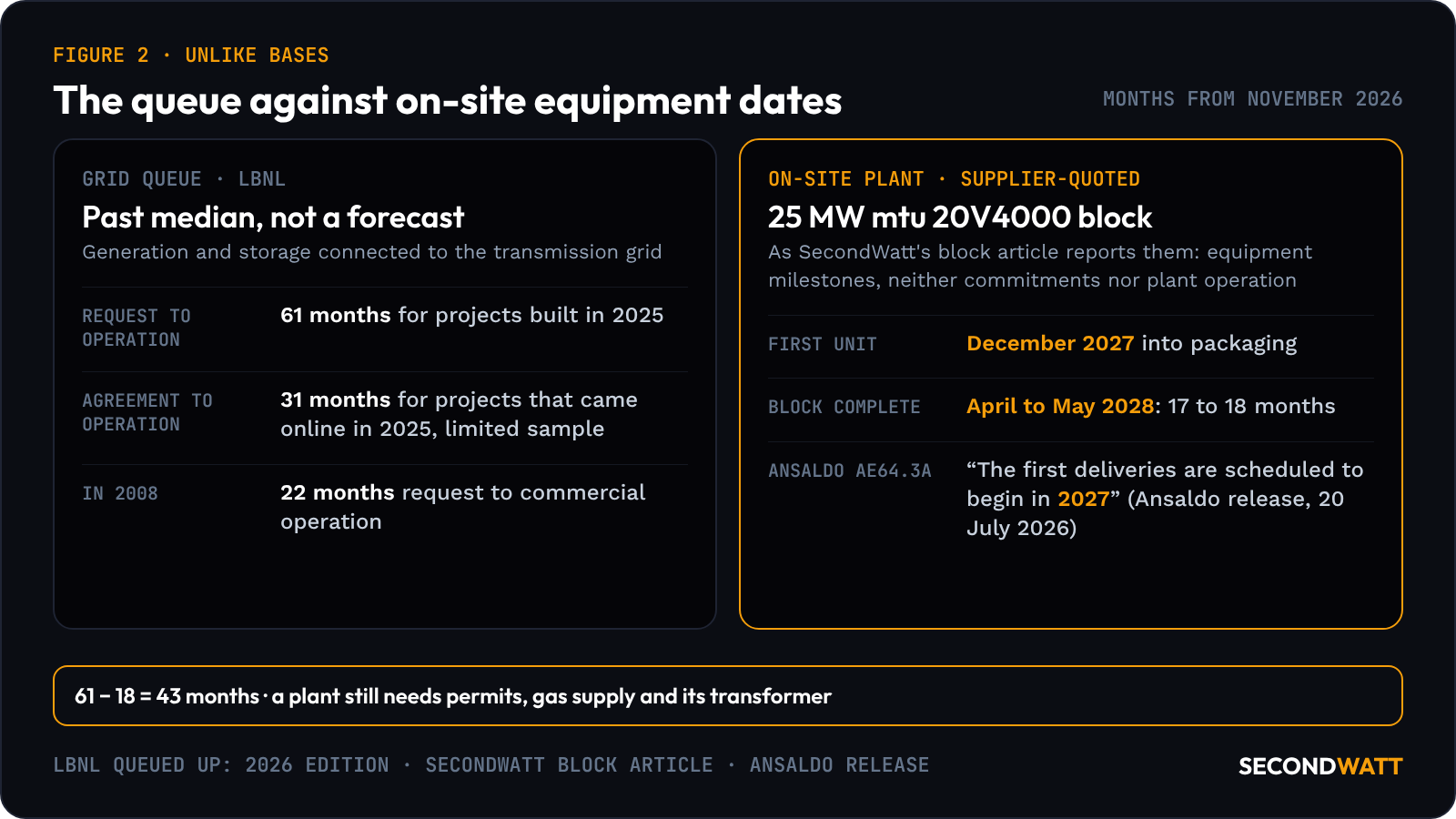
The 25 MW mtu 20V4000 gas power block is rated 25.18 MW gross, 60 Hz, at mtu datasheet conditions. It carries two supplier-quoted dates, as SecondWatt's block article reports them: first engine-generator into packaging in December 2027, and ten units and the E-house complete in April to May 2028. Every other span on its schedule is planning logic. Its scope ends at 13.8 kV, and the step-up transformer and interconnection belong to the buyer.
Eight Ansaldo Energia AE64.3A gas turbines in a 60 Hz configuration, with their generators, are under contract to Pacifico Energy for a project supporting a data center in Texas. "The first deliveries are scheduled to begin in 2027," in the words of Ansaldo's release of 20 July 2026.
The comparison counts months from November 2026:
- block complete, April to May 2028: 17 to 18 months;
- LBNL's 2025 median, request to commercial operation: 61 months;
- 61 − 18 = 43 months, and 61 ÷ 18 = 3.389, so the median is about 3.4 times the later end of the quoted window.
The two sides are unlike, and the difference matters. The block dates are equipment milestones quoted by a supplier; they are neither commitments nor plant operation. The 61 months is a past median for generation and storage projects connected to the transmission grid, not a forecast for any request. A plant still needs permits, gas supply and its transformer, and a grid-parallel plant meets the utility's own process.
31 months — the median from interconnection agreement to commercial operation for projects that came online in 2025, up from 21 months in 2008, on the limited sample in LBNL's Queued Up: 2026 Edition.
Long agreement-to-operation spans come largely from factors outside the interconnection process, such as procurement and offtake, permitting and transmission completion, in LBNL's reading. A buyer comparing routes should line up each dependency with a date and a source.
Options while you wait#
Five options recur, and each changes the schedule in a different way.
- Bridge power carries the load until the permanent supply is ready; the bridge power guide covers the plan, and the mobile gas turbine guide covers trailer-mounted units.
- Behind-the-meter generation serves the load directly, under the export and behind-the-meter rules in the previous sections.
- Phased energization takes grid power in steps, as the load ramp in Dominion's GS-5 contract allows.
- Flexible or curtailable service can let a load connect sooner if it accepts curtailment.
- A microgrid, as a DOE fact sheet defines it, groups loads and distributed energy resources into one controllable entity that can run grid-connected or in island mode.
One study sizes the opportunity: Rethinking Load Growth, from Duke University's Nicholas Institute in February 2025, summarized in three key takeaways. The 22 largest US balancing authorities could add nearly 100 GW of large loads if those loads accept curtailment averaging 0.5% of their maximum uptime each year. Average curtailments would last about two hours. The study calls this a first-order estimate of headroom on existing capacity.
PJM's interim service applies the same idea to transmission service, under FERC's directives. FERC directed PJM to let customers seeking network service for co-located load take a new non-firm service on an interim basis, until the network upgrades for the requested service are complete.
FAQ: interconnection queues#
How long is the interconnection queue for a data center?#
For a generator request, reaching a signed interconnection agreement took a median of about 12 to 30 months, depending on size, in LBNL's sample of agreements signed since 2010. The median was 12 months under 5 MW rated capacity and 15 months from 5 to under 20 MW. Projects of 20 MW or more hovered around 30 months; 20 MW is the line between FERC's small and large generator procedures. The load request itself follows the utility's timeline, which LBNL's figures do not cover.
What does FERC Order No. 2023 require of transmission providers?#
It requires firm study deadlines, with penalties when providers miss them (with certain exceptions), in place of the old "reasonable efforts" standard. Providers must also keep a public heatmap of available transmission capacity. The rule sits in Docket RM22-14-000, and FERC's explainer says its summary should not be relied on as a legal document.
Can a data center avoid the interconnection queue?#
Not for a grid-connected load, which still goes through the utility's connection process. What can change is whether on-site generation enters a generator queue, and that depends on export and on the territory's rules. In Rule 21's initial review, a facility that will not export must incorporate one of six listed options (Options 1, 2, 3, 4, 7 or 8), such as reverse power protection. The requirement sits on Sheet 147 of PG&E's Rule 21, in the version effective 29 August 2025.
Can a customer on a large-load tariff such as GS-5 cut its contracted capacity?#
Yes, within limits, on Dominion's GS-5 in Virginia. During the contract term, a GS-5 customer may cut contracted capacity by up to 20% at no cost, and by a further 30% if another customer agrees to take it over. Each reduction needs a separate 36-month notice under the State Corporation Commission's final order of 25 November 2025.
Is on-site generation faster than waiting for the grid?#
Quoted equipment dates can be, but equipment is one dependency among several. OEM slots and transformer deliveries carry their own lead times, covered in the turbine OEM backlog review and the transformer lead-time guide. The how SecondWatt works guide covers when waiting for the grid fits the schedule.
Sourcing power while the queue moves#
SecondWatt publishes equipment research and helps buyers source power equipment; it earns a fee when a sale it arranges closes. If your grid date is years out, send a request with the site, the load ramp and the date you need power. If you own generation or electrical equipment that could serve a waiting project, list it with SecondWatt.