
Renewable diesel, also called HVO (hydrotreated vegetable oil), is a diesel fuel made from fats and oils. The DOE Alternative Fuels Data Center (AFDC) notes that it is processed to be chemically the same as petroleum diesel. Standby generators can run on it when the engine maker approves it. Caterpillar, Cummins, Rolls-Royce (mtu) and Kohler have published HVO approvals for named diesel generator sets or engines.
For owners of diesel standby generators, three documents decide whether a set may switch: the OEM approval for that engine family, the fuel standard the approval names, and the site's air permit.
Key Takeaways
- Renewable diesel and biodiesel are different fuels. Renewable diesel is a paraffinic hydrocarbon, most often from hydrotreated fats and oils; biodiesel is a fatty acid methyl ester made by transesterification.
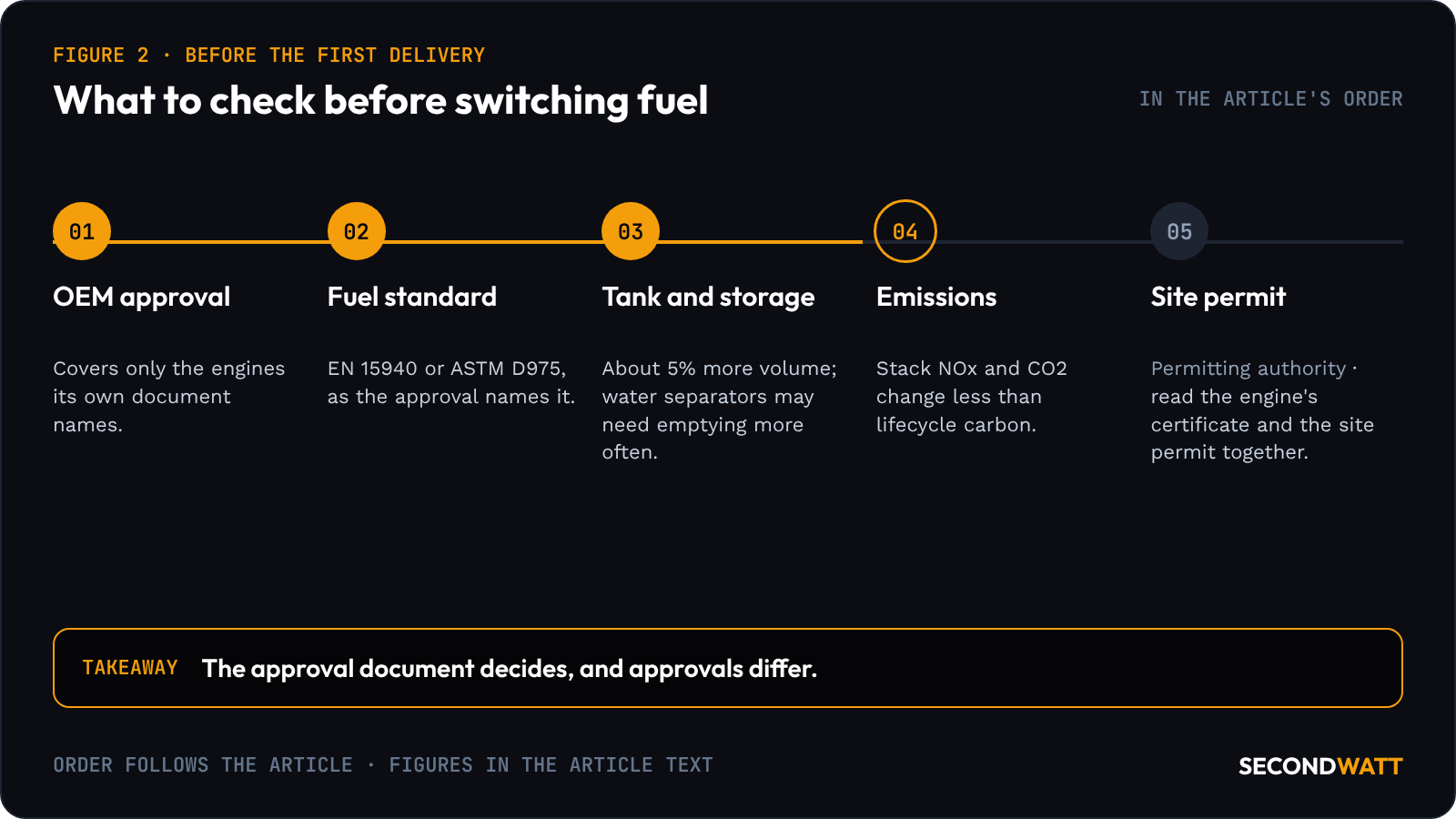
- The approval document decides, and approvals differ. Caterpillar accepts HVO meeting EN 15940 or ASTM D975 in all its diesel sets; Cummins requires EN 15940 and excludes some QSX15 configurations.
- Plan for about 5% more fuel by volume. CARB's energy densities imply about 3.7% more; Caterpillar expects about 5%, and Cummins says to add 5% to data-sheet values.
- Lifecycle carbon depends on the feedstock pathway. At one Washington plant, CARB has certified CA-GREET3.0 pathways at 20.69 gCO2e/MJ for used cooking oil and 58.10 for soybean oil.
- Stack NOx and CO2 change less than lifecycle carbon. On 100% HVO in a 3500 Series set, Caterpillar expects diesel-equivalent NOx above 50% load; tailpipe CO2 may not fall significantly.
What renewable diesel is#
Renewable diesel is a hydrocarbon, most often made by hydrotreating: the fat or oil reacts with hydrogen at high temperature and pressure over a catalyst. Commercial plants use that route today, with fats, oils and greases as the most common feedstocks. EIA's Biofuels explained page says most renewable diesel is hydroprocessed esters and fatty acids (HEFA), made by hydrogenating triglycerides.
As a drop-in fuel, renewable diesel meets the ASTM D975 specification for petroleum diesel, the same EIA page says. The AFDC adds that it meets EN 15940, the standard for paraffinic diesel fuels. Federal fuel rules at 40 CFR 1090.80 define it as diesel fuel made from renewable feedstocks that "is not a mono-alkyl ester."
A 16 May 2024 Cummins article notes that R100 and HVO are other names for the same product.
Renewable diesel vs biodiesel#
Four fuels can end up in a standby tank. Each ASTM standard below is the active edition on ASTM's page as of 7 Nov 2026.
Diesel fuels for standby generators: chemistry, standard and storage, from ASTM, AFDC, EIA, Caterpillar and Cummins documents#
| Fuel | Chemistry | Fuel standard | Blending, as OEMs state it | Storage note |
|---|---|---|---|---|
| Petroleum diesel | Petroleum distillate | ASTM D975-26c: seven grades, six set by sulfur limit and use, plus Grade No. 4-D heavy distillate | Base fuel | D975 sets properties "at the time and place of delivery," unless otherwise agreed |
| Renewable diesel (HVO, R100) | Paraffinic hydrocarbon, most often from hydrotreated fats and oils | Meets D975 (AFDC, EIA); meets EN 15940 (AFDC) | Any blend with diesel (Caterpillar, Cummins); Caterpillar requires the blend to meet EN 15940 or D975 | Shelf life similar to or longer than diesel (Caterpillar) |
| Biodiesel B100 | Mono-alkyl ester (FAME) made by transesterification | ASTM D6751-24: six grades of B100 as a blend component | More than 5% biodiesel not recommended in standby sets, for oxidation stability (Caterpillar) | Much shorter shelf life; not recommended for standby (Caterpillar) |
| Biodiesel blends B6 to B20 | 6% to 20% biodiesel by volume; the rest light middle or middle distillate diesel to D975, with stated exceptions | ASTM D7467-23 | Above Caterpillar's 5% standby guidance | Biodiesel storage "needs careful consideration" (Caterpillar) |
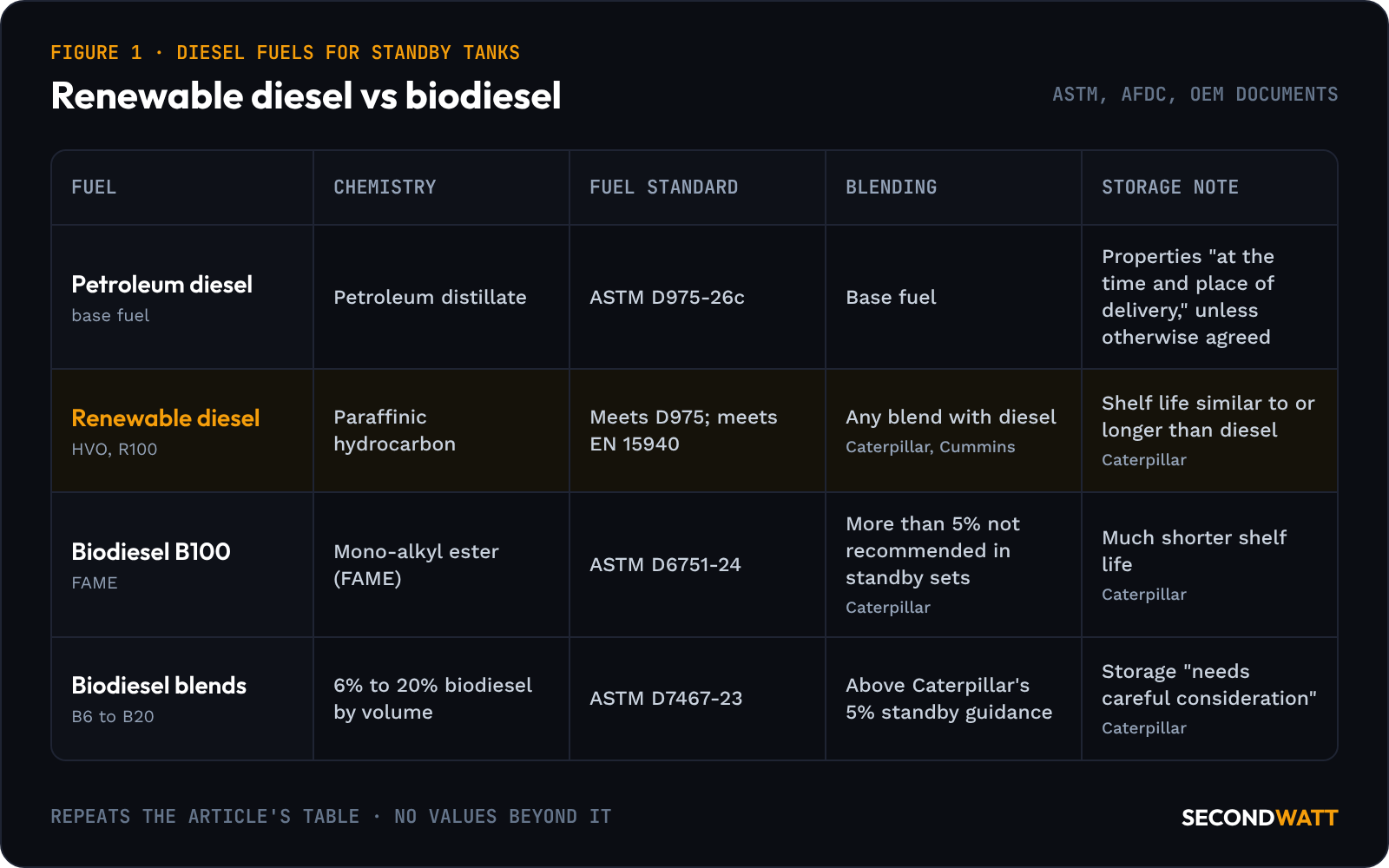
Cummins' HVO FAQ, Bulletin 6408485, says the two renewable fuels can come from the same feedstocks through different processes. Biodiesel keeps oxygenated groups that can weaken fuel stability. Hydrotreating leaves none, which helps HVO's oxidation stability.
Which generator makers approve HVO#
Each approval covers only the engines and the fuel standard its own document names. The table holds one row per document, each current as of 7 Nov 2026.
OEM approvals of HVO for diesel generator sets, from current OEM documents#
| OEM | Approval statement (quoted) | Engines or sets covered | Fuel standard named | Document and date |
|---|---|---|---|---|
| Caterpillar | "HVO can be used in all Cat generator sets if it meets either EN15940 or ASTM D975 specifications." | All Cat generator sets; experience cited from 3500 and C175 Series at 50 and 60 Hz | EN 15940 (preferred) or ASTM D975 | Renewable Liquid Fuels FAQ for 3500 and C175 Series, cat.com, no date printed |
| Cummins | "Cummins approves use of HVO fuel in all* generator sets." | All generator sets except some QSX15-powered configurations; engines in G-Drive applications only if the application is standby | EN 15940 ("Cummins requires") | Frequently asked questions on HVO fuel, Bulletin 6408485, Rev. 10/24 |
| Cummins | "an entire line of diesel generator sets that are approved for use with paraffinic fuels such as HVO in Power Generation standby applications" | Diesel generator sets in standby applications | EN 15940 described, not stated as a condition | Newsroom article, 1 Jul 2022 |
| Rolls-Royce (mtu) | "approved its Series 1600 and Series 4000 generator sets for use with EN15940 synthetic diesel fuels" | mtu Series 1600 and Series 4000 generator sets | EN 15940 | Press release, 11 May 2022 |
| Rolls-Royce (mtu) | "HVO and GtL fuels meeting fuel specification EN15940" (standard features) | 16V4000 DS2250, 2,250 kWe standby, 60 Hz | EN 15940 | Spec sheet 231208, 2026-03 |
| Kohler | "these engines are approved for hydrotreated vegetable oil (HVO)" | KOHLER G-Drive KD Series engines, KD18L06 to KD103V20 | None named in the brochure | KD Series Engines brochure WF76900, 2/23 |
The fuel-standard column is where approvals part ways. A delivery certified only to ASTM D975 fits the wording of Caterpillar's HVO FAQ. Cummins' Bulletin 6408485 says fuel for its sets must comply with EN 15940, from any supplier. EN 15940 is also the standard named for mtu Series 1600 and Series 4000 sets in a Rolls-Royce release of 11 May 2022.
Scope limits matter on a mixed fleet. "Some configuration of QSX15 powered generator sets" are carved out of the Cummins approval, and Cummins engines in G-Drive applications are approved only for standby. The mtu spec sheet 231208 for the 16V4000 DS2250 lists "Diesel #2/HVO" as the recommended fuel. Owners of a Cat 3516E, Cummins QSK60 or mtu 16V4000 should keep the matching approval in the site file.
2% — the approximate power derate Caterpillar expects most 3500 Series sets to see on HVO, and as much as 5% depending on environmental and specific fuel properties.
Output can dip because HVO carries less energy. Most C175 Series operators should see no derate, by Caterpillar's estimate. Cummins' Bulletin 6408485 puts the potential mechanical power loss on its sets at 1–2%. Most Cummins ratings have enough margin to need no generator set derate.
Fuel standards, NFPA 110 and storage#
In its published scope, ASTM D975-26c "prescribes the required properties of diesel fuels at the time and place of delivery," unless purchaser and supplier agree otherwise. D6751 and D7467 use the same delivery-point phrase, but by purchaser–supplier agreement their requirements may also apply at other points in production and distribution.
NFPA 110, the standard for emergency and standby power systems, is in its 2025 edition, as NFPA's page for the standard shows. The NFPA 110 guide covers classes and testing.
HVO's lower energy density changes the fuel volume a set needs. In Table 4 of CARB's Low Carbon Fuel Standard regulation, diesel carries 134.47 MJ/gal and renewable diesel 129.65 MJ/gal, as lower-heating-value energy densities. Matching the energy takes 134.47 ÷ 129.65 = about 1.037 gallons of renewable diesel per gallon of diesel, about 3.7% more. The OEM guidance is higher: Caterpillar expects "approximately 5%" more volume, noting "Tank sizing may need to be considered," and Cummins says to add 5% to data-sheet values.
Storage routines change little. Apart from some QSX15 configurations, Cummins' Bulletin 6408485 gives the same maintenance, polishing and storage recommendations for HVO and diesel, and most polishing systems work with either fuel unmodified. Water and dirt contamination risks stay the same. Polishing frequency could be reduced "if fuel test data can show a trend where fuel is clean, dry & sediment free," in Cummins' words.
Water handling is one difference. Caterpillar's HVO FAQ says HVO "does shed water more easily than diesel," so water separators may need emptying more often, depending on the fuel's exposure to moisture. The fuel polishing guide covers the equipment side.
Cold flow comes from the supplier's data. HVO's cold weather properties are similar to #2 diesel, Caterpillar says, but sites that use a winter diesel blend should ask the HVO supplier. Cummins says the supplier should confirm the fuel works at all site ambient conditions; "traditional methods of fuel blending or anti-gelling agents may not be effective." Cummins' 16 May 2024 article names cloud point and cold filter plugging point as the attributes to check.
Seal compatibility is documented for Cat sets. Caterpillar's HVO FAQ says Cat fuel system elastomeric seals have gone through aging tests in HVO. They are compatible with 100% HVO and any blend with diesel.
Emissions: at the stack and across the lifecycle#
Diesel generator emissions at the stack shift with engine and load. On 100% HVO in a 3500 Series set, Caterpillar's HVO FAQ expects NOx to be lower below 50% load and equivalent to diesel above it. Filter Smoke Number should fall about 60% above 30% load, with a similar cut in particulate matter.
On a C175-20 50 Hz set burning 100% HVO, Caterpillar measured NOx equivalent to diesel above 35% and below 15% of rated power. NOx rose slightly between 15% and 35%. Smoke number was about 40% lower above 30% load. Cummins' Bulletin 6408485 reports comparable NOx and lower PM on its sets.
Rolls-Royce's release of 11 May 2022 makes a vendor claim. It says HVO cuts nitrogen oxide emissions "by an average of eight percent" and particulates by up to 80 percent against fossil diesel. The release states those figures for HVO in general, with no engine, load or test cycle.
The larger change is lifecycle carbon. Caterpillar says tailpipe CO2 "may not significantly" fall, but lifecycle CO2 can, because the fuel's carbon is biogenic. California's Low Carbon Fuel Standard (LCFS) scores this as carbon intensity, which § 95481 of the regulation defines as life cycle greenhouse gas emissions per unit of fuel energy, in gCO2e/MJ. The program covers California's transportation fuel pool.
Each producer's pathway carries its own certified score, listed on CARB's LCFS Pathway Certified Carbon Intensities page. Across those certified scores, renewable diesel averages 65% below petroleum diesel, the AFDC says. Feedstock moves the score even at one plant. BP's Cherry Point refinery in Blaine, Washington, holds two CA-GREET3.0 pathways, for used cooking oil and soybean oil, both certified 4 Jun 2026, according to CARB's Current Fuel Pathways spreadsheet.
20.69 gCO2e/MJ — CARB's certified carbon intensity for renewable diesel from North American used cooking oil at BP Cherry Point (pathway RND001B08490500, CA-GREET3.0, 2026), against CARB's current CA-GREET4.0 lookup value of 105.76 for ULSD.
Worked example, one set's annual test fuel. The mtu 16V4000 DS2250 burns 617 L/h at 100% of its 2,250 kWe standby rating at 60 Hz, according to spec sheet 231208. Assume 50 hours of full-load testing a year, as an illustration. The sheet does not name the fuel behind 617 L/h, so the example treats it as diesel and assumes the engine needs the same fuel energy on either fuel.
- Diesel volume: 617 L/h × 50 h = 30,850 L ÷ 3.785411784 L/gal = 8,149.71 gal.
- Fuel energy: 8,149.71 gal × 134.47 MJ/gal = about 1,095,892 MJ.
- ULSD at 105.76 gCO2e/MJ (Table 7-1 lookup value): about 115.9 t CO2e.
- Used cooking oil pathway at 20.69: about 22.7 t CO2e, a saving of about 93.2 t (80.4%).
- Soybean oil pathway RND005B08490200 at 58.10: about 63.7 t CO2e, a saving of about 52.2 t (45.1%).
The ULSD value is the CA-GREET4.0 figure in Table 7-1 of the LCFS regulation, in force since 1 Jul 2025, and replaced CA-GREET3.0's 100.45. Both BP pathways remain CA-GREET3.0 certifications, so model versions differ. The same energy as renewable diesel is 1,095,892 ÷ 129.65 = about 8,452.7 gallons.

Engine certification and permits#
Subpart IIII can tie engine operation to the maker's instructions. Under paragraph (a) of 40 CFR 60.4211, except as paragraph (g) permits, an owner or operator who must comply with the subpart's emission standards must operate and maintain the engine and control device "according to the manufacturer's emission-related written instructions." The same paragraph allows only emission-related setting changes the manufacturer permits and requires meeting 40 CFR part 1068 as it applies.
Subpart IIII also sets a fuel rule. Under § 60.4207(b), beginning 1 October 2010, owners and operators of stationary CI engines subject to the subpart, with displacement under 30 liters per cylinder, that use diesel fuel must use fuel meeting 40 CFR 1090.305 for nonroad diesel. Fuel obtained before that date could be used until depleted. With the exceptions in § 1090.300(a), section 1090.305 sets a 15 ppm sulfur maximum and either a cetane index of at least 40 or aromatics of at most 35 volume percent.
The two parts define diesel fuel differently. Subpart IIII's definition, in § 60.4219, is any liquid "obtained from the distillation of petroleum with a boiling point of approximately 150 to 360 degrees Celsius." Part 1090 counts renewable diesel fuel as diesel fuel in § 1090.80. How a permit applies those terms is a question for the permitting authority.
On certification, the OEM documents speak for their own engines. Cummins' Bulletin 6408485 says EPA Tier 2 certification and TA Luft 2g compliance are not affected by HVO on its sets. Standard emissions data sheets apply for submittals and permitting. HVO may raise fuel consumption slightly, which permits that measure fuel consumption must account for, and site permits are issued "at the discretion of local authorities."
Adjusting an engine to recover lost power "may cause a user to violate regulatory requirements," with EPA's anti-tampering provisions as Caterpillar's example. Read the engine's certificate and the site permit together before the first delivery. The Tier 4 guide covers what Tier 4 Final requires, and the 2026 diesel generator procurement guide covers buying diesel sets for data centers.
Supply and price#
On 1 January 2026, 19 US plants could make 324 thousand barrels a day of renewable diesel and other biofuels, says EIA's 24 Sep 2026 capacity report. A year earlier, EIA's 1 Jan 2025 report put the figure at 308. Both include renewable jet fuel, naphtha and refineries co-processing renewable feedstock.
Production fell in 2025 and rose in 2026. US output was 2,946 million gallons in 2025, against 3,194 million in 2024, in Table 10.4b of the EIA Monthly Energy Review released 29 October 2026. July 2026 output of 331.5 million gallons is the highest month in the table, which starts in January 2011. January to July 2026 ran about 16.2% above the same months of 2025.
Demand sits mostly in one state. Nearly all renewable diesel made or imported in the US is used in California, because of the Low Carbon Fuel Standard, the AFDC says.
Retail prices are published for California in the July 2026 Clean Cities and Communities Alternative Fuel Price Report. In prices provided between 1 and 31 July 2026, renewable diesel averaged $6.42 a gallon there against $6.38 for diesel, both nominal 2026 retail prices at the pump.
FAQ: renewable diesel for generators#
Can a diesel generator run on renewable diesel without modification?#
For approved engines, yes, in the makers' own words. "Standard diesel generator sets can utilize 100% HVO," Caterpillar says, with no software or setting changes. A 1 Jul 2022 Cummins article says approved Cummins engines need no hardware or software changes, and Cummins standard and extended warranties apply. "No adaptation is needed," says Kohler's KD Series engine brochure.
Is HVO the same as biodiesel?#
No. Federal fuel rules at 40 CFR 1090.80 list them as two kinds of nonpetroleum diesel fuel: "renewable diesel fuel or biodiesel." The AFDC notes that biodiesel is approved for blending with petroleum diesel, while renewable diesel can replace it or be blended in any amount. Caterpillar adds that oil changes may come sooner on 100% biodiesel, while 100% HVO is expected to keep diesel's maintenance intervals.
Does renewable diesel reduce NOx?#
In a CARB study, only the engine without SCR or a DPF showed lower NOx. UC Riverside ran the study, whose final report is dated November 2021. In that 2009 off-road engine, 100% renewable diesel cut NOx about 5% and PM about 30%, according to a CARB notice. In a 2019 on-road and a 2018 off-road engine with SCR and DPF aftertreatment, its NOx was no different from conventional diesel.
How long can renewable diesel be stored?#
More than 12 months, in Caterpillar's FAQ, which rates HVO's shelf life "similar or longer" than diesel's. Cummins says HVO from reputable suppliers tends to form less sediment than ULSD in long storage and is not susceptible to bacterial growth. It "can be stored long-term," in Kohler's brochure.
Does renewable diesel meet the EN 590 diesel standard used in Europe?#
All but its density limit, by Caterpillar's account: "Everything except density." The AFDC notes that renewable diesel does not meet EN 590's minimum density requirement. Cummins' Bulletin 6408485, Rev. 10/24, gives EN 15940's minimum flash point as 55 °C. Fuel with a higher flash point can be used where local rules require it.
Sourcing generators for renewable diesel#
SecondWatt publishes equipment research and helps buyers source power equipment; it earns a fee when a sale it arranges closes. Buyers adding sets for HVO can request equipment and ask for each unit's engine family and the OEM approval that covers it; owners can sell generators with their fuel and maintenance records.