
A short list of gas turbine manufacturers builds machines in the sizes that data center power plants use. Six of them are covered here: Ansaldo Energia, GE Vernova, Baker Hughes, Siemens Energy, Mitsubishi Power and Solar Turbines. Their models fall into three classes: aeroderivative, industrial and heavy-duty. The useful comparison is model by model, on one rating basis.
GE Vernova's LM6000 is the reference point here, because alternatives matter most when an LM6000 slot is hard to get. Ansaldo Energia's AE64.3A gets the closest look, after its July 2026 order for a Texas data center project. The sections below compare it with the LM6000 PF+ Sprint line by line and count how many of each cover a 150 MW load. The gas turbines hub links every model page used here.
Key Takeaways
- Six makers cover three classes. Aeroderivative, industrial and heavy-duty models from Ansaldo, GE Vernova, Baker Hughes, Siemens, Mitsubishi and Solar span 16.9 to 190 MW at ISO, on mixed bases.
- The AE64.3A is Ansaldo's small F-class turbine, at 78 MW gross, ISO. It suits 60 Hz applications through a gearbox-based configuration and dedicated generator package, in Ansaldo's words.
- Eight AE64.3A turbines were ordered for a Texas data center project. Ansaldo announced the contract on 20 July 2026; first deliveries are scheduled to begin in 2027.
- Three AE64.3A or four LM6000 PF+ Sprint units cover 150 MW with one spare, on ISO ratings. That sets 78 MW gross against 56.9 MW net, so the bases differ.
- Rating bases differ between makers. Net or gross, losses included or excluded, ISO or site, and 50 or 60 Hz change the number on a data sheet.
Who builds gas turbines for data center power#
The gas turbine manufacturers with models in data center sizes come from two backgrounds. Aircraft-engine lines produce aeroderivatives: GE Vernova's LM2500, LM6000 and LMS100, Baker Hughes' LM9000, Siemens Energy's SGT-A35 and Mitsubishi Power's FT8. Power-generation designs make up the industrial and heavy-duty classes, from Baker Hughes' NovaLT16 up to Ansaldo Energia's AE94.2. The trade-offs between the first two classes are set out in aeroderivative vs industrial gas turbines.
Class labels come from the makers. Siemens Energy calls the SGT-800 an "industrial gas turbine" on its SGT-800 page. Mitsubishi Power's H-25 page calls the H-25 a "heavy duty type" even though its ISO base rating is 41.0 MW. Size alone does not set the class, so the table below keeps each maker's own term.
For a data center buyer, class shapes start time, emissions hardware and the maintenance model. The rating basis printed beside each figure matters as much, because makers do not all count losses the same way.
Manufacturers and models by size class#
Gas turbine companies and suppliers publish their ratings on different bases, so each cell below carries the basis the maker states. Ratings are at ISO conditions. GE Vernova, Baker Hughes and Siemens Energy state natural gas fuel; the Mitsubishi Power and Solar Turbines tables name no fuel.
Gas turbine manufacturers and models by class (OEM product pages, Ansaldo's 20 Jul 2026 release and GE Vernova fact sheets GEA35743, GEA35742 and GEA35773)#
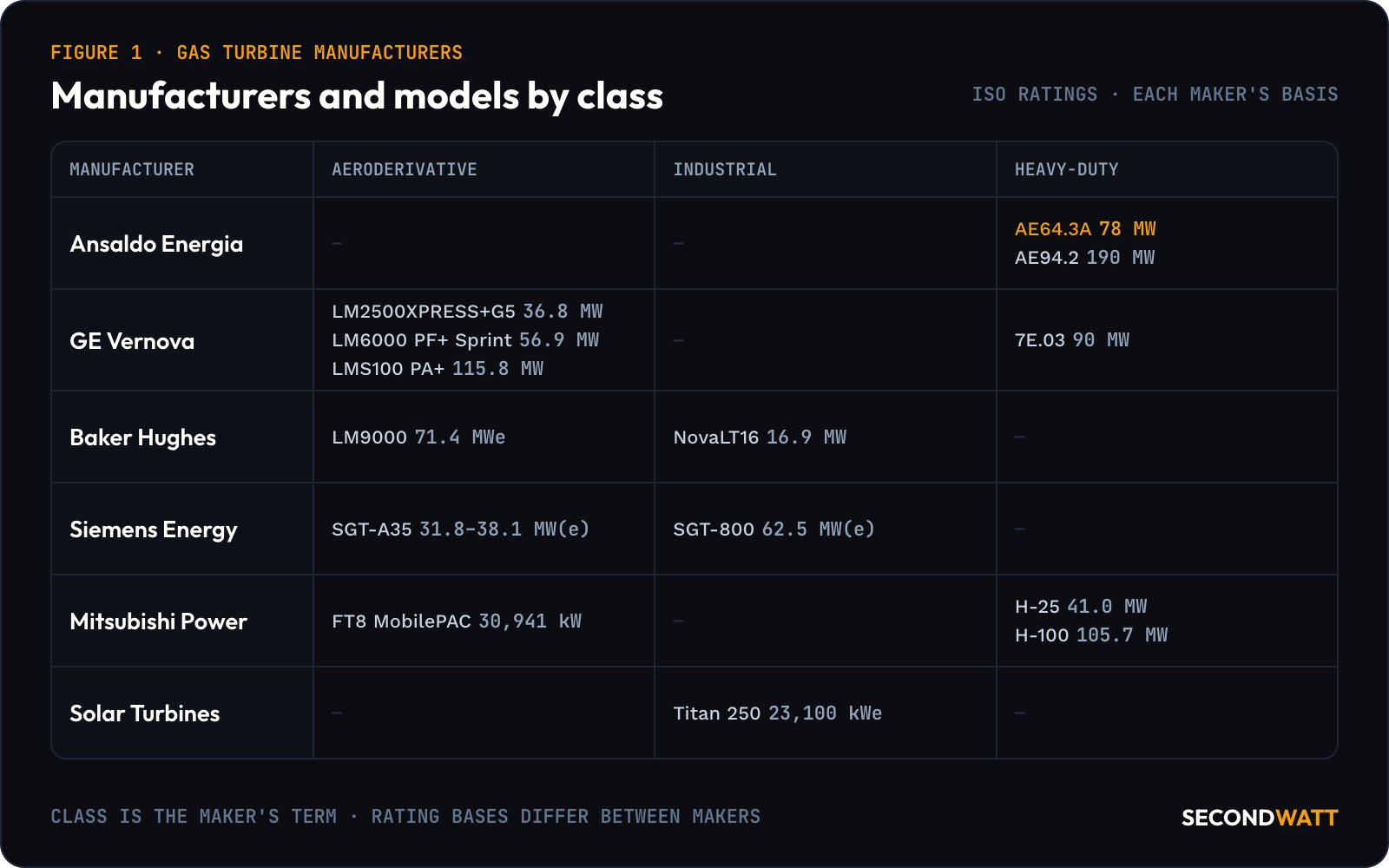
Read the last column before the number. GE Vernova's net figures for the LM6000, LM2500 and LMS100 include inlet and exhaust losses and exclude balance of plant. The LM9000, NovaLT16, SGT-800 and SGT-A35 figures leave inlet and exhaust losses out. The two Ansaldo figures are gross gas turbine output, while the Mitsubishi Power and Solar Turbines pages print an ISO rating with no net or gross label.
Ansaldo Energia's AE64.3A#
In a 20 July 2026 release, Ansaldo Energia describes the AE64.3A as "the small F-class gas turbine in Ansaldo Energia’s portfolio, specifically suited for 60 Hz applications through its gearbox-based configuration and dedicated generator package." The AE64.3A dossier carries the model history.
Ansaldo's contract with Pacifico Energy is "for the supply of eight AE64.3A gas turbines in a 60 Hz configuration, together with the associated generators." The project is "supporting a major data center infrastructure in Texas," and "The first deliveries are scheduled to begin in 2027." The release says the agreement marks "the company’s return to the USA new-build power generation market after more than thirty years."
The release gives no project output and does not say whether the plant runs in simple or combined cycle. Its claims are about the model: output range, fuel flexibility and operational versatility make it "particularly well suited to the modular and redundant architectures typically adopted by data centers," in Ansaldo's words. The release names "grid-connected and Behind-the-Meter (BTM) applications" and says the model "can also support cogeneration configurations."
78 MW — the AE64.3A's gross gas turbine power output at ISO conditions, from the ISO performance table on Ansaldo's product page.
The same table on the AE64.3A product page gives 36.9% gross efficiency and an exhaust flow of 215 kg/s at 580 °C. For an optimized combined cycle, the page lists 120 MW net plant output at 55.7% net efficiency in a 1+1, and 243 MW at 56.4% in a 2+1. Gas turbine figures there are gross and combined-cycle figures net, so each comparison below keeps its label.
The machine has a single-shaft rotor, a 15-stage compressor with variable inlet guide vanes, an annular combustion chamber and a four-stage axial turbine. The rotor design and annular combustor give "easy operation, fast start-up/hot restart time and high grid support capability," in Ansaldo's description. The product page also calls the AE64.3A "the ideal gas burner for data centres."
How the AE64.3A compares with the LM6000#
The two ratings sit on different bases. The LM6000 PF+ Sprint's 56.9 MW is a net plant rating at ISO conditions, with inlet and exhaust losses included and balance of plant excluded. The AE64.3A's 78 MW is gross gas turbine output at ISO, so the simple-cycle rows set gross against net. Combined-cycle rows are net on both sides, which makes them the closer comparison.
AE64.3A vs LM6000 PF+ Sprint (Ansaldo AE64.3A product page and 20 Jul 2026 release; GE Vernova GEA35743, 09/2025; Baker Hughes LM6000PF+ page where marked)#
| Item | Ansaldo AE64.3A | GE Vernova LM6000 PF+ Sprint |
|---|---|---|
| Simple-cycle output | 78 MW gross, ISO | 56.9 MW net plant, ISO |
| Simple-cycle efficiency | 36.9% gross, ISO | 41.0% net, LHV, ISO |
| 1-on-1 combined cycle: net plant output, net efficiency | 120 MW, 55.7% | 75.8 MW, 54.9% LHV |
| 2-on-1 combined cycle: net plant output, net efficiency | 243 MW, 56.4% | 152.0 MW, 55.0% LHV |
| Exhaust | 215 kg/s at 580 °C | 496 °C, LM6000PF+ power generation (Baker Hughes) |
| Frequency | 60 Hz through a gearbox-based configuration | 50/60 Hz |
| Fast start (maker's claim) | "fast-start capability", no time stated (release) | 5 min (GEA35743) |
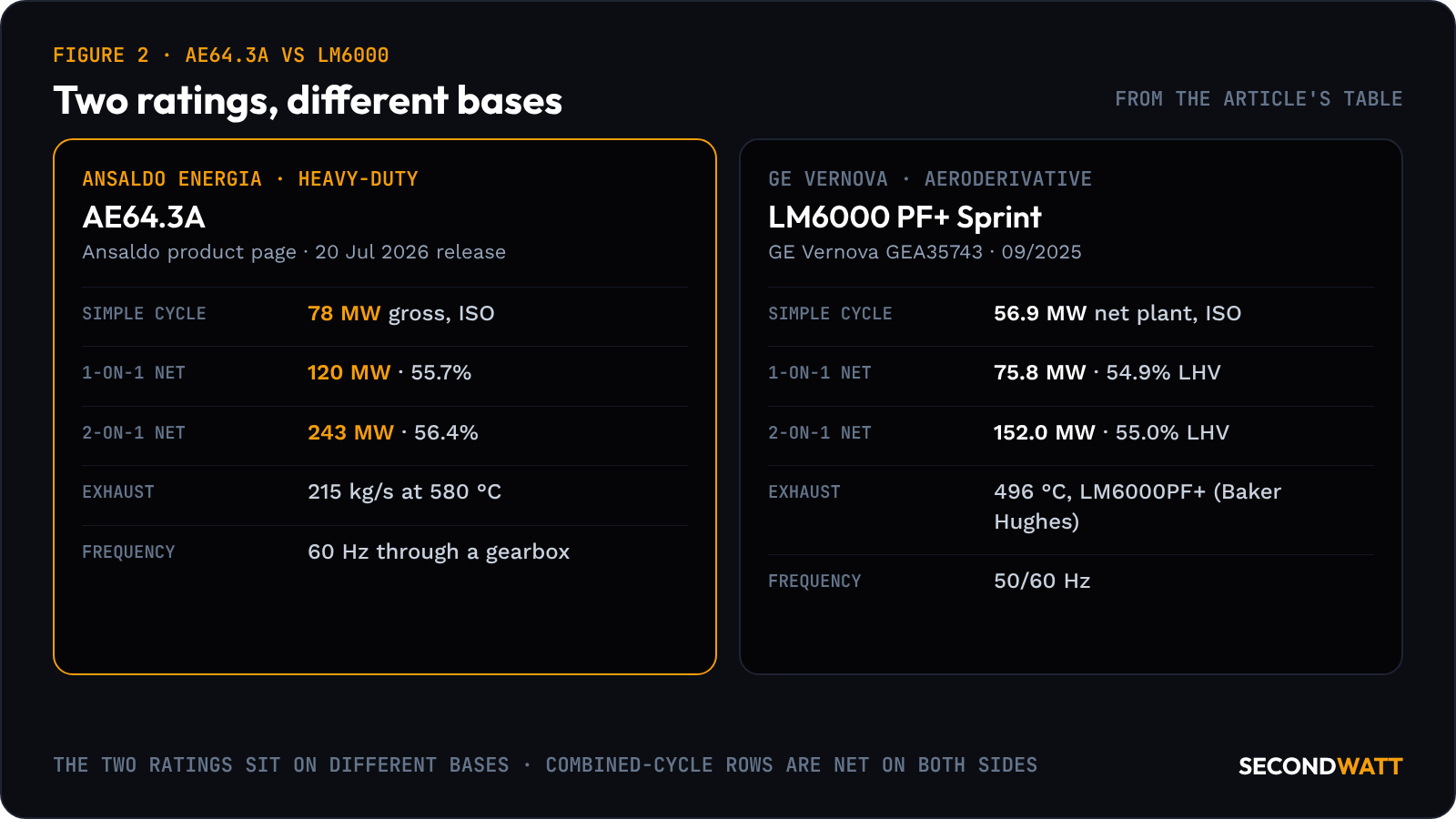
The LM6000 exhaust figure comes from the Baker Hughes LM6000PF+ page. That page rates the LM6000PF+ for 50/60 Hz power generation at 52.5 MWe at the generator terminals, at ISO-type inlet conditions with no inlet or exhaust losses. It lists NOx below 25 ppm and a 25,000-hour hot section inspection. It also lists "High power output with the possibility for an additional 4 MW when configured with SPRINT option."
The AE64.3A is the larger single machine, and its combined-cycle blocks are larger too: 120 MW against 75.8 MW net in a 1-on-1. In simple cycle, the LM6000 PF+ Sprint's 41.0% net and the AE64.3A's 36.9% gross are an unlike pair. In a 1-on-1, Ansaldo prints 55.7% net against GE Vernova's 54.9% net, LHV. Ansaldo's table names no heating-value basis, so ask for it before reading the 0.8-point gap as a lead.
Sprint itself has a cost. GE Vernova's LM6000 page says it cools the air during compression and is based on "an atomized water spray injected through spray nozzles." A site that cannot supply that water gives up the Sprint margin, as covered in LM6000 Sprint output and water requirements.
Units for a 150 MW load, worked#
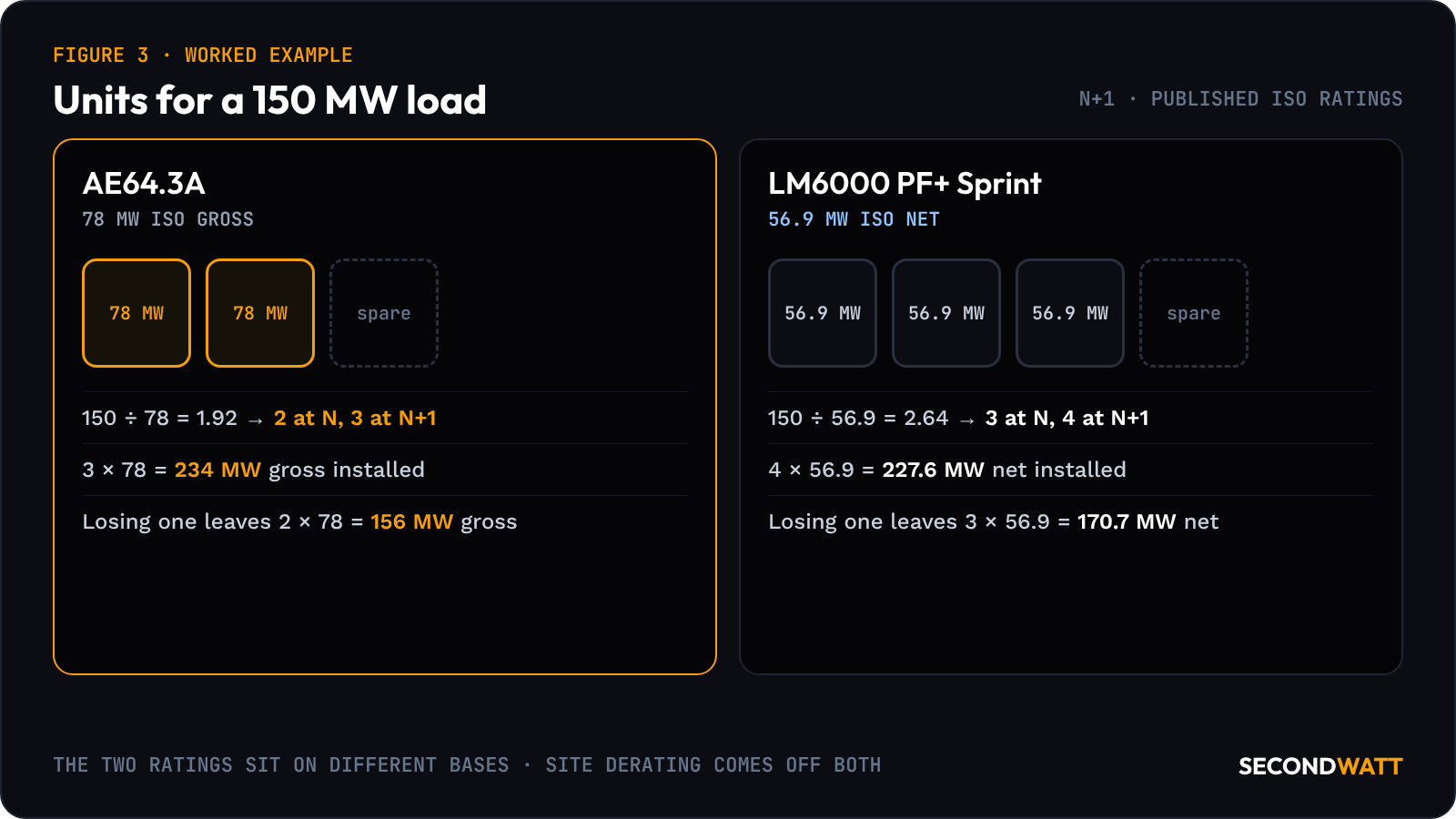
This worked example counts units for a 150 MW data center load on published ISO ratings, with one spare unit (N+1). The two ratings sit on different bases: the AE64.3A's 78 MW is gross, and the LM6000 PF+ Sprint's 56.9 MW is net, inlet and exhaust losses included. A site hotter or higher than ISO conditions lowers both, as do auxiliary load and any inlet and exhaust losses a rating leaves out.
AE64.3A, 78 MW gross, ISO: 150 ÷ 78 = 1.92, so 2 units at N and 3 at N+1; 3 × 78 = 234 MW gross installed.
LM6000 PF+ Sprint, 56.9 MW net, ISO: 150 ÷ 56.9 = 2.64, so 3 units at N and 4 at N+1; 4 × 56.9 = 227.6 MW net installed.
56.9 MW — the LM6000 PF+ Sprint's simple-cycle net plant rating at ISO conditions, 50/60 Hz, inlet and exhaust losses included, according to GE Vernova.
A second check uses Baker Hughes' LM6000PF+ rating, 52.5 MWe at the generator terminals with no inlet or exhaust losses. Then 150 ÷ 52.5 = 2.86, so 3 units at N and 4 at N+1; 4 × 52.5 = 210 MW installed at the terminals. The count does not change. On published ISO figures, gross against net, the AE64.3A plant needs one fewer machine for the same N+1 duty.
Fewer, larger units mean fewer packages, but each trip removes a bigger share of supply. With three AE64.3A, losing one leaves 2 × 78 = 156 MW gross, ISO, against the 150 MW load. With four LM6000 PF+ Sprint, losing one leaves 3 × 56.9 = 170.7 MW net, ISO.
A 6 MW margin on a gross ISO rating is thin once site derating and auxiliary load come off, so the site rating decides whether N+1 holds. Sizing for 100 MW blocks is covered in gas turbines for a 100 MW data center.
Other alternatives by class#
Start time, NOx and fuel limits can rule a model out before output is compared. Each model below gets the OEM figures the table does not carry.
Among aeroderivatives, GE Vernova's LM2500 page says the LM2500 can "ramp up from cold iron to base load within 5 minutes." Its dual-fuel dry low emissions combustion "meets 15ppm NOx when operating on gas fuel." The LMS100 page claims "an 8-minute start to full load" for the LMS100. For a three-way comparison, see LM2500 vs LM6000 vs SGT-800.
The LM9000 suits power generation "without the need of a gearbox," according to the Baker Hughes LM9000 page. The page lists NOx of 15 to 25 ppm and a 36,000-hour hot section inspection. According to Siemens Energy's SGT-A35 page, the SGT-A35 reaches 25 vppm NOx dry at 15% oxygen with its DLE option. It burns up to 15% hydrogen with DLE burners. The FT8 MobilePAC rides on two trailers and controls NOx by water injection, according to Mitsubishi Power's FT8 MobilePAC page. The page lists 10 minutes from cold start to full power.
Among industrial machines, Siemens Energy's SGT-800 page calls the SGT-800 "capable of down to 9 ppm NOx emissions." It can burn up to 75 vol% hydrogen with its DLE burners. The Baker Hughes NovaLT16 page lists 15 ppm NOx for the NovaLT16, with 9 ppm on request, and a 35,000-hour hot gas path inspection. The Titan 250 exhausts at 865 °F and lists SoLoNOx (DLE) or conventional combustion, according to the Solar Turbines Titan 250 page.
Among heavy-duty frames, the 7E.03 claims "up to 100% load in less than 10 minutes," and GE Vernova's 7E page lists 7EA among its former names. Ansaldo's AE94.2 page says the AE94.2 has two external combustion chambers and a 2-minute gas-to-oil and oil-to-gas fuel switchover.
For the H-25, Mitsubishi Power's H-25 page lists 15 ppm NOx at 15% oxygen and a 22-minute starting time. The H-100 page describes the H-100 as a two-shaft machine with a 10-minute fast start and 9 ppm NOx at 15% oxygen.
What to ask a turbine manufacturer#
A maker's data sheet answers the ISO question. A data center needs the site answer, in writing, on the same basis for every bidder. These seven questions get there.
- Rating basis: Net or gross, which losses are included, and the output at your site's temperature, altitude and humidity. Derating changes the unit count.
- Frequency and gearbox: Whether the 60 Hz configuration uses a gearbox, as the AE64.3A does, and how 50 Hz and 60 Hz versions differ in rating.
- Combustor and NOx: The guaranteed NOx level, its oxygen reference, its load range, and whether it needs water injection.
- Hydrogen: The percentage the maker will state for your combustor, and whether it is by volume. GE Vernova's LM6000 fact sheet claims "Up to 100% Hydrogen (H2) Capability"; ask which combustor that covers.
- Package scope: Whether the price includes the generator, enclosure, controls and balance of plant. GE Vernova's aeroderivative net ratings exclude balance of plant equipment, and Ansaldo's Texas order names "the associated generators" separately.
- Delivery date: A written date for the first unit and the last, tied to the purchase order. A release that names a delivery year is a start, not a schedule.
- US service: Where parts, field engineers and repair shops sit for that model.
FAQ: gas turbine manufacturers#
Which of these turbines have the largest fleets?#
Of the unit counts on the makers' pages cited here, the LM6000's is the largest: more than 1,500 units sold on GE Vernova's LM6000 page, and more than 1,320 shipped in its September 2025 fact sheet. GE Vernova gives the LM2500 family about 140 million operating hours, against about 60 million for the LM6000, and no unit count. Siemens Energy reports more than 890 SGT-A35 units sold and 620 SGT-800 installations. Ansaldo's release says the AE64.3A has "more than 70 units installed worldwide."
Is the AE64.3A an F-class turbine?#
Yes, by Ansaldo's own description, and it shares its design base with a much larger machine. Ansaldo's product page says the AE64.3A is "Scaled down by the well-proven AE94.3A technology." Ansaldo's AE94.3A product page rates the AE94.3A at 340 MW gross at ISO, more than four times the AE64.3A's 78 MW gross.
What fuels does the AE64.3A burn?#
Natural gas and light oil, through 24 dry low-NOx burners, according to the AE64.3A product page. The page adds that "A wide selection of fuels, ranging from low-BTU natural gas to liquid fuels, are burnt in dry pre-mix mode with no water consumption." Ask for the guaranteed NOx level on each fuel, with its oxygen reference, in writing.
What are the alternatives to an LM6000 for a data center?#
Size and duty decide. Between 40 and 80 MW at ISO, on mixed bases, the table's alternatives are the H-25, SGT-800, LM9000 and AE64.3A. Above that sit the 7E.03, H-100, LMS100 and AE94.2. For engine-based blocks, compare the gas turbines and reciprocating gas engines analysis.
How long are gas turbine lead times?#
Lead times vary by maker and order book; backlog data are in turbine OEM backlog and lead times. An in-service year needs the order date before it says anything about lead time. GE Vernova's two LM6000VELOX packages for Lincoln Electric System are "adding approximately 100 MW of flexible capacity once operational in 2029," and the LM6000 page gives no order date.
Sourcing gas turbines#
SecondWatt publishes equipment research and helps buyers source power equipment; it earns a fee when a sale it arranges closes. Buyers comparing gas turbine manufacturers can send a request with the load, frequency and site conditions, and the rating basis each bid must use. Owners with gas turbines to place can start at sell gas turbines.