
An industrial natural gas generator is a packaged generator set: a spark-ignited gas engine, an alternator, controls and a gas train, sold and rated as one unit. The sets compared here run from 1,000 kW standby to up to 4,477 kW at the generator terminals, and most carry continuous ratings. What a site can expect from one depends on three things: the duty behind its rating, the gas pressure and quality at its inlet, and how much load it accepts in one step.
For a buyer, the package rating is the number to compare, because pumps and options change it. SecondWatt's gas engines hub holds the model pages, and the reciprocating engine guide covers the engines themselves: speeds, combustion and efficiency.
Key Takeaways
- The rating belongs to the package. The 60 Hz Cat G3520H is rated 2,490 ekW continuous at 0.8 pf without engine-driven pumps and 2,476 ekW with them.
- Most sets compared here are rated continuous. Five of nine table rows carry a continuous rating; only the G3516 Fast Response adds a standby rating, also 1,500 ekW.
- Start claims end at different points. Caterpillar says the G3516 Fast Response can start and accept load as quickly as 6.5 to 7.5 seconds. INNIO says the J620 fast start reaches full load in under 45 seconds.
- Cummins sets run on low inlet pressure. Three 60 Hz sheets call for 2.2 to 6.7 psi at the fuel shutoff valve and minimum methane indexes of 55 to 78.
- At N+1, a 20 MW load takes nine 2,518 kWe units, gross. Eight give 20,144 kW at the seller's 95 °F, 328 ft basis; the ninth is the spare.
What an industrial natural gas generator is#
The engine is only part of the product. In a 5 January 2022 release, Caterpillar said the G3516 Fast Response package's expanded features include "gas train, package-mounted radiators, and simplified wiring."
Package options move the rating. Caterpillar's data sheet LEXE1552-03 rates the 60 Hz Cat G3520H at 2,490 ekW (3,113 kVA) continuous at 0.8 power factor without engine-driven pumps. With them, it is rated 2,476 ekW (3,095 kVA). The pumps cost 14 kW of rated output.
An engine rating is a different number again. Waukesha's sheet IWK-123055 rates the Waukesha VHP P9394GSI Series Five engine at 2,500 bhp (1,864 kWb) at 1,200 rpm. That rating is at the crankshaft, before any alternator losses. The reciprocating engine guide works through that crankshaft-to-terminals gap on a Waukesha genset.
Standby, prime and continuous ratings#
A gas genset's rating type says how long it may run and how its load may vary. Cummins' sheets tie their standby and continuous ratings to ISO 8528, a paid standard, so the definitions below are the OEMs' own.
Rating types as OEM documents define them (Caterpillar Electric Power Ratings Guide LEXE7582-23, March 2026, gas definitions; Cummins data sheets D-6455, Jan 2020, and D-6409f, Dec 2019)#
| Rating | Definition, in the OEM's terms | Where it appears among the sets in this article |
|---|---|---|
| Standby (Caterpillar); Emergency Standby Power (Cummins) | Caterpillar: varying load for the duration of the interruption of normal source power; average output 70% of the standby rating; typical operation 200 hours a year, maximum expected 500. Cummins: varying load for the duration of a power interruption of a reliable utility source; ESP "in accordance with ISO 8528" | Cat G3516 Fast Response (1,500 ekW); Cummins QSK60G C1000N6 (1,000 kW) |
| Prime (Caterpillar) | Varying load for an unlimited time; average output 70% of the prime rating; typical peak demand 100% of it | None of the sets in this article carries a prime rating on its OEM document |
| Continuous (Caterpillar; Cummins) | Caterpillar: non-varying or varying load for an unlimited time; average output 70–100% of the continuous rating. Cummins: a constant load up to the full rating for unlimited hours, with no sustained overload; "Equivalent to Continuous Power in accordance with ISO8528" | Cat G3516 Fast Response, G3520H and G3520K; Cummins HSK78G and QSK60G C1400N6C |
One OEM can define a term two ways. Standby average output is 100% of the standby rating on the G3516 Fast Response sheet LEHE20847-07, dated 05/24. The Caterpillar Electric Power Ratings Guide puts it at 70%. Read the definition printed on the sheet for the set being bought.
Two OEMs here pitch gas sets beyond standby duty. Cummins' HSK78G series page says the series is built for prime and peaking power applications. Fast-start mtu gas gensets can serve data centers for emergency power, continuous power, or alongside mtu diesel gensets, Rolls-Royce said in a 2 October 2025 release. See the prime power guide for prime ratings.
Sizes and models used at data centers#
The table lines up eight 60 Hz natural gas power generator packages and one engine. Each figure keeps the OEM's own rating type, power factor and basis, and the start column quotes each OEM.
Industrial natural gas generators at 60 Hz: OEM rating, efficiency and stated start or load acceptance (OEM data sheets, pages and releases named below)#
| Model | Rating, type and basis (60 Hz) | Electrical efficiency or heat rate, as published | Start or load acceptance, in the OEM's words |
|---|---|---|---|
| Cat G3516 Fast Response | 1,500 ekW standby at 0.8 pf; sheet lists the same 1,500 ekW continuous | 9,771 Btu/ekW-hr at 100% load with fan (EPA-certified standby data) | "start and accept load from a cold start as quickly as 6.5 to 7.5 seconds"; "Accepts 100% block load in one step" |
| Cat G3520H | 2,490 ekW continuous at 0.8 pf, no pumps | 7,632 Btu/ekW-hr at 100% load with fan (High Efficiency, 1.0 g/bhp-hr NOx) | "Capable of ISO 8528-5 Class G1 transient performance with specified load steps" |
| Cat G3520K | 2,552 ekW continuous at 1.0 pf, no pumps | 44.9–46.3% across two packages and two NOx levels | "Capable of ISO 8528-5 Class G1 & G2 transient performance with specified load steps" |
| Cummins HSK78G C2000N6CD | 2,000 kW continuous, pipeline natural gas | 43.5% (ISO 3046/1, at 1.0 pf, without engine-driven coolant pumps) | HSK78G series page: "30% load step at G1 with four steps to load" |
| Cummins QSK60G C1400N6C | 1,400 kW continuous, pipeline natural gas | 37.1% (ISO 3046/1, at 1.0 pf) | Not stated on the data sheet |
| mtu 20V4000 GS L64FNER | 2,520 kWel at pf 1.0, nominal voltage and frequency; 1,500 rpm engine with a 1,500–1,800 rpm gearbox; rating type not named | 43.6% | Current Series 4000 gas gensets: "fast-start capability of 120 seconds" |
| Jenbacher J620 Fast Start | 3,091 kW at generator terminals, full load; rating type not named | Up to 43.0% | "full load under 45 seconds" (INNIO data center launch release, 29 Oct 2019) |
| Jenbacher J624 | Up to 4,477 kW at generator terminals, natural gas; rating type not named | Up to 46.8% | Not stated on the page |
| Waukesha VHP P9394GSI S5 (engine only) | 2,500 bhp (1,864 kWb) at the crankshaft, 1,200 rpm; engine rating, no generator frequency or rating type named | 6,974 Btu/bhp-hr (LHV), engine basis | Not stated on the sheet |
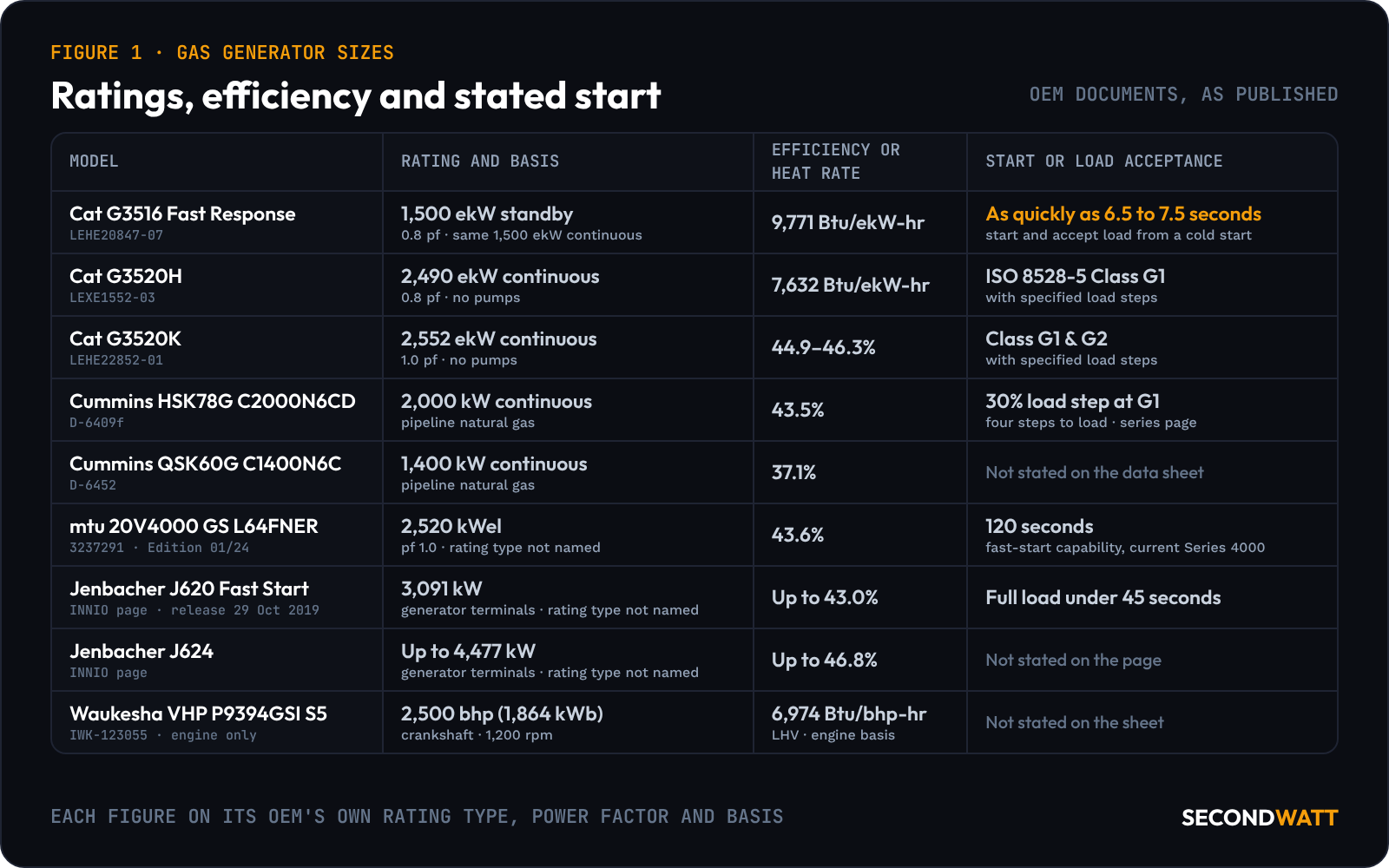
The G3516 Fast Response figures come from sheet LEHE20847-07 and the 2022 release, and the G3520K figures from sheet LEHE22852-01 (11/25). A different G3520H headline, 2,519 / 2,500 ekW continuous at 1.0 pf and 45.30% maximum electrical efficiency, sits on its Caterpillar G3520H page. The table uses the 60 Hz data sheet.
The HSK78G row is from Cummins data sheet D-6409f. Its load-step line is a series-level statement on the HSK78G series page. The QSK60G row is from data sheet D-6452. Its efficiency recomputes from the sheet's own fuel figure: 1,400 ÷ 3,776 = 37.1%.
The mtu 20V4000 L64 row comes from mtu sheet 3237291, Edition 01/24, with energy input to ISO 3046/I-2002 and a 5% tolerance. The Jenbacher rows are INNIO's 60 Hz natural gas figures for the J620 Fast Start and the J624, with energy input to DIN ISO 3046 and DIN 6271 and a +5% tolerance.
4,477 kW — the largest 60 Hz natural gas output in the table: up to 4,477 kW at the generator terminals for Jenbacher's J624, whose page names no rating type.
A large natural gas generator rated at 0.8 pf and one rated at 1.0 pf report different kW for similar hardware. Compare two Caterpillar gas generator sets, or any two makers, only on the same rating type, power factor and pump configuration.
Gas supply: pressure, quality and reliability#
The Cummins sets in this article run on low supply pressure. The HSK78G C2000N6CD needs 0.15–0.45 bar (2.2–6.5 psi) at the fuel shutoff valve inlet. Two QSK60G sets need 0.2–0.46 bar (2.9–6.7 psi), on Cummins' data sheets D-6455 and D-6452. The G3516 Fast Response engine is "Designed for maximum performance on low pressure gaseous fuel supply", on sheet LEHE20847-07.
Each pressure figure has a reference point. On sheet LEHE20847-07, Caterpillar specifies the G3516 Fast Response's fuel pressure range to the engine fuel control valve. It notes that additional fuel train components "may be required and should be considered in pressure and flow calculations."
Gas quality limits the rating as well. The minimum methane index is 70 for the HSK78G C2000N6CD, 78 for the QSK60G C1400N6C and 55 for the QSK60G C1000N6, on their Cummins data sheets. The mtu ratings on sheet 3237291 reference methane number 72 or more, and 80 or more for hot ambient conditions. Lower-methane gas cuts the load a QSK60G may carry, under the methane index derate table on its sheets.
Methane number is explained in the reciprocating engine guide. Turbine buyers face higher pressures and different quality limits, covered in the gas turbine fuel requirements guide.
Pipeline supply has an NFPA 110 caveat at Level 1. Cummins reprints clauses of the 2019 edition in a 25 March 2021 NFPA 110 deck. There, an exception to clause 5.1.1 covers Level 1 installations where the probability of interruption of off-site fuel supplies is high. In those installations, on-site storage of an alternate energy source must allow full output for the class specified, with automatic transfer to it.
Load steps and starting#
Performance classes G1 to G4 are defined in ISO 8528-1, and ISO 8528-5:2018 sets their transient limits, in the 2/25 revision of a Cummins white paper. G1 suits loads where only basic voltage and frequency need specifying; G2 suits sets whose voltage closely matches the public utility system, with temporary but acceptable deviations in voltage and frequency when load changes. G3 serves equipment that makes severe demands on frequency, voltage and waveform, and G4 covers supplies adapted to the application, usually by agreement between manufacturer and customer.
Load acceptance is tested in steps set by the engine's brake mean effective pressure (BMEP), with up to six steps; load rejection is always 100% in one step. In the paper's table from ISO 8528-5:2018, spark-ignition engines may dip by up to 25%, 20% and 15% below rated frequency on a load increase in G1, G2 and G3. The base row for the same parameter gives 15%, 10% and 7%.
Beyond the table, the G3516 Fast Response sheet says the set "Conforms to ISO 8528-5 G2 load acceptance criteria" and facilitates compliance with NFPA 110 Type 10 starting and loading requirements (LV and MV).
25% — the largest frequency dip on a load increase that ISO 8528-5:2018 allows a spark-ignition set in class G1, against 15% in the base row, as Cummins tabulates it.
OEM start claims each name their own end point. Caterpillar says the G3516 Fast Response can start and accept load from a cold start as quickly as 6.5 to 7.5 seconds. The Jenbacher J620 fast-start set provides "full load under 45 seconds," according to INNIO's 29 October 2019 release launching it for data centers.
Current mtu Series 4000 gas gensets carry a 120-second fast start, Rolls-Royce says. From 2026, a new 20-cylinder L64 for the 60 Hz market is to deliver its full output of 2.8 MW in 45 seconds without a gearbox; the release names no rating type.
Where a site's largest step exceeds what one set accepts, the loads can be connected in stages. This is step loading: automatic transfer switches or feeder circuit breakers bring load onto the sets gradually, in Cummins' paper. Oversizing the alternator might also improve transient performance, the paper notes.
From one generator to a 25 MW block#
Data center loads outgrow any single set, so gas sets run in parallel. Caterpillar's release says the optional Cat EMCP 4.4 control can parallel multiple generator sets. The paralleling switchgear guide covers the switchgear that ties them to a common bus.
SecondWatt's mtu 25 MW gas block page lists ten mtu 20V4000 GS units at 2,518 kWe each, 25.18 MW gross at 95 °F and 328 ft. That unit figure is the seller's datasheet rating for unrestricted heavy duty, mtu application group 3A, as the mtu block guide publishes it.
Worked example (SecondWatt calculation): a 20 MW load on that 2,518 kWe gross unit rating.
20,000 ÷ 2,518 = 7.94, so N is 8 units, giving 8 × 2,518 = 20,144 kW gross.
N+1 is 9 units: 9 × 2,518 = 22,662 kW gross installed, and 20,144 kW gross firm with any one unit out. mtu's public sheet 3237291 lists the 20V4000 GS L64FNER at 2,520 kWel at pf 1.0 and nominal voltage and frequency, a different basis. There, 20,000 ÷ 2,520 = 7.94 gives the same 8 and 9 units.
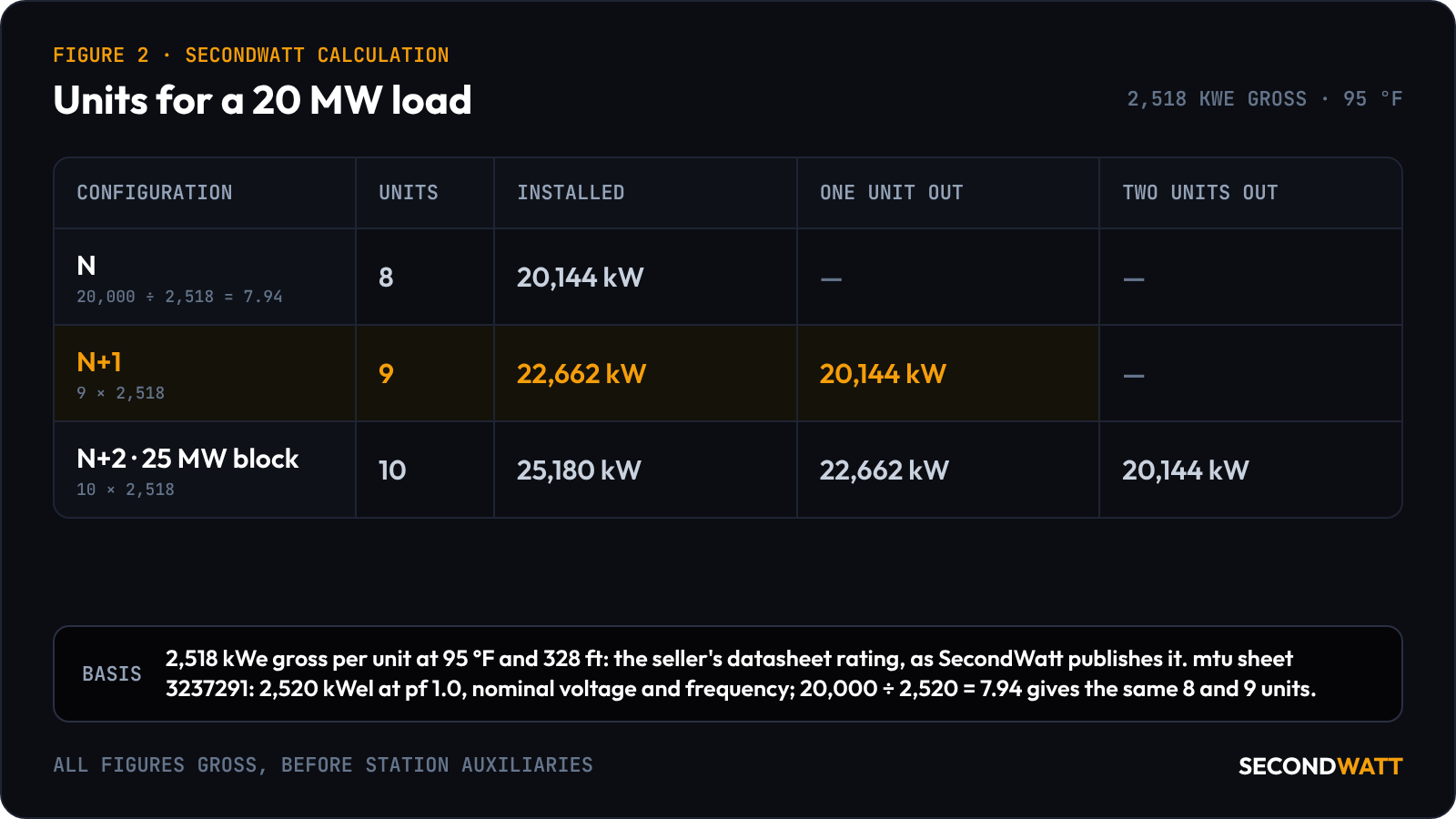
The ten-unit block covers the same 20 MW at N+2: 25,180 kW installed, 22,662 kW with one unit out and 20,144 kW with two. All three figures are gross, before station auxiliaries, at the block's stated ambient and altitude. Output falls with ambient temperature and elevation, so the count must be rerun on the derated rating.
Unit size changes the spare. With the HSK78G C2000N6CD at 2,000 kW continuous, 20,000 ÷ 2,000 = 10 units at N and 11 at N+1, or 22,000 kW installed. The two counts rest on different OEM bases, so they compare unit counts, not plant output. The redundancy guide covers N+1 and 2N layouts.
Emissions and permits#
In the US, federal NSPS Subpart JJJJ applies to manufacturers, owners and operators of stationary spark-ignition engines as paragraphs (a)(1) to (6) of 40 CFR 60.4230 specify. Under (a)(4), it covers owners and operators of engines that commence construction after June 12, 2006 and are manufactured on or after a date set by maximum engine power, lean-burn type and emergency use. For this subpart, construction commences on the date the owner or operator orders the engine.
Section 60.4236, on deadlines for importing or installing engines produced in previous model years, applies to all owners and operators whose engines commence construction after June 12, 2006. Owners and operators of engines modified or reconstructed after June 12, 2006 are also covered, as is any person who modifies or reconstructs one after that date.
Under § 60.4230(c), an owner or operator of an area source subject to the subpart is exempt from obtaining a permit under 40 CFR Part 70 or 71. That holds only if no such permit is required under § 70.3(a) or § 71.3(a) for a reason other than area-source status under the subpart. The owner or operator must still comply with the subpart as applicable.
Fast-response Cat gas sets are offered with additional emissions reduction technologies that can lower NOx to as low as 0.5 g/bhp-hr without aftertreatment, Caterpillar says. The HSK78G is listed "As low as 250 mg/Nm3 (0.5g/hp-hr) NOx without aftertreatment". The G3516 Fast Response meets the US EPA stationary non-emergency standard for use in emergency and non-emergency applications, on its sheet.
The JJJJ dates, Table 1 limits and Subpart ZZZZ links are set out in the reciprocating engine guide.
FAQ: industrial natural gas generators#
Can natural gas generators serve as data center standby?#
Some are built for it. A Type 10 system restores acceptable power within 10 seconds, as the 9/24 revision of a Cummins white paper reads the 2016 edition. The clock runs from the loss of power at the load side of the transfer switch. In the Cummins deck, clause 4.4.1 of the 2016 edition says Level 1 applies where failure of the equipment to perform could result in loss of human life or serious injuries.
The G3516 Fast Response is compatible with NFPA 110 Level 1 Type 10, Caterpillar states. Not every set carries that statement. On Cummins' HSK78G series page, NFPA 110 Level and Type are still to be determined under 60 Hz compliance for the USA. The NFPA 110 guide covers classes, testing and records.
How much gas does a 2 MW continuous natural gas generator use?#
The HSK78G C2000N6CD burns 4,599 kW of fuel (LHV) at its 2,000 kW continuous rating, at ISO 3046 reference conditions without engine-driven coolant pumps, per data sheet D-6409f. In Btu, 4,599 × 3,412.14 = 15.69 million Btu per hour; the sheet prints 15.71.
The sheet's test gas has a lower heating value of 905 Btu/scf, so 15,692,432 ÷ 905 = about 17,340 scf per hour on the same LHV basis. At 50% load the sheet lists 2,495 kW of fuel, so fuel per kWh rises as load falls.
What sizes do industrial natural gas generators come in?#
Packaged 60 Hz natural gas sets run from 20 ekW to 4,050 ekW in Caterpillar's line, according to its March 2026 Electric Power Ratings Guide. The largest is a 900 rpm CG260-16, rated continuous at 1.0 pf. Medium-speed engines from other makers go larger, as the reciprocating engine guide shows.
Natural gas or diesel generators for a data center?#
Either can qualify as an NFPA 110 energy source. Clause 5.1.1 of the 2019 edition, as Cummins reprints it in its NFPA 110 deck, lists liquid petroleum products, liquefied petroleum gas, and natural or synthetic gas. For continuous duty, Rolls-Royce calls the continuous-power use of its fast-start mtu gas gensets especially attractive when existing grid power cannot take on a new data center's load. The diesel generator procurement guide covers the diesel side, and the used gas generator checks cover second-hand gas sets.
Do natural gas generators need SCR?#
It depends on the permit. The OEM NOx levels above are engine-out, without aftertreatment. NOx is frequently the limiting factor for permitting large-scale data centers, and selective catalytic reduction (SCR) can reduce it further, according to INNIO's 2019 J620 fast-start release. Ask the OEM for engine-out NOx at the rating you will run, and give it to the permitting engineer.
Sourcing natural gas generators#
SecondWatt publishes equipment research and helps buyers source power equipment; it earns a fee when a sale it arranges closes. If you are buying, send a request that names the rating type, frequency, power factor, gas pressure and methane number you need, so offers line up like for like. If you own gas generator sets leaving service, start at the generator seller page.