
An owner's representative advises the owner and looks after its interests across a project. AIA Contract Documents describes the role as running from initiation and design through procurement and construction. In engineering firm RWE's description of its own service, an owner's engineer reviews the technical work. As SecondWatt's How We Work page puts it, a buyer's agent acts for a buyer on a defined project and, depending on its appointment, may research, source, negotiate or commit the buyer.
In a power equipment purchase, the owner's rep watches budget and schedule, and the owner's engineer checks equipment against the specification. The buyer's agent works the market for a source and terms. Before hiring any of them, check who the adviser works for, who pays it and what it may commit you to. SecondWatt offers the third role as buyer representation, through a separate procurement engagement.
Key Takeaways
- Titles blur, so define authority in the contract. Owner's representative, project manager and construction manager agent/advisor are used seemingly interchangeably; authority and services may vary by project.
- Ask who pays every adviser, and get it in writing. On SecondWatt's terms, compensation from both a source and the buyer on the same transaction requires the buyer's written agreement.
- Research, negotiation and commitment are separate grants of authority. The owner's representative's authority is limited under AIA's C104–2024; many other AIA forms name one with full authority.
- Reporting intervals belong in the engagement. Monthly is the default status report in AIA's C104–2024 owner's representative form, and the parties may insert a different interval.
- Commitments stay with the buyer under SecondWatt's separate engagement. The buyer approves every term and signs every contract; the letter of appointment gives SecondWatt limited authority on one project.
What an owner's representative does#
A July 2023 AIA Contract Documents article calls an owner's representative "a professional hired to oversee and advise the owner throughout the design and construction process."
The standard form gives the role a scope. Under C104–2024, the owner's rep "assists the owner in an advisory capacity" during project initiation, design, procurement and construction. Basic services include consulting in all phases, budget and schedule support, meetings, monthly reports and close-out, according to AIA's C104–2024 instructions.
An April 2018 article in the American Bar Association's Under Construction says the titles owner's representative, project manager, program manager, tenant representative and construction manager agent/advisor are used "seemingly interchangeably." Both the scope of authority and the scope of services may vary significantly from project to project, the article warns.
Some public owners must have one. In Massachusetts, the requirement covers a public agency's contract to build, reconstruct, install, demolish, maintain or repair a building. Where that contract is estimated to cost not less than $1,500,000, the agency needs an owner's project manager under General Laws chapter 149, section 44A½, as the statute stood on 7 Nov 2026.
Before contracting design services under chapter 7, section 38D or 38K, the agency must contract one as its "agent and consultant" during planning, design and implementation. It may instead assign an existing employee who meets the section's qualification and experience conditions.
$1,500,000 — under Massachusetts law as of 7 Nov 2026, the estimated cost at or above which a public agency's contract to build, reconstruct, install, demolish, maintain or repair a building comes under the owner's project manager requirement of General Laws chapter 149, section 44A½.
A power equipment purchase can be one procurement inside a larger project. C104–2024 names procurement among the phases the role covers. Dealing with sellers is a separate question of authority.
Owner's rep, owner's engineer and buyer's agent compared#
An owner's rep, an owner's engineer and a buyer's agent can all sit on the buyer's side of one equipment deal.
Representation roles compared: who each works for, who pays and its authority (AIA C104–2024 instructions; RWE owner's engineering sheet; SecondWatt's How We Work and buyer representation pages)#
| Role | Works for | Typical scope | Who pays | Authority | Source |
|---|---|---|---|---|---|
| Owner's representative | The owner | Advisory role across initiation, design, procurement and construction; budget, schedule, meetings, monthly reports | The owner, on the compensation basis inserted in the agreement | Limited under C104–2024; many other AIA forms name an owner's representative with full authority | AIA C104–2024 instructions |
| Owner's engineer | The owner, as its client | Design reviews, bid evaluation, contract reviews, equipment inspections, commissioning and testing | Set by its engagement | May evaluate without authority to negotiate or commit a client | RWE (vendor's description); "Evaluating technical fit" on SecondWatt's How We Work page for engineers |
| Procurement consultant | A buyer, as its client | Procurement work for the buyer, within its engagement | Set by its engagement; SecondWatt asks who expects to compensate it | Research, source, negotiate or commit the buyer, as engaged | "Representing a buyer" on SecondWatt's How We Work page for buyers' agents |
| Buyer's agent (SecondWatt's buyer representation) | The buyer that appoints it | Agreed search, approaching sources, assessing opportunities, and support for negotiation, diligence and closing | The buyer, on terms set out in its proposal, with seller-side compensation credited against its fee | A letter of appointment; cannot sign for, bind or commit the funds of the buyer | SecondWatt's buyer representation page |
| Seller-paid intermediary (SecondWatt's standard route) | Coordinates introductions between buyer and source | Matches a requirement and coordinates introductions | The source side, under a separate source-side agreement; no buyer fee under the buyer confidentiality agreement | Not appointed as the buyer's procurement agent | "How we are paid" and "How we begin" on SecondWatt's How We Work pages; SecondWatt's buyer representation page |
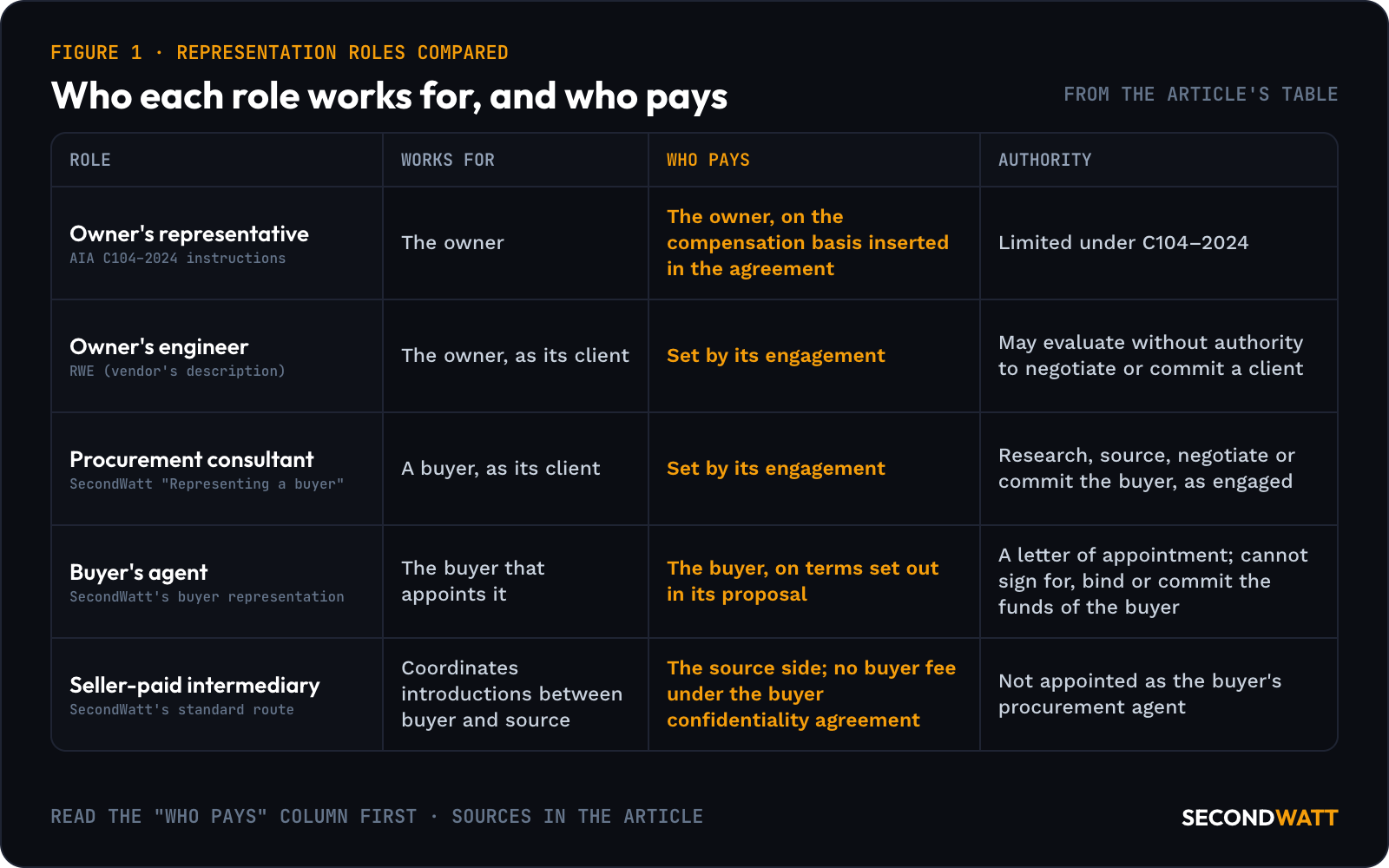
Read the "who pays" column first, then authority. The last two rows are SecondWatt's own routes, set out in the next section.
Who pays, and why it matters#
Massachusetts public-works law sets both an independence rule and a pay rule for the owner's representative on a "major contract". That term includes a contract for the commonwealth or one of its public agencies or authorities to procure the construction, repair or rehabilitation of a publicly owned highway, railway, bridge, tunnel, building platform or component. Its certified estimate of cost exceeds $50,000,000, under General Laws chapter 30, section 39M½, as the statute stood on 7 Nov 2026.
On each major contract, the commonwealth, agency or authority must "engage and maintain an owner's representative" to provide professional project oversight, selected and retained before award. The representative certifies in writing, under the pains and penalties of perjury, that "his sole responsibility shall be to the commonwealth and the agency which has retained his services."
The representative must also be "wholly independent of the designer, general contractor or any subcontractor" on the project and attest to that in a sworn statement. No awarding agency may pay the independent owner's representative "on a cost-plus basis."
$50,000,000 — under Massachusetts law as of 7 Nov 2026, the certified estimate of cost above which a contract for the commonwealth or one of its public agencies or authorities to procure the construction, repair or rehabilitation of a publicly owned highway, railway, bridge, tunnel, building platform or component is a "major contract" under General Laws chapter 30, section 39M½, which needs an owner's representative.
A private equipment buyer can write the same points into its own contract: whom the adviser answers to, whom it must be independent of and how it is paid.
SecondWatt's two routes put the payer on opposite sides. Under "How we are paid," SecondWatt's How We Work page says that on the standard route, SecondWatt "is compensated under a separate source-side agreement." The buyer pays SecondWatt no fee under the buyer confidentiality agreement. Under "How we begin," SecondWatt's page for buyers adds that this route "does not appoint SecondWatt as your procurement agent."
On the other route, a buyer may engage SecondWatt for procurement services "under written scope and fee terms." Any seller-side compensation "is credited against the buyer's fee, as the engagement terms provide." The page sets one rule for mixed pay: "Compensation from both a source and the buyer on the same transaction requires the buyer's written agreement." Both routes are mapped in how SecondWatt works and who pays it.
Research, negotiate or commit#
A title does not settle authority. Under "Representing a buyer," SecondWatt's How We Work page addresses procurement firms, consultants and other professionals working with a buyer. It tells them: "Your authority may be to research, source, negotiate or commit the buyer. We record the scope rather than assume it."
Authority to bind needs clear terms. All project participants should understand the representative's authority to act for the owner and bind it under the design and construction contracts. In the words of the American Bar Association's April 2018 article, the limits of authority "should be clearly defined in the contract and consistently implemented in practice."
The standard forms differ on authority. C104–2024 "places limitations on the owner's representative's authority to act on behalf of the owner" on the project. In many other AIA agreements the owner names an owner's representative with full authority to act for it. AIA's C104–2024 instructions tell users to consult an attorney before naming the C104 representative in them.
When a representative brings a buyer, SecondWatt asks what it is engaged to do and the form, date and limits of that engagement. It also asks about the intermediary chain and who expects to compensate the representative. A client's confidentiality policy may change how that is confirmed; "it does not turn an unconfirmed representation claim into established authority."
What to put in the engagement#
Seven items put the role, the pay and the authority into the engagement letter:
- Requirement and target: the equipment, capacity, rating basis, quantity, delivery dates and the price target the representative works to.
- Deliverables: market search results, offer comparisons, negotiation support or closing coordination.
- Reporting cadence: how often written reports arrive and what they contain.
- Limits of authority: research, source, negotiate or commit, with any spending limit and the person who approves terms.
- Compensation and its disclosure: the fee basis, any pay from the seller side, and when each is disclosed in writing.
- Confidentiality: what the representative may disclose about the buyer, to whom and for what purpose.
- Term: when the engagement starts, which lots or projects it covers and when it ends.
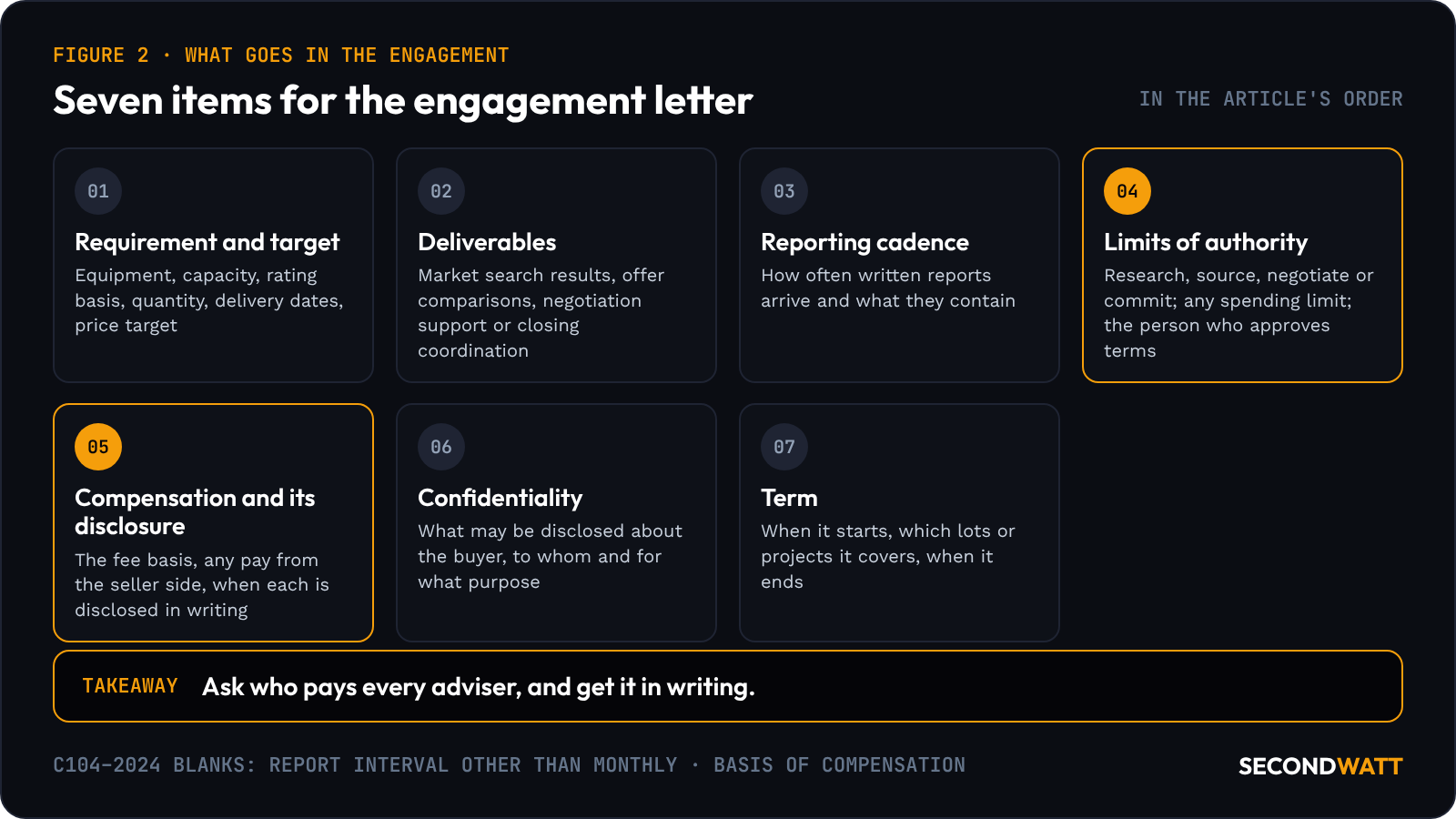
C104–2024 leaves two of these as blanks for the parties: any report interval other than monthly, and the basis of compensation. The parties also set the owner's schedule milestones and the number of in-person meetings.
How SecondWatt's buyer representation works#
Under "Buyer representation, by engagement," SecondWatt's How We Work page for buyers says: "For buyers with a defined project who want SecondWatt acting on their behalf, we offer a separate procurement engagement." The page lists five points:
- The requirement and target: "We agree your requirement and target price with you."
- The market: "We take it to the market and give you every written offer we receive for it, as received."
- Your name: "We request pricing in your name only with your approval."
- Negotiation and closing: "We negotiate where you invite us," and SecondWatt coordinates inspection and title through closing.
- Reporting: "We report to you in writing every two weeks while the engagement is active."
"The fee for each lot is set in writing before any source is named. It is based on the savings achieved against an agreed equipment-only benchmark, with a minimum." All compensation "is disclosed to you in writing before you commit."
"You approve every term and sign every contract. SecondWatt never binds you or commits your funds, and the benchmark is a basis for the fee, not a guarantee of savings or market value. Engagements are agreed project by project."
Under buyer representation, the buyer signs a letter of appointment, which SecondWatt presents to owners and authorized sellers. It "gives us a limited, official authority to represent you on this project," in the page's words. Its stated limit: "SecondWatt can't sign for you, bind you or commit your funds." The page also says: "A letter of appointment improves access; it doesn't guarantee it."
Where the engineer's role starts#
Technical judgment stays with engineers the buyer appoints. Under "Evaluating technical fit," SecondWatt's How We Work page for engineers says: "Your appointed engineering and inspection professionals determine suitability and the additional work needed. SecondWatt coordinates permitted information and open questions; we do not certify condition, performance or compliance for your application."
"A consulting engineer may have authority to evaluate without authority to negotiate or commit a client," and SecondWatt records that distinction. Diligence follows the same line on the buyer representation page: "Diligence conclusions are your advisers'." Qualified firms the buyer appoints perform inspections, title review and technical review.
For a technical review, the engineers route lists hours, starts, maintenance, overhaul and preservation information, where provided. On a used gas turbine, those records underpin remaining life and overhaul decisions. How a seller labels condition and warranty is a separate question, covered in condition labels and warranty terms. The technical requirements then go into the specification; see the gas turbine RFQ checklist.
FAQ: representation in equipment purchases#
Do I need an owner's rep to buy power equipment?#
It depends on the team you already have. Where hiring one is discretionary, the American Bar Association's April 2018 article says, owners must consider whether they have the internal capabilities and resources to manage the construction process. They must also weigh whether the added expense will improve schedule, cost or quality. Plante Moran, a firm that offers the service, wrote in May 2023 that owner's reps supplement an organization's internal team on significant capital programs.
How are owner's representatives paid?#
Under AIA's C104–2024, they are paid a stipulated sum or on another basis the parties insert. Four listed methods are time-based: a multiple of direct salary expense, a multiple of direct personnel expense, fee plus expenses, and hourly billing rates. A fifth multiplies the bills of the owner's consultants and contractors. No method is recommended, the list is not claimed to be complete, and AIA has no guidelines on the amount, according to its C104–2024 instructions.
What is the difference between an owner's rep and a construction manager?#
In the April 2018 American Bar Association article, a construction manager as advisor is authorized to make important project decisions for the owner. Its responsibilities overlap with the designer's and contractor's. Like an owner's rep, it is a fee-based consultant that does not directly hold design or construction contracts. Owner's representatives "are not builders like construction project managers, general contractors, or design-builders," Plante Moran wrote in May 2023, and they are not designers.
Can one adviser act for both the buyer and the seller?#
For engineers, dual pay turns on disclosure and agreement. Section II.4.b of the NSPE Code of Ethics for Engineers, as revised in July 2019, sets the rule. Engineers "shall not accept compensation, financial or otherwise, from more than one party for services on the same project, or for services pertaining to the same project," unless the circumstances are fully disclosed to and agreed by all interested parties.
What does an owner's engineer do in an equipment purchase?#
Specification and bid work are part of the scope: preparing and reviewing technical specifications and requests for proposals, analyzing responses and monitoring equipment against the specification. RWE's Owner's Engineering Services sheet lists operational and maintenance review and cost/benefit analysis too. That is one vendor's description of its own service.
Engaging representation#
SecondWatt publishes equipment research and helps buyers source power equipment; it earns a fee when a sale it arranges closes. To start with a requirement, request equipment; to discuss a buyer representation engagement, contact SecondWatt.