
A non circumvention agreement is a promise not to go around the person who introduced you to a buyer, a seller or a deal. Paired with confidentiality terms, it becomes a non-circumvention, non-disclosure agreement, written NCND or NCNDA. It is commonly used in the early stages of a transaction, so the introducer stays in the deal it opened.
For a buyer's representative or an introducer in a power-equipment deal, the agreement is only as good as its detail. It needs to say who is protected, what counts as going around them, and for how long. This article covers those working parts, the warning signs, and how SecondWatt's own buyer agreement fits its published process.
Key Takeaways
- A non-circumvention agreement protects an introducer's place in a deal. It usually covers introduced contacts, a continued role or agreed compensation if the deal closes, or a network's commercial advantage.
- An NDA protects information; an NCNDA also protects the relationship. Where parties can lawfully keep dealing without misusing confidential information, an NDA alone may leave the introducer cut out.
- Vague wording can leave the clause unenforceable. In a 2012 non-precedential opinion applying Massachusetts law, the Third Circuit agreed a two-page agreement's non-circumvention provision was unenforceable because "circumvent" was indefinite.
- Non-circumvention language also turns up in fraud. Non-circumvent and non-disclosure agreements are on the US Treasury inspector general's list of prime bank fraud phrases to watch for.
- In SecondWatt's standard buyer-side process, the signing party registers each buyer and project before a source is identified. The standard seller-paid route creates no buyer fee under the buyer agreement.
What a non-circumvention agreement is#
In a 2020 post, Miami's Trembly Law Firm describes a non-circumvention agreement as a legally binding contract that keeps at least one party from being bypassed despite its contributions. It often comes into play when companies in the same industry pass business opportunities to each other. It can stand alone or sit inside another contract. Its downsides fall almost entirely on the restricted party, which can lose future business, especially under an overly restrictive agreement.
The clause usually protects one of three things, according to a 2026 post by South Florida firm Coto & Waddington. It can be the introduced contacts, the ability to stay in a deal or receive agreed compensation if it closes, or the commercial advantage created by a network and its timing.
In independent-sponsor deals, the same covenant protects the independent sponsor, according to a 10 April 2024 Holland & Knight article. It stops an equity provider from going directly to the target or its advisors to contract around the sponsor.
This article explains how these agreements are used in equipment deals; it is not legal advice.
NCNDA vs NDA: what each one protects#
As Coto & Waddington puts it, the two provisions solve different problems, and many deals need both. They can sit in one combined agreement, but the confidentiality section and the non-circumvention section should define protected information and protected contacts consistently. Otherwise the contract can create ambiguity instead of clarity.
NDA vs non-circumvention clause compared, from the Florida law-firm sources cited (EPGD Business Law, updated 2025; Coto & Waddington, 2026)#
| Point | NDA | Non-circumvention clause |
|---|---|---|
| What it protects | Confidential information: customer identities, pricing, plans and other sensitive data (EPGD Business Law) | The introduced relationship and the introducer's role in the deal (EPGD Business Law; Coto & Waddington) |
| Core risk addressed | Disclosure or misuse of sensitive information (Coto & Waddington) | Being bypassed in a transaction (Coto & Waddington) |
| The promise in one line | "Don't misuse what I told you." (Coto & Waddington) | "Don't use who I introduced you to in a way that cuts me out." (Coto & Waddington) |
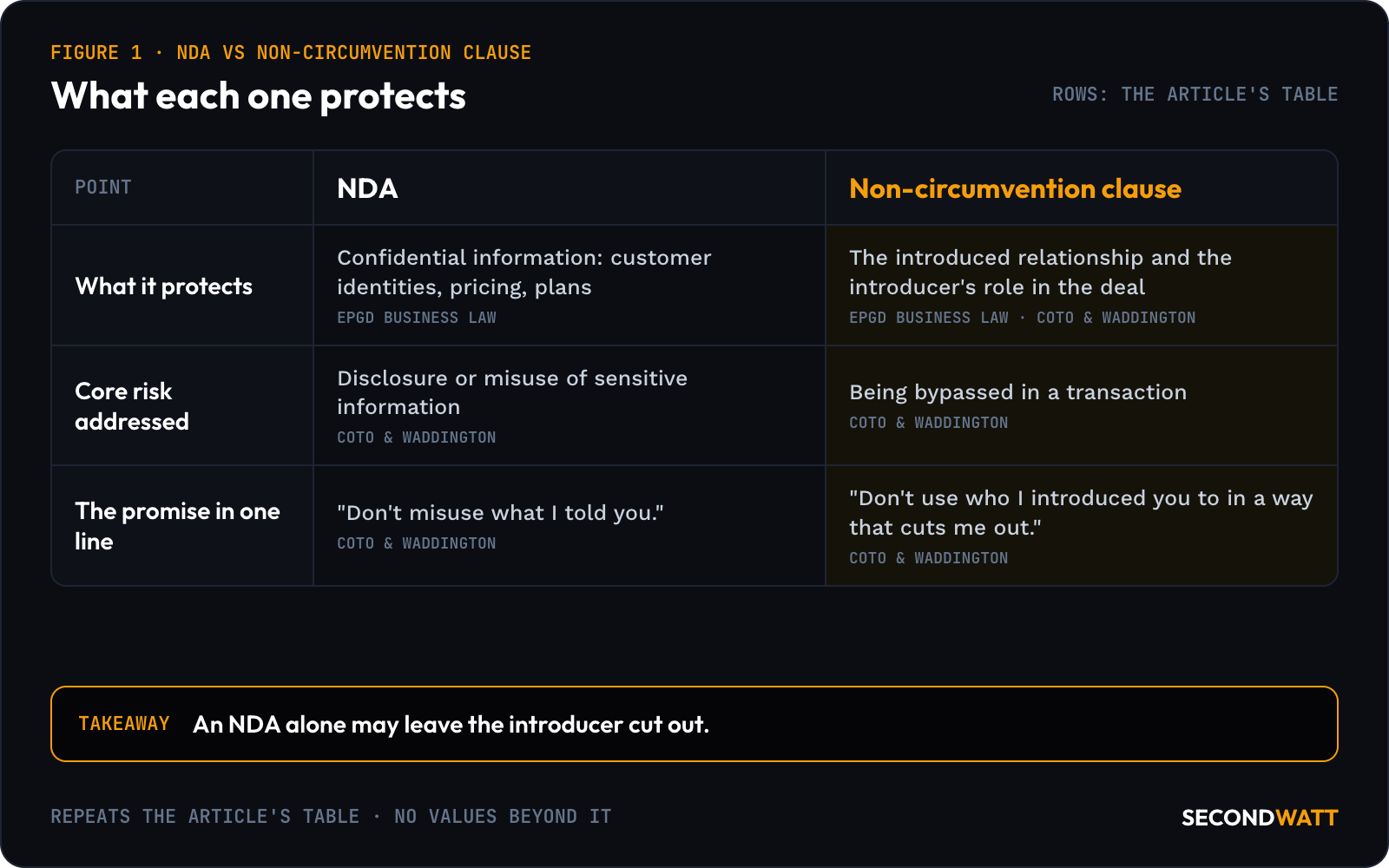
The gap between the columns is the point. Coto & Waddington notes that an NDA protects information, not the economic value of the relationship. If the parties can lawfully keep dealing without misusing confidential information, the person who created the opportunity may still be cut out.
Coral Gables firm EPGD Business Law describes the parts of an NCND agreement in an explainer updated in 2025. Such an agreement typically has special conditions for the specific deal and general conditions that apply across most such agreements. It also requires the signing parties to formally acknowledge the middleman's role and contributions.
The clauses that do the work#
Protected parties come first. Coto & Waddington calls a clause that says only "contacts" too thin. It should say whether protection covers named parties, affiliates, introduced entities or people disclosed during the term. The introducer wants a record of who was introduced and when, and a named schedule is one way to define how a protected introduction happens.
The circumvention definition carries the weight. New York firm Sadis & Goldberg, writing for independent sponsors, says that to be enforceable, an agreement must be specific and well defined. It should name the actions that count, such as directly approaching or transacting with introduced parties without the sponsor's consent, and it should cover indirect circumvention.
Term and tail are separate questions. Coto & Waddington says the term has to match the deal cycle. The tail, or survival wording, decides whether the restriction ends when the agreement does, even though the deal pipeline may just be opening.
The basis of the clock changes the cover. Take two hypothetical clauses and illustrative dates: an agreement signed on 1 March 2027, with introductions on 15 April and 15 October 2027. A two-year term running from the last introduction covers the second introduction until 15 October 2029: 731 days. A two-year term running from signing ends on 1 March 2029, leaving that introduction 503 days, about 16.5 months.
Pre-existing relationships need a carve-out. Coto & Waddington calls a clause with no carve-out for existing contacts "an invitation to a future facts fight." If the other side already knew the contact, the agreement should say how it proves that; screenshots gathered after a dispute starts are not enough.
Remedies decide what a breach costs. In Coto & Waddington's account, injunctive relief seeks to stop the bypass and is useful when the problem is caught early. Monetary damages seek lost fees, commissions or deal value and suit a transaction that has already moved forward. Without a paper trail, such as intro emails, meeting invites, CRM notes and redlined contracts, the claim becomes harder.
A liquidated damages clause sets the amount in advance. Without one, Sadis & Goldberg warns, proving damages can be challenging, as courts may deem them speculative. In a 2001 Delaware Chancery case, the court adopted the defendants' damages theory for lack of reliable information supporting the plaintiff's.
With one, the outcome can differ. Sadis & Goldberg cites Schwartz v. Sensei, a 2022 case in the Southern District of New York. There the court applied New York law, enforced a liquidated damages clause after a non-circumvent breach and awarded the plaintiff money damages under it. A clause letting the prevailing party recover reasonable attorney fees is also part of the firm's drafting advice, and Delaware and New York are, in its words, "preferred jurisdictions for many commercial transactions."
Why NCNDAs come up in equipment deals#
Intermediated deals create the need. In EPGD Business Law's description, the middlemen an NCND protects introduce parties, promote business opportunities and assist with negotiations in domestic and international trade. Coto & Waddington says the business version of the clause is common where access matters more than hard assets, including equipment deals.
Trade paperwork of this kind has a fraud record. The International Chamber of Commerce (ICC) issued a warning to traders on 1 April 2005. It said false references to ICC instruments in fraudulent internet offers most often concerned trading in currencies, commodities, gold and financial instruments. Some websites carried full texts of bogus ICC non-circumvention and non-disclosure agreements.
ICC does publish a genuine model: the ICC Model Occasional Intermediary Contract (NCND). ICC's 16 February 2026 fraud notice says the model defines the intermediary's services and exclusive rights, and provides protections regarding payment of the intermediary's fee.
When an NCNDA stops protecting anyone#
An NCNDA protects little when nobody can say what it forbids. In Global Energy Consultants v. Holtec, the Third Circuit agreed that "circumvent" was indefinite and the non-circumvention provision therefore unenforceable under Massachusetts law. The court's 2 May 2012 opinion is marked not precedential.
The court found no precise definition on the face of the agreement or in the parties' dealings, and the plaintiff's own reading of the word shifted during the case.
2 pages — the length of the Holtec agreement, whose clause barred circumvention "without prior written authorization" but gave no definition or examples of it (3d Cir., 2012).
Unnamed parties are a second failure. On a page changed 20 November 2024, the US Treasury Office of Inspector General puts "Non-circumvention" and "Non-disclosure" on a list of terms misused in prime bank fraud. "A refusal to give 'full disclosure' of all involved" is among the phrases to watch for. Prime bank promoters sometimes ask investors to sign non-disclosure agreements, a 5 February 2015 SEC Investor Alert warns.
$10,000,000 — the lower minimum trade amount, with $100,000,000, for pooled funds on Treasury OIG's list (changed 20 Nov 2024) of prime bank fraud phrases to watch for.
SecondWatt's process pauses on related signals. Under "What pauses an opportunity", its How we work page lists "An owner or authorized source still isn’t identified once confidentiality is in place." It also lists "Someone presses for a buyer’s identity, funding evidence or an LOI before showing their own authority." Authority, in that section's words, "counts when it is confirmed directly with the named owner or signatory."
SecondWatt's Making a professional introduction page asks an introducer working with several people to identify the contracting party and each participant's role. Anyone receiving protected information must have the required permission and written obligations. "Listing a person's name alone does not establish those protections." An opportunity also pauses if "important participants remain undisclosed."
How SecondWatt uses its buyer agreement#
Under SecondWatt's standard buyer-side process, as its Representing a buyer page puts it, "your firm or the applicable contracting party signs the Buyer Confidentiality and Non-Circumvention Agreement. It then registers each buyer and project before SecondWatt identifies a source."
An organization buying for its own account can use the standard seller-paid route. SecondWatt's Buying equipment for your organization page explains: "The standard seller-paid introduction route uses our buyer confidentiality agreement and buyer and project registration. It creates no buyer fee under that agreement and does not appoint SecondWatt as your procurement agent."
Registration has limits. As the Representing a buyer page notes, "A seller may separately require its own NDA or transaction documents." A representative sharing with a client must "Preserve source restrictions and give the written notice required by the agreement," and "Registration alone does not authorize disclosure to other intermediaries."
The signed documents govern, in the pages' own words: "These pages describe our process. The signed agreements and transaction documents govern the parties' rights and obligations." Who pays SecondWatt on each route is set out in How SecondWatt works and who pays it.
Before you sign one#
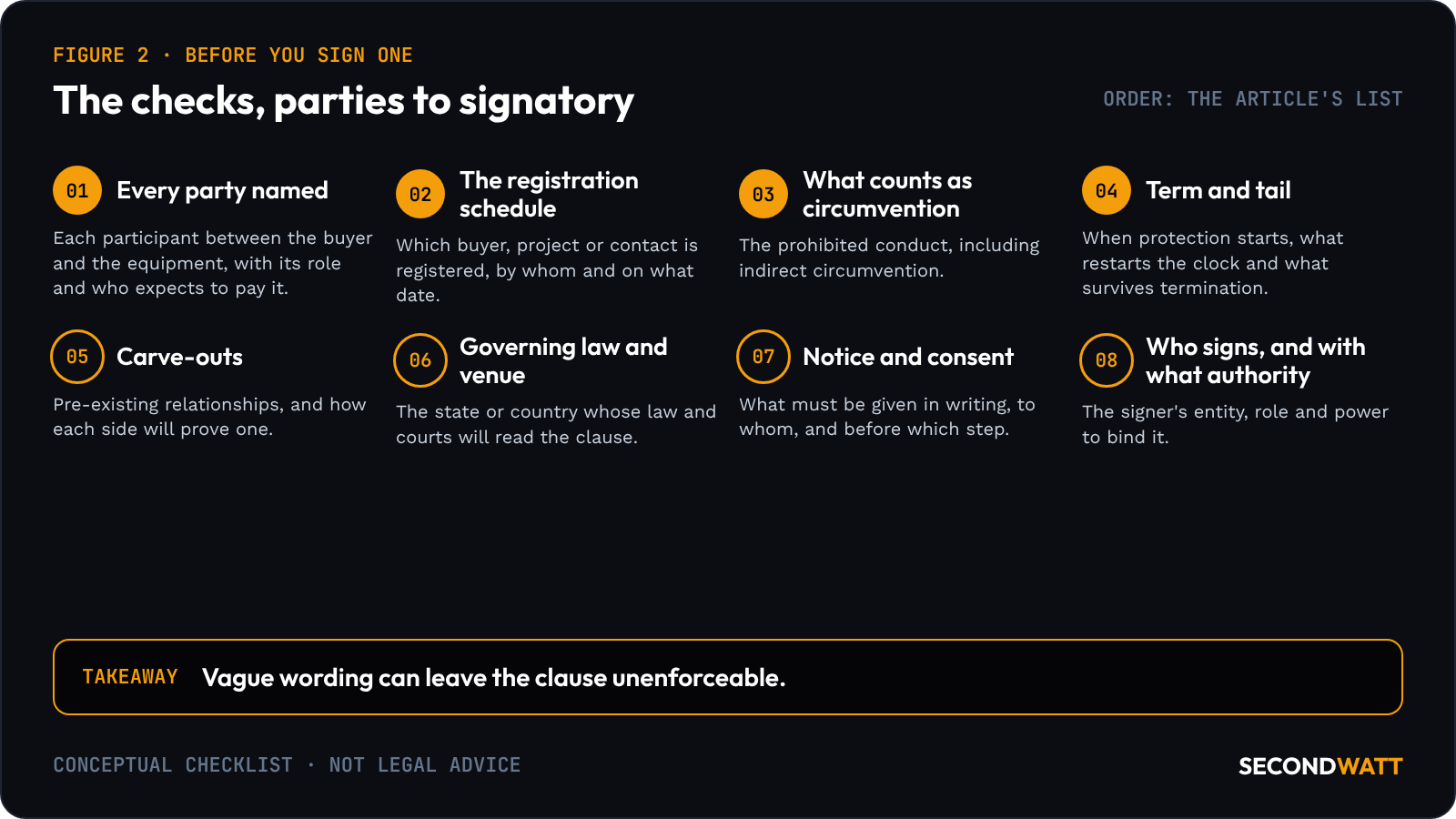
Each check below follows from a clause or failure described above.
- Every party named: each participant between the buyer and the equipment, with its role and who expects to pay it.
- The registration schedule: which buyer, project or contact is registered, by whom and on what date.
- What counts as circumvention: the prohibited conduct, including indirect circumvention.
- Term and tail: when protection starts, what restarts the clock and what survives termination.
- Carve-outs: pre-existing relationships, and how each side will prove one.
- Governing law and venue: the state or country whose law and courts will read the clause.
- Notice and consent: what must be given in writing, to whom, and before which step.
- Who signs, and with what authority: the signer's entity, role and power to bind it.
The same discipline runs through the paperwork that follows. A seller's documentation is covered in the used gas turbine seller checklist, and a buyer's comparable request in the gas turbine RFQ checklist.
FAQ: non-circumvention agreements#
Are non-circumvention agreements enforceable?#
They can be, but Sadis & Goldberg notes that courts often scrutinize them, and poorly drafted clauses can make them unenforceable. Coto & Waddington says Florida courts can enforce these clauses but look hard at whether the restriction is specific, reasonable and tied to a legitimate business purpose. Delaware is often viewed as contract-friendly, especially when experienced parties negotiate clear terms. For a Florida business, language that reads like a blanket ban on doing business may meet a court's resistance.
Is an IMFPA an ICC document?#
No. The "Irrevocable Master Free Protection Agreement (IMFPA)", in ICC's own spelling, is on ICC's non-exhaustive list of documents it never issues, in the 16 February 2026 fraud notice. A form presented as an ICC-issued IMFPA did not come from ICC.
How long does a non-circumvention agreement last?#
As long as its term and survival wording say. Coto & Waddington says a shorter term may work for a simple referral and a longer one may be justified for a strategic partnership. Too short can let the parties wait the introducer out, and too long can look like a trade restraint. Sadis & Goldberg adds that overly broad agreements are more likely to be struck down, so geographic, time and activity limits should be reasonable.
Does signing an NCNDA commit me to buy anything?#
The core promises these firms describe are not to bypass and not to disclose. EPGD Business Law says NCND agreements are often used to let parties hold initial discussions or explore potential transactions. On SecondWatt's process, its How we work page says, "The parties and their appointed advisers handle technical review, inspections, title, funding and the transaction documents."
Does my client have to sign SecondWatt's registration documents?#
No. The Representing a buyer page says: "A separate client is not required to sign SecondWatt's registration documents, or to authorize you to bind it to them. Registration does not make that client a party." The page for introduced buyers adds: "An agent or introducer discloses its actual relationship and authority."
Starting a controlled introduction#
SecondWatt publishes equipment research and helps buyers source power equipment; it earns a fee when a sale it arranges closes. Buyers and their representatives can request equipment starting from a non-identifying requirement, and introducers can contact SecondWatt to describe the relationship first, then wait for the agreed process before sending restricted client or source information.