
Powered land is land marketed for data centers on the strength of its access to power. A utility letter saying it could serve the site is far from a signed service agreement and an energized substation. A site is worth what its documents show.
For a buyer or investor, the question is which document the seller holds, who signed it and what it commits each side to. Sites that plan to make their own power add a second set of requirements: firm gas transportation, delivery pressure, an air permit and water. SecondWatt's data center intelligence pages cover the markets and operators around those sites.
Key Takeaways
- A contractual right to power characterizes powered land. Broadly, it is a plot with a grid connection, in the definition Linklaters publishes.
- Grid documents firm up in stages. In Dominion Energy's Virginia process, study agreements count as potential load and construction agreements as firm load; no meter is set without a service agreement.
- On-site power needs gas at the right pressure. CHP gas turbines take 100–500 psig, with compression, and reciprocating engines 1–75 psig, in EPA's CHP catalog.
- At full load all day, 100 MW net burns about 22,136 Dth. Our calculation uses the LM6000 PF+ Sprint's 8,328 Btu/kWh ISO net heat rate (LHV), converted to HHV.
- Label every power claim by its evidence. SecondWatt's four statuses, from directly confirmed to pending, separate a fact checked with the relevant party from a claim only stated.
What powered land means#
In Part 1 of Linklaters' Powered Land series, published 2 June 2026, powered land is broadly a plot with a grid connection. A contractual right to power is what characterizes the opportunity. The nature and terms of those arrangements vary considerably. Beyond proximity to demand, access to reliable, near-term power is the principal driver of land value in data center development, in Linklaters' analysis.
Proximity alone settles little. Being near a high-voltage line doesn't guarantee access to power, law firm Benesch notes. Data center developments often bring energy-intensive, hyperscale loads. Those loads frequently require upgrades to and extensions of the utility's distribution system.
Sites near existing transmission lines and substations can shorten the time to deliver power, in Dominion Energy's guidance for its Virginia territory. Loads under 50 MW can frequently connect through existing distribution, typically in 1–2 years from the first planning conversations. Loads above 50 MW will most likely need extended transmission lines and a new substation.
In its January 2026 letter to PJM, Dominion calls the market it serves the largest data center market in the world, with a 2025 coincident peak of 4 GW. Northern Virginia's 'Data Centre Alley' carries the same title in Linklaters' Part 1. A data center campus marketed as powered land may hold anything from a feasibility conversation to an executed service agreement.
Powered land, powered shell and energy parks#
Three terms describe how much of the power problem a site has already solved. Each definition belongs to the source that gives it.
Three site terms compared (definitions from Linklaters, Stream Data Centers and Ireland's Large Energy User Action Plan)#
| Term | What is delivered | Who carries the power risk | Whose definition |
|---|---|---|---|
| Powered land | Land with a grid connection; a contractual right to power characterizes it | Often shared: network operators have little commercial incentive to accept material liability for late connections, and network upgrades sit outside the landowner's control; deferred or contingent consideration and clawbacks can allocate the risk between landowner and capital provider | Linklaters, Part 1 (2 June 2026) |
| Powered shell | A newly constructed building or highly specialized retrofit designed for data center use | The power comes built in: shells are typically connected to two separate substations, and customers scale in phases | Stream Data Centers glossary |
| Energy park | Ireland's "green energy parks": co-location of energy-intensive sectors with renewable energy generation | The site's own generation: co-located generation lets the data center draw power directly rather than from the grid | Ireland's LEAP (energy park); Linklaters, Part 3, 5 August 2026 (co-located generation) |
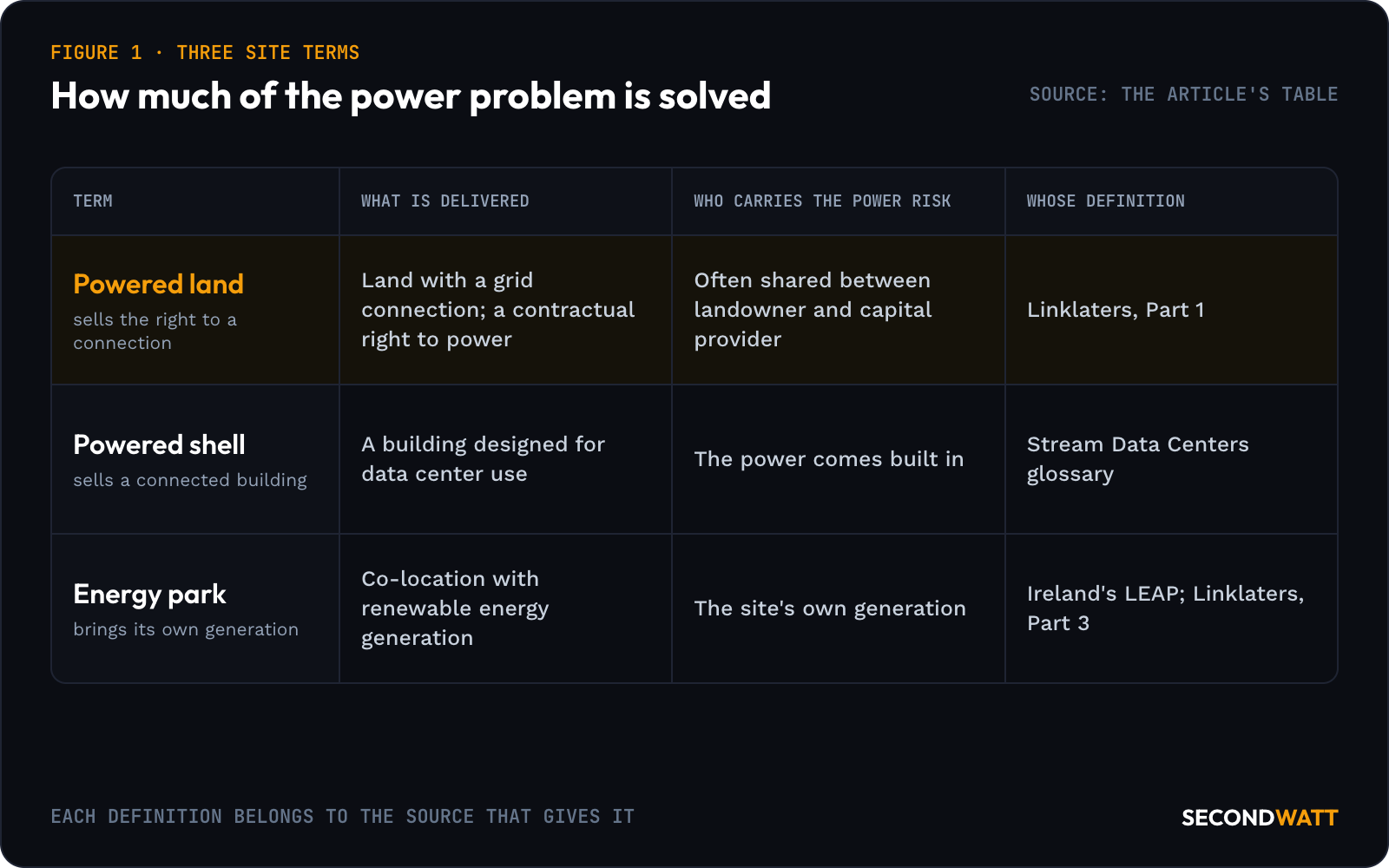
Powered land sells the right to a connection, a powered shell sells a connected building, and an energy park brings its own generation. The powered shell definition is Stream's, with its Ready-to-Fit Data Center as the example. The energy park wording is from Ireland's Large Energy User Action Plan.
In Part 3 of Linklaters' series, co-located generation, sometimes called hybrid powering or behind-the-meter generation, puts a generation asset on or adjacent to the data center site. A fundamental question, in Linklaters' framing, is full independence from the grid or supplementation of a grid connection. The behind-the-meter power guide covers that choice.
What proves a site has grid power#
The ladder below follows two utilities' published processes: SRP's will-serve letters in Arizona and Dominion Energy's three-contract structure in Virginia. Names differ by utility. Benesch's list of data center agreements runs from engineering and construction study agreements to contribution in aid of construction agreements. It ends with electric service agreements "with and without load ramp optionality."
The evidence ladder for grid power (SRP will-serve page; Dominion Energy data center requests page, letter to PJM of 6 January 2026 and GS-5 report of May 2026; Linklaters Part 1)#
| Document | What it shows | What it leaves open |
|---|---|---|
| Will-serve letter | Typically, whether the utility serves the project area and, if it does, an overview of its process and next steps, per SRP | It does not guarantee service, only that the utility could serve the property; depending on the project's scope, nature and location, a contribution in aid of construction, other fees or land rights may be required, per SRP |
| Load study results (Dominion's engineering letter, ELOA) | The infrastructure needed, an estimated energization date and projected costs, from a study that typically takes 9 to 12 months | The customer is not obligated to proceed; Dominion does not count ELOAs as firm load |
| Construction agreement (Dominion's CLOA) | Dominion reserves capacity and counts the load as firm; the customer takes on cost responsibility and long-lead equipment deposits | The customer must reimburse Dominion's investment if the project is canceled before energization; the service agreement is still to be signed |
| Electric service agreement (ESA) | The contracted capacity, collateral and applicable tariff; Dominion requires one to set a meter | Collateral due before the meter is set; issued within one year of energization |
| Energized substation | Power delivered to the site, typically in stages that match the facility's load ramp | Outages, phased reinforcement works and reduced grid availability, per Linklaters |
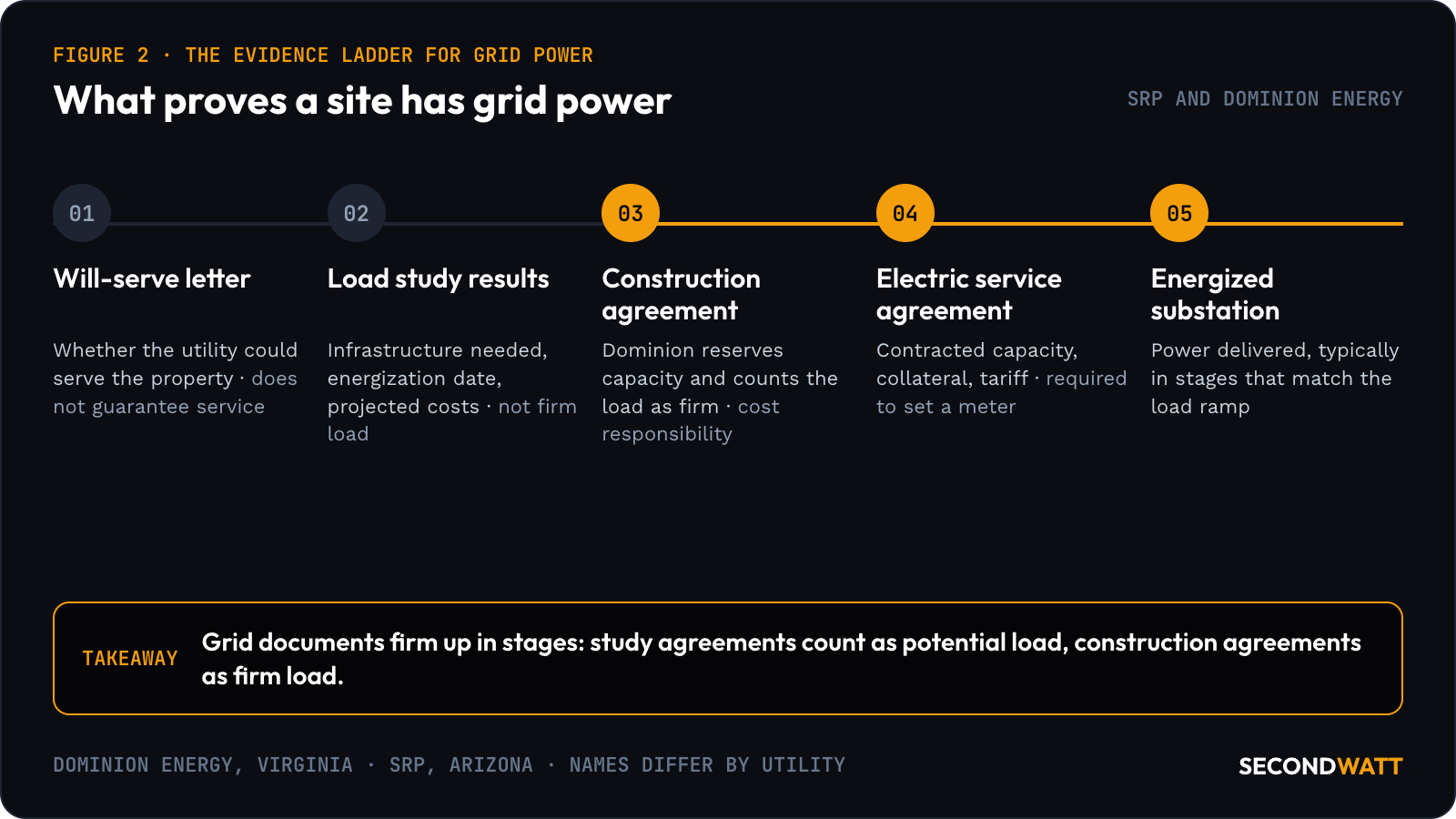
Dominion's engineering letter follows prerequisites such as site control and an engineered site plan, according to its 6 January 2026 letter to PJM. It carries a $250,000 deposit toward engineering costs.
30.1 GW — of the 47 GW capacity value of Dominion Energy's executed data center contracts in July 2025 was in engineering letters, which it counts as potential long-term growth, according to Dominion's 6 January 2026 letter to PJM.
The rest split into 7.1 GW of construction letters and 9.8 GW of service agreements: 9.8 + 7.1 + 30.1 = 47.0 GW. Dominion forecasts 16.6 GW of demand by 2046 against that 47 GW, a difference that, in its words, "highlights the difference between capacity and demand." A site whose best document is an engineering study holds study results.
Dominion's documents name the steps differently. The January 2026 letter to PJM says "Letter of Authorization"; the GS-5 large-load report of May 2026 says "Letter of Agreement". Read the document itself, whatever the seller calls it.
Gas, water and permits for on-site power#
A site that makes its own power from gas needs gas delivered to the fence. The US network has about 3 million miles of mainline and other pipelines, according to EIA's natural gas pipelines page, last updated 19 March 2024. Wide-diameter, high-pressure interstate and intrastate transmission lines carry gas to distribution centers. Local distribution companies deliver it through small-diameter, lower-pressure service lines.
The contract class matters as much as the pipe. Under FERC's 18 CFR Part 284, an interstate pipeline providing transportation under subpart B or G must offer it on a firm basis, separately from any sales service; an intrastate pipeline under subpart C may. Under 18 CFR 284.7(a)(3), service on a firm basis "is not subject to a prior claim by another customer or another class of service and receives the same priority as any other class of firm service."
An interstate pipeline that provides firm transportation under subpart B or G must also offer interruptible service under that subpart, separately from any sales service; an intrastate pipeline under subpart C may. Under 18 CFR 284.9, interruptible capacity "is subject to a prior claim by another customer or another class of service and receives a lower priority than such other classes of service." No reservation fee may be imposed for it. A plant that cannot accept that lower priority needs firm capacity.
A pipeline providing service under subpart B, C or G need not provide requested transportation for which capacity is not available or that would require constructing or acquiring new facilities. That limit is in 18 CFR 284.7(f), and 284.9(b) applies it to interruptible service.
Table 1-3 of the September 2017 EPA Catalog of CHP Technologies shows CHP fuel pressure depends on the prime mover. It runs 1–75 psig for reciprocating engines and 100–500 psig, with a compressor, for gas turbines. The catalog's LM6000-based CHP system in Table 3-2, rated 44,488 kW net, requires 538 psig fuel gas. The fuel requirements guide explains why to ask for the OEM's requirement at the stated interface.
Water comes next. The PF+ Sprint configuration used below takes its name from SPRINT. As GE Vernova describes it, SPRINT atomizes demineralized water and sprays it into the low-pressure compressor inlet and, where installed, the high-pressure compressor. The turbine water guide and the Sprint water article cover that demand.
EPA's Clean Air Act page for data centers says state and local air agencies issue most air permits for data centers, under programs approved as meeting minimum Clean Air Act and EPA requirements. Stationary combustion turbines and engines are subject to various federal emission standards. On 11 May 2026 EPA proposed revising "begin actual construction" in its New Source Review preconstruction permitting program. The permitting guide covers the steps.
How to label what a seller claims#
Every item in a SecondWatt Transaction Readiness Summary carries one of four statuses, set out under "How we describe evidence" on the How we work page. A buyer can borrow them to sort a site's power claims. The page defines each one:
- Directly confirmed: "We checked a specific fact with the relevant party through an authenticated channel. The summary identifies the source and the date."
- Document reviewed: "We received and reviewed a document. This does not by itself independently establish its contents."
- Reported: "The information has been stated but is not yet adequately supported."
- Pending: "Evidence needed for the next step has not yet been obtained."
Applied to a site, a capacity figure the buyer checked with the utility through an authenticated channel is directly confirmed. A copy of a construction letter in the data room is document reviewed, since a copy alone does not establish what was signed. A marketing deck that says substation capacity is reserved is reported. A gas transportation agreement still in negotiation is pending.
The page sets its limits beside the statuses: "A confirmation from the party making a claim is different from an independent professional assessment." The summary "records the scope of the review; it is not a guarantee of title, condition, funding, performance or closing." The How SecondWatt works article shows where the summary sits in the process.
Gas for a 100 MW on-site plant, worked#
This worked example sizes the daily gas for 100 MW of net output. The plant size, 24 hours at full load and pipeline gas at EPA's average heat content are this example's assumptions. Its input is the LM6000 PF+ Sprint heat rate below, from GE Vernova's LM6000 fact sheet GEA35743, dated 09/2025. The rate is on a lower heating value (LHV) basis, with inlet and exhaust losses included.
8,328 Btu/kWh — the LM6000 PF+ Sprint's simple-cycle net heat rate (LHV), rated at ISO conditions on natural gas with balance of plant excluded, according to GE Vernova's September 2025 data.
Gas is bought on the other basis. Note 43 to Table 3-2 of the EPA catalog says turbine and engine makers quote heat rates on LHV, while fuel prices are given in higher heating value (HHV). For natural gas, note 16 to Table 2-2 gives the average heat content as 1,030 Btu/scf on an HHV basis and 930 Btu/scf on an LHV basis, a ratio of approximately 0.9 (LHV/HHV). The ratio of HHV to LHV is 1,030 ÷ 930 = 1.1075.
100 MW net output × 24 h = 2,400 MWh = 2,400,000 kWh
2,400,000 kWh × 8,328 Btu/kWh = 19,987.2 MMBtu a day (LHV)
19,987.2 × 1,030 ÷ 930 = 22,136.4 MMBtu a day (HHV)
EIA defines a therm as 100,000 Btu and, in its glossary, a dekatherm (Dth) as ten therms or 1,000,000 Btu, so 1 Dth equals 1 MMBtu. By this calculation, the plant needs about 22,136 Dth a day. At 1,030 Btu/scf, that is 22,136.4 MMBtu ÷ 1,030 = about 21.49 million standard cubic feet a day. EIA's conversion table uses 1,036 Btu per cubic foot, which gives about 21.37 million.
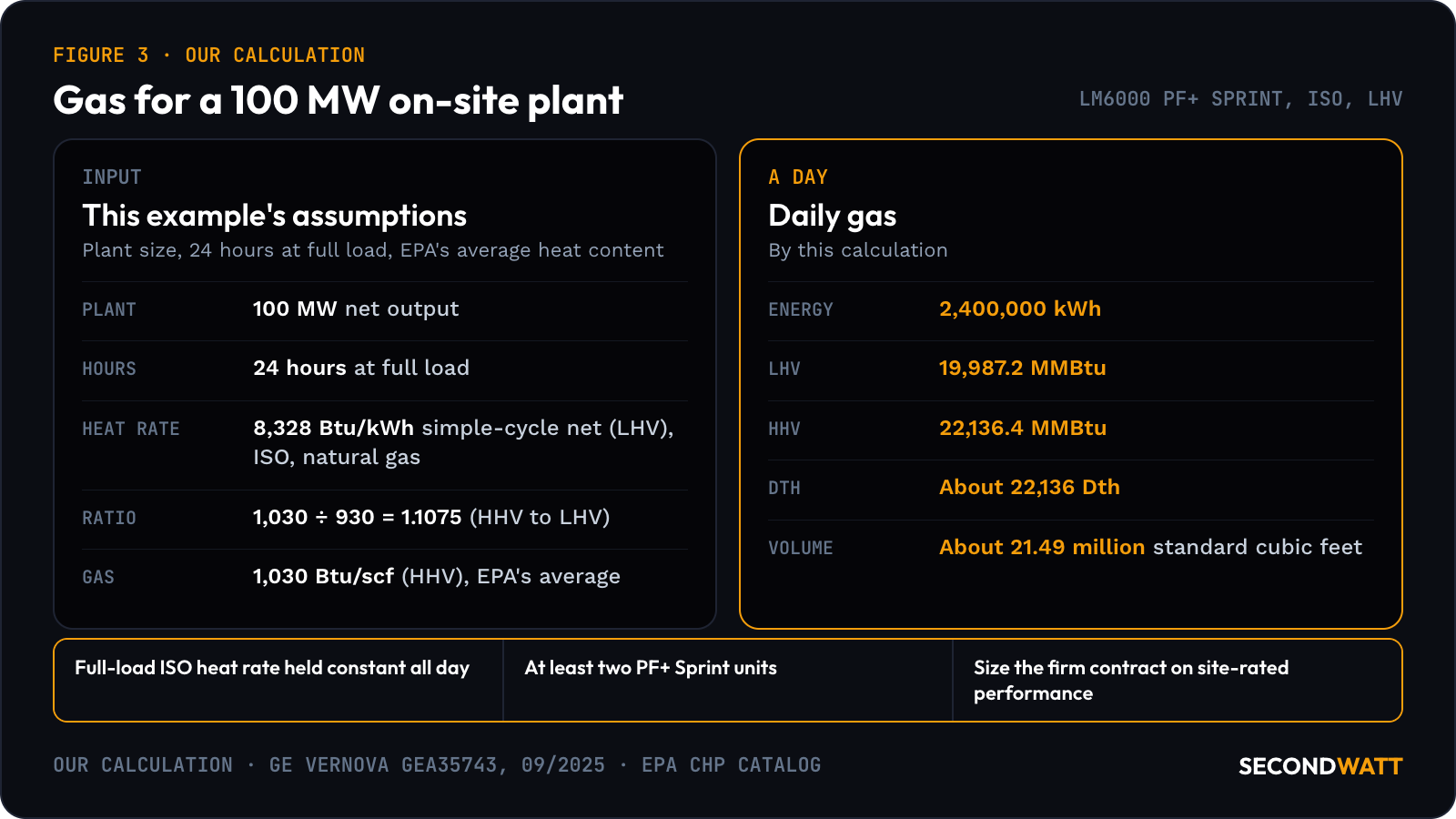
The figure holds the full-load ISO heat rate constant all day. Delivering 100 MW net takes at least two PF+ Sprint units (100 ÷ 56.9 = 1.76). Sharing the load equally, each runs at about 88% of its 56.9 MW ISO net rating. Actual performance varies with project conditions, fuel and ambient conditions, as GE Vernova notes, so size the firm contract on site-rated performance; the LM6000 dossier is a starting point.
A due diligence checklist for a powered site#
Each line names a document or figure to ask for, with its date and source.
- The highest grid document reached: will-serve letter, study agreement, construction agreement or service agreement, with its counterparty, date, capacity and load ramp.
- The clock on the next step. At Dominion, the customer has 90 days after the engineering study to request a construction letter and another 90 to execute it, or the project is canceled.
- Cost responsibility: deposits paid, collateral due and any reimbursement owed if the project stops before energization.
- Gas supply: the pipeline or distribution company, firm or interruptible service, and the contracted daily quantity in Dth against the plant's need.
- Delivery pressure at the site against the prime mover's requirement, and whether compression is in the plan.
- Water: the source, the volume and the quality the plant needs.
- The air permit: the issuing agency, its status and the equipment it names.
- The equipment schedule: units, ratings and delivery dates for power blocks, gas turbines or engines such as the mtu 20V4000 L64. Size the transformers with the transformer sizing guide.
- Who holds each document, and which of the four evidence statuses it has earned.
FAQ: powered land#
Does a site's committed megawattage equal usable data center capacity?#
No, in Linklaters' Part 1 analysis: headline committed megawattage does not translate directly into usable data center capacity. The gap reflects power diverted to functions such as cooling, switchgear and backup systems. In ISO/IEC 30134-2:2026, edition 2 of January 2026, power usage effectiveness (PUE) tracks the energy computing equipment uses against total facility energy consumption.
How long does a will-serve letter take?#
At SRP in Arizona, applicants are asked to allow five to 10 business days for processing, according to the will-serve letter page. The Will Serve Center provides information on available electrical service capacities for proposed development projects in SRP's territory, and SRP reserves the right to modify and update a letter.
Can land be powered by on-site generation instead of the grid?#
Yes. One multibillion-dollar powered land and data center development transaction included an "on-site 500 MW natural gas generation facility"; Benesch represented the developer. Linklaters' Part 3 says brownfield and industrial sites are often considered attractive for co-location, and frequently carry pre-existing grid connections. The bridge power guide covers generation that runs until the grid arrives.
What does a green energy park include?#
In Ireland's Large Energy User Action Plan, green energy parks "co-locate LEUs, dispatchable generation, storage and renewable generation." In the plan, LEU means a very large energy user. A park "would not necessarily require all the elements" of the plan's concept drawing, which is for illustrative purposes only.
Who pays for new utility infrastructure?#
It depends on the utility's tariff. Dominion Energy's May 2026 GS-5 report says that in its Virginia territory, where new distribution infrastructure is required to serve a data center, the customer pays all engineering, construction and long-lead-time equipment costs, even if it does not proceed. Virginia's State Corporation Commission approved a GS-5 class and tariff for "customers with particularly high demand and load factor characteristics", effective 1 January 2027. It brings enhanced deposit and collateral requirements and a 14-year contract term including a four-year ramp.
Powering a site#
SecondWatt publishes equipment research and helps buyers source power equipment; it earns a fee when a sale it arranges closes. If you are planning on-site generation for a powered site, send a request with the load, gas pressure and permit status. If you own turbines, engines or electrical equipment a site like this could use, the seller page explains how SecondWatt works with owners.