
A data center microgrid is a set of loads and local power sources inside a defined electrical boundary that runs as one controllable system. It can run connected to the utility or islanded from it. The sources can be gas engines or turbines, fuel cells and batteries, joined on paralleling switchgear and directed by one controller.
What a buyer procures is a build list: switchgear, controls, generation, storage and the protection that works in both modes. Get those right and the same plant can carry a campus before its grid connection is ready, then run in parallel with the utility once it is. The switchgear hub holds the paralleling lineups and master controls named below.
Key Takeaways
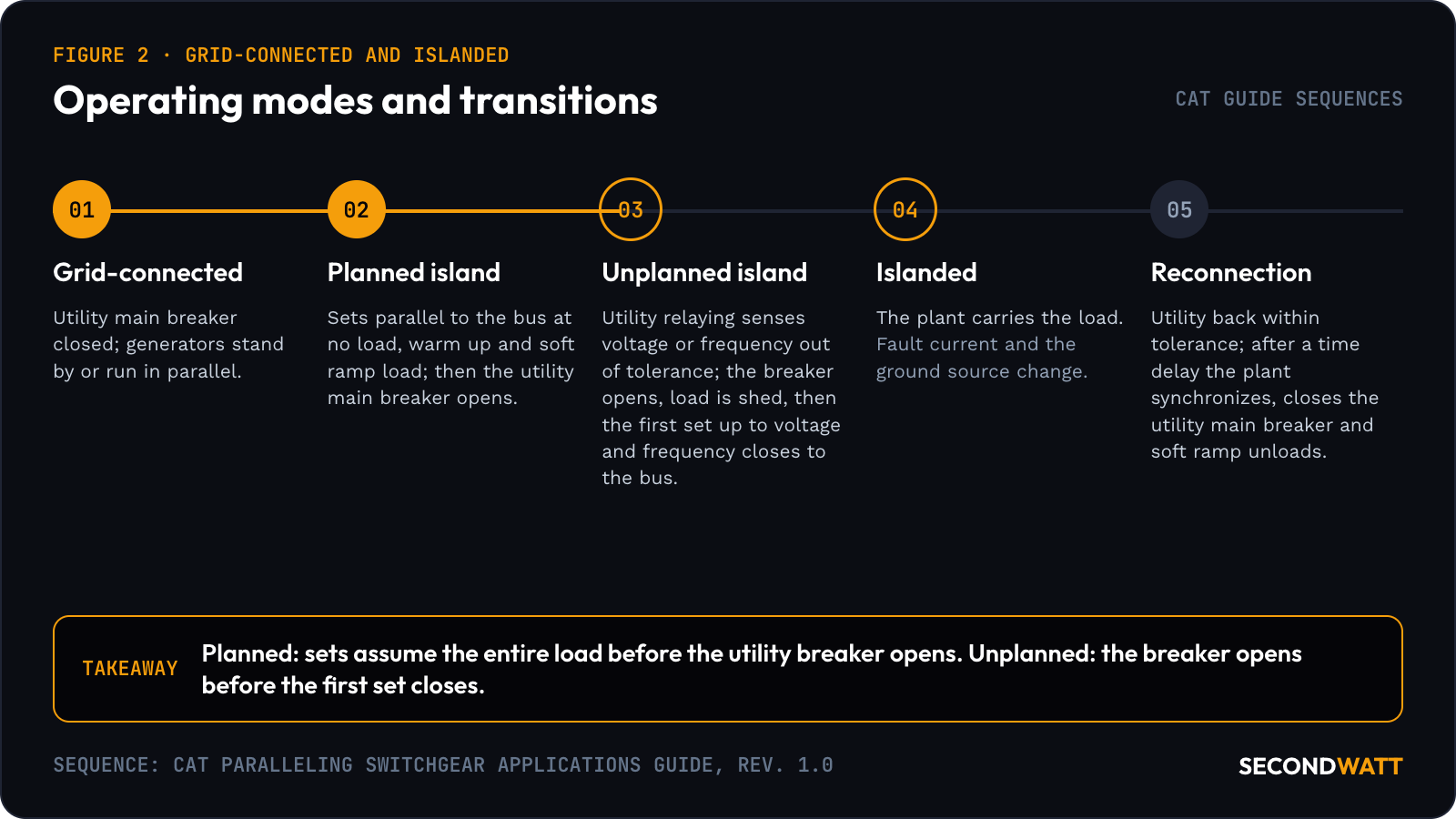
- Island transitions run in opposite orders. Planned: sets assume the entire load before the utility breaker opens. Unplanned: the breaker opens and load is shed before the first set closes.
- Switchgear and master controls form the core. Paralleling switchgear synchronizes sources onto a common bus; a master control such as Cat's EMCP 4.4 runs emergency standby, island and utility-paralleling modes.
- Islanding changes fault current and the ground source. Inverter current limits can hold fault contribution to as low as 1.1 per unit, and separation disconnects the substation ground source.
- The step gap sizes the battery. Assuming four 2,000 kW continuous, 60 Hz sets take 30%-of-rating steps at G1, a 6,000 kW step needs 3,600 kW of battery.
- On-site generation can bring a site online ahead of the grid. Rolls-Royce says an independent gas plant may let operators come online faster; NEMA says showing peak-time islanding helps projects through queues.
What a data center microgrid is#
A microgrid system is "a group of interconnected loads and local energy resources within clearly defined electrical boundaries that acts as a single controllable entity with respect to the grid," in the definition used by the US Department of Energy's Office of Electricity. Three attributes follow from it in DOE's reading: control with respect to the grid, use of local energy resources, and advanced controllers that balance those resources against demand.
The first attribute matters most to a data center: the microgrid can move between "grid connected" operation and operating "islanded" during power outages or emergencies.
Microgrids also "accelerate grid connection for large-load utility customers," by the same DOE page, which names data centers among the massive new loads that require end-to-end innovation.
The point of common coupling (PCC) is where the microgrid meets the utility. A March 2002 CERTS white paper on protection, prepared for DOE, places the main separation device there. Everything inside the boundary, from distributed generation to the data hall feeders, has to work with or without the utility behind it.
The equipment in a microgrid#
Each component has one job; most examples carry published OEM figures.
Microgrid components, their roles and OEM examples (ASCO publication 2023 R2; Caterpillar and Cummins product pages; DOE; Utility Dive, 10 February 2026)#
| Component | Role in the microgrid | OEM example and published figure | SecondWatt page |
|---|---|---|---|
| Paralleling switchgear | Synchronizes sources onto a common bus; adds or removes sources and loads; ties the bus to the utility | ASCO 7000 Series PCS: parallels up to 32 generators; models at 600 V max. and at 5 kV/15 kV | ASCO 7000 Series |
| Master control | Runs plant modes and sequences across all sets and the utility tie | Cat EMCP 4.4 Master Control Panel: up to 8 generator sets; emergency standby, island and utility paralleling modes | Cat EMCP 4.4 stack |
| Master control, larger plants | Same role for more sources and utilities | Cummins DMC8000: unlimited gensets, utilities and loads; DMC2000 up to 8 generators and 1 utility | Cummins DMC |
| Genset controls | Engine and generator control, protection and monitoring on each set | Cat EMCP 4 on the G3516 Fast Response | Cat G3516 Fast Response |
| Gas engines or turbines | Firm generation in island and parallel operation | Cummins C2000N6CD: 2,000 kW continuous, 60 Hz; Cat G3516 Fast Response: 1,500 ekW standby at 0.8 pf, 60 Hz, for standby systems | Gas engines |
| Fuel cells | Produce electricity and heat as long as fuel is supplied | DOE fuel cell description | Fuel cells |
| Batteries | Carry load steps beyond the engines' step; add redundancy and support power quality | Cat battery storage: "genset transient assist"; NEMA comments reported by Utility Dive, Feb 2026 | Batteries |
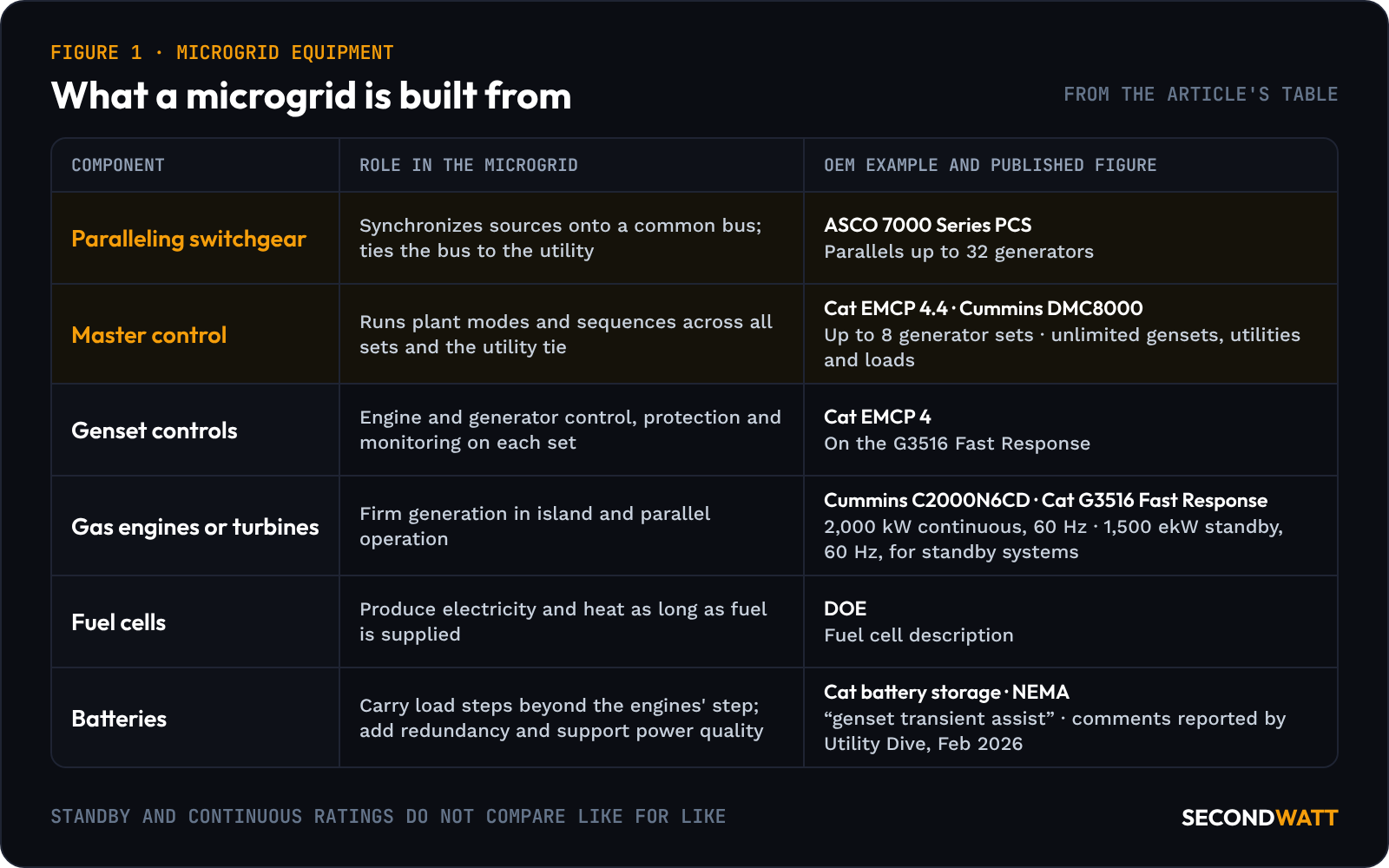
Paralleling switchgear is the bus everything meets on. The ASCO 7000 Series offers four modes on both its low- and medium-voltage models, according to the 2023 R2 edition of ASCO's 7000 Series PCS brochure. They are isolated bus (open transition), generator soft load and unload, utility tie with momentary closed transition, and utility tie with soft load and unload. The series can also support microgrids.
Master controls sit above the switchgear. Caterpillar's EMCP 4.4 Master Control Panel monitors and controls up to eight generators "for operation in parallel with or without a single utility source," at 208 V to 38 kV. Each set carries its own EMCP 4.4 control, and the panel reaches the sets over a high-speed network. The Cummins DMC8000 supports unlimited generators, loads and utilities, at low and medium voltage.
Fuel cells and batteries join through the same bus. As the Department of Energy explains, a fuel cell produces electricity and heat as long as fuel is supplied. It does not run down or need recharging the way a battery does. The fuel cell guide compares their time to power with turbines, and the battery storage sizing guide treats power and energy as separate specifications.
Operating modes and transitions#
The scope of IEEE 2030.7-2017 calls the microgrid energy management system "a key element of microgrid operation," with control functions that let the microgrid "manage itself, operate autonomously or grid connected, and seamlessly connect to and disconnect from the main distribution grid."
Grid-connected operation comes first. The utility main breaker is closed, and generators either stand by or run in parallel. Revision 1.0 of Caterpillar's Paralleling Switchgear Applications Guide, dated September 2021, covers the company's XLM switchgear. The switchgear allows closed transition, soft loading and unloading, and peak shaving with generators running continuously in parallel with the utility.
A planned island is a controlled handover. In the Cat guide's sequence, the operator selects the closed transfer mode, and the sets are paralleled to the bus at no load and warmed up. Once all sets are on the bus, they are soft ramp loaded until the generator plant assumes the entire load, and the utility main breaker opens. A closed-transition transfer is a momentary paralleling of both sources with no interruption to the loads, possible only when the sources are properly synchronized, in the guide's definition.
An unplanned island starts with the utility. In the Cat guide's emergency sequence, utility protective relaying senses voltage or frequency out of tolerance, and the utility main breaker opens. A load shed sequence runs, and the first set up to voltage and frequency closes to the bus.
The 2002 CERTS white paper says that if very fast separation is required and nuisance trips are to be avoided, transfer trip is needed between the utility substation and the PCC breaker.
Reconnection reverses the order. After utility relaying senses voltage and frequency back within tolerance, an adjustable time delay confirms the source is stable. The plant is synchronized and paralleled to the utility by closing the utility main breaker, then soft ramp unloaded until the utility carries the load. The CERTS paper adds that a microgrid with several sources at different locations should have automatic re-synchronizing built into its design.
Protection, fault current and grounding#
Fault current is the first thing that changes when a site islands. On a typical on-site system, the MV/LV transformer fuses are typically sized to operate in 0.1 to 0.2 seconds for the utility's fault current, which may be 20 to 50 times the fuse's maximum load current. As an islanded microgrid, the same system's own sources give a medium-voltage fault current that "will likely not exceed 5 times the full load current and may be considerably less," the 2002 CERTS white paper says. Those fuses become extremely slow for such faults.
Inverter-based sources lower it further. The CERTS paper expected inverter fault current to stay below twice rated current unless the unit is specifically designed for high fault current. The current limit of PV inverters is typically 1.1 to 1.4 per unit, in a May 2017 Sandia National Laboratories report. It warns that overcurrent protection "could fail completely to pick up the fault" in microgrids with significant inverter-based generation.
Relay settings therefore have to answer for both modes. The Sandia report says fault levels can change so much between grid-connected and islanded operation that coordinating overcurrent protection for both is very difficult, or even impossible in some cases. In the CERTS paper, the choice is to readjust settings on islanding or find one setting for both. The ANSI device numbers guide decodes the relay functions a protection study names.
Grounding is the second change. When a microgrid separates at the PCC, it disconnects from the substation ground source. The grounding condition may then be set by the source's transformer connection and in some cases by the generator's own grounding. The 2002 CERTS white paper notes that a grounded wye-delta transformer with the delta on the generator side keeps the medium-voltage system effectively grounded. That is because the transformer itself is a ground source.
Where an effectively grounded source must come from a unit connected through a transformer with its delta on the medium-voltage side, the CERTS paper says a grounding transformer "is often a more economical alternative than a change to the main transformer." In Section 5 of the Cat guide, Cat Switchgear recommends low-resistance grounding for medium-voltage switchgear. The recommended neutral grounding resistor sits on the generator neutral, rated for 10 seconds and the line-to-neutral voltage. The neutral grounding resistor guide covers resistor sizing and grounding transformers.
Load steps and storage, worked#
Engines accept load in defined steps. ISO 8528-5 sets operating limits for performance classes G1, G2 and G3, plus a G4 class whose limits manufacturer and customer must agree, as Caterpillar's white paper on diesel generator sets describes it.
The standard sizes the load steps from the engine's brake mean effective pressure, and a genset typically reaches full load in three to six steps, depending on engine and rating. Caterpillar's paper, citing ISO 8528-5:2022, adds that if a specification defines other load steps, classes G1 to G3 no longer apply and G4 is needed.
The Cummins HSK78G lean-burn gas series has a published step. Cummins's HSK78G page lists a "30% load step at G1 with four steps to load." The C2000N6CD in that series is rated 2,000 kW continuous at 60 Hz.
When a load step exceeds what the sets on the bus can take in one step, a battery can cover the difference. Battery energy storage is "suitable for grid integration and genset transient assist," in the list of its benefits on Caterpillar's microgrid page.
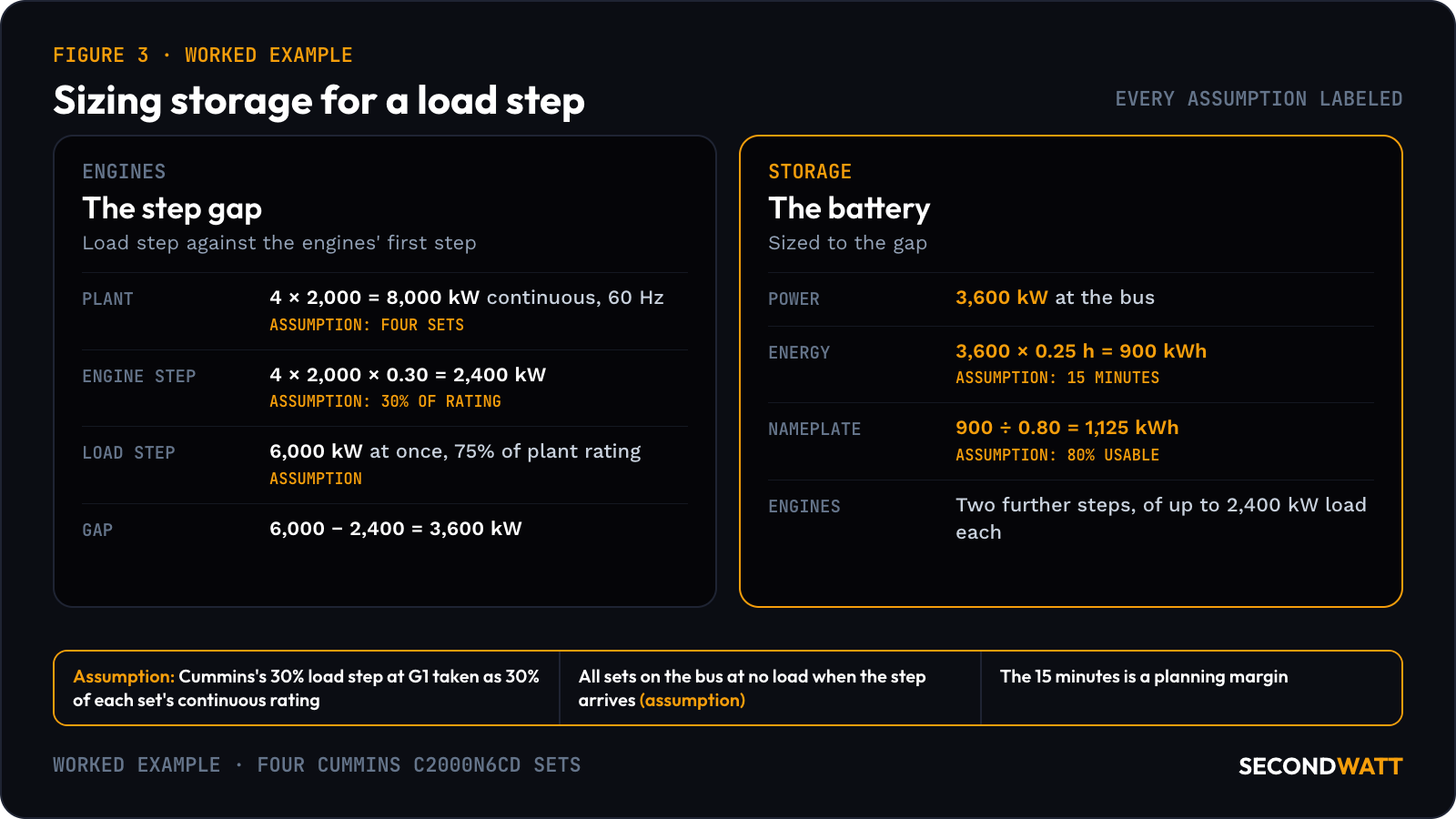
Worked example, with every assumption labeled:
- Plant: four Cummins C2000N6CD sets (assumption), 2,000 kW continuous each, 60 Hz (Cummins), all on the bus at no load when the step arrives (assumption). Plant rating 4 × 2,000 = 8,000 kW continuous.
- Engine step: 30% at G1 (Cummins), taken here as 30% of each set's continuous rating (assumption). One step: 4 × 2,000 × 0.30 = 2,400 kW.
- Load step: 6,000 kW applied to the island at once (assumption), or 75% of plant rating.
- Battery power: 6,000 − 2,400 = 3,600 kW at the bus.
- Hold time: 15 minutes while the engines take the rest in further steps (assumption). Energy: 3,600 × 0.25 h = 900 kWh.
- Usable share of nameplate energy: 80% (assumption). Nameplate: 900 ÷ 0.80 = 1,125 kWh.
The engines then need two further steps, of up to 2,400 kW load each, to carry the remaining 3,600 kW load. The 15 minutes is a planning margin; the controller's step timing and the battery's recharge plan set the real figure.
A fast-response gas set changes the arithmetic. The G3516 Fast Response "is capable of accepting and recovering from a 100% block load," Caterpillar said in a 5 January 2022 release. The set is engineered "for emergency, legally required or optional standby systems" and suits peak shaving or load management, so its 1,500 ekW standby rating at 60 Hz does not compare like for like with the Cummins continuous ratings.
6.5 to 7.5 seconds — the G3516 Fast Response is engineered to "start and accept load from a cold start as quickly as 6.5 to 7.5 seconds," in Caterpillar's January 2022 release.
How a microgrid speeds up power#
One speed-to-power route is to run without the grid first. Rolls-Royce said in a 2 Oct 2025 release that continuous gas power is "especially attractive when the existing grid power is not sufficient" for a new data center load. In its view, an independent gas plant may let operators come online faster.
Utilities increasingly value data centers that can island during peak demand, said Patrick Hughes, senior vice president at the National Electrical Manufacturers Association (NEMA). Showing "you can island during peak times" will get a data center through the interconnection queue faster, he told Utility Dive. Developers add gas-fired generation to reduce the interconnection capacity they need, he said in the 10 Feb 2026 Utility Dive report.
Large-load queues can stretch up to seven years in some regions, by a Cleanview analysis in the same report, and about 75% of the behind-the-meter assets it could identify use natural gas.
30% — the approximate share of all planned US data center capacity whose facilities plan to run on behind-the-meter resources, in Cleanview's analysis as reported by Utility Dive in February 2026.
The islanded-first sequence is the microgrid's version of bridge power. In the Cat guide, grid-parallel operation brings the utility's own protection: relays the utility requires to detect abnormal conditions and open the utility breaker. The large-load interconnection guide covers FERC's RM26-4 rulemaking, and the behind-the-meter guide sets out the configurations.
Specifying a microgrid#
A specification that covers both modes names these items:
- Boundary and PCC. Where the microgrid ends, which breaker separates it, and whether the utility requires transfer trip at that breaker.
- Sources and storage. Each generator's rating type and frequency, each battery's power and energy, and how fuel cells or other sources join the bus.
- Switchgear and controller. The modes required (open transition, momentary closed transition, soft load and unload), the number of sources and utilities, and which device performs the controller's functions; the paralleling switchgear article compares the modes.
- Protection study for both modes. Fault levels grid-connected and islanded, with inverter contribution stated, and the relay settings or settings changes for each.
- Grounding. The ground source when islanded: a transformer connection, a grounding transformer or a generator neutral resistor.
- Black start. Which source starts the island with the grid dead, and what it needs; the black start and load acceptance guide covers turbines.
- Load-step plan. The largest block the island must pick up, against the engines' published step, with the battery sized to the gap.
- Testing. Controller tests to the procedures IEEE 2030.8 defines, plus load-step and transition tests on site.
FAQ: data center microgrids#
What does a microgrid controller do?#
It runs the microgrid as one system, with functions "above the component control level" that are common to all microgrids, in the scope of IEEE 2030.7. A revision of the standard, P2030.7, is now under way (PAR approved 27 Mar 2025). Its scope adds the control approaches the microgrid operator uses to control assets and allow interaction with the electric power system. Genset controls work at the component level beneath it.
Can a data center run on a microgrid with no grid connection?#
Yes, as an islanded system. In advanced microgrids, generation and storage keep the local grid running when the larger grid is interrupted, or for remote areas "where there is no connection to the larger grid," as the National Laboratory of the Rockies (NLR) describes them. The Cat guide calls that a prime power application, in which the generators are the only power source. Redundancy then has to come from inside the boundary.
Does a microgrid need batteries?#
It depends on the largest load step. A plant whose sets can accept that step in one step can island without storage for that purpose. Storage also adds redundancy and can help optimize power quality to protect sensitive electronics, said Hughes of NEMA.
A PV-battery-diesel hybrid that NLR built for the US Army gave load-step response comparable to a diesel generator's. It kept high power quality as the grid-forming role passed between the diesel generator and the hybrid, and during a black start onto a load.
Which standards apply to microgrid controllers?#
Two IEEE standards cover the controller. IEEE 2030.7-2017, published 23 Apr 2018, specifies the controller's functions. IEEE 2030.8-2018 develops testing procedures to quantify the performance of those functions against expected minimum requirements. It was published 24 Aug 2018. Both are active, and P2030.8, a project to revise 2030.8, gained PAR approval on 26 Mar 2026.
How is a microgrid different from standby generators?#
By duty and by mode. An emergency standby application means typical usage of 50 hours per year, with a maximum of 200, in Caterpillar's definition. A standby plant waits for the utility to fail, while a microgrid also runs in parallel with the utility or islanded by choice.
Sourcing microgrid equipment#
SecondWatt publishes equipment research and helps buyers source power equipment; it earns a fee when a sale it arranges closes. If you are specifying a microgrid, send a request that states the modes, the largest load step and the rating type you need, so offers can be compared on the same basis. If you own paralleling switchgear, generators or storage you no longer need, the seller page explains how SecondWatt works with owners.