NVIDIA H100 SXM5 80GB
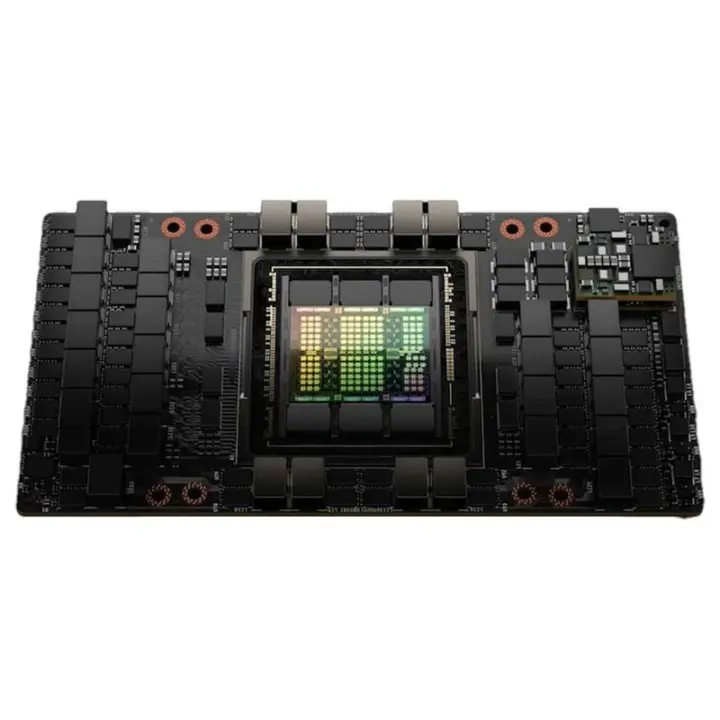
700 W Hopper accelerator whose eight-GPU node draws 10.2 kW and racks four-deep at 40.8 kW
NVIDIA H100 SXM5 80GB is one of 24 data center GPUs tracked in the SecondWatt catalogue, each with specifications, lead times and indicative secondary-market pricing.
NVIDIA H100 SXM5 80GB specs, verified power figures and used pricing: 700 W per GPU, 10.2 kW per 8-GPU node, 40.8 kW per rack at four nodes.
The H100 SXM5 80GB is the reference Hopper part and the deepest pool in today's secondary accelerator market. It carries 80 GB of memory at 3.35 TB/s, rates at up to 700 W configurable, and mounts only to an HGX H100 four- or eight-GPU baseboard or an NVIDIA DGX H100. It is not a card, and that single fact shapes every purchase. The number that matters to a facility is not the 700 W. NVIDIA rates a DGX H100 at 10.2 kW maximum, against 5,600 W of accelerator, so the eight GPUs are 54.9 percent of node power. Anyone sizing a hall from GPU nameplate alone under-provisions by 45 percent, and that error is the most common one in this category. Rack density is settled by NVIDIA rather than by preference. The DGX SuperPOD design guide states that densities above four DGX H100 systems per rack are not recommended for thermodynamic reasons, which puts a full rack at 40.8 kW electrical against NVIDIA's own statement that consumption per rack exceeds 40 kW. That 40 kW figure is why this generation still sells. Hopper is the last NVIDIA data center line a conventional air-cooled hall can host at full eight-GPU node density, with direct-to-chip liquid optional rather than required. A buyer with 2022-era power and cooling can deploy these today and cannot deploy a rack-scale Blackwell system at all.
Why it matters
This is the part that sets the secondary market's price floor and the reference point every other accelerator is quoted against. It is also the clearest case where GPU nameplate misleads: 700 W per accelerator becomes 10.2 kW per node and 40.8 kW per rack, and the gap between those figures is where facility budgets fail.
Who buys it
Operators and colocation tenants who need training or high-throughput inference capacity inside an existing 40 kW air-cooled envelope, at roughly 55 to 70 percent of new-silicon capital cost. Also research computing groups, regional cloud providers and enterprises buying decommissioned hyperscaler fleets as those upgrade to H200 and Blackwell.
Role in the data center
Multi-node training and large-model fine-tuning, plus high-throughput inference where NVLink bandwidth is the constraint. Density band: 40.8 kW electrical and 45.2 kW of cooling at NVIDIA's recommended maximum of four eight-GPU nodes a rack, air-cooled. The facility number that matters: accelerators are only 54.9 percent of the 10.2 kW node, so size from the node, never from 8 x 700 W. Transients: production telemetry on DGX-H100 racks shows site power swinging by tens to hundreds of MW with spectral energy between 0.2 and 3 Hz during synchronised training, documented as a grid risk.
Power envelope
Specifications verified 2026-09-10.
- Per accelerator
- 700 W — Verified: Maximum configurable board power, manufacturer specification (configurable). source
- Per 8-accelerator node
- 10.2 kW electrical — Verified: NVIDIA DGX H100 published maximum system power — 10.2 kW against 5.6 kW of accelerator (1.82x). Sizing from accelerator watts alone under-provisions the building. source
- Heat load per node
- 11.3 kW thermal — Verified: NVIDIA DGX H100 published heat load. Stated separately from the 10.2 kW electrical figure — size cooling on this one. source
- Per rack
- ~41 kW — Derived: 4 nodes per rack at the published node power, bound by NVIDIA DGX H100 per-rack guidance of 4 systems (power alone would allow 12). State your own budget and rack height and the count changes.
- Cooling class
- DLC recommended — Derived: Per-accelerator power at or above 700 W — air cooling possible at reduced rack density.
- Accelerators per IT MW
- ~784 — Derived: 1 MW IT load / (10.2 kW per 8-accelerator NVIDIA DGX H100 node). IT load only — excludes cooling and distribution losses.
Node figures are published OEM system ratings; rack counts are arithmetic against a stated rack budget and move with your own cooling design. Assumption set version 2026-09-11a.
Key specifications
| GPU memory | 80 GB |
|---|---|
| Memory bandwidth | 3.35 TB/s |
| Max thermal design power | Up to 700 (configurable) W |
| Form factor | SXM |
| NVLink interconnect | 900 GB/s |
| PCIe interconnect | Gen5, 128 GB/s |
| FP8 Tensor Core, with sparsity | 3,958 teraFLOPS |
| FP64 Tensor Core | 67 teraFLOPS |
| Multi-Instance GPU | Up to 7 at 10 GB each instances |
| Node maximum power, 8-GPU DGX H100 | 10.2 kW |
| Node heat output, 8-GPU DGX H100 | 38,557 BTU/hr |
| Node airflow at 80 percent fan PWM | 1,105 CFM |
| Node height | 8 U |
| Maximum recommended nodes per rack | 4 systems |
| Rack power at 4 nodes | 40.8 kW |
| Server options | HGX H100 with 4 or 8 GPUs; DGX H100 with 8 GPUs |
Technical summary
Architecture: Hopper, TSMC 4N process, over 80 billion transistors. Form factor: SXM, HGX baseboard or DGX system only, not a PCIe card. Memory: 80 GB at 3.35 TB/s bandwidth. Max TDP: up to 700 W, configurable (NVIDIA H100 product page). Node power: 10.2 kW maximum for an eight-GPU DGX H100 (NVIDIA user guide). Rack power: 40.8 kW at NVIDIA's recommended maximum of four nodes per rack. Interconnect: NVLink 900 GB/s GPU-to-GPU; PCIe Gen5 at 128 GB/s to host. Multi-Instance GPU: up to 7 instances at 10 GB each. Dense throughput: FP8 1,979 teraFLOPS (NVIDIA publishes 3,958 with sparsity). Cooling: air or direct-to-chip liquid; liquid is optional, not required. Decoders: 7 NVDEC, 7 JPEG. Baseboard part number seen in channel: 935-24287-0301-000 (HGX H100 8-GPU).
Major variations
HGX H100 baseboards ship in four-GPU and eight-GPU configurations, and NVIDIA's own DGX H100 uses the eight-GPU form. TDP is configurable below the 700 W maximum, which matters when a hall cannot deliver 40.8 kW per rack. NVIDIA's enterprise software suite is an add-on for this part rather than bundled, unlike the H100 NVL card. Cooling is available as air or direct-to-chip liquid depending on integrator, and liquid is optional throughout.
Configurations and options
The two configurations that matter commercially are the eight-GPU DGX H100 at 8U and 10.2 kW, and an OEM eight-GPU HGX H100 chassis such as the Supermicro SYS-821GE-TNHR, also 8U, with six 3000 W supplies in a four-plus-two group giving 12 kW usable. Watch the ambient ratings, because they differ and the system rating governs. NVIDIA rates the DGX H100 from 5 to 30 C while the Supermicro chassis is rated 10 to 35 C. In a hall running warm the DGX ceiling of 30 C is the binding constraint.
Compatibility and dependencies
Host platform: an HGX H100 four- or eight-GPU baseboard or an NVIDIA DGX H100, not a PCIe card. Secondary trade is usually the whole eight-GPU baseboard, part 935-24287-0301-000, because SXM5 modules are not field-replaceable. Node power, from NVIDIA's own user guide: 10.2 kW maximum with six 3300 W supplies, four energized. Eight accelerators at 700 W is 5,600 W, so the GPUs are 54.9 percent of node power, and sizing from GPU nameplate alone under-provisions by 45 percent. Two NVIDIA figures for the same node disagree; do not average them. The guide states a 10.2 kW electrical maximum and 38,557 BTU/hr, which is 11.30 kW. Size electrical distribution from 10.2 kW a node and cooling from 11.30 kW. NVIDIA does not recommend more than four DGX H100 a rack: 40.8 kW electrical, three rPDU feeds at N+1, 415 VAC 32 A three-phase. Plan alongside liquid cooling, busway, PDUs, racks and CRAC units.
Pricing and availability
Published price range: $19,000 - $27,000 per GPU, used or refurbished, baseboard basis, Q3 2026. Trend: falling Cloud rental at launch in 2023 ran $7 to $10 a GPU-hour. Purchase pricing peaked in mid-2024 scarcity at up to $50,000 a GPU, then settled to $25,000 to $40,000 retail from mid-2024 into early 2026. Compute Exchange put used at $15,000 to $28,000 and refurbished at $21,000 to $34,000 in late 2025, tightening to a $22,000 to $27,000 used band by Q3 2026. Value retention is reported at 75 to 85 percent over the first 24 months, with refurbished trading 15 to 25 points above used. Blackwell availability is expected to add 10 to 20 percent of downward pressure. Rental moved the other way, with one-year contract rates rising from $1.70 to $2.35 per GPU-hour between October 2025 and March 2026. Lead time, new: Roughly 2 to 4 weeks through the channel as of early 2026; historically over 12 months during the shortage period. Lead time, used or refurbished: Immediate to 2 weeks from stock-holding resellers; eight-GPU baseboards were listed with 10 units available on 2026-09-10. Warranty, new: Three years is the common channel offer on new boards and cards in this family. Warranty, used: Three years offered by at least one refurbisher on HGX H100 boards; transferability to a subsequent owner was not established.
Lifecycle and maintenance
Lifecycle status as of 2026-09-10: supported and purchasable, no longer merchandised. No Hopper part appears on NVIDIA's enterprise-software end-of-life notice list, which carries Volta, Turing, Ampere and Ada Lovelace. NVIDIA's HGX platform page now lists only Vera Rubin, Rubin, B300 and B200 baseboards, so this generation is off the page NVIDIA merchandises while both product pages stay live with full specifications. No manufacturer service-life figure is published. Operator depreciation schedules are the available proxy: Amazon shortened to 5 years in 2025, Meta extended to 5.5 years, CoreWeave uses 6 years, and Azure retired 2014 to 2016 silicon in 2023 for an observed 7 to 9 year life.
Common failure points
- HBM3 memory stack — Correctable ECC counts climb, then uncorrectable errors and retired pages, and training jobs abort mid-run
- SXM5 module on a non-serviceable baseboard — One accelerator drops from enumeration and total memory reads short of 640 GB
- Power supply group — A supply drops out of the six-unit group and the node either derates or refuses to start
- NVLink and NVSwitch fabric — Links fail to train or retrain repeatedly, collective operations stall, and per-lane CRC counters rise
- Cooling path and fan set — Fans pinned near 100 percent at moderate load, inlet-to-outlet rise beyond the expected 16 to 18 C, clocks dropping under sustained load
- Fleet-level power oscillation — Aggregate site load swings by tens to hundreds of MW with spectral energy between 0.2 and 3 Hz during synchronised training
- Firmware and provenance on gray-market boards — Reported specifications disagree with NVIDIA's published figures, attestation fails, or drivers refuse to bind
Inspection checklist
HBM row-remapping history: run nvidia-smi -q -d ECC on every one of the 8 modules and record retired page counts; HBM stacks are not repairable and a rising remap count sets the remaining life of the whole baseboard. Uncorrectable ECC event log: pull the full volatile and aggregate ECC counters; any non-zero uncorrectable count on a board offered as tested is grounds to reject or reprice. Hours in service: request the accumulated power-on hours per module and compare against the seller's claimed age; a 2022-vintage board with under 8,000 hours is unusual enough to verify. Thermal-throttle event counts: read the clock-throttle reason counters and confirm sustained-load clocks hold without HW slowdown events accumulating over a 72-hour soak.
Procurement channels
Broker and marketplace: Compute Exchange publishes indicative bands and is the most quotable reference for this part. Stock-holding resellers such as Network Outlet list eight-GPU baseboards outright. ITAD channel presence is not listed inventory. ALTA Technologies, named as an active datacenter GPU reseller, showed zero products on its used H100 collection page on 2026-09-10 and routes buyers to a quote request, so expect quote-only for most ITAD sourcing. eBay carries eight-GPU baseboards in quantity, including new-in-box units at asking prices well above broker bands. Treat asking prices as asks, not as market, and verify export provenance on anything sourced outside the United States.
Regional notes
Classification: ECCN 3A090.a and.b, with 4A090 for computers incorporating them. BIS guidance of 31 May 2026 turns on the counterparty: a licence is required for any entity headquartered in Country Group D:5 or Macau, or with an ultimate parent there, from every destination outside the US, regardless of location. 91 FR 1684 of 15 January 2026 gates case-by-case China and Macau review at both total processing performance under 21,000 and DRAM bandwidth under 6,500 GB/s. This module publishes 3,350 GB/s (3.35 TB/s), under the gate, with no TPP figure published; BIS named the H200 and MI325X, not any H100.