NVIDIA B300 SXM6 (Blackwell Ultra)
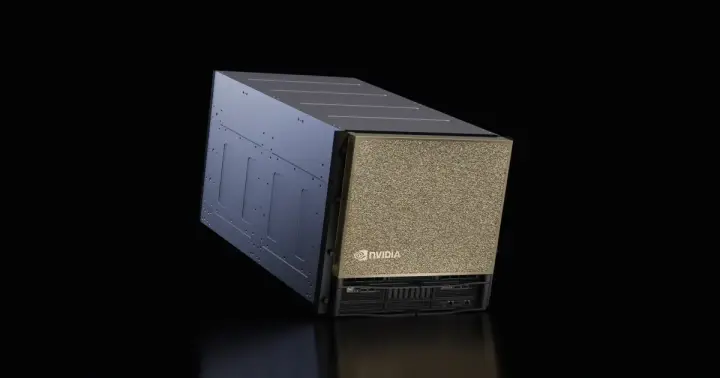
1,100 W Blackwell Ultra baseboard part, not the 1,400 W GB300, at 14.5 kW a node and about 58 kW a rack.
NVIDIA B300 SXM6 (Blackwell Ultra) is one of 24 data center GPUs tracked in the SecondWatt catalogue, each with specifications, lead times and indicative secondary-market pricing.
NVIDIA B300 SXM6 Blackwell Ultra specs: 1,100 W per GPU not the 1,400 W GB300 figure, 14.5 kW per 8-GPU node, 58 kW per rack, plus both memory figures.
The B300 SXM6 is the Blackwell Ultra accelerator sold on an 8-GPU baseboard, and the name is a trap. NVIDIA announced the part as HGX B300 NVL16 in March 2025, now calls the baseboard HGX B300, and Dell and Supermicro call it HGX B300 NVL8. The NVL16 count referred to the 16 Blackwell Ultra dies rather than the 8 SXM packages, and Supermicro's own launch text gives 2.3 TB per system at 288 GB a GPU, which divides to eight. GB300 is a different product entirely, being Grace-paired, liquid-cooled only, and rated configurable up to 1,400 W a GPU. That 1,400 W figure is the one buyers misapply. NVIDIA specifies the HGX B300 baseboard part at configurable up to 1,100 W, so a facility sized on 1,400 W a GPU is over-built by 27 percent on the GPU line item. A DGX B300 is published at 14.5 kW power consumption against a 15 kW system maximum in 10 rack units, four of those nodes give 32 GPUs and about 58 kW a rack, and the inlet-air window is 10 to 30 degrees C rather than the 10 to 35 of a DGX B200. Memory is published two ways at once. The October 2025 Blackwell Ultra datasheet and the current HGX page give 270 GB a GPU and 2.1 TB across eight, while the DGX B300 user guide gives 288 GB a GPU and 2.3 TB total. The physical stack is 288 GB and the whole reseller channel quotes that, so get the usable figure written onto the quote rather than averaging the two.
Why it matters
Two numbers on this part are wrong almost everywhere they appear. The TDP in circulation is 1,400 W, which belongs to GB300 in an NVL72 rack, and the memory figure gets quoted as one number when NVIDIA publishes two. Getting either wrong changes the electrical plan or the model that fits, so every figure here names its platform.
Who buys it
Inference and reasoning operators whose economics turn on memory a GPU and on key-value cache capacity, neoclouds refreshing a 2025 Blackwell fleet, and training operators who want 108 PFLOPS of dense FP4 across one node. Buyers here are also the ones ordering on allocation, since the only configured-node quote found carried a 20-plus week lead time.
Role in the data center
Reasoning and long-context inference first, training second, landing at about 58 kW a rack at 32 GPUs air cooled. Liquid builds take the same footprint to 64 GPUs, and the 2-OU OCP configuration reaches 144 GPUs and 158 kW of GPU alone.
Power envelope
- Per accelerator
- 1,100 W — Verified: Maximum configurable board power, manufacturer specification. source
- Per 8-accelerator node
- 14.5 kW electrical — Verified: NVIDIA DGX B300 published maximum system power — 14.5 kW against 8.8 kW of accelerator (1.65x). The chassis is rated to a 15 kW system maximum; 14.5 kW is the published consumption figure and is the one used here. Sizing from accelerator watts alone under-provisions the building. source
- Per rack
- ~58 kW — Derived: 4 nodes per rack at the published node power, bound by the 10U chassis height in a 42U rack (power alone would allow 8). State your own budget and rack height and the count changes.
- Cooling class
- DLC strongly preferred — Derived: Per-accelerator power at or above 1000 W. Air-cooled OEM systems exist at this level, at reduced rack density and higher airflow; liquid cooling is the practical choice above roughly 40 kW per rack. Configuration decides, not the accelerator alone.
- Accelerators per IT MW
- ~551 — Derived: 1 MW IT load / (14.5 kW per 8-accelerator NVIDIA DGX B300 node). IT load only — excludes cooling and distribution losses.
Node figures are published OEM system ratings; rack counts are arithmetic against a stated rack budget and move with your own cooling design. Assumption set version 2026-09-11a.
Key specifications
| GPU memory, HGX B300 baseboard specification | 270 GB HBM3E |
|---|---|
| GPU memory, DGX B300 user guide | 288 GB HBM3E |
| Total fast memory, HGX B300 platform page | 2.1 TB |
| Total GPU memory, DGX B300 user guide | 2.3 TB |
| Memory bandwidth per GPU | 7.7 TB/s |
| Max thermal design power, configurable | up to 1,100 W |
| Max thermal design power of the same silicon in GB300 NVL72 | up to 1,400 W |
| Node power consumption, 8-GPU DGX B300 | 14.5 kW |
| Node height | 10 RU |
| Rack power, four nodes and 32 GPUs air-cooled | 58 kW |
| DC busbar input option | 54 VDC at 300 A max current |
| Inlet air temperature range | 10 to 30 degrees C |
| Heat rejection, 8-GPU node | 49,476 BTU/hr |
| Node fabric bandwidth | 1.6 TB/s |
| Host interface | PCIe Gen6, 256 GB/s |
| FP4 throughput across 8 GPUs, sparse and dense | 144 and 108 PFLOPS |
| Node system maximum, 8-GPU DGX B300 | 15 kW |
Technical summary
Architecture: Blackwell Ultra, two dies with HBM3E, same package family as B200. Form factor: SXM6 on an 8-GPU HGX B300 baseboard, also named HGX B300 NVL8. Memory: 270 GB a GPU and 2.1 TB across eight on the HGX B300 specification. Memory, DGX platform: 288 GB a GPU and 2.3 TB total in the DGX B300 user guide. Bandwidth: 7.7 TB/s a GPU and 62 TB/s across eight. Max TDP: configurable up to 1,100 W, against 1,400 W for GB300 in an NVL72. Node power: 14.5 kW published power consumption for an 8-GPU DGX B300 in 10 rack units, air cooled; NVIDIA states a 15 kW system maximum in the same user guide, which is the figure to provision to. Rack power: about 58 kW at four nodes and 32 GPUs air cooled. Interconnect: fifth-generation NVLink 1.8 TB/s a GPU, 14.4 TB/s across eight. Host link: PCIe Gen6 at 256 GB/s, with 8 integrated ConnectX-8 at 800 Gb/s. Throughput: 144 PFLOPS FP4 sparse and 108 PFLOPS dense across eight, vendor figures. Cooling: air baseboard 935-26287-0070-000, plus 4U cold-plate liquid systems.
Major variations
The naming history is the variation that costs money. NVIDIA announced this part as HGX B300 NVL16 on 18 March 2025, the October 2025 datasheet and current platform page call it HGX B300, and Dell and Supermicro call the same baseboard HGX B300 NVL8. The NVL16 count was the 16 Blackwell Ultra dies rather than the 8 SXM packages, which Supermicro's launch text confirms by giving 2.3 TB a system at 288 GB a GPU. GB300 is not this part. It pairs Blackwell Ultra with a Grace CPU in a liquid-cooled GB300 NVL72 rack, publishes 279 GB HBM3E a GPU at 8 TB/s and is rated up to 1,400 W. Quoting 1,400 W against an HGX B300 baseboard over-builds the GPU line item by 27 percent. Memory appears three ways across NVIDIA's own documents: 270 GB a GPU for HGX B300, 288 GB for DGX B300 and 279 GB for GB300 NVL72. The physical stack is 288 GB, and NVIDIA publishes no note reconciling the three.
Configurations and options
Air-cooled 8U chassis at four nodes and 32 GPUs a rack with six 6,600 W supplies at 3+3, and 4U cold-plate liquid chassis at eight nodes and 64 GPUs a rack with four 6,600 W supplies at 2+2. A 2-OU liquid variant in OCP ORV3 21-inch racks reaches 18 nodes and 144 GPUs. DGX B300 is the NVIDIA-built reference at 10 rack units, air cooled, in AC-supply and 54 VDC busbar forms.
Compatibility and dependencies
Host platform is an 8-GPU HGX B300 baseboard, part 935-26287-0070-000 for the air-cooled passive version, in an OEM chassis or an NVIDIA DGX B300. Two host gates differ from B200 and both are hard requirements. Host link is PCIe Gen6 at 256 GB/s, so a Gen5-only platform will not deliver the specified bandwidth. And 8 ConnectX-8 NICs at 800 Gb/s are integrated onto the baseboard, so NIC choice is not a configuration option and a NIC fault is a baseboard service event. A DGX B300 uses twelve 3.2 kW supplies at N plus N with a minimum of six, or a 54 VDC busbar input rated 300 A. Supermicro air-cooled reference clusters distribute at 415 V 60 A three-phase and liquid clusters add 250 kW in-rack coolant distribution. Plan alongside busway for the 54 VDC 300 A input and the 58 kW-plus feed, liquid cooling for the cold-plate option, PDUs and racks.
Pricing and availability
Evidence: broker listing · new condition · Configured eight-GPU node · observed Jul 2026. Comparable secondary-market band: 640000–690000 $ per configured 8-GPU node (Jul 2026). Trend: rising No series exists. Blackwell Ultra partner availability began in the second half of 2025, and Supermicro announced volume shipments of Blackwell Ultra systems on 11 September 2025, so this part had roughly one year of market history on 10 September 2026. The only dated price point moves in one direction, being an allocation quote with a 20-plus week lead time, so the trend is recorded as up rather than as a depreciation curve. Lead time, new: 20-plus weeks for a configured 8-GPU node on an allocation basis, per a broker quote dated 18 July 2026.. Lead time, used or refurbished: No secondary channel.. Warranty, new: 3 years with 120 days advance replacement on a new baseboard, per the reseller listing carrying NVIDIA part number 935-26287-0070-000.. Warranty, used: Treat a used board as out of warranty unless the seller produces a written transfer, and note the advance-replacement window is a 120-day clock from original sale..
Lifecycle and maintenance
NVIDIA publishes no MTBF or service-life figure for any data center accelerator, and B300 is current rather than deprecated in NVIDIA's enterprise software support lineup. The documented envelope is a 10 to 30 degree C inlet, 1,500 CFM on the AC-supply variant and 1,350 CFM on the busbar variant at 70 percent fan speed, and 49,476 BTU/hr of heat. New baseboards carry a 3-year warranty with 120 days advance replacement, so a used board is worth pricing as out of warranty. NVIDIA's own HGX page already lists Rubin baseboards with HBM4 alongside this part, so treat every figure here as dated and review it when Rubin specifications publish.
Common failure points
- Memory capacity mismatch between quote and delivery — Delivered usable memory reads 270 GB a GPU where the purchase order says 288 GB
- Facility sized on the GB300 TDP — Cooling and electrical capacity over-built, or a rack refused because the plan says 1,400 W a GPU
- Inlet-air window narrower than the previous generation — Node passes at commissioning then throttles in summer on a warm aisle
- HBM3E memory stack — Correctable ECC counts climb, then uncorrectable errors and retired pages, and inference workers restart
- Cold-plate loop fault on a 4U liquid node — Per-GPU thermal excursions with no whole-node thermal alarm
- Host PCIe generation shortfall — Host-to-GPU transfers cap well below the specified 256 GB/s
- Integrated ConnectX-8 with no spare path — A NIC fault takes fabric bandwidth down and the NIC cannot be replaced independently
Inspection checklist
Usable memory a GPU in writing: the quote must state 270 GB or 288 GB explicitly, because NVIDIA publishes 270 GB for HGX B300 and 288 GB for DGX B300 and the channel quotes only the higher figure. Baseboard part number: confirm 935-26287-0070-000 for the air-cooled passive board, and get a distinct part number in writing if the seller claims a liquid variant. HBM row-remapping history: run nvidia-smi -q -d ECC on all 8 modules and record retired page counts, because HBM3E is not repairable and the remap trend sets remaining life for the baseboard. Uncorrectable ECC event log: pull volatile and aggregate counters, and treat any non-zero uncorrectable count on a board sold as tested as grounds to reject or reprice.
Procurement channels
New through OEMs and integrators, as a line item inside a configured server. Ahead-IT publishes a bare baseboard price and states it cannot be ordered separately; Wiredzone and smicro.eu list the same part number with no price; one broker publishes a configured-node price on allocation. Supermicro is named as the qualified 8U air-cooled platform on NVIDIA's own marketplace, and Dell publishes baseboard firmware, so both are legitimate integration routes. No secondary channel exists.
Regional notes
Blackwell Ultra is in the BIS 3A090/4A090 control set per guidance of 31 May 2026, which classifies rather than names models. No export-compliant variant is published; B30A appears only in trade reporting. BIS guidance of 31 May 2026 turns on the counterparty: a licence is required for any entity headquartered in Country Group D:5 or Macau, or with an ultimate parent there, from every destination outside the US, regardless of location. 91 FR 1684 of 15 January 2026 gates case-by-case China and Macau review at both total processing performance under 21,000 and DRAM bandwidth under 6,500 GB/s. B300's 7,700 GB/s is above the gate, so presumption of denial holds; no Blackwell TPP is published.