NVIDIA A100 PCIe 80GB
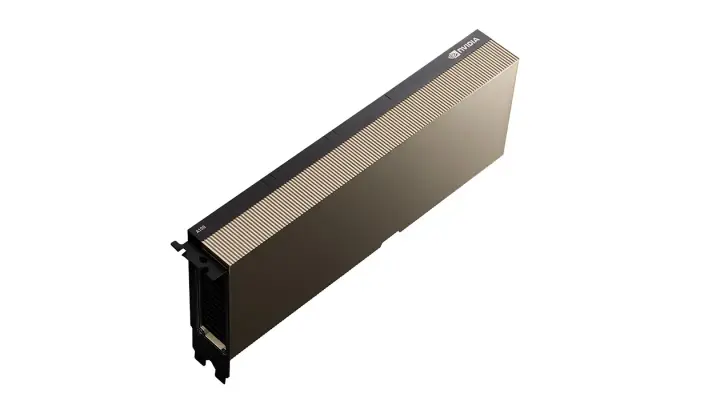
Ampere PCIe card at 300 W with 1,935 GB/s, and the only A100 variant with a single-slot liquid-cooled option
NVIDIA A100 PCIe 80GB is one of 24 data center GPUs tracked in the SecondWatt catalogue, each with specifications, lead times and indicative secondary-market pricing.
NVIDIA A100 PCIe 80GB dossier: 300 W, 1,935 GB/s, air or single-slot liquid cooling, rack kW, export status and a $7,000 to $12,500 used range.
The NVIDIA A100 PCIe 80GB is an Ampere accelerator in a PCIe card form factor rated 300 W. NVIDIA publishes 80 GB of HBM2e at 1,935 GB/s, an NVLink bridge giving 600 GB/s between two cards, PCIe Gen4 at 64 GB/s, and multi-instance partitioning into up to seven instances of 10 GB. Compute is identical to the SXM4 module: 9.7 TFLOPS FP64, 19.5 on tensor cores, 156 TFLOPS TF32 and 312 TFLOPS BF16 dense. NVIDIA documents this card as available in a dual-slot air-cooled form or a single-slot liquid-cooled one. It is the only NVIDIA A100 variant with a documented single-slot liquid-cooled form, and that is a genuinely useful and little-known option for a density retrofit where slot count rather than power is the binding constraint. Against the SXM4 module it trades interconnect for deployability. NVLink here bridges pairs rather than joining an eight-module domain, and bandwidth is 1,935 GB/s against 2,039. In exchange it drops into any PCIe Gen4 server at 300 W rather than requiring an HGX baseboard. For an operator adding accelerators to an existing fleet, that single distinction outweighs the specification gap.
Why it matters
This is the retrofit path into Ampere and it prices below the SXM4 module at $7,000 to $12,500 across three channels. It is also the one part here NVIDIA documents in a single-slot liquid-cooled form, which is the kind of option that solves a density problem without a hall rebuild. It is export-controlled, named in NVIDIA's own October 2023 filing.
Who buys it
Operators adding Ampere capacity to an existing PCIe server fleet rather than buying purpose-built HGX chassis. The 300 W envelope and standard dual-slot space fit conventional rack servers, and the single-slot liquid variant suits density retrofits. Mixed enterprise inference and fine-tuning workloads dominate, plus scientific work that needs the 9.7 TFLOPS of FP64.
Role in the data center
Inference, fine-tuning and mixed enterprise workloads in existing PCIe fleets, plus scientific work needing 9.7 TFLOPS of FP64. Multi-instance partitioning into seven 10 GB slices suits multi-tenant serving. Lands well inside a 26 to 40 kW rack density band on air.
Power envelope
Specifications verified 2026-09-10.
- Per accelerator
- 300 W — Verified: Maximum configurable board power, manufacturer specification. source
- Cooling class
- Air-coolable — Derived: Per-accelerator power below 400 W — standard air-cooled halls.
No published node-level power rating exists for this part, so node, rack and per-MW figures are not stated. The baseboard sibling does carry one — A100 SXM4 80GB.
Node figures are published OEM system ratings; rack counts are arithmetic against a stated rack budget and move with your own cooling design. Assumption set version 2026-09-11a.
Key specifications
| Architecture | Ampere |
|---|---|
| Form factor | PCIe dual-slot air, or single-slot liquid cooled |
| Memory capacity | 80 GB HBM2e |
| Memory bandwidth | 1,935 GB/s |
| Maximum thermal design power | 300 W |
| NVLink bridge | 600 GB/s for 2 cards |
| Host interconnect | PCIe Gen4 64 GB/s |
| Multi-instance partitioning | Up to 7 at 10 GB each |
| FP64 | 9.7 TFLOPS |
| FP64 tensor core | 19.5 TFLOPS |
| BF16 and FP16 dense | 312 TFLOPS, 624 with sparsity |
| Part number | 900-21001-0020-000 |
| Accelerator-only load, 8 cards | 2.4 kW |
| Used range | 7,000 to 12,500 USD per card, three channels |
| Secondary lead time | 2 to 4 weeks |
| Named in NVIDIA's 17 October 2023 export filing | Yes |
Technical summary
Architecture: Ampere; 300 W maximum thermal design power. Memory: 80 GB HBM2e, 1,935 GB/s bandwidth. Form factor: PCIe dual-slot air cooled, or single-slot liquid cooled. Interconnect: NVLink bridge for 2 cards at 600 GB/s; PCIe Gen4 at 64 GB/s. Multi-instance partitioning: up to 7 instances of 10 GB each. Compute: FP64 9.7 TFLOPS, FP64 tensor core 19.5, FP32 19.5 TFLOPS. TF32 156 TFLOPS dense, 312 with sparsity; BF16 and FP16 312 dense, 624 with sparsity. INT8 624 TOPS dense, 1,248 with sparsity; no FP8 support. Compute is identical to the A100 SXM4 module on every precision NVIDIA publishes. Accelerator-only load, 8 cards: 2.4 kW; proxy-estimated node draw, not an OEM figure, 4.9 kW. Export: named in NVIDIA's Form 8-K of 17 October 2023 as licence-controlled.
Major variations
NVIDIA documents two thermal variants of this card: a dual-slot air-cooled form and a single-slot liquid-cooled one. They are not interchangeable in a chassis and the liquid variant requires a coolant loop, so establish which one a listing describes before agreeing a price. A100 PCIe 40GB is the separate 250 W card with 40 GB of HBM2 at up to 1,555 GB/s and 5 GB multi-instance partitions, priced roughly half this card. A100 SXM4 80GB is the 400 W module on an HGX baseboard with full NVLink. Compute is identical across all four A100 variants on NVIDIA's own tables.
Configurations and options
Deployed in conventional PCIe Gen4 servers, typically four to eight cards a node, optionally with NVLink bridges joining pairs at 600 GB/s. Eight cards is 2.4 kW of card load, and NVIDIA's DGX A100 node ratio of 2.03x, used here only as a proxy because the manufacturer publishes no node figure, suggests roughly 4.9 kW. The single-slot liquid-cooled variant is the configuration worth knowing about. It halves slot consumption for the same 300 W, which is the right answer when a chassis runs out of physical slots before it runs out of power or cooling. NVIDIA publishes no configurable-TDP range, so 300 W should be treated as fixed.
Compatibility and dependencies
Fits any PCIe Gen4 x16 slot able to supply and cool 300 W, in a dual-slot space for the air variant or a single slot for the liquid one. NVLink bridging joins two cards at 600 GB/s, so the interconnect domain is a pair rather than the eight-module domain an SXM4 baseboard provides. That is the design limit for distributed training. Eight cards draw 2.4 kW and an estimated node lands near 4.9 kW, so a rack of these sits comfortably inside a 26 to 40 kW air envelope. Plan alongside racks, PDUs and CRAC or chiller capacity for the air variant, and liquid cooling for the single-slot form. Multi-instance partitioning into seven 10 GB slices makes it a practical multi-tenant card.
Pricing and availability
Published price range: $7,000 to $12,500 per card used or refurbished, three independent channels, Q3 and mid-2026. Evidence: channel observation · used or refurbished condition · Single card. Trend: falling sell-server.com records this card at $12,000 to $15,000 in mid-2025 falling to $9,500 to $12,500 in mid-2026, which the source states as an 18 percent decline over the year. Compute Exchange puts Q3 2026 A100 80GB stock at $7,000 to $9,500 and describes that as roughly 50 percent below original list price. Hashrate Index projected on 8 April 2026 a further 10 to 15 percent decline in used A100 purchase prices through 2026, which falls inside the rate observed on the 40 GB card rather than above it. Do not treat that range as an independent channel; its $7,800 to $18,900 figures are Network Outlet's own catalogue prices for two different A100 variants. Lead time, new: Past its selling life. New cards appear only sporadically through resellers; the normal route is used or refurbished stock.. Lead time, used or refurbished: 2 to 4 weeks from a secondary dealer per sell-server.com, notably shorter than the 4 to 8 weeks for the SXM4 module because the buyer is acquiring a card rather than a baseboard.. Warranty, new: Not applicable in the current market; this card is bought used or refurbished.. Warranty, used: 3-year reseller warranty on refurbished stock per Network Outlet, described as a limited manufacturer or refurbished warranty depending on condition. No manufacturer warranty transfer was documented in this category..
Lifecycle and maintenance
Two generations behind the current flagship, with the product page still live and a full specification table. Secondary supply is deep and lead times are short at 2 to 4 weeks, which makes this among the most liquid items in the category alongside the L40S. As a passive card its service life depends on host airflow more than on anything on the board. Operator depreciation practice runs 4 years at Nebius, 5 at Lambda Labs and 6 at CoreWeave, against an observed 7.5-year service life on an earlier NVIDIA generation, so accounting life understates usable life.
Common failure points
- HBM2e memory stack — Rising correctable ECC counts, then retired rows, then uncorrectable errors and job crashes under sustained memory pressure
- Passive cooling airflow dependency — Throttling only under full load in a chassis whose fan curve was not qualified for a 300 W passive card
- Liquid cooling loop on the single-slot variant — Flow alarm, pressure drop, or clocks falling away as delta-T climbs after a pump-out event
- PCIe link degradation — Link trains below Gen4 x16 or reports corrected-error storms on the host link
- NVLink bridge — A bridged pair reports below 600 GB/s or fails to enumerate as a pair
- Driver and CUDA support horizon — Card functions but a framework release drops Ampere compute capability, and no FP8 path exists for quantised models
Inspection checklist
Driver-reported memory must read 80 GB HBM2e: 40 GB indicates the 250 W variant sold as this card. Stream benchmark bandwidth within 10 percent of 1,935 GB/s: 1,555 GB/s is the 40 GB figure and identifies the variant. Sustained power draw within 5 percent of 300 W under load: 400 W indicates an SXM4 module rather than this card. HBM2e correctable and uncorrectable ECC counters read before purchase: repeat after a 24-hour soak at full load. Retired-page and row-remap logs pulled before purchase: HBM retirement is the dominant end-of-life signal here. Host PCIe link trains at Gen4 x16 for 64 GB/s: negotiating Gen3 or x8 halves host bandwidth. NVLink bridge, if fitted, trains at 600 GB/s across a pair: this card bridges pairs, not an 8-card domain. Multi-instance partitioning creates up to 7 instances of 10 GB each: 5 GB instances mean a 40 GB card.
Procurement channels
Secondary is the whole market here. Compute Exchange acts as a broker with a published band, sell-server.com quotes 2 to 4 week lead times, and refurbishers such as Network Outlet hold stock with a 3-year warranty. Quote-only channels carry inventory without displaying prices, including IT Creations and PC Server and Parts, which prices accelerators through a quote desk because availability moves quickly. Live eBay listings exist in volume, 26 for this card alone on 10 September 2026, but every figure captured there was an asking price.
Regional notes
Export-controlled under NVIDIA's Form 8-K of 17 October 2023, for China and Country Groups D1, D4 and D5. Provenance: of 26 live listings on 10 September 2026, six were new-in-box from China at $22,500 to $28,800. BIS guidance of 31 May 2026 turns on the counterparty: a licence is required for any entity headquartered in Country Group D:5 or Macau, or with an ultimate parent there, from every destination outside the US, regardless of location. 91 FR 1684 of 15 January 2026 gates case-by-case China and Macau review at both total processing performance under 21,000 and DRAM bandwidth under 6,500 GB/s. Its 1,935 GB/s is well under the bandwidth gate; no TPP figure.