NVIDIA A100 SXM4 80GB
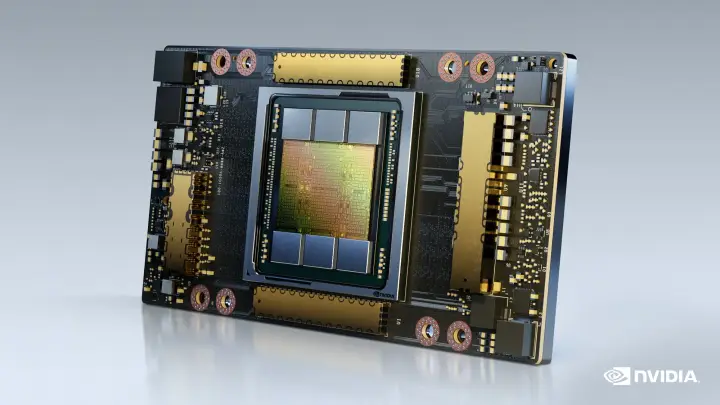
Ampere SXM4 module at 400 W with 2,039 GB/s of HBM2e, and the deepest secondary supply here
NVIDIA A100 SXM4 80GB is one of 24 data center GPUs tracked in the SecondWatt catalogue, each with specifications, lead times and indicative secondary-market pricing.
NVIDIA A100 SXM4 80GB dossier: 400 W, 2,039 GB/s HBM2e, verified 6.5 kW node and 26-39 kW rack, export status and a $7,000 to $14,000 used range.
The NVIDIA A100 SXM4 80GB is an Ampere accelerator on an SXM4 module rated 400 W. NVIDIA publishes 80 GB of HBM2e at 2,039 GB/s, NVLink at 600 GB/s, and multi-instance partitioning into up to seven instances of 10 GB each. Compute is 9.7 TFLOPS FP64, 19.5 TFLOPS FP64 on tensor cores, 19.5 TFLOPS FP32, 156 TFLOPS TF32 and 312 TFLOPS BF16, with sparsity figures double those. This is the value point of the category and Compute Exchange says so directly, describing it as the best value point in its hardware market with Very High supply as operators cycle from Ampere to Hopper and Blackwell. It is the one part in this category that carries meaningful double precision, which keeps it useful for scientific computing long after its inference relevance fades. It has no FP8 support at all. It also supplies the only fully verified node figure in this category. NVIDIA's DGX A100 datasheet gives 6.5 kW maximum for a 6U system holding eight of these modules, and eight times 400 W is 3.2 kW of accelerator load. So the accelerators are 49 percent of node power and the whole-node multiplier is 2.03 times. Anyone sizing a hall from accelerator watts alone under-provisions it by about half.
Why it matters
Three independent channels agree on a used price here, which makes this one of only four parts in the category able to publish a range. It is also the anchor for the node-power multiplier the whole catalog relies on, at a verified 6.5 kW against 3.2 kW of accelerator load. And 26 to 39 kW a rack is a figure a great many existing halls can actually deliver.
Who buys it
Operators wanting training, fine-tuning or inference capacity at a fraction of new-silicon cost, in a hall built for 2020-era density rather than liquid-cooled racks. Academic and scientific buyers come for the 9.7 TFLOPS of FP64, which the inference-tier parts do not have. Buyers need an HGX or DGX chassis, because the module cannot go into a PCIe server.
Role in the data center
Inference, fine-tuning, and academic or legacy scientific computing where 9.7 TFLOPS of FP64 and 19.5 on tensor cores still matter. Multi-instance partitioning into seven 10 GB slices suits multi-tenant serving. Lands in a verified 26 to 39 kW rack density band on air.
Power envelope
Specifications verified 2026-09-10.
- Per accelerator
- 400 W — Verified: Maximum configurable board power, manufacturer specification. source
- Per 8-accelerator node
- 6.5 kW electrical — Verified: NVIDIA DGX A100 published maximum system power — 6.5 kW against 3.2 kW of accelerator (2.03x). Sizing from accelerator watts alone under-provisions the building. source
- Per rack
- ~46 kW — Derived: 7 nodes per rack at the published node power, bound by the 6U chassis height in a 42U rack (power alone would allow 20). State your own budget and rack height and the count changes.
- Cooling class
- Air or DLC — Derived: Deployable air-cooled; liquid cooling raises achievable rack density.
- Accelerators per IT MW
- ~1,230 — Derived: 1 MW IT load / (6.5 kW per 8-accelerator NVIDIA DGX A100 node). IT load only — excludes cooling and distribution losses.
Node figures are published OEM system ratings; rack counts are arithmetic against a stated rack budget and move with your own cooling design. Assumption set version 2026-09-11a.
Key specifications
| Architecture | Ampere |
|---|---|
| Form factor | SXM4 |
| Memory capacity | 80 GB HBM2e |
| Memory bandwidth | 2,039 GB/s |
| Maximum thermal design power | 400 W standard (500 W in the custom thermal solution configuration) |
| NVLink bandwidth | 600 GB/s |
| Multi-instance partitioning | Up to 7 at 10 GB each |
| FP64 | 9.7 TFLOPS |
| FP64 tensor core | 19.5 TFLOPS |
| BF16 and FP16 dense | 312 TFLOPS, 624 with sparsity |
| HGX A100 8-module aggregate bandwidth | 4.8 TB/s |
| Verified node power, DGX A100 | 6.5 kW maximum |
| Accelerator share of node power | 49 percent, 3.2 of 6.5 kW |
| Verified rack density | 26 to 39 kW at four to six nodes |
| Used range | 7,000 to 14,000 USD per module, three channels |
| Named in NVIDIA's 17 October 2023 export filing | Yes |
Technical summary
Architecture: Ampere; form factor SXM4, 400 W maximum thermal design power. Memory: 80 GB HBM2e, 2,039 GB/s bandwidth. Interconnect: NVLink at 600 GB/s; PCIe Gen4 at 64 GB/s. Multi-instance partitioning: up to 7 instances of 10 GB each. Compute: FP64 9.7 TFLOPS, FP64 tensor core 19.5, FP32 19.5 TFLOPS. TF32 156 TFLOPS dense, 312 with sparsity; BF16 and FP16 312 dense, 624 with sparsity. INT8 624 TOPS dense, 1,248 with sparsity; no FP8 support. Host platform: HGX A100 baseboard in 4, 8 or 16-module configurations, or DGX A100. HGX A100 8-module with 80 GB parts: 640 GB total, about 16.3 TB/s aggregate memory bandwidth, 2nd-generation NVSwitch. Verified node: DGX A100 at 6.5 kW maximum, 6U, six 3000 W supplies in 3+3 redundancy. Accelerator-only load, 8 modules: 3.2 kW, which is 49 percent of node power. Rack density 26 kW at four nodes and 39 kW at six, both verified figures.
Major variations
A100 SXM4 40GB is the same 400 W module with 40 GB of HBM2 at 1,555 GB/s and multi-instance partitioning into up to seven instances of 5 GB. It shares this module's power rating and host platform, and no channel prices it separately, so it belongs here as a variant rather than as its own row. The PCIe variants are separate parts with materially different power: A100 PCIe 80GB at 300 W and A100 PCIe 40GB at 250 W. Compute is identical across all four A100 variants on NVIDIA's own tables, so the family differs on memory, bandwidth, power and form factor but never on throughput.
Configurations and options
The module mounts to an HGX A100 baseboard in 4, 8 or 16-module configurations. With 80 GB modules the 4-module board has no NVSwitch and gives 320 GB with about 8.1 TB/s of aggregate memory bandwidth; the 8-module board gives 640 GB and about 16.3 TB/s with second-generation NVSwitch; the 16-module configuration gives 1,280 GB. All three run NVLink at 600 GB/s between modules. The reference system is DGX A100: 6U, eight modules, 6.5 kW maximum, six 3000 W supplies in 3+3 redundancy at 200 to 240 volts and 16 amps per supply, 123 kg, and a 5 to 30 degree Celsius operating range. Note that the DGX A100 as documented carries eight 40 GB modules for 320 GB total, so an 80 GB build is a different memory configuration in the same chassis.
Compatibility and dependencies
Requires an HGX A100 baseboard or a DGX A100 chassis and cannot be retrofitted into a PCIe server. NVLink at 600 GB/s connects modules on the baseboard, with second-generation NVSwitch on 8 and 16-module configurations. Host attachment is PCIe Gen4 at 64 GB/s. The power arithmetic here is the verified anchor for the whole category. Eight modules at 400 W is 3.2 kW of accelerator load inside a system NVIDIA rates at 6.5 kW maximum, so accelerators are 49 percent of node power and the multiplier is 2.03 times. Four 6U nodes fill a rack at 26 kW and six at 39 kW. That is inside what a great many existing air-cooled halls deliver, so plan alongside racks, busway, PDUs and CRAC or chiller capacity but expect no liquid requirement.
Pricing and availability
Published price range: $7,000 to $14,000 per module used, three independent channels; roughly $7,000 to $9,500 at broker volume and $9,900 to $14,000 for warrantied single units. Evidence: channel observation · used condition · Single module. Trend: falling sell-server.com records the 80 GB module at $14,000 to $17,000 in mid-2025 falling to $11,000 to $14,000 in mid-2026, a 20 percent fall. Compute Exchange puts Q3 2026 used stock at $7,000 to $9,500, about 50 percent below original list. For the family: $12,500 for a 40 GB card in May 2020 against Compute Exchange's $4,000 to $6,000 Q3 2026 band is 52 to 68 percent over 6.33 years, or 10.9 to 16.5 percent a year compounded. The DGX A100 launched 14 May 2020 at $199,000 for eight 40 GB modules, $24,875 a module. Hashrate Index projected on 8 April 2026 a further 10 to 15 percent through 2026, inside it. Its range and the PC Server and Parts range restate dealer catalogues already listed. Lead time, new: Past its selling life. New HGX A100 baseboards are no longer a normal order route; the buying route is a used module, baseboard or whole node.. Lead time, used or refurbished: 4 to 8 weeks from a secondary dealer per sell-server.com, reflecting that the buyer is usually acquiring a baseboard or whole node rather than a module. Network Outlet showed stock ready to ship.. Warranty, new: Not applicable in the current market; this part is bought used or refurbished.. Warranty, used: 3-year reseller warranty on tested and certified stock per Network Outlet. No manufacturer warranty transfer was documented anywhere in this category..
Lifecycle and maintenance
Two generations behind the current training flagship, with Compute Exchange rating secondary supply Very High as operators cycle from Ampere to Hopper and Blackwell. NVIDIA's product page remains live with a full specification table, so the part is still documented even though it is well past its selling life. The usable service-life evidence is observed hyperscaler practice: Azure ran V100-based instances about 7.5 years before retiring them in September 2025, against operator depreciation schedules of 4 years at Nebius, 5 at Lambda Labs and 6 at CoreWeave. Observed service life exceeds accounting life in every case.
Common failure points
- HBM2e memory stack — Rising correctable ECC counts, then retired rows, then uncorrectable errors and job crashes under sustained memory pressure
- Thermal interface material — Clocks decline gradually at constant load as delta-T rises over months, costing throughput before any alarm fires
- NVLink and NVSwitch — Link trains below 600 GB/s or reports corrected-error storms, collapsing collective throughput across the baseboard
- Baseboard power delivery — Intermittent resets under transient load, or one module dropping out of an eight-module set
- Chassis airflow and fans — Throttling only at full load, or rising noise followed by thermal shutdown
- Driver and CUDA support horizon — Module functions but a framework release drops Ampere compute capability, and no FP8 path exists for quantised models
Inspection checklist
Driver-reported memory must read 80 GB HBM2e: 40 GB indicates the earlier SXM4 variant sold as this part. Stream benchmark bandwidth within 10 percent of 2,039 GB/s: 1,555 GB/s is the 40 GB figure and identifies the variant. Sustained power draw within 5 percent of 400 W under load: a module capped well below is throttling. HBM2e correctable and uncorrectable ECC counters read before purchase: repeat after a 24-hour soak at full load. Retired-page and row-remap logs pulled before purchase: HBM retirement is the dominant end-of-life signal on this part. NVLink trains at 600 GB/s across the baseboard: 2nd-generation NVSwitch must be present on 8 and 16-module boards. Multi-instance partitioning creates up to 7 instances of 10 GB each: 5 GB instances mean a 40 GB module. Part number matches 699-2G506-0210-300 or an OEM equivalent: confirm it designates an SXM4 80GB module.
Procurement channels
Secondary is the whole market for this part. Compute Exchange acts as a broker with a published band and Very High supply, Network Outlet holds tested stock with a 3-year warranty, and sell-server.com quotes 4 to 8 week lead times. Quote-only channels carry inventory without displaying prices: IT Creations lists four A100 SXM variants with a quote request on every one, and PC Server and Parts prices accelerators through its quote desk. Live eBay listings exist in volume but every figure captured there was an asking price.
Regional notes
Export-controlled: NVIDIA's Form 8-K of 17 October 2023 names A100 and extends the licence to any system incorporating it, for China and Country Groups D1, D4 and D5. Resale is itself an export. BIS guidance of 31 May 2026 turns on the counterparty: a licence is required for any entity headquartered in Country Group D:5 or Macau, or with an ultimate parent there, from every destination outside the US, regardless of location. 91 FR 1684 of 15 January 2026 gates case-by-case China and Macau review at both total processing performance under 21,000 and DRAM bandwidth under 6,500 GB/s. Its 2,039 GB/s is well under the gate, which sets review policy rather than licence need.