AMD Instinct MI210 64GB
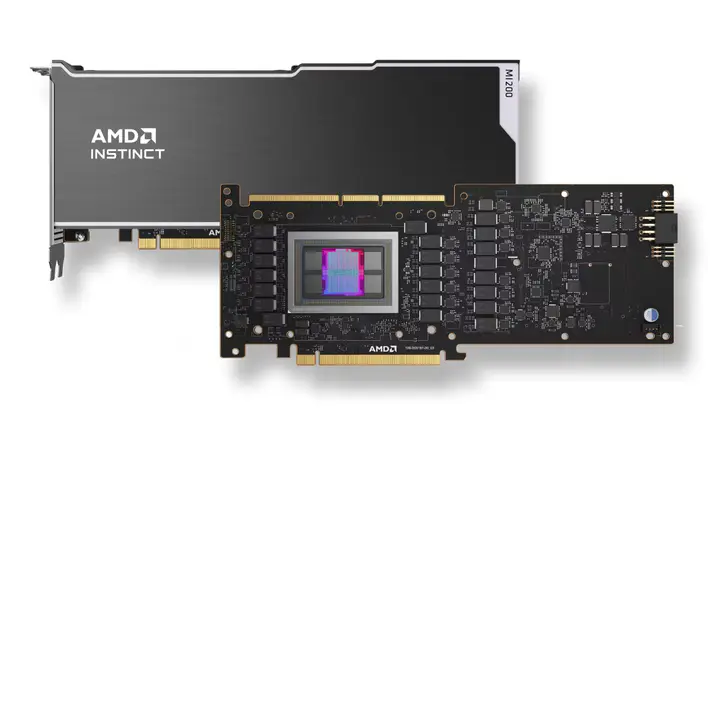
A passive PCIe CDNA 2 accelerator with HBM2e memory for ROCm workloads.
AMD Instinct MI210 64GB is one of 24 data center GPUs tracked in the SecondWatt catalogue, each with specifications, lead times and indicative secondary-market pricing.
Review Instinct MI210 64GB specifications, sourcing evidence, compatibility, pricing where verified, and inspection checks for a used purchase.
AMD Instinct MI210 is a [CDNA 2 PCIe accelerator with 64GB HBM2e, launched 2022-03-22](https://www.amd.com/en/products/accelerators/instinct/mi200/mi210.html). The transactable unit here is a production add-in card, not an OAM module. The product page states [1.6TB/s memory bandwidth and PCIe Gen4 x16](https://www.amd.com/en/products/accelerators/instinct/mi200/mi210.html), while AMD’s acceptance guide specifies [300W board power](https://instinct.docs.amd.com/projects/system-acceptance/en/latest/gpus/mi210.html). A receiving server needs a qualified passive-cooling installation and power path. AMD documents [direct Infinity Fabric hive configurations using suitable bridge hardware](https://instinct.docs.amd.com/projects/system-acceptance/en/latest/gpus/mi210.html). A collection of PCIe cards without those bridges is a different communication topology. Public [used-card](https://www.ebay.com/itm/278273231125) and [used-card](https://www.ebay.com/itm/178353445390) listings provide matched secondary asking-price observations. Condition labels are not substitutes for a ROCm acceptance run in the intended host.
Why it matters
The card combines HBM2e capacity and FP64 matrix capability with a PCIe form factor. Its value to a buyer depends on the working software, approved host and bridge topology; the asking-price band below does not establish a CUDA-equivalent performance or cost ratio.
Who buys it
As a fit assessment, buyers include scientific-computing and AI teams whose applications are supported by ROCm on MI210, plus operators replacing cards in an existing validated AMD installation. A CUDA deployment needs an application-porting assessment before MI210 is considered a substitute.
Role in the data center
AMD identifies scientific-computing and AI accelerator capabilities and documents PCIe host and directly linked hive configurations. The 300W board rating needs to be combined with a server-specific electrical and thermal specification before selecting rack density.
Power envelope
Specifications verified 2026-09-10.
- Per accelerator
- 300 W — Verified: Maximum configurable board power, manufacturer specification. source
- Cooling class
- Air-coolable — Derived: Per-accelerator power below 400 W — standard air-cooled halls.
No published node-level power rating exists for this part, so node, rack and per-MW figures are not stated. Multiplying accelerator watts by an assumed overhead under-provisions a building by roughly 45% against measured systems.
Node figures are published OEM system ratings; rack counts are arithmetic against a stated rack budget and move with your own cooling design. Assumption set version 2026-09-11a.
Key specifications
| GPU memory per card | 64 GB HBM2e |
|---|---|
| Peak memory bandwidth | 1.6 TB/s |
| Board power | 300 W |
| Compute units | 104 compute units |
| Stream processors | 6656 processors |
| Peak engine clock | 1700 MHz |
| PCIe interface generation | 4 generation |
| PCIe lane width | 16 lanes |
| Infinity Fabric link count | 3 links |
| Infinity Fabric bandwidth per link | 100 GB/s |
| Board length | 267 mm |
| Peak dense FP64 vector | 22.6 TFLOPS |
| Peak dense FP64 matrix | 45.3 TFLOPS |
| Peak dense FP32 vector | 22.6 TFLOPS |
| Peak dense FP32 matrix | 45.3 TFLOPS |
| Peak dense BF16 matrix | 181 TFLOPS |
| Peak dense FP16 matrix | 181 TFLOPS |
| Peak dense INT8 matrix | 181 TOPS |
Technical summary
AMD specifies 64GB HBM2e, 1.6TB/s bandwidth, 104 compute units and a 1,700MHz peak engine clock. Its directly attached peer interface provides three Infinity Fabric links rated at 100GB/s per link; a per-link specification is not a measured all-to-all fabric result. Published compute ratings are peak dense FP64 vector 22.6TFLOPS and matrix 45.3TFLOPS; dense FP32 vector 22.6TFLOPS and matrix 45.3TFLOPS; dense BF16/FP16 matrix 181TFLOPS and dense INT8 matrix 181TOPS. No unsupported FP8, TF32 or sparse throughput is inferred.
Major variations
The MI210 PCIe 64GB product differs from MI250X OAM 128GB in physical form, memory and platform integration. Reconcile OEM part labels in used-card offers with the server support list before purchase.
Configurations and options
AMD’s guide describes standalone PCIe deployment and directly bridged multi-card hives. Specify the original passive card, host-qualified power accessories, risers and any Infinity Fabric bridge set; an MI250X OAM module is not a card substitute.
Compatibility and dependencies
Use the MI210-specific acceptance and platform guidance together with the receiving OEM’s BIOS, power and airflow requirements. Verify the actual PCIe Gen4 x16 and Infinity Fabric interfaces rather than assigning aggregate fabric capability to unbridged cards. ROCm support is a matrix of GPU, operating system and software versions, not a single universal minimum. Use the MI210 acceptance process and the receiving OEM’s approved firmware baseline; a used card’s support entitlement needs separate written confirmation.
Pricing and availability
Published price range: USD 4,299.00–4,799.00 per used GPU card, observed 2026-09-10: [USD 4,299.00](https://www.ebay.com/itm/278273231125), [USD 4,299.99](https://www.ebay.com/itm/168646534196), [USD 4,799.00](https://www.ebay.com/itm/178353445390). The band is the minimum and maximum of this matched public asking-price sample (United States listing locations); it is not a completed-sale range or a market-wide valuation. Freight, tax, import charges and negotiated discounts are excluded.. Evidence: asking price · used condition · Single card · observed Sep 2026. Lead time, used or refurbished: Public [used-card](https://www.ebay.com/itm/278273231125) and [used-card](https://www.ebay.com/itm/178353445390) offers were accessible on 2026-09-10. Reconfirm the offered OEM revision, tested condition and dispatch commitment; a page’s delivery estimate is not a typical lead time..
Lifecycle and maintenance
Maintain the installation against the current ROCm compatibility matrix and MI210 platform acceptance requirements. Retain health, stress and workload-validation records with the unit; current software documentation is not an announced hardware end-of-support date or a remaining-service-life estimate.
Common failure points
- HBM2e memory — [Memory validation reports hardware or soft errors](https://instinct.docs.amd.com/projects/system-acceptance/en/latest/common/system-validation.html). This is an acceptance failure category, not a model-specific incidence claim.
- PCIe path — [PCIe validation exposes an incorrect configuration or abnormal transfer behavior](https://instinct.docs.amd.com/projects/system-acceptance/en/latest/common/system-validation.html).
- Cooling and power under load — [GPU stress qualification fails or cannot maintain the expected operating behavior](https://instinct.docs.amd.com/projects/system-acceptance/en/latest/common/system-validation.html).
- Infinity Fabric bridges — The installed cards do not show the [expected directly connected hive topology](https://instinct.docs.amd.com/projects/system-acceptance/en/latest/gpus/mi210.html) or collective tests fail.
- Firmware / ROCm stack — The system fails the [supported GPU/OS/software combination](https://rocm.docs.amd.com/en/latest/compatibility/compatibility-matrix.html) or [basic acceptance checks](https://instinct.docs.amd.com/projects/system-acceptance/en/latest/gpus/mi210.html).
Inspection checklist
- Match labels, OEM part revision and MI210 memory and form-factor specifications; obtain photographs of the actual card.
- Verify the approved host, passive cooling, power accessories and PCIe/hive configuration.
- Record OS and ROCm compatibility and the MI210 platform requirements before changing the software state.
- Collect GPU health logs and topology and preserve them with the serial record.
- Run supported memory, PCIe and compute stress tests in the actual receiving host.
- Run the intended application and collective-communication validation for any bridged configuration with agreed acceptance criteria.
- Obtain written warranty and return terms for the supplied serial; a marketplace used-condition label does not establish OEM support transfer.
- Complete classification and destination/end-user review for the intended shipment.
Procurement channels
The matched observations are used-card, used-card and used-card marketplace offers. Request private serial-level identification, host compatibility, bridge completeness, ROCm test output, return terms and the actual warranty counterparty.
Regional notes
For a cross-border resale, obtain the manufacturer’s current classification for the actual board or system and screen destination, end-user and end-use restrictions. A used condition does not establish export eligibility; retain the classification and licensing documents with the transaction.