NVIDIA H100 PCIe 80GB
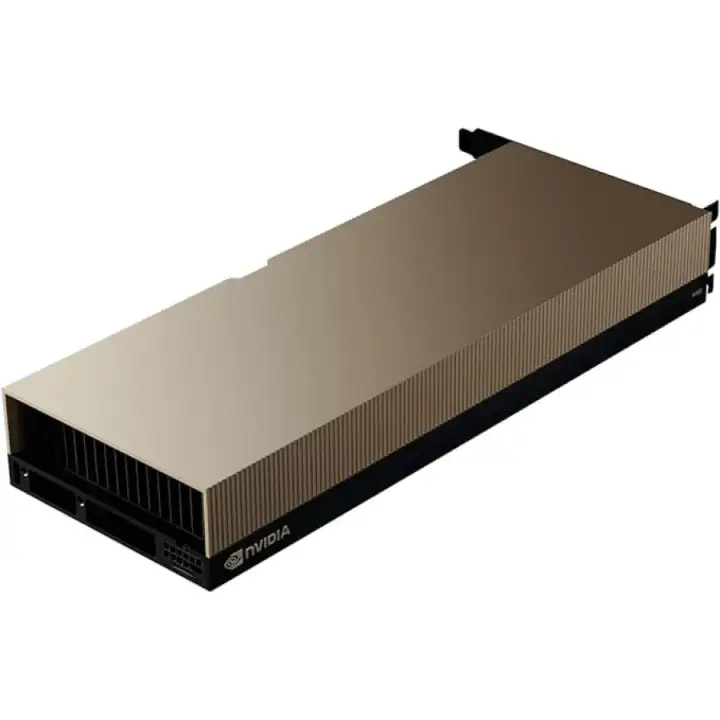
350 W passive Hopper card on HBM2e, and the lowest-disruption route into an existing server fleet
NVIDIA H100 PCIe 80GB is one of 24 data center GPUs tracked in the SecondWatt catalogue, each with specifications, lead times and indicative secondary-market pricing.
NVIDIA H100 PCIe 80GB specs and power: 350 W passive card on HBM2e at 2,000 GB/s, 2.80 kW per eight-card server, with used and new channel observations.
The H100 PCIe 80GB is a full-height, full-length dual-slot passive card rated at 350 W default and 350 W maximum, with a 300 W power mode available. It carries 80 GB of HBM2e at 2,000 GB/s and takes power through a single PCIe 16-pin auxiliary connector. It fits any qualified PCIe Gen5 x16 or Gen4 x16 server on the platform's approved list. It is not a de-rated H100 SXM5, and buyers routinely assume otherwise. NVIDIA's own product brief specifies HBM2e at 2,000 GB/s here against HBM3 at 3,350 GB/s on the SXM5 part. That is a 40 percent bandwidth deficit on top of half the TDP, and it is a different memory subsystem rather than a lower clock. Eight of these cards is 2.80 kW of accelerator, the lightest Hopper configuration in the generation. NVIDIA publishes no node or rack power total for any PCIe Hopper part, so the GPU-only sum is the only figure that can be stated honestly, and the balance of node power depends entirely on the host chassis. The card is passive. It generates no airflow of its own, accepts flow left-to-right or right-to-left, and depends completely on the chassis. Qualified-platform lists govern: Supermicro's SYS-421GE-TNRT, a ten-slot 4U GPU chassis, does not list any Hopper PCIe part among its supported accelerators.
Why it matters
This is the Hopper part most likely to be mis-specified in a purchase. Its HBM2e memory subsystem at 2,000 GB/s is 40 percent slower than the SXM5 part that shares its name, and one reseller page observed on 2026-09-10 mislabels it as HBM3. Verifying bandwidth on receipt is the difference between the part you bought and the part you wanted.
Who buys it
Enterprises and service providers adding accelerators to an existing rack-server fleet rather than buying purpose-built 8U HGX chassis. The buyer trades interconnect bandwidth for the ability to deploy inside a 350 W-per-slot thermal budget and an existing procurement path, at a used band well below SXM5.
Role in the data center
Inference serving, single-node fine-tuning and mixed HPC, chosen when the accelerator must enter an existing server fleet rather than a purpose-built HGX chassis. Density band: the lightest Hopper option at 2.80 kW of accelerator per eight-card server, air-cooled, with no liquid option. The split leans to inference because HBM2e at 2,000 GB/s is 40 percent behind SXM5, which costs more in training than in serving. NVIDIA publishes no node or rack kW here, so size from the chassis budget and the 2.80 kW sum, and do not carry the 10.2 kW SXM5 node figure across form factors.
Power envelope
Specifications verified 2026-09-10.
- Per accelerator
- 350 W — Verified: Maximum configurable board power, manufacturer specification. source
- Cooling class
- Air-coolable — Derived: Per-accelerator power below 400 W — standard air-cooled halls.
No published node-level power rating exists for this part, so node, rack and per-MW figures are not stated. The baseboard sibling does carry one — H100 SXM5 80GB.
Node figures are published OEM system ratings; rack counts are arithmetic against a stated rack budget and move with your own cooling design. Assumption set version 2026-09-11a.
Key specifications
| GPU memory | 80 GB HBM2e |
|---|---|
| Memory bandwidth | 2,000 GB/s |
| Total board power, default | 350 W |
| Total board power, maximum | 350 W |
| Lower power mode | 300 W |
| Power connector | One PCIe 16-pin auxiliary |
| Thermal solution | Passive, bidirectional heat sink |
| Form factor | FHFL 10.5 inch, dual-slot |
| PCIe interface | Gen5 x16; Gen4 x16 |
| Multi-Instance GPU | Supported, seven instances instances |
| SR-IOV virtual functions | 32 VF |
| GPU-only power at 8 cards | 2.80 kW |
| Nameplate part number | 900-21010-0000-000 |
| Configurable power range in channel listing | 300 to 350 W |
Technical summary
Architecture: Hopper, TSMC 4N process. Form factor: full-height full-length 10.5 inch, dual-slot, passive. Memory: 80 GB HBM2e at 2,000 GB/s (NVIDIA product brief PB-11133-001_v02). Total board power: 350 W default, 350 W maximum; 300 W power mode supported. Power connector: one PCIe 16-pin auxiliary connector. Thermal solution: passive bidirectional heat sink, left-to-right or right-to-left airflow. PCIe: Gen5 x16 and Gen4 x16. NVLink: three bridges supported; bandwidth figure is in conflict, see variations. Multi-Instance GPU: supported, seven instances. SR-IOV: supported, 32 virtual functions; Secure Boot (CEC) supported. GPU-only power at 8 cards: 2.80 kW, the lightest Hopper configuration. Nameplate part number: 900-21010-0000-000.
Major variations
Power configuration: 350 W default and maximum, with a 300 W power mode supported. One reseller listing describes the card as 300 W to 350 W, consistent with that pair. Interface: PCIe Gen5 x16 or Gen4 x16, with three NVLink bridges supported for pairing. An open conflict in NVIDIA's own documentation, published here as a conflict. Product brief PB-11133-001_v02 states NVLink bridge bandwidth of 900 GB/s bidirectional, while NVIDIA's H100 product page gives 600 GB/s for the bridged NVL variant and two IT Creations listings give 600 GB/s for this PCIe card. The 600 GB/s figure carries more independent corroboration and the 900 GB/s figure is in NVIDIA's brief, so confirm against the specific bridge kit before designing around either.
Configurations and options
One to eight cards per qualified server, optionally NVLink-bridged in pairs. At eight cards the accelerator load is 2.80 kW, which is the lightest configuration in the Hopper generation. Do not derive a node total from the SXM5 figure. A DGX H100's 4.6 kW of non-GPU overhead reflects 2 TB of DRAM, eight ConnectX-7 adapters and an NVSwitch fabric that a PCIe server does not carry, so carrying that number across form factors would be an interpolation rather than a measurement.
Compatibility and dependencies
Host platform: a qualified PCIe Gen5 x16 or Gen4 x16 server, and the qualified list is narrower than slot count suggests. Supermicro's SYS-421GE-TNRT, a 4U chassis with ten GPU slots, lists A10, L4, L40, L40S and RTX Ada and no Hopper PCIe part. Thermal dependency is total: the card is passive with a bidirectional heat sink, so all cooling is chassis airflow, and one PCIe 16-pin connector carries the whole 350 W. Memory assumption to correct: this is HBM2e at 2,000 GB/s, not HBM3 at 3,350 GB/s, a different memory technology and not a de-rated SXM5, so the 40 percent bandwidth deficit cannot be recovered by raising the power limit. Eight cards is 2.80 kW of accelerator, and NVIDIA publishes no node or rack total for any PCIe Hopper part. Upgrade trap: eight H200 NVL cards raise load to 4.80 kW, 71 percent more at identical slot count. Plan alongside racks, PDUs, busway and CRAC units.
Pricing and availability
Evidence: channel observation · used condition · Eight-GPU baseboard basis. Reference band for another model: 19000–27000 $ per GPU (NVIDIA H100 SXM5 80GB comparable). It is not a price for this model. Trend: falling Compute Exchange placed used H100 PCIe at $16,000 to $20,000 with a High supply signal in Q3 2026, against a broader H100 used range of $15,000 to $28,000 in late 2025. Refurbished units of this form factor were quoted at $19,000 to $23,000 in the same Q3 2026 snapshot. New-card asks observed on 2026-09-10 spanned $29,400 to $35,315.93, well above the used band. Blackwell general availability is expected to exert a further 10 to 20 percent of downward pressure across H100 secondary pricing. Lead time, new: In stock at multiple resellers on 2026-09-10; roughly 2 to 4 weeks quoted through the channel in early 2026. Lead time, used or refurbished: One reseller quoted an estimated 3 to 4 days on a used card on 2026-09-10. Warranty, new: Three-year limited warranty offered by at least one reseller, bundled with an enterprise software entitlement. Warranty, used: Refurbished units in this family are offered with documented diagnostic reports; transferability of any NVIDIA-backed cover was not established.
Lifecycle and maintenance
Lifecycle status as of 2026-09-10: supported and purchasable, no longer merchandised. No Hopper part appears on NVIDIA's enterprise-software end-of-life notice list, which carries Volta, Turing, Ampere and Ada Lovelace. NVIDIA's HGX platform page now lists only Vera Rubin, Rubin, B300 and B200 baseboards, so this generation is off the page NVIDIA merchandises while both product pages stay live with full specifications. NVIDIA's H100 product page no longer carries a PCIe column, so the November 2022 product brief PB-11133-001_v02 is the authoritative specification for this part. No manufacturer service-life figure is published; operator depreciation schedules of 5 to 6 years and an observed 7 to 9 year Azure retirement history are the available proxies.
Common failure points
- HBM2e memory stack — Correctable ECC counts rise, then uncorrectable errors and retired pages, and inference workers restart
- PCIe 16-pin auxiliary power connector — Discoloured or melted connector shell and intermittent power loss under sustained load
- Passive heatsink starved of chassis airflow — Clocks drop within minutes of sustained load and throttle counters climb steadily
- PCIe link negotiation — Host-to-device bandwidth measures roughly half expected and the link reports Gen4 or x8
- Thermal interface degradation — Rising die-to-inlet delta over months at unchanged load, with fans compensating
- Firmware and provenance on gray-market cards — Reported memory type or bandwidth disagrees with NVIDIA's brief, or Secure Boot attestation fails
Inspection checklist
Memory bandwidth verification: a bandwidth benchmark must land near the published 2,000 GB/s on HBM2e; a card reading near 3,350 GB/s is not this part and has been mislabelled. Default power limit: nvidia-smi -q must report a 350 W default; a 300 W reading means the lower power mode is strapped and a higher reading means the board is not stock. HBM2e row-remapping history: read retired page counts via nvidia-smi -q -d ECC; HBM is not repairable, so any remap growth over a 72-hour soak caps the card's remaining life. Uncorrectable ECC event log: pull both volatile and aggregate counters; 0 is the only acceptable uncorrectable count on a card sold as tested and recertified. Hours in service: request accumulated power-on hours and reconcile against the claimed age; cards from 2022 and 2023 fleets commonly carry over 20,000 hours.
Procurement channels
New-card channel is the most liquid for this part, with in-stock listings from integrators such as Exxact and Dihuni observed on 2026-09-10. Both carry an NVIDIA nameplate part number of 900-21010-0000-000. Used and refurbished supply is brokered rather than browsable. Compute Exchange publishes bands for both conditions; IT Creations listed a used card with a short estimated ship time but no displayed price. Verify the memory specification against NVIDIA's product brief rather than the listing. One integrator page observed on 2026-09-10 states HBM3 for this card where NVIDIA specifies HBM2e, which is a spec error on a page that otherwise carries a real price.
Regional notes
Classification: ECCN 3A090.a and.b, with 4A090 for computers incorporating them. BIS guidance of 31 May 2026 turns on the counterparty: a licence is required for any entity headquartered in Country Group D:5 or Macau, or with an ultimate parent there, from every destination outside the US, regardless of location. 91 FR 1684 of 15 January 2026 gates case-by-case China and Macau review at both total processing performance under 21,000 and DRAM bandwidth under 6,500 GB/s. This card's 2,000 GB/s is the lowest in Hopper and well under the gate; no TPP figure is published, and BIS named the H200 and MI325X.