NVIDIA GB200 NVL72
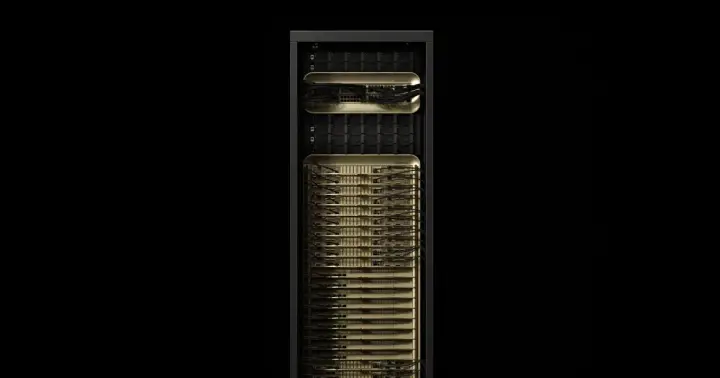
48U liquid-only rack at 132 kW nominal that HPE says to feed from a 192 kW busway, 72 GPUs in one NVLink domain.
NVIDIA GB200 NVL72 is one of 24 data center GPUs tracked in the SecondWatt catalogue, each with specifications, lead times and indicative secondary-market pricing.
NVIDIA GB200 NVL72 rack dossier: 132 kW nominal against a 192 kW busway, 1,200 W per GPU, 115 kW liquid and 17 kW air, 45 deg C loop, quote-only channel.
The GB200 NVL72 is not a card and not a server. It is one 48U rack, shipped and warranted as a single unit, holding 18 compute trays, 9 NVLink switch trays, 6 to 8 power shelves and a 44U coolant manifold. Inside it, 72 Blackwell GPUs and 36 Grace CPUs sit in one NVLink domain, so software addresses the rack as a single accelerator with 13.4 TB of pooled HBM3E. That pooling is the product thesis. Models too large for an 8-GPU baseboard fit in one coherent memory space, at 1,200 W per GPU and a rack draw no air-cooled hall can absorb. Direct-to-chip liquid is mandatory here, not an upgrade, because no air-cooled version of this rack exists. The published power figures look contradictory and are not. NVIDIA states approximately 120 kW as a design point, Supermicro publishes a 125 to 135 kW operating band for its configured SuperCluster, and HPE publishes 132 kW nominal. They measure different things, and each is attributed on this page rather than blended into an average. One number matters more than the rest. HPE puts the electrical design power peak at roughly 192 kW and tells buyers to provision the busway to it. A rack rated 132 kW therefore needs 60 kW per rack of headroom that its nameplate never shows.
Why it matters
A 132 kW nameplate rack that HPE says to feed from a 192 kW busway is the clearest example in the catalog of why accelerators are a power question. Provisioning to the nameplate leaves 60 kW per rack short. Add 115 kW of liquid heat rejection, 17 kW of air, a 45 deg C water loop and 1,472 kg on a 0.64 sq m footprint, and the purchase is a facility project rather than a hardware order.
Who buys it
Hyperscalers and neoclouds first, then sovereign compute programmes, national labs and the small set of enterprises running one very large model. Nobody buys a single unit for a closet. Because one in-row coolant distribution unit serves up to 8 racks, the practical purchase quantum is a row of roughly 1.06 MW nominal, and the buyer is usually a facilities team as much as a compute team.
Role in the data center
NVIDIA positions this rack for large-language-model inference and advanced datacenter work. In practice the 72-GPU coherent domain serves three things an 8-GPU baseboard cannot: training whose model state exceeds one baseboard, long-context and reasoning inference needing the key-value cache in pooled HBM, and mixture-of-experts serving across the domain. Density is 125 to 140 kW nominal in one 48U frame, against 5 to 15 kW for a legacy rack and 30 to 50 kW for dense air-cooled compute. Deployment scales in rows: one in-row coolant unit serves up to 8 racks, roughly 1.06 MW nominal a row.
Power envelope
- Per accelerator
- 1,200 W — Verified: Maximum configurable TGP, manufacturer specification. source
- Per rack, operating band
- 125–135 kW — Verified: Published rack power for the complete 72-accelerator system, 132 kW nominal. This is a rack-scale product — there is no node figure to size from. source
- Busway provisioning
- 192 kW — Verified: Vendor-recommended electrical design power for the busway feeding one rack. Provision this absolute figure — do not derive it as a multiple of the nominal rack load. source
- Heat split, liquid / air
- 115 / 17 kW — Verified: Published heat rejection split. Direct-to-chip liquid does not remove the air path — the hall still needs the air-side capacity. source
- Cooling class
- Liquid cooling required — Derived: Rack-scale NVL72 systems are supplied liquid-cooled as a rack, so the rack configuration sets the cooling method. On accelerator power alone the class would read "DLC strongly preferred".
- Accelerators per IT MW
- ~533 — Derived: 1 MW IT load / (135 kW, the top of the published 125–135 kW operating band per 72-accelerator rack). Size the feed on the busway figure, not this one.
- Racks per IT MW
- ~7.4 — Derived: 1 MW IT load / 135 kW, the top of the published 125–135 kW operating band. IT load only.
- Busway provisioning per IT MW
- ~1.42 MW — Derived: 7.4 racks per IT MW × 192 kW of busway per rack. Distribution is sized on this figure, not on the IT load.
Rack and busway figures are published vendor ratings for the complete rack-scale system; per-MW counts are arithmetic against nominal rack power. Assumption set version 2026-09-11a.
Key specifications
| GPUs per rack | 72 Blackwell GPUs |
|---|---|
| Grace CPUs per rack | 36 CPUs |
| Per-GPU TDP ceiling | Configurable up to 1,200 W |
| Rack nominal TDP | 132 kW |
| Electrical design power peak (busway sizing) | 192 kW |
| Rack design point stated by NVIDIA | Approximately 120 kW |
| Rack operating band, configured SuperCluster | 125 to 135 kW |
| Heat rejected to liquid | 115 kW |
| Heat rejected to air | 17 kW |
| Maximum coolant inlet temperature | 45 deg C |
| Coolant flow rate | Up to 130 LPM per rack |
| GPU memory | 13.4 TB HBM3E at 576 TB/s |
| NVLink aggregate bandwidth | 130 TB/s |
| Rack height | 48 U |
| Weight, fully loaded | 3,245 lb |
| Busbar voltage | 50 V DC |
Technical summary
72 Blackwell GPUs and 36 Grace CPUs in one 5th-generation NVLink domain, 130 TB/s aggregate. Per-GPU TDP configurable up to 1,200 W, per NVIDIA Blackwell Datasheet 4204213 dated OCT25. 13.4 TB HBM3E at 576 TB/s, plus 17 TB LPDDR5X at 14 TB/s, 31 TB total fast memory. 720 PFLOPS NVFP4 dense and 1,440 PFLOPS sparse, both figures published by NVIDIA. Rack nominal TDP 132 kW; electrical design power peak about 192 kW, which is the busway figure. Heat split 115 kW to liquid and 17 kW to air, so an air path is still required. Direct-to-chip liquid cooling mandatory; maximum coolant inlet 45 deg C, return 65 deg C. Coolant flow up to 130 LPM per rack at a 20 deg C loop delta-T, 10 deg C approach. 48U frame, 2495 x 600 x 1068 mm, 3,245 lb loaded, 50 V DC busbar, 44U manifold. 6 to 8 power shelves at 33 kW each, 6 x 5.5 kW PSUs per shelf, N plus N redundant. 4 x ConnectX-7 400G and 2 x BlueField-3 dual-port 400G per compute tray. Quantum-X800 InfiniBand or Spectrum-X Ethernet for the scale-out fabric.
Major variations
GB300 NVL72 is the successor in the same 48U frame, at 20 TB of pooled HBM3E and ConnectX-8. It has its own dossier. GB200 NVL4 is shipping and a different facility problem: 4 Blackwell GPUs and 2 Grace CPUs in a 2U direct-liquid-cooled server at the same 1,200 W per-GPU ceiling, with 1.8 TB of fast memory and 7.2 TB/s NVLink, per NVIDIA's Blackwell Datasheet 4204213 of OCT25. Its reported 5,400 W module TDP recomputes cleanly, since 4 x 1,200 W leaves 600 W for two Grace CPUs and overhead, and at 2,700 W per U it matches this rack's 2,750 W per U. One OEM SKU exists, the GIGABYTE XN24-VC0-LA61 announced 2026-01-26 for RIKEN. GB200 NVL2 is not sourceable today: as of 2026-09-10 NVIDIA hosts a preliminary page marked subject to change, it is absent from the OCT25 datasheet spec table, and no OEM shipping SKU is published. Treat single-rack NVL72 as the shipping configuration.
Configurations and options
The rack itself is fixed at 72 GPUs and 36 CPUs. What a buyer configures is the cooling and the fabric. Coolant distribution comes three ways and the choice is a facility decision: an in-rack 4U unit rated 250 kW for one rack, an in-row unit rated 1.3 MW for up to 8 racks, which HPE names as the Vertiv XDU1350, and a liquid-to-air sidecar rated 180 kW or 240 kW where there is no cooling tower or process water. Power shelves populate 6 to 8 at 33 kW each. Feeds are IEC 60309 5-wire 560P6W whips at 400 V or 480 V and 60 A, top or bottom entry, and the coolant unit takes 3-phase 380 to 480 V. Rear door heat exchangers are at 208 to 230 V for the air fraction. Scale-out is Quantum-X800 InfiniBand or Spectrum-X Ethernet. The coolant unit is not included in the base rack and is priced separately, which makes its omission from a budget a schedule problem rather than a cost one.
Compatibility and dependencies
There is no host platform to choose. The rack ships with CPUs, NVLink switches, power shelves and manifold inside, the 36 Grace CPUs integral and the 72 GPUs in one NVLink domain at 130 TB/s. The buyer supplies the facility side: a 400 V or 480 V 60 A feed on IEC 60309 560P6W whips and a busway provisioned to 192 kW, not the 132 kW nameplate. Internal distribution is a 50 V DC busbar, and NVIDIA's OCP submission cites 1,400 A, which is 70 kW at 50 V against a 132 kW draw, so multiple runs or a per-segment rating is implied. Direct-to-chip liquid is mandatory; no air-cooled version exists. The loop takes up to 45 deg C inlet, so a dry cooler suffices in most climates. 115 kW goes to liquid and 17 kW to air. No OEM document names an ASHRAE water class; 45 deg C is W45, and the circulating H1 attribution is wrong because H1 is an air class. See busway, pdus, liquid-cooling and racks.
Pricing and availability
Trend: rising Direction is well supported and magnitude is not. Rack-scale NVLink systems did not exist before 2024, so there is no five-year series for this part. What the record shows is a rising ladder at a constant 72-GPU count: GB200 NVL72 estimates cluster at 2 to 3 million dollars per rack across 2024 to 2026, GB300 NVL72 at 3 to 4 million for the same GPU count, and Vera Rubin NVL72 reported at up to 8.8 million. Every one of those figures is an analyst estimate rather than a transacted price, and the aggregators citing them are not independent of each other. Treat the direction as sound and the numbers as indicative. Price trend is recorded as up on that basis alone. Lead time, new: No OEM publishes a lead time for this rack. HPE, Supermicro and Dell are quote-gated and none of the pages reviewed on 2026-09-10 states a delivery window. Compute Exchange, on reserved capacity, says lead times track provider datacenter buildouts, with terms from 1 to 36 months. Reported schedule risk sits in facility readiness rather than silicon: 192 kW of busway, a coolant distribution unit, a 45 deg C loop and a floor rated for 1,472 kg are the long poles.. Lead time, used or refurbished: Not applicable as a market. See procurement channels for why the resale channel does not yet exist.. Warranty, new: No published term. Warranty is a negotiated line inside an OEM quote on every channel reviewed on 2026-09-10, and no HPE, Dell or Supermicro page states a duration for the integrated rack.. Warranty, used: Because the rack is supported as one integrated unit, including firmware and coolant service, treat any unit acquired outside the OEM channel as unsupported until an OEM confirms otherwise in writing..
Lifecycle and maintenance
Announced March 2024, first OEM shipment February 2025, superseded at the top of the line by GB300 NVL72 within about twelve months. That cadence against a five-year book life is the commercial risk in this category. No OEM page reviewed on 2026-09-10 publishes a warranty term or a coolant change interval. Both are negotiated inside a quote. Liquid service items have no equivalent on air-cooled gear: coolant chemistry, filter service, pump replacement, leak-sensor validation and the blind-mate manifold seals NVIDIA describes to the Open Compute Project. Support transferability on resale is not addressed by any published OEM statement found. Treat a rack acquired outside the OEM channel as unsupported until an OEM confirms otherwise in writing.
Common failure points
- Liquid cooling loop, cold plate and manifold — A detector trips and NVIDIA Mission Control reports leak large, starting a 10 minute going-down timeout before forced node shutdown
- GPU reset and NVLink fabric — Reset fails in about 0.006 percent of attempts, roughly 1 in 17,000 iterations, and the fabric stays incomplete so no workload will launch on that GPU
- NVLink switch tray — Partial tray reboot produces XID 145 and NVLS traffic failure, with reboot history showing repeated platform reset entries
- Power shelf and PSU — Loss of a 5.5 kW PSU or a 33 kW shelf rides through on N plus N, but headroom against the 192 kW peak collapses
- Busbar at 1,400 A — Thermal rise, discolouration or intermittent tray dropout at a busbar landing
- BMC and management plane — After an auxiliary or PDU power cycle the BMC may fail to restore the prior power state when PowerRestorePolicy is LastState, and leak sensors may not show degraded even when the BMC marks them so
- Grace CPU boot chain — SBIOS will not boot after an L2 reset if the boot chain is corrupt, and GPU firmware cannot update until SBIOS reaches UEFI
Inspection checklist
Rack height and frame: confirm 48U and 2495 x 600 x 1068 mm; a 44U figure describes the coolant manifold, not the rack. Loaded weight: verify against 3,245 lb; a low reading means trays are absent. Compute tray count: confirm 18 trays, each holding 2 Grace CPUs and 4 Blackwell GPUs. NVLink switch tray count: confirm 9 trays; any shortfall breaks the 72-GPU domain and cannot be filled from generic stock. Power shelf census: count 6 to 8 shelves at 33 kW each and confirm N plus N is populated, not just the frame. PSU census: confirm 6 x 5.5 kW units per shelf and that none are bypassed. Busbar condition: confirm the 50 V DC part and inspect every tray landing for arc marks or discolouration. Feed hardware: confirm IEC 60309 5-wire 560P6W whips at 400 V or 480 V, 60 A, matched to the site. Busway headroom: verify the branch is provisioned to 192 kW, not to the 132 kW nameplate.
Procurement channels
NVIDIA does not sell this rack directly; the channel is OEM and integrator, and every one is quote-gated. HPE carries product 1014890104 with QuickSpecs dated 2026-09-08, Dell builds it on the PowerEdge XE9712 and IR7000 rack, and Supermicro, QCT, GIGABYTE, ASUS and Lenovo also have named systems. Secondary, as of 2026-09-10: Compute Exchange lists this rack only as reserved forward rental capacity, and its refurbished market covers individual GPUs rather than rack-scale systems. Field units are young and under warranty, and a 1,472 kg liquid-filled cabinet needing a matched coolant unit, a 192 kW feed and a 45 deg C loop does not move through a channel built for pallets of PCIe cards.
Regional notes
GB200 sits under presumption of denial for China and Macau under ECCN 3A090, per Federal Register document 2026-00789 of 2026-01-15. A 25 percent Section 232 tariff applies by presidential proclamation of 2026-01-14. BIS guidance of 31 May 2026 turns on the counterparty: a licence is required for any entity headquartered in Country Group D:5 or Macau, or with an ultimate parent there, from every destination outside the US, regardless of location. 91 FR 1684 of 15 January 2026 gates case-by-case China and Macau review at both total processing performance under 21,000 and DRAM bandwidth under 6,500 GB/s. This rack is far above both gates and does not qualify; no NVL72 variant is published.