NVIDIA H200 NVL 141GB
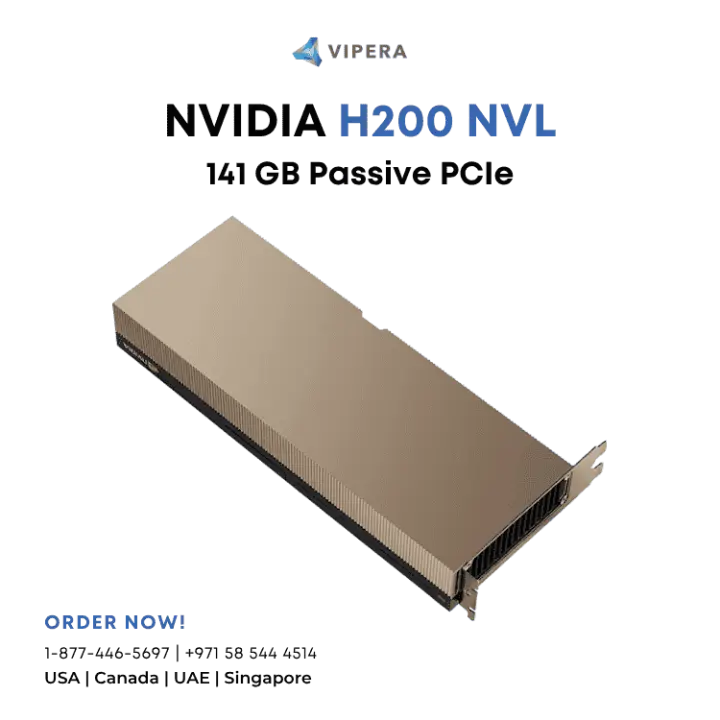
600 W air-cooled PCIe card carrying full 141 GB HBM3e, and the part that breaks the low-power assumption
NVIDIA H200 NVL 141GB is one of 24 data center GPUs tracked in the SecondWatt catalogue, each with specifications, lead times and indicative secondary-market pricing.
NVIDIA H200 NVL 141GB specs and power: a 600 W passive PCIe card with 141 GB HBM3e at 4.8 TB/s, and 4.80 kW of accelerator per eight-card node.
The H200 NVL 141GB is a dual-slot air-cooled PCIe card rated at up to 600 W configurable, carrying the full 141 GB of HBM3e at 4.8 TB/s that the SXM part carries. It runs on the MGX platform rather than HGX, in partner and NVIDIA-Certified systems with up to eight GPUs. NVLink comes as a two-way or four-way bridge at 900 GB/s per GPU. It is the outlier of the PCIe family and the one that breaks facility assumptions. Eight cards is 4.80 kW of accelerator in a single air-cooled chassis, which is 86 percent of an eight-GPU SXM5 baseboard's 5.60 kW. The card is passive, has no liquid option, and depends entirely on chassis airflow to move 600 W. The upgrade arithmetic is what buyers miss. Moving from eight H100 PCIe cards to eight of these takes accelerator load from 2.80 kW to 4.80 kW, a 71 percent increase, with no change in slot count and no signposting in NVIDIA's material. Anyone treating a PCIe retrofit as thermally neutral will find the chassis and the rack short. What it buys is memory. Arithmetic throughput is 15.6 percent below H200 SXM at 1,671 against 1,979 teraFLOPS BF16, but the memory is identical, and a four-way bridge group presents 564 GB of HBM3e at up to 1.8 TB/s. That makes it the memory-bound inference part of the generation.
Why it matters
This is the row that disproves the assumption that PCIe means low power. At 600 W a card, eight of these carry 86 percent of an eight-GPU SXM5 board's accelerator load in a passive air-cooled chassis. The facility consequence of a PCIe retrofit here is a 71 percent load increase over H100 PCIe with identical slot count.
Who buys it
Enterprises serving large or long-context models from standard MGX rack servers, where 564 GB across a four-way bridge group is the target and an HGX baseboard is out of scope. Also buyers who want H200 memory capacity without a purpose-built 8U chassis, provided they can deliver 4.80 kW of air-cooled accelerator per node.
Role in the data center
Memory-bound inference and long-context serving from MGX rack servers, where 564 GB across a four-way bridge group is the target rather than raw throughput. Density band: 4.80 kW of accelerator per eight-card node, air-cooled and passive, the densest air-cooled PCIe configuration in Hopper. Inference-weighted by design: throughput is 15.6 percent below H200 SXM at 1,671 against 1,979 teraFLOPS BF16, while memory is identical at 141 GB and 4.8 TB/s.
Power envelope
Specifications verified 2026-09-10.
- Per accelerator
- 600 W — Verified: Maximum configurable board power, manufacturer specification (configurable). source
- Cooling class
- Air or DLC — Derived: Deployable air-cooled; liquid cooling raises achievable rack density.
No published node-level power rating exists for this part, so node, rack and per-MW figures are not stated. The baseboard sibling does carry one — H200 SXM 141GB.
Node figures are published OEM system ratings; rack counts are arithmetic against a stated rack budget and move with your own cooling design. Assumption set version 2026-09-11a.
Key specifications
| GPU memory | 141 GB HBM3e |
|---|---|
| Memory bandwidth | 4.8 TB/s |
| Max thermal design power | Up to 600 (configurable) W |
| Form factor | PCIe, dual-slot air-cooled |
| NVLink bridge | 2-way or 4-way, 900 per GPU GB/s |
| Four-way bridge group memory | 564 GB HBM3e |
| Four-way bridge group bandwidth | Up to 1.8 TB/s |
| PCIe interconnect | Gen5, 128 GB/s |
| Host platform | MGX partner and NVIDIA-Certified Systems, up to 8 GPUs |
| FP8 Tensor Core, with sparsity | 3,341 TFLOPS |
| Multi-Instance GPU | Up to 7 at 16.5 GB each instances |
| Confidential Computing | Supported |
| GPU-only power at 8 cards | 4.80 kW |
| Reference configuration | PCIe Optimized 2-8-5: 2 CPUs, 8 GPUs, 5 network adapters |
| Nameplate part number | 900-21010-0040-000 |
| OEM option and bridge kits | Lenovo 4X67A97315 card; 4X67A97320 2-way; 4X67A97322 4-way |
Technical summary
Architecture: Hopper, TSMC 4N process. Form factor: PCIe, dual-slot air-cooled, passive. Memory: 141 GB HBM3e at 4.8 TB/s, identical to the SXM part. Max TDP: up to 600 W, configurable. NVLink: two-way or four-way bridge at 900 GB/s per GPU. Four-way bridge group: 564 GB HBM3e at up to 1.8 TB/s. PCIe: Gen5 at 128 GB/s. Host platform: MGX H200 NVL partner and NVIDIA-Certified systems, up to 8 GPUs. Multi-Instance GPU: up to 7 instances at 16.5 GB each. Dense throughput: FP8 1,671 teraFLOPS (NVIDIA publishes 3,341 with sparsity). GPU-only power at 8 cards: 4.80 kW, which is 86 percent of an 8-GPU SXM5 board. Nameplate part number: 900-21010-0040-000.
Major variations
Bridge topology is the main variation and it is ordered separately. NVIDIA supports two-way or four-way NVLink bridges at 900 GB/s per GPU, and Lenovo catalogues them as distinct option codes 4X67A97320 and 4X67A97322 alongside the card itself at 4X67A97315. A four-way group presents 564 GB of HBM3e at up to 1.8 TB/s, which reconciles against the 141 GB per card. TDP is configurable below the 600 W maximum, which matters because 600 W is the highest passive per-card load in this generation. Note the platform difference from every other PCIe part here. This card runs on MGX, not HGX and not a generic PCIe server, in partner and NVIDIA-Certified systems with up to eight GPUs.
Configurations and options
NVIDIA's own enterprise reference architecture specifies a PCIe Optimized 2-8-5 configuration, meaning two CPU sockets, eight GPUs and five network adapters, with Spectrum-X Ethernet and BlueField-3 SuperNICs at 400 gigabits per second for every two GPUs. At that configuration accelerator load is 4.80 kW. NVIDIA publishes no node or rack total for the reference architecture, so 4.80 kW of accelerator is the only figure stated here and the balance depends on the chassis.
Compatibility and dependencies
Host platform: MGX H200 NVL partner and NVIDIA-Certified systems. This is MGX rather than HGX and not a generic PCIe part; NVIDIA's reference architecture is a PCIe Optimized 2-8-5 build. Thermal dependency is the tightest here: passive, dual-slot, air-cooled with no liquid option, shedding up to 600 W on chassis airflow. Eight cards is 4.80 kW, 86 percent of an eight-GPU H100 SXM5 baseboard's 5.60 kW, and a move from eight H100 PCIe cards at 2.80 kW is a 71 percent increase at identical slot count. Interconnect: two-way or four-way NVLink bridge at 900 GB/s per GPU, a four-way group presenting 564 GB of HBM3e. Bridge kits are separate order codes, 4X67A97320 and 4X67A97322 in Lenovo's catalogue, routinely absent from secondary sales. NVIDIA publishes no node or rack total for this part, so size from the 4.80 kW sum plus the chassis budget. Plan alongside racks, PDUs, busway and CRAC units.
Pricing and availability
Evidence: channel observation · used condition. Reference band for another model: 30000–35000 $ per GPU (NVIDIA H200 SXM comparable). It is not a price for this model. Trend: stable No time series exists for this part in the open record, and no broker publishes an indicative band for it. Compute Exchange carries bands for six other accelerators in its Q3 2026 snapshot but none for H200 NVL. The parent H200 SXM part shows a flat pattern with almost no used discount, which is consistent with a Low supply signal across the H200 family generally. Lead time, new: Offered from stock by at least one overseas marketplace seller on 2026-09-10 with more than ten units available; no domestic integrator displayed a lead time. Lead time, used or refurbished: No used-condition channel displayed stock or a lead time for this part on 2026-09-10.
Lifecycle and maintenance
Lifecycle status as of 2026-09-10: supported and purchasable, no longer merchandised. No Hopper part appears on NVIDIA's enterprise-software end-of-life notice list, which carries Volta, Turing, Ampere and Ada Lovelace. NVIDIA's HGX platform page now lists only Vera Rubin, Rubin, B300 and B200 baseboards, so this generation is off the page NVIDIA merchandises while both product pages stay live with full specifications. This is the newest Hopper part and it remains on NVIDIA's current H200 page with a full specification column. No manufacturer service-life figure is published. Retain matched bridge groups and their kits as one asset through redeployment, because a split group loses the 564 GB domain it was bought for.
Common failure points
- Passive heatsink starved of chassis airflow — Clocks drop within minutes of sustained load and throttle counters climb, worst on downstream cards of a group
- HBM3e memory stack — Correctable ECC counts rise, then uncorrectable errors and retired pages, and long-context inference workers restart
- Auxiliary power connector and cabling — Discoloured or melted connector shell and intermittent dropouts under sustained load
- NVLink bridge kit — The group fails to form and cards present isolated memory rather than 564 GB across four
- Chassis and rack power budget — Node trips or derates when all eight cards reach sustained load, or rack circuits alarm
- Provenance on gray-market cards — New-in-box stock offered in volume from jurisdictions subject to licence requirements, with no chain of custody
Inspection checklist
Memory capacity and bandwidth: each card must report 141 GB and benchmark near 4.8 TB/s; a card reading 94 GB or 3,938 GB/s is an H100 NVL being sold as this part. Default power limit: nvidia-smi -q must report a 600 W default; verify the host chassis is rated to deliver 600 W to that slot before load testing. Chassis thermal headroom: confirm the server carries 8 cards at 600 W, which is 4.80 kW of passive accelerator, and that it appears on the MGX qualified-platform list. NVLink bridge kit and topology: confirm which of the 2-way or 4-way bridge kits is present, because they are separate order codes and routinely omitted from resale. Four-way group formation: a 4-card group must present 564 GB of HBM3e at up to 1.8 TB/s; a short reading means the bridge is absent or mis-seated.
Procurement channels
Formal channel supply is thin. NVIDIA-Certified MGX system integrators and OEMs such as Lenovo catalogue the card and its bridge kits as option codes, but no broker publishes an indicative price band for it. Marketplace supply exists and carries a compliance question rather than only a warranty one. New-in-box cards were offered in quantities above ten from a Shenzhen-based eBay seller on 2026-09-10, at an ask of $39,999.00. Treat that channel with care. The H200 is the specific part BIS named in its January 2026 case-by-case rule for China and Macau, so buying controlled parts back out of that market is an export-compliance exposure before it is a commercial decision.
Regional notes
The part family BIS named. Sourcing flag: new-in-box cards under part 900-21010-0040-000 were offered above ten units by a Shenzhen-based seller on 2026-09-10, and the counterparty test reaches every party in that chain. BIS guidance of 31 May 2026 turns on the counterparty: a licence is required for any entity headquartered in Country Group D:5 or Macau, or with an ultimate parent there, from every destination outside the US, regardless of location. 91 FR 1684 of 15 January 2026 gates case-by-case China and Macau review at both total processing performance under 21,000 and DRAM bandwidth under 6,500 GB/s. This card publishes 4,800 GB/s (4.8 TB/s), under the gate; no TPP figure.