NVIDIA HGX H100 8-GPU baseboard
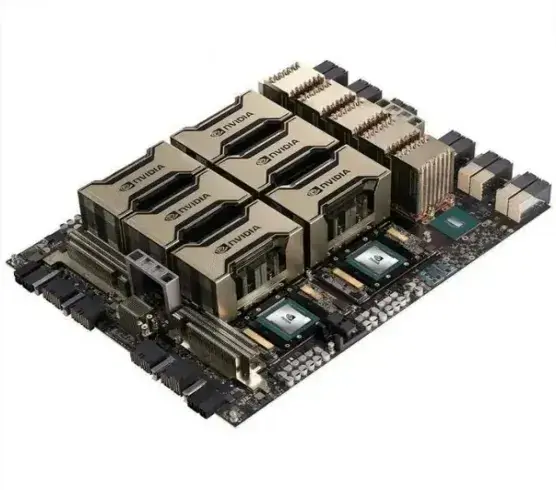
A populated H100 baseboard with NVSwitch fabric, for integration into an approved host.
NVIDIA HGX H100 8-GPU baseboard is one of 24 data center GPUs tracked in the SecondWatt catalogue, each with specifications, lead times and indicative secondary-market pricing.
Review HGX H100 8-GPU baseboard specifications, sourcing evidence, compatibility, pricing where verified, and inspection checks for a used purchase.
This dossier covers a populated [HGX H100 baseboard with eight H100 SXM5 GPUs](https://dam-cdn.nvd.orangelogic.com/AssetLink/705n6ur546g0uk43w0117r17n8042d73.pdf). It does not include host CPUs, chassis, storage, networking or power supplies unless the quotation explicitly adds them. NVIDIA documents [four third-generation NVSwitch devices connecting the eight GPUs](https://docs.nvidia.com/datacenter/tesla/fabric-manager-user-guide/index.html). Fabric completeness is part of the transactable unit, not an optional cosmetic attribute of the board. The baseboard’s [full-bandwidth NVLink topology](https://dam-cdn.nvd.orangelogic.com/AssetLink/705n6ur546g0uk43w0117r17n8042d73.pdf) supports tightly coupled GPU workloads inside an approved server. External cluster networking is a separate design and procurement decision. A [public historical advertisement explicitly offers populated HGX H100 baseboards and complete systems](https://www.linkedin.com/posts/revo-tech-marketplace_nvidia-h100-hgx-sxm-8-way-gpu-systems-activity-7281988588286734336-s_3r). It establishes an advertised transaction unit, not current stock, condition or an executed sale; specification values in this dossier come from NVIDIA.
Why it matters
A baseboard’s purchase value includes the complete GPU/NVSwitch topology and compatibility with the receiving chassis. Multiplying a loose-module asking price cannot establish its value: the assembly, cooling interface, diagnostics and integration work are separate deliverables.
Who buys it
As a fit assessment, buyers include integrators and operators replacing an assembly in an approved HGX H100 host. Buyers seeking a ready server should request the full configuration, because a populated accelerator baseboard is not independently deployable infrastructure.
Role in the data center
The eight-GPU HGX H100 configuration uses NVSwitch for tightly coupled training and other collective workloads. A completed DGX H100 reference server is rated at 10.2kW maximum system power, but that figure must not be assigned to every HGX baseboard or multiplied into a universal rack-density claim.
Power envelope
Specifications verified 2026-09-10.
- Per accelerator
- 700 W — Verified: Maximum configurable board power, manufacturer specification. source
- Per 8-accelerator node
- 10.2 kW electrical — Verified: NVIDIA DGX H100 published maximum system power — 10.2 kW against 5.6 kW of accelerator (1.82x). Sizing from accelerator watts alone under-provisions the building. source
- Heat load per node
- 11.3 kW thermal — Verified: NVIDIA DGX H100 published heat load. Stated separately from the 10.2 kW electrical figure — size cooling on this one. source
- Per rack
- ~41 kW — Derived: 4 nodes per rack at the published node power, bound by NVIDIA DGX H100 per-rack guidance of 4 systems (power alone would allow 12). State your own budget and rack height and the count changes.
- Cooling class
- DLC recommended — Derived: Per-accelerator power at or above 700 W — air cooling possible at reduced rack density.
- Accelerators per IT MW
- ~784 — Derived: 1 MW IT load / (10.2 kW per 8-accelerator NVIDIA DGX H100 node). IT load only — excludes cooling and distribution losses.
Node figures are published OEM system ratings; rack counts are arithmetic against a stated rack budget and move with your own cooling design. Assumption set version 2026-09-11a.
Key specifications
| Installed H100 SXM5 GPUs | 8 GPUs |
|---|---|
| Installed NVSwitch devices | 4 switches |
| NVSwitch generation | 3 generation |
| GPU memory per module | 80 GB HBM3 |
| Memory bandwidth per GPU | 3.35 TB/s |
| NVLink bandwidth per GPU | 900 GB/s bidirectional |
| NVLink generation | 4 generation |
| Maximum configurable TDP per GPU | 700 W |
| PCIe interface generation per GPU | 5 generation |
| PCIe aggregate bandwidth per GPU | 128 GB/s bidirectional |
| Peak dense FP64 per GPU, whitepaper | 33.5 TFLOPS |
| Peak dense FP32 per GPU, whitepaper | 66.9 TFLOPS |
| Peak dense FP8 Tensor per GPU, whitepaper | 1978.9 TFLOPS |
| Peak sparse FP8 Tensor per GPU, whitepaper | 3957.8 TFLOPS |
Technical summary
The assembly contains eight H100 GPUs and four NVSwitch devices. Each SXM GPU is specified at 80GB memory, 3.35TB/s memory bandwidth, 900GB/s NVLink and up to 700W configurable GPU TDP; these are per-GPU quantities, not a single shared memory pool or a whole-baseboard input rating. The whitepaper publishes per-GPU peak dense FP64 33.5TFLOPS and dense FP32 66.9TFLOPS; dense/sparse FP8 Tensor 1,978.9/3,957.8TFLOPS. The current product page lists peak dense FP64 34TFLOPS and FP32 67TFLOPS; sparse FP8 Tensor 3,958TFLOPS; the structured compute rows retain the whitepaper’s precision rather than deriving a new aggregate figure.
Major variations
Keep the four-GPU direct-linked and eight-GPU switched HGX H100 designs separate. A DGX H100 complete system includes its own host hardware and is not the same transactable unit as this baseboard. The public advertisement describes HBM2e, whereas NVIDIA specifies HBM3 for H100 SXM5; the advertisement is used only as market evidence, not as a specification authority.
Configurations and options
The four-GPU HGX H100 design uses direct NVLink, whereas the eight-GPU design includes NVSwitch. This dossier covers only the latter populated assembly; require its production part revision, cooling interface and receiving-platform compatibility rather than accepting a bare carrier under the same description.
Compatibility and dependencies
The receiving server must support this HGX H100 baseboard and its complete fabric and matching Fabric Manager stack. Host CPU trays, PCIe routing, networking, cooling and power delivery need to be part of the integrator’s bill of materials. Manufacturer examples include SYS-821GE-TNHR and PowerEdge XE9680 platforms. These references do not authorize cross-OEM baseboard swaps; obtain written compatibility for the actual assembly, software branch and chassis revision.
Lifecycle and maintenance
Plan software maintenance against NVIDIA’s published driver-branch support table and the architecture/toolkit compatibility matrix. The driver lifecycle policy describes software branches, not the remaining physical life of an individual accelerator; retain firmware and diagnostic records when transferring the hardware. Preserve fabric configuration and switch/GPU error logs together with the full node diagnostic record. Maintenance acceptance should verify all populated paths; a server boot alone cannot establish that the assembly’s intended fabric works.
Common failure points
- HBM memory — [Uncorrectable ECC errors or a persistently high corrected-error rate](https://docs.nvidia.com/deploy/gpu-debug-guidelines/gpu-node-triage.html) warrant fault isolation; these are diagnostic categories, not a measured failure rate for this model.
- PCIe path — [A GPU disappears from the bus](https://docs.nvidia.com/deploy/gpu-debug-guidelines/gpu-node-triage.html) or [PCIe tests report errors](https://docs.nvidia.com/datacenter/dcgm/latest/user-guide/dcgm-diagnostics.html).
- Cooling path — [Thermal slowdown flags and falling clocks under load](https://docs.nvidia.com/deploy/nvidia-smi/index.html) indicate that performance is being limited.
- Power delivery — [Power-brake or hardware-slowdown telemetry](https://docs.nvidia.com/deploy/nvidia-smi/index.html) can identify a host or board power constraint.
- NVLink / NVSwitch — [NVLink errors](https://docs.nvidia.com/deploy/gpu-debug-guidelines/gpu-node-triage.html) or [fabric registration failures](https://docs.nvidia.com/datacenter/tesla/fabric-manager-user-guide/index.html) can prevent the intended multi-GPU operation.
- NVSwitch / fabric software — [Switch or fabric-registration failures can prevent CUDA work from launching](https://docs.nvidia.com/datacenter/tesla/fabric-manager-user-guide/index.html).
Inspection checklist
- Match the purchase order, physical labels and reported GPU identity, memory and VBIOS; match the populated eight-GPU HGX H100 assembly and every module label.
- Inspect the carrier, NVSwitch population, GPU modules, cooler interface and mounting hardware against the cited manufacturer configuration; record photographs and the supplied accessories.
- Collect ECC, memory-health, temperature, clock and power telemetry before stress testing; ask for historical logs separately.
- Run supported memory, PCIe and compute diagnostics in the actual receiving host; preserve the complete output and software versions.
- Exercise the intended application while recording temperature, power and slowdown flags; agree workload-specific acceptance criteria in the contract.
- Validate every intended GPU peer path and the Fabric Manager configuration where NVSwitch is present; include a collective-communication test across the intended nodes.
- Inventory the host-side items separately; use node and network acceptance tests after installation.
- Require written serial-specific warranty scope, return terms and software entitlement confirmation before acceptance; an offer’s condition label is insufficient evidence of OEM entitlement.
- Complete classification and destination/end-user screening for the actual shipment; retain the supporting records.
Procurement channels
A historical public baseboard/system offer and a secondary channel that buys H100 backplanes identify sourcing routes. Require a fresh assembly-level quote with GPU and NVSwitch population, cooler, firmware, host compatibility and acceptance evidence stated; neither historical advertising nor a buying programme is a reservation.
Regional notes
For a cross-border resale, obtain the manufacturer’s current classification for the actual board or system and screen destination, end-user and end-use restrictions. A used condition does not establish export eligibility; retain the classification and licensing documents with the transaction.