VYCON VDC flywheel energy storage, 300 kW
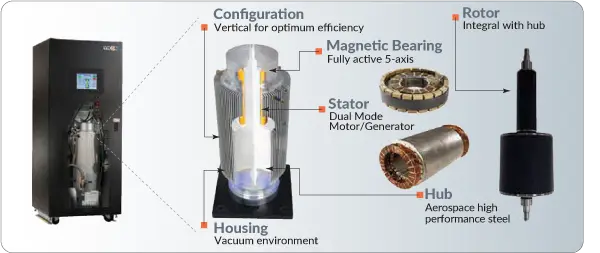
VYCON's magnetically levitated DC-bus flywheel store, a battery replacement that retrofits to an existing static UPS
This model is part of SecondWatt’s ups system research catalogue. Specifications and price observations are included where supported by sources. Equipment availability and commercial terms require confirmation.
VYCON VDC dossier: 300 kW DC-bus flywheel at 18,500-36,000 rpm on magnetic bearings, ownership status since 2022, and a used-unit inspection checklist.
The VDC is a flywheel energy storage system rated 300 kW maximum with a total energy of 6,000 kilowatt-seconds, delivering 300 kW for 16 seconds. The rotating group spins between 18,500 rpm fully discharged and 36,000 rpm fully charged on five-axis active magnetic levitation, with ceramic backup bearings that VYCON states can support multiple high-speed drops and recover without damage. A medical-grade vacuum pump maintains the enclosure, its mineral oil is replaced roughly yearly in a ten-minute procedure performed without taking the unit offline, and the pump itself lasts eight to ten years.
Architecturally the VDC is not a UPS. Like the Piller POWERBRIDGE it is a battery-replacement module that connects to the DC bus of an existing static UPS, UL listed for 400 to 600 VDC and connectable up to 850 VDC. That makes it the most retrofit-friendly product of its class and the one most likely to appear used as a standalone transferable asset, with more than 1,400 VDC systems deployed and over 13 million discharge and recharge cycles reported.
Ownership is the open question and it needs correcting on any listing. Calnetix Technologies, which formed VYCON in 2002, now lists VYCON's status as sold in 2022, and VYCON does not appear on Calnetix's current affiliates and subsidiaries page. The buyer is not named anywhere, and VYCON's own About, Contact and News pages carry no parent-company statement. VYCON is no longer a Calnetix company, and a listing that describes it as one is out of date.
Why it matters
Runtime that does not degrade is a genuine used-asset advantage, and it is conditional on one thing: vacuum integrity. A unit that sat decommissioned with an unserviced pump has almost certainly lost vacuum, windage losses rise and the published runtime no longer holds. Combined with unverifiable parts continuity since 2022, that puts the diligence squarely on service records rather than calendar age.
Who buys it
Operators retrofitting an existing static UPS DC bus to cut battery cycling, and facilities that want short high-power ride-through with no battery room. VYCON's own battery-hardening configuration puts the flywheel in parallel with batteries, where it absorbs over 98% of the discharges that would otherwise have cycled the cells, which is newly relevant where compute loads cycle batteries harder than legacy workloads did.
Role in the data center
DC-bus energy store retrofitted to an existing static UPS, either replacing the battery string outright or sitting in parallel with it to absorb short discharges. It connects on the UPS DC bus rather than on the AC side, is UL listed for 400 to 600 VDC and connectable to 850 VDC, and needs no cooling, so it can sit where a battery room cannot.
Key specifications
| Power rating | 300 maximum (300 kW for 16 seconds) kW |
|---|---|
| Total energy | 6,000 kilowatt-seconds (6 MJ) |
| Rotational speed | 18,500 discharged to 36,000 charged rpm |
| Bearing type | Five-axis active magnetic levitation with ceramic backup bearings |
| Vacuum system | Medical-grade pump, yearly oil change, 8-10 year pump life |
| DC voltage | UL listed 400-600; connectable to 850 VDC |
| Design life | greater than 20 years |
| Recharge time | approximately 12 minutes |
| DC capacitor replacement | about 7-8 years |
| Installed base | more than 1,400 systems, over 13 million discharge and recharge cycles |
| Battery-hardening claim | absorbs over 98% of discharges that would have cycled the batteries |
| Cooling requirement | None required |
| Ownership status |
Technical summary
Power rating: 300 kW maximum; 300 kW for 16 seconds of runtime. Total energy: 6,000 kilowatt-seconds maximum (6 MJ). Rotational speed: 18,500 rpm fully discharged to 36,000 rpm fully charged. Bearings: five-axis active magnetic levitation with ceramic backup bearings. Vacuum: medical-grade pump, mineral oil replaced yearly in a 10-minute online procedure, 8-10 year pump life. DC connection: UL listed for 400-600 VDC; connectable up to 850 VDC. Design life: greater than 20 years with runtime that does not degrade. Recharge: approximately 12 minutes after complete discharge. Maintenance: DC capacitors replaced at about 7-8 years; no cooling required. Installed base: more than 1,400 systems and over 13 million discharge and recharge cycles.
Major variations
The VDC-XXT is the reference model, quoted as VDC XXT-540 V against a 540 V minimum bus. Four published configurations exist: ride-through to a standby generator, battery hardening in parallel with cells, industrial glitch protection, and a custom single-package build on request. The REGEN line is the sibling product for rail and recycling duty.
Configurations and options
The VDC is configured by how it is applied rather than by frame options. VYCON publishes four configurations: ride-through to a standby generator, battery hardening in parallel with an existing string, industrial glitch protection, and a custom single-package build on request. In the hardening configuration the flywheel absorbs over 98% of the discharges that would otherwise have cycled the cells, so it is bought alongside a battery plant rather than instead of one. The reference model is the VDC-XXT, quoted as VDC XXT-540 V against a 540 V minimum bus, and the runtime curve is published on that basis at 0.9 output power factor and 96% host inverter efficiency. VYCON publishes no cabinet dimensions, weight, kVA rating or list price as of September 2026, so the configuration and the price both come from a quotation.
Compatibility and dependencies
The VDC is a DC-bus device, not an AC UPS. It connects to the DC bus of an existing static UPS in place of, or in parallel with, a battery string. It is UL listed for 400 to 600 VDC and connectable up to 850 VDC, so the host bus voltage decides whether an installation sits inside the listed window. Runtime is 16 seconds at 300 kW, which makes the standby generator and its transfer scheme part of the specification, and recharge after a full discharge takes about 12 minutes. It needs no cooling, no battery room and no spill containment, but it carries its own consumables: a medical-grade vacuum pump on an annual mineral-oil change done in ten minutes without taking the unit offline, an 8 to 10 year pump life, and DC capacitors at about 7 to 8 years. The five-axis magnetic bearing controller is proprietary and not field-substitutable, so parts continuity is a purchase condition.
Pricing and availability
Trend: rising Lead time, used or refurbished: No used or refurbished unit listed as of August 2026. Warranty, used: 1-year typical from refurbishment dealers.
Lifecycle and maintenance
VYCON rates the VDC above 20 years of design life with runtime that does not degrade, which is a genuine used-asset advantage and is conditional on vacuum integrity. The consumables are documented and dated: mineral oil in the medical-grade vacuum pump is replaced roughly yearly in a ten-minute procedure performed without taking the unit offline, the pump itself lasts eight to ten years, and the DC capacitors are replaced at about seven to eight years. Five-axis active magnetic levitation means no scheduled bearing replacement, but it makes the machine dependent on proprietary bearing-controller electronics. VYCON publishes a relative claim of 20 times the MTBF of a single battery string and no absolute MTBF hours. Calnetix lists VYCON as sold in 2022 and names no buyer, so parts and warranty continuity should be confirmed in writing.
Thermal and emissions profile
Flywheel and rotary UPS produce no combustion emissions and carry no battery at all, which removes the category's largest environmental liability: no lead-acid recycling stream, no lithium fire code, and what Piller describes as no environmental disposal concerns at end of life. The second-order saving is cooling. Batteries need a controlled room at 25 degrees C or lower to reach rated life, while VYCON states the VDC needs no cooling and Piller states air conditioning is not required for POWERBRIDGE. Active Power rates CleanSource HD to 104 degrees F (40 degrees C) at 96.5% efficiency on half load and up to 98% at full load, so the parasitic cooling load a battery room imposes never appears.
Common failure points
- Vacuum system and pump — A unit stored with an unserviced pump loses vacuum, windage losses rise and the published runtime no longer holds
- Magnetic bearing controller — Five-axis active levitation depends on proprietary controller electronics that are not field-substitutable
- Ceramic backup bearings — The rotor turns at 18,500 to 36,000 rpm and recovers from only a limited number of high-speed drops onto its backup bearings
- DC capacitors — Aged DC capacitors degrade the converter and the energy the unit can deliver
- Host DC bus compatibility — The unit is UL listed for 400 to 600 VDC while it can connect up to 850 VDC, so a host outside the listed window is a compliance question
- Corporate parts continuity — Calnetix lists VYCON as sold in 2022 and names no buyer, so warranty backing is not documented publicly
Inspection checklist
Start with the vacuum system: demand pump service records and pump age, and budget a replacement on any unit past eight years, because lost vacuum raises windage losses and voids the published runtime. Ask for the rotor drop-event log and count the drops; the rotor turns at 18,500 to 36,000 rpm and recovers from only a limited number of high-speed drops onto its ceramic backup bearings. Confirm DC capacitor age against VYCON's seven to eight year replacement point. Verify the annual mineral-oil service history on the vacuum pump. Confirm the host UPS DC bus falls inside the UL-listed 400 to 600 VDC window rather than the 850 VDC connection ceiling. Get parts entitlement and warranty backing in writing, since Calnetix lists VYCON as sold in 2022 and names no buyer.
Procurement channels
New units are quote-only direct from VYCON in Chino, California. No dealer or refurbishment channel carries the product, and no used unit carries a published price as of August 2026. Vertiv's North American energy storage guide specification does list a Vycon flywheel option with a 20-year design life, which is the one integrator pairing documented in a major manufacturer's own specification.
Regional notes
Operates from 14592 Central Avenue, Chino, California. The site is live and markets the VDC as an active product, but the newest news item is dated October 2024 and the footer reads 2024, so production status should be treated as uncertain and confirmed in writing before transacting.