Mitsubishi Electric 7011A Series single-phase UPS, 6-12 kVA
Manufacturer: Mitsubishi Electric
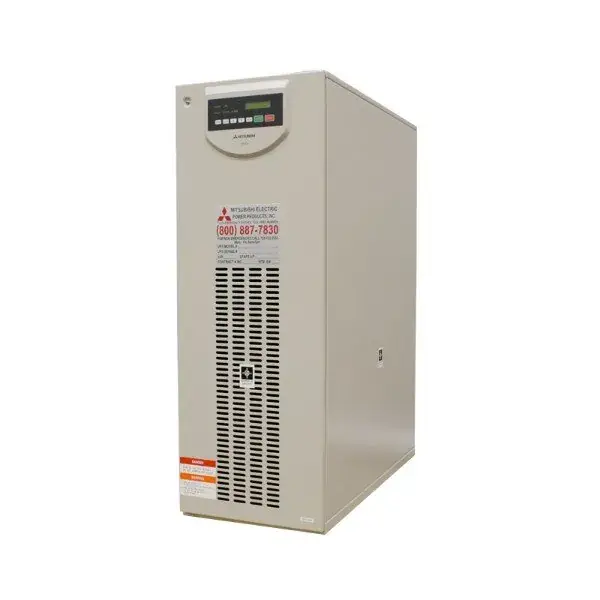
Mitsubishi's discontinued single-phase online UPS, with factory support ending January 2027 and a 0.7 rated power factor
This model is part of SecondWatt’s ups system research catalogue. Specifications and price observations are included where supported by sources. Equipment availability and commercial terms require confirmation.
Mitsubishi Electric 7011A dossier: 6-12 kVA single-phase, 0.7 power factor, factory support ending 01/2027, dealer pricing, and inspection tips.
The 7011A Series is a discontinued single-phase online double-conversion UPS from Mitsubishi Electric Power Products, rated 6.0, 8.0, 10.0 and 12.0 kVA. Its rated load power factor is 0.7, which is unusually low by modern standards and a real derate when sizing against a 0.9 or unity replacement: a 12 kVA 7011A delivers 8.4 kW. Input is 240/120 V single-phase or 208/120 V two-phase, output is 240/120, 208/120 or 120/120 V, and the battery bus is 216 VDC with a five-year design life.
The support clock is the commercial fact. MEPPI classifies the 7011A as sustained support with an announced end date of January 2027 and names the 7011B as its replacement. MEPPI is also the only OEM in this category publishing a dated four-stage lifecycle table, and the same table shows what happens after: the 2033 series and 9800A-A through -D are obsolete with technical support and replacement parts no longer available.
A consumables aftermarket is alive for the platform, with replacement battery kits for the 7011A-80, -100 and -120 sold by independent battery suppliers, and a long list of dealers holding or servicing units without published prices. Given the five-year battery design life and the 216 VDC string, any 7011A on the market today should be assumed to need a full battery replacement and priced cabinet only.
Why it matters
This is the category's clearest dated support cliff, and dated cliffs are what make a spares market legible. MEPPI publishes an exact month, January 2027, and names the successor. That single fact reprices every unit in the field, because a buyer can calculate remaining parts entitlement instead of guessing at it, which is impossible for almost every other nameplate in the category.
Who buys it
Facilities running an installed 7011A that need a like-for-like replacement or spare before factory support ends, and service firms stocking against that deadline. New buyers should be routed to the 7011B successor, since a 7011A bought today has under a year of factory parts entitlement and then moves to the third-party broker market exactly as the 2033 series already has.
Role in the data center
Room-level or rack-adjacent single-phase UPS for small computer rooms, control systems and emergency lighting circuits, where the UL 924 listing matters. At a 0.7 rated load power factor a 12 kVA unit delivers 8.4 kW, so it sizes very differently from a 0.9 or unity replacement feeding the same panel.
Key specifications
| Rating range | 6.0-12.0 (4.2-8.4 kW) kVA |
|---|---|
| Rated load power factor | 0.7 |
| Input voltage | 240/120 single-phase or 208/120 two-phase V |
| Output regulation | plus or minus 0.01 on frequency % |
| Battery bus | 216 (sealed lead-acid, 5-year design life) VDC |
| Dimensions | 13.8 W x 29.9 D; 27.8-40.6 H in |
| Weight | 307 (-60) to 507 (-80 through -12.0) lb |
| Standards | UL 1778, UL 924, cUL, FCC Class B |
| Lifecycle stage | Sustained support, ending 01/2027 |
| Successor | 7011B, 6-12 kVA |
| Fan replacement interval | 5 years |
| Capacitor replacement interval | 15 years |
Technical summary
Ratings: 7011A-60 6.0 kVA/4.2 kW; -80 8.0/5.6; -100 10.0/7.0; -12.0 12.0/8.4. Rated load power factor: 0.7. Input: 240/120 V single-phase or 208/120 V two-phase, 50/60 Hz plus or minus 5%. Output: 240/120, 208/120 or 120/120 V, 50/60 Hz plus or minus 0.01%. Topology: true online double conversion, IGBT converter and inverter. Dimensions: 13.8 in W x 29.9 in D; 27.8 in H at 307 lb (-60), 40.6 in H at 507 lb (-80 to -12.0). Battery: sealed lead-acid, 216 VDC nominal, 5-year design life. Standards: UL 1778, UL 924, cUL, FCC Class B, ISO 9001. Support: sustained support ending 01/2027; successor 7011B at 6-12 kVA. Service intervals: fans every 5 years, capacitors every 15 years per MEPPI.
Major variations
Four ratings in two cabinet heights: the 7011A-60 at 6.0 kVA/4.2 kW in a 27.8 inch cabinet at 307 lb, and the -80, -100 and -12.0 at 8.0/5.6, 10.0/7.0 and 12.0/8.4 kVA/kW in a 40.6 inch cabinet at 507 lb, all 13.8 inches wide and 29.9 inches deep. Input is single-phase 240/120 V or two-phase 208/120 V; output is 240/120, 208/120 or 120/120 V. The 7011B successor covers the same 6 to 12 kVA band and is the current product; MEPPI's lifecycle table names it as the replacement when 7011A support ends in January 2027.
Configurations and options
Four ratings in two cabinet heights: the 7011A-60 at 6.0 kVA and 4.2 kW in a 27.8 in cabinet at 307 lb, and the -80, -100 and -12.0 at 8.0, 10.0 and 12.0 kVA in a 40.6 in cabinet at 507 lb. The configuration that has to be confirmed on any used unit is the voltage build, because input is either 240/120 V single-phase or 208/120 V two-phase and output is 240/120, 208/120 or 120/120 V, and those are not field-selectable equivalents. The battery is a sealed lead-acid string at 216 VDC nominal with a five-year design life, and independent suppliers sell replacement kits for the -80, -100 and -120, so a cabinet-only price plus a battery kit is the realistic cost basis. The successor 7011B covers the same 6-12 kVA band and is the current part.
Compatibility and dependencies
The unit has to be matched to a single-phase 240/120 V or two-phase 208/120 V source at 50 or 60 Hz within 5%, and its output voltage is fixed by the build, so a replacement in an existing rack has to match the branch it feeds rather than merely the kVA. Rated load power factor is 0.7, which is a real derate against a modern 0.9 or unity machine: a 12 kVA 7011A supports 8.4 kW, not 12. It is listed to UL 1778 and UL 924, so it can sit on an emergency lighting branch, and it is 13.8 in wide by 29.9 in deep. The dependency that governs a purchase is support: MEPPI carries the 7011A in sustained support to January 2027, after which parts move to the broker market, and dealers document parts confusion between Toshiba and Mitsubishi UPS assemblies during repair.
Pricing and availability
Trend: rising Support status rather than condition sets the direction on this platform, and the evidence is a sibling series rather than this nameplate. MEPPI's lifecycle table ends 7011A factory support in January 2027; the 2033 series has already passed that point and is listed obsolete with replacement parts no longer available. Critical Parts Warehouse published preowned 2033 units on 18 August 2026 at 4,049.90 USD for a 30 kVA through 5,824.90 USD for an 80 kVA, roughly 50 to 135 USD per kVA. That band describes MEPPI legacy three-phase iron after the support cliff, not this single-phase model, but it is the closest dated read on where post-support Mitsubishi hardware settles. Lead time, new: Discontinued; the current equivalent is the 7011B. Lead time, used or refurbished: 1-3 weeks from parts distributors and independent dealers. Warranty, used: Radwell sells the part under its own 2-year warranty rather than as an authorised Mitsubishi Electric distributor..
Lifecycle and maintenance
Static UPS cabinets serve roughly 15 years, the figure Mitsubishi publishes alongside a lifecycle-parts-or-replace decision at 10-12 years. The wear items are documented: Eaton rates DC bus capacitors at 7 years of continuous duty and up to 10 in favourable conditions, Riello puts capacitor service life at 10 years with replacement recommended between years 4 and 8, and Vertiv field data gives 6 years for capacitors and 5-6 years or 40,000-50,000 hours for cooling fans. Batteries turn over far faster, at 3-5 years for sealed VRLA and 12-15 for flooded cells, and spent lead-acid leaves as regulated waste through compliant recycling rather than resale. Service life extension programs rebuild the power train inside the original shell, which is why cabinets routinely outlive their electronics.
Thermal and emissions profile
UPS systems produce no combustion emissions, so the regulatory profile is battery handling, efficiency reporting and fire code. VRLA cells are regulated lead-acid waste at end of life and route through compliant recycling rather than resale, which is why asset recovery firms treat cabinet and cells as two separate economies. ENERGY STAR version 2.0 sets the efficiency benchmark, requiring VFI units above 10,000 W to meet 0.0058 x ln(P) + 0.886 and every AC-output unit to hold at least 90% power factor at full load, measured as a load-weighted average at 25, 50, 75 and 100% load. Efficiency is itself the emissions lever, since each point of double-conversion loss is continuous waste heat the cooling plant has to reject.
Common failure points
- Battery strings — VRLA capacity fades below 80% of nameplate and takes the ride-through with it
- DC bus capacitors — Silent open-circuit loss, or a short that pops and sprays electrolyte across adjacent boards
- Cooling fans — Overheating transfers the load to bypass and leaves it unprotected
- Air filters and dust — Restricted airflow raises internal temperature and shortens capacitor life
- Static bypass switch — Failure to transfer strands the load during maintenance or overload
- Controls obsolescence — Discontinued display and logic boards turn a routine repair into a scavenger hunt
Inspection checklist
Battery age: sealed VRLA turns over at 3-5 years per Eaton lifecycle guidance; assume a full string past that. Battery capacity: reject any string below 80% of nameplate capacity under IEEE 1188 practice. Battery impedance: treat ohmic readings more than 20% above the commissioning baseline as an investigation trigger under IEEE 1188 field practice, then confirm against the battery manufacturer limit for the chemistry before condemning a cell. Float voltage: verify 2.23-2.27 VPC at 25 degrees C; float current above 3x steady state flags thermal runaway. Intercell connectors: thermal image every joint; a delta above 5 degrees C against neighbors triggers a capacity test. DC bus capacitors: Eaton rates 7 years of continuous duty (10 optimal); Vertiv field data gives 6 years at 45,000-50,000 h. Cooling fans: Vertiv field data gives 5-6 years or 40,000-50,000 hours; listen for bearing noise at the intake. Air filters: pull every filter; a clogged element is the best single proxy for a cabinet that ran above 25 degrees C.
Procurement channels
Radwell carries the part with its own warranty rather than as an authorized Mitsubishi distributor, and a long dealer list including Quality Power Solutions, Emergency Power, Mission Critical Facilities International, Static Power and Millennium UPS holds or services units without published prices. Replacement battery kits are available from independent battery suppliers.
Regional notes
North American product listed to UL 1778 and UL 924, built and serviced from MEPPI's Pittsburgh and Warrendale, Pennsylvania operations. MEPPI relocated and roughly doubled its California service facility in February 2026.