Toshiba G9000 Series, 100-2000 kVA
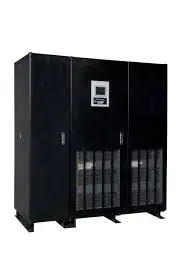
Toshiba's monolithic UL 1778 double-conversion UPS with a published new-price curve
This model is part of SecondWatt’s ups system research catalogue. Specifications and price observations are included where supported by sources. Equipment availability and commercial terms require confirmation.
Toshiba G9000 dossier: 100-2000 kVA, UL 1778 listed, up to 97% efficiency, new pricing from 312 to 397 USD per kVA, and a full used-unit inspection checklist.
The G9000 Series is Toshiba International Corporation's monolithic transformerless double-conversion UPS, built in three rating families: 100 to 225 kVA at 0.9 power factor, 300 to 750 kVA at unity, and 1000 to 2000 kVA at unity. It uses fifth-generation CSTBT IGBTs designed specifically for UPS duty, holds output regulation within 1%, and reaches up to 97% efficiency between 50 and 100% load while staying above 94% down to 20% load. Toshiba publishes no eco-mode efficiency figure for the G9000, so its published efficiency story is high double conversion rather than an economy-mode headline. Units parallel four ways at 100-225 kVA and eight ways at 300-750 kVA to 4 MVA.
Toshiba's US UPS business has not been acquired. Toshiba Corporation was taken private in 2023 by a Japan Industrial Partners-led consortium, but Toshiba International Corporation in Houston remains a wholly owned subsidiary, operates four Houston plants, and launched the 3000 SP Series single-phase UPS in 2025. The G9000 stays current at 100-2000 kVA with the G9400 succeeding it at megawatt class.
The G9000 carries an unusually clean published new-price curve, and it falls with frame size: 397 USD per kVA at 160 kVA, 361 at 300 kVA and 312 at 1000 kVA, all new, all now sold out, so these were transacted prices. A used 225 kVA unit built in 2022 asked 111,000 USD, about 493 USD per kVA, which sits above that curve; the listing states no battery package, and 30 to 48 week new lead times in the class are the likeliest explanation.
Why it matters
A dealer-published 12 to 16 week lead time on a new 500 kVA G9000 sits against a market benchmark of 30 to 48 weeks for static UPS in the 500 to 1,500 kVA class. That 20 to 32 week schedule advantage is unusual in this category, where UPS is already the shortest-lead major electrical asset in a build. It also caps what a used G9000 can command, since the new alternative is not far away.
Who buys it
Data center operators, hospitals, industrial plants and public-sector buyers who specify a UL 1778 listed monolithic UPS and buy on double-conversion efficiency rather than on an economy-mode headline. The G9000 also has an unusually active rental channel, with Global Power Supply running trailer-mounted G9000 units and CI Group listing rental systems, which is the classic origin of ex-fleet secondary stock.
Role in the data center
Facility-level primary UPS from a single 100 kVA cabinet to an eight-unit 4 MVA parallel bus, sitting on the critical distribution bus with an external and separately priced battery plant. Toshiba publishes no eco-mode efficiency figure for the platform, so the design is specified and operated on its double-conversion numbers.
Key specifications
| Rating range | 100-2000 kVA |
|---|---|
| Output power factor | 0.9 below 300 kVA; 1.0 at and above |
| Double conversion efficiency, product page | up to 97 (above 94 at 20% load) % |
| Parallel capability | 4 units (100-225 kVA); 8 units (300-750 kVA) |
| Standards | UL/cUL 1778, ANSI C62.41, IEC 62040-2 |
| Battery chemistries | VRLA, NiCd, Toshiba SCiB lithium titanate |
| Dimensions at 500 kVA | 70.9 W x 32.8 D x 80.7 H (3,300 lb) in |
| Dimensions at 2000 kVA | 222.4 W x 35.5 D x 80.7 H (13,558 lb) in |
| Warranty | 3-year onsite; batteries 36 months plus 7 years pro-rated |
| New price at 160 kVA | 63,599.99 (397 USD per kVA) USD |
| New price at 300 kVA | 108,199.00 (361 USD per kVA) USD |
| New price at 1000 kVA | 311,999.00 (312 USD per kVA) USD |
| Observed used 225 kVA | 111,000 (about 493 USD per kVA) USD |
| Published new lead time at 500 kVA | 12-16 weeks |
| Double conversion efficiency, brochure | 96.4-97.0 at full load, 94.2-96.3 at 25% load % |
Technical summary
Ratings: 100/90 to 225/202.5 kVA/kW; 300/300 to 750/750; 1000/1000 to 2000/2000. Power factor: 0.9 below 300 kVA, unity at 300 kVA and above; input PF above 0.99. Input/output (US): 480 V three-phase, three-wire plus ground; regulation plus or minus 1%. Efficiency: up to 97% at 50-100% load; above 94% down to 20% load; the brochure gives 96.4-97.0% at full load and 94.2-96.3% at 25% load. Eco mode: Toshiba publishes no eco-mode efficiency figure for the G9000, so the published figures are double conversion. Topology: monolithic transformerless, fifth-generation CSTBT IGBTs. Parallel: 4 units at 100-225 kVA, 8 units at 300-750 kVA, to 4 MVA. Battery: VRLA, NiCd and Toshiba SCiB lithium titanate, external and separately priced. Standards: UL and cUL 1778 listed; ANSI C62.41; IEC 62040-2; ENERGY STAR on 650 and 1000 kVA. Warranty: three-year onsite; batteries 36 months full replacement plus 7 years pro-rated.
Major variations
Three rating families rather than one: 100/90 to 225/202.5 kVA/kW at 0.9 power factor, 300/300 to 750/750 at unity and 1000/1000 to 2000/2000 at unity. Builds split by market, with 480 V three-wire UL units for the US and a separate 380/400/415 V three- or four-wire international series. Battery configurations run VRLA, NiCd or Toshiba SCiB lithium titanate, and the 400 V version is also flywheel-compatible. Global Power Supply stocks 500 kVA builds new, with lithium batteries, and trailer-mounted. The G9400 succeeds the line at megawatt class while the G9000 continues below it.
Configurations and options
Three rating families rather than one: 100 to 225 kVA at 0.9 power factor, 300 to 750 at unity and 1000 to 2000 at unity, so kVA and kW diverge below 300 kVA and a 225 kVA machine supports 202.5 kW. The market build is the next choice, with 480 V three-wire UL units for North America and a separate 380/400/415 V three or four wire international series carrying its own lower efficiency table. Battery type is specified separately and priced separately, across VRLA, NiCd and Toshiba SCiB lithium titanate, with the 400 V version also offered flywheel-compatible. Global Power Supply stocks 500 kVA units plain, with lithium batteries, and trailer-mounted. Warranty is three years onsite with batteries at 36 months full replacement plus seven years pro-rated, and ENERGY STAR certification covers the 650 and 1000 kVA models.
Compatibility and dependencies
The US machine takes 480 V three-phase, three-wire plus ground, tolerating minus 20% to plus 15% without discharging the battery, and holds output within 1%. Batteries are external and separately priced in every configuration. Paralleling depends on frame size, four units at 100-225 kVA and eight at 300-750 kVA to 4 MVA, and Toshiba states this needs no special switchgear cabinet, which removes a line item competitors carry. Size scales hard with rating: a 100 kVA cabinet is 27.6 in wide at 772 lb, a 500 kVA is 70.9 in at 3,300 lb, and a 2000 kVA is 222.4 in wide at 13,558 lb, so the rigging path and floor loading gate the largest frames. Two service dependencies matter on a used unit: an SCiB lithium titanate battery system is Toshiba proprietary and serviceable only through Toshiba's channel, and air filters are an explicitly listed consumable.
Pricing and availability
Trend: rising New dealer pricing falls cleanly with frame size across the range: 397 USD per kVA at 160 kVA, 361 at 300 kVA and 312 at 1000 kVA, all now marked sold out. Within the Toshiba brand, a 2015 4400 80 kVA with bypass and two battery cabinets sold at roughly 350 USD per kVA while a 4200 80 kVA sold at roughly 97, a 3.6x spread driven by age, condition and battery inclusion. Lead time, new: 12-16 weeks at 500 kVA (dealer published), against a 30-48 week class benchmark. Lead time, used or refurbished: 1-4 weeks from dealer stock. Warranty, new: Three-year onsite standard; batteries 36 months full replacement plus 7 years pro-rated.. Warranty, used: Dealer terms vary; Critical Parts Warehouse and Gruber Power Services publish a 1-year full replacement warranty on refurbished three-phase stock..
Lifecycle and maintenance
Static UPS cabinets serve roughly 15 years, the figure Mitsubishi publishes alongside a lifecycle-parts-or-replace decision at 10-12 years. The wear items are documented: Eaton rates DC bus capacitors at 7 years of continuous duty and up to 10 in favourable conditions, Riello puts capacitor service life at 10 years with replacement recommended between years 4 and 8, and Vertiv field data gives 6 years for capacitors and 5-6 years or 40,000-50,000 hours for cooling fans. Batteries turn over far faster, at 3-5 years for sealed VRLA and 12-15 for flooded cells, and spent lead-acid leaves as regulated waste through compliant recycling rather than resale. Service life extension programs rebuild the power train inside the original shell, which is why cabinets routinely outlive their electronics.
Thermal and emissions profile
UPS systems produce no combustion emissions, so the regulatory profile is battery handling, efficiency reporting and fire code. VRLA cells are regulated lead-acid waste at end of life and route through compliant recycling rather than resale, which is why asset recovery firms treat cabinet and cells as two separate economies. ENERGY STAR version 2.0 sets the efficiency benchmark, requiring VFI units above 10,000 W to meet 0.0058 x ln(P) + 0.886 and every AC-output unit to hold at least 90% power factor at full load, measured as a load-weighted average at 25, 50, 75 and 100% load. Efficiency is itself the emissions lever, since each point of double-conversion loss is continuous waste heat the cooling plant has to reject.
Common failure points
- Battery strings — VRLA capacity fades below 80% of nameplate and takes the ride-through with it
- DC bus capacitors — Silent open-circuit loss, or a short that pops and sprays electrolyte across adjacent boards
- Cooling fans — Overheating transfers the load to bypass and leaves it unprotected
- Air filters and dust — Restricted airflow raises internal temperature and shortens capacitor life
- Static bypass switch — Failure to transfer strands the load during maintenance or overload
- Controls obsolescence — Discontinued display and logic boards turn a routine repair into a scavenger hunt
Inspection checklist
Battery age: sealed VRLA turns over at 3-5 years per Eaton lifecycle guidance; assume a full string past that. Battery capacity: reject any string below 80% of nameplate capacity under IEEE 1188 practice. Battery impedance: treat ohmic readings more than 20% above the commissioning baseline as an investigation trigger under IEEE 1188 field practice, then confirm against the battery manufacturer limit for the chemistry before condemning a cell. Float voltage: verify 2.23-2.27 VPC at 25 degrees C; float current above 3x steady state flags thermal runaway. Intercell connectors: thermal image every joint; a delta above 5 degrees C against neighbors triggers a capacity test. DC bus capacitors: Eaton rates 7 years of continuous duty (10 optimal); Vertiv field data gives 6 years at 45,000-50,000 h. Cooling fans: Vertiv field data gives 5-6 years or 40,000-50,000 hours; listen for bearing noise at the intake. Air filters: pull every filter; a clogged element is the best single proxy for a cabinet that ran above 25 degrees C.
Procurement channels
Toshiba's US dealer network (Global Power Supply, CI Group, Critical Power Warehouse, Quality Power Solutions, Toromont) sells new, refurbished and rental G9000 units. The rental fleets are the most likely source of ex-fleet secondary supply.
Regional notes
US 480 V three-wire builds carry UL and cUL 1778 listings, with ENERGY STAR certification on the 650 and 1000 kVA models. A separate 380/400/415 V three- or four-wire series covers international markets at lower published efficiency, with 95.1% at full load, 94.5% at quarter load and above 92.5% at 20% load on the 400 V model, and it is also offered flywheel-compatible.