ABB MegaFlex DPA
Manufacturer: ABB
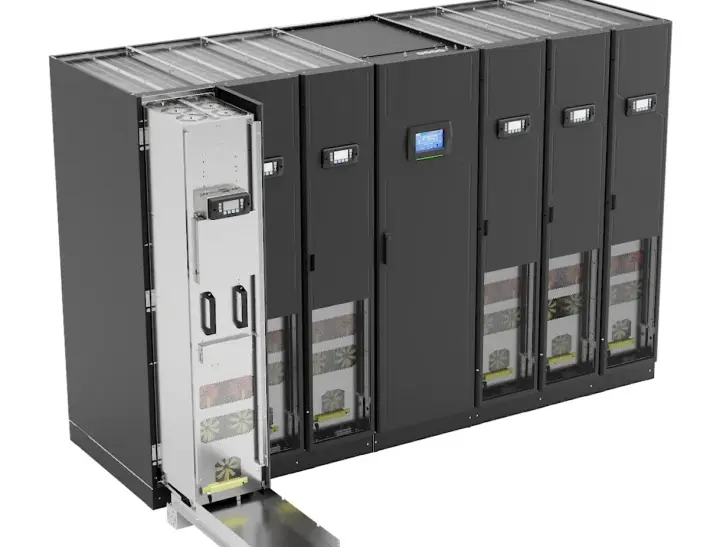
ABB's megawatt-class modular UPS, extended to 2,000 kW in March 2026 and the only ABB line trading used
This model is part of SecondWatt’s ups system research catalogue. Specifications and price observations are included where supported by sources. Equipment availability and commercial terms require confirmation.
ABB MegaFlex DPA and MegaFlex UL dossier: 250 kW modules to 2,000 kW, 97.6% efficiency, an open-box 1.5 MW observation at 33 USD per kW, and inspection notes.
MegaFlex is ABB's high-power UPS platform and it exists as two distinct products that should not be merged: MegaFlex DPA for IEC markets at 400 V, and MegaFlex UL for North America at 415 V and 480 V. The IEC line runs 250 to 1,500 kW from 250 kW slide-in modules and was extended to 1,000-2,000 kW on 23 March 2026 with 97.6% double conversion efficiency, universal 380 to 480 V input, a 15-year design life and predictive-maintenance telemetry. The UL variant is monolithic and transformerless with 337 kW modules at 415 V and 400 kW modules at 480 V, reaching 1,600 kW and paralleling four ways.
Neither variant carries integrated batteries. The DC bus is external at 480 to 600 V and supports lithium-ion with a 15-year design life, VRLA, VLA, NiCd and nickel-zinc. That makes cabinet-only pricing the default for the platform and removes the battery-inclusion ambiguity that confounds most of this category.
One priced secondary observation exists and it is the most commercially interesting number in the ABB set: an open-box 1.5 MW, 480 V MegaFlex described as never hooked up, offered at 50,000 USD by a general freight and surplus reseller in Virginia. That is roughly 33 USD per kW. The caveats belong beside the number: the seller is a general surplus and freight reseller rather than a power-equipment dealer, the listing states no test or inspection record, there is no battery system, no ABB startup or warranty is implied, and the 480 V rating sits oddly against a 400 kW UL module size.
Why it matters
The 33 USD per kW observation is a direct test of whether megawatt UPS follows the same discount pattern as smaller frames. Against small three-phase new-equipment proxies at 620 to 1,589 USD per kVA, an open-box megawatt machine at 33 USD per kW is an order of magnitude below any other UPS observation on this site. It should be confirmed before it is treated as a market reference, but if it holds it is the clearest capex argument in the category.
Who buys it
Hyperscale, colocation and neocloud data center developers buying megawatt UPS blocks, and the engineering firms specifying them. On the secondary side the buyer is a developer willing to underwrite an open-box asset that carries no published test record against a 40 to 60 week new-equipment queue for modular UPS above 2,000 kVA, and to fund startup and commissioning independently.
Role in the data center
Megawatt-class primary UPS for hyperscale and colocation halls, sitting on the critical bus between medium-voltage transformation and the data hall distribution. It is configured N+1, 2N, 2N+1, N+N or as a distributed-redundant catcher, always with an external lithium-ion or VRLA plant on a 480-600 V DC bus rather than batteries in the cabinet.
Key specifications
| MegaFlex DPA range | 250-1,500 (extended to 2,000) kW |
|---|---|
| Module rating (DPA) | 250 kW |
| Double conversion efficiency | 96.5 at full load, 97.4 at half % |
| Eco mode efficiency | 99 % |
| MegaFlex UL ratings | 1000-1600 at 480 V; 1000-1350 at 415 V kW |
| MegaFlex UL module | 400 at 480 V; 337 at 415 V kW |
| MegaFlex UL standards | UL 1778 and UL 9540; EN 62040-1 |
| Dimensions at 1,500 kW | 3045 x 2000 x 1000 (3,250 kg) mm |
| Noise | 78 dBA |
| Battery bus | 480-600 (external only) V |
| Design life | 15 years |
| Observed open-box 1.5 MW | 50,000 (about 33 USD per kW) USD |
Technical summary
MegaFlex DPA range: 250-1,500 kW, extended to 1,000-2,000 kW in March 2026. Module: 250 kW slide-in, online-swappable, automatic isolation on fault. Efficiency (DPA): 96.5% at full load, 97.4% at half load; 99% eco; 97.6% VFI on the 2026 range. MegaFlex UL ratings: 1000-1350 kW at 415 V; 1000-1600 kW at 480 V. MegaFlex UL modules: 337 kW at 415 V; 400 kW at 480 V. MegaFlex UL efficiency: up to 97% double conversion; up to 99% in eBoost. Dimensions (1,500 kW DPA): 3045 x 2000 x 1000 mm, 3,250 kg; noise 78 dBA. Battery: external only, 480-600 V; lithium-ion, VRLA, VLA, NiCd, nickel-zinc. Design life: 15 years. Standards: UL 1778 and UL 9540 on the UL variant; EN 62040-1; EMC class C3.
Major variations
Two distinct products that should not be merged. MegaFlex DPA is the IEC 400 V line at 250-1,500 kW built from 250 kW slide-in modules, extended to 1,000-2,000 kW on 23 March 2026 with universal 380 to 480 V input, 3- or 4-wire, and a choice of distributed or central static bypass. MegaFlex UL is the North American line, monolithic and transformerless, at 1000, 1100, 1200, 1250 and 1350 kW on 415 V and 1000, 1100, 1200, 1500 and 1600 kW on 480 V. ABB separately marks the ex-GE SG Series and LP33 Series II as previous-generation products.
Configurations and options
The first order decision is which product is being bought: MegaFlex DPA is the IEC 400 V line built from 250 kW slide-in modules at 250-1,500 kW, extended to 1,000-2,000 kW on 23 March 2026, while MegaFlex UL is the North American line on 337 kW modules at 415 V and 400 kW modules at 480 V. Options that move price and lead time are installed module count against frame rating, the choice of distributed or central static bypass, which appears in the frame part number, universal input at 380 to 480 V in three or four wire, redundancy topology on the UL build across N+1, 2N, 2N+1, N+N, 3N/2 and distributed-redundant catcher, external battery chemistry, and SmartTracker telemetry, which arrived with the 2026 range and is absent from earlier frames.
Compatibility and dependencies
Neither variant carries an integrated battery. The DC bus is external at 480-600 V and accepts lithium-ion, VRLA, VLA, NiCd and nickel-zinc, with the UL build documented at a 480 V nominal bus of 240 cells, so cabinet-only pricing is the default and the battery plant, its cabinets and its DC breakers are a separate procurement. A 1,500 kW DPA frame is 3045 x 2000 x 1000 mm at 3,250 kg; the UL frame is 3300 x 2200 x 1000 mm at 8,157-9,039 lb, which sets the rigging path and floor loading. The room has to take 78 dBA and hold 0-40 deg C at up to 95% relative humidity. The UL variant parallels up to four units through its redundant parallel architecture and is tested to UL 1778 and UL 9540, the second of which is the energy storage system listing an authority will ask for.
Pricing and availability
Comparable secondary-market band: 620–1589 $ per kVA. Trend: rising Lead time, new: 40-60 weeks (modular UPS above 2,000 kVA, class benchmark). Lead time, used or refurbished: 1-4 weeks where open-box stock exists. Warranty, used: 1-year typical from refurbishment dealers.
Lifecycle and maintenance
Modular frames outlive their modules: cabinet, bus and static bypass run 15 years or more while the hot-swap power modules carry the fans and DC capacitors that wear, so the question is module hours and module count rather than cabinet age. A 1,500 kW ABB DPA system holds 30 module-level fan and capacitor sets. Eaton rates DC bus capacitors at 7 years of continuous duty and up to 10 in favourable conditions, and Vertiv field data gives 6 years for capacitors and 5-6 years or 40,000-50,000 hours for fans. Batteries turn over far faster, at 3-5 years for sealed VRLA and 12-15 for flooded cells, and spent lead-acid leaves as regulated waste through compliant recycling rather than resale. Eaton's 93PM service life extension program rebuilds the power train inside the existing shell in about 24 hours and resets another 10 years.
Thermal and emissions profile
UPS systems produce no combustion emissions, so the regulatory weight sits on the battery. The 2026 edition of NFPA 855 broadens detection to smoke, thermal-imaging and radiant-energy systems, mandates large-scale fire testing alongside UL 9540A to prove no propagation between adjacent units, and adds a staging exception for batteries held at or below 50% state of charge that matters directly to anyone moving lithium cabinets through a secondary market. Uptime Institute's 2026 outage analysis names lithium-ion batteries in UPS systems as a clear contributor to a gradual rise in major data center fires. Confirm UL 1973, UL 9540A and UL 9540 status on any lithium cabinet, then confirm what the authority having jurisdiction requires to requalify the room.
Common failure points
- Power module population — A frame sold on nameplate ships with fewer modules than the rating implies
- Module fans and capacitors — Consumables sit inside each module, so wear scales with module count not cabinet count
- Battery strings — VRLA capacity fades below 80% of nameplate and takes the ride-through with it
- Missing filler plates — Open slots break the cooling path and signal careless handling
- Live Swap entitlement — A frame without the Live Swap label must be bypassed for any module work
- Controls obsolescence — Controller and display boards reach end of life ahead of the power train
Inspection checklist
Module count: count populated slots against the frame rating; Eaton lists a 4 kVA 9PXM power module at 4,377 USD. Filler plates: Schneider's manual requires a module or filler plate in every slot on a 50 kW module bay. Module consumables: fans and capacitors live inside each module; a 1,500 kW DPA system carries 30 such sets. Live Swap label: verify the physical label; a Galaxy VS or VL without it must be bypassed, at 200 mm standoff. Module part numbers: confirm interchange; Schneider GVPM50KD is 50 kW at 400/480 V and 25 kW at 208 V. Battery age: sealed VRLA turns over at 3-5 years per Eaton lifecycle guidance; assume a full string past that. Battery capacity: reject any string below 80% of nameplate capacity under IEEE 1188 practice. Battery impedance: treat ohmic readings more than 20% above the commissioning baseline as an investigation trigger under IEEE 1188 field practice, then confirm against the battery manufacturer limit for the chemistry before condemning a cell.
Procurement channels
New units through ABB and its authorized channel, quote-only in North America. The one secondary unit listed as of 18 August 2026 came through a general surplus reseller rather than a power-equipment dealer, which is itself the diligence warning.
Regional notes
A US buyer purchases MegaFlex UL, not MegaFlex DPA. Both names appear in ABB's global systems index and only the UL variant is tested to UL 1778 and UL 9540; the IEC line cites EN 62040-1 and EMC class C3. The two lines also differ in module size, at 250 kW on the IEC product against 337 kW at 415 V and 400 kW at 480 V on the UL product, so a US quote written against IEC ratings is a mismatch.