Vertiv Liebert EXL S1, 250-1200 kW
Manufacturer: Vertiv
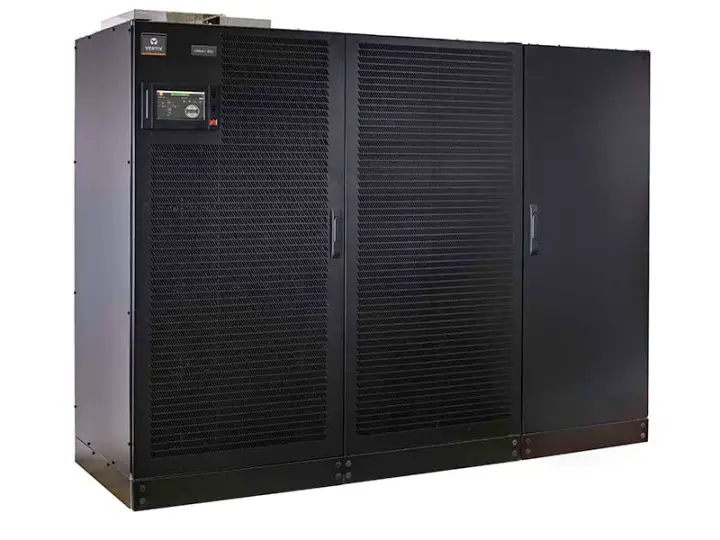
Vertiv's Americas megawatt UPS at 250-1200 kW, the declared successor to the discontinued Liebert NX 225-600 kVA
This model is part of SecondWatt’s ups system research catalogue. Specifications and price observations are included where supported by sources. Equipment availability and commercial terms require confirmation.
Vertiv Liebert EXL S1 dossier: 250-1200 kW scalable to 9.6 MW, 97% double conversion, predecessor pricing benchmarks, and a used-unit inspection checklist.
Liebert EXL S1 is Vertiv's large monolithic UPS for the Americas, and 1000 kVA is one rating inside the family rather than the family itself. Vertiv publishes the range as 250 to 1200 kW in four frame groups: 250/300/400 kW, 500/600 kW, 625/750/800 kW and 1000/1100/1200 kW. Output power factor is unity, the load power factor window runs 0.7 leading to 0.4 lagging without derating, and up to eight units parallel to 9.6 MW.
Efficiency reaches up to 97% in double conversion, up to 99% in Dynamic Online and above 99% in ECO, on a 480 V three-wire input and output with a 480 VDC battery bus floating at 540. The topology is transformer-free with an optional distributed static switch for multi-module systems, and Vertiv includes high-impedance DC ground fault detection. Vertiv's own Liebert NX 225-600 kVA page names the EXL S1 as its replacement.
One data-quality warning belongs on any EXL S1 quote. A dealer publishes a Liebert Vertiv EXL S1 12000 at 12 kVA as a new product, which is outside Vertiv's published 250 to 1200 kW range. Treat any EXL S1 offer below 250 kW as mislabeled. No used or refurbished EXL S1 carries a published price, which is consistent with a current-production, large-frame product.
Why it matters
The predecessor pricing shows what an EXL S1 will eventually be worth. Refurbished large-frame Liebert cabinets with batteries excluded price at roughly 60 to 130 USD per kVA, with an NXL 750 kVA at 47,945.68 USD or about 64 per kVA. That is the trajectory a 2020s EXL S1 fleet joins once the first retrofit wave hits, and it is far below what the same nameplate commands new.
Who buys it
Large data center, colocation and industrial buyers in the Americas specifying 250 kW to 9.6 MW of conditioned power, and integrators building multi-module systems around a distributed static switch. The practical secondary buyer today is shopping the discontinued predecessors, Liebert NX 225-600 kVA and NXL, where refurbished cabinets do trade.
Role in the data center
Megawatt-class primary UPS for Americas data halls, sitting on a 480 V three-wire critical bus and paralleled up to eight ways to 9.6 MW with a distributed static switch. The battery bus is external at 480 VDC nominal and 540 VDC float, so cabinet and battery are separate line items in any quote.
Key specifications
| Rating range | 250-1200 across 4 frame groups (250/300/400, 500/600, 625/750/800, 1000/1100/1200) kW |
|---|---|
| Maximum parallel system | 9.6 (8 units) MW |
| Output power factor | 1.0 |
| Load power factor window | 0.7 leading to 0.4 lagging without derating |
| Double conversion efficiency | up to 97 % |
| Dynamic Online efficiency | up to 99 % |
| ECO mode efficiency | above 99 % |
| Battery bus | 480 nominal, 540 float VDC |
| Footprint at 250-400 kW | 79.1 H x 51.3 W x 36.0 D (1,970 lb) in |
| Footprint at 1000-1200 kW | 104.5 W (4,667 lb) in |
| Standards | UL 1778 5th ed., CSA 22.2 No. 107.3, IEC 62040-2, IBC 2015 seismic |
| Declared predecessor | Liebert NX 225-600 kVA, discontinued |
| Predecessor refurbished benchmark | 47,945.68 for an NXL 750 kVA cabinet (about 64 USD per kVA) USD |
| Footprint at 500-600 kW | 63.0 W (2,750 lb) in |
| Footprint at 625-800 kW | 78.8 W (3,508 lb) in |
Technical summary
Ratings: 250-1200 kW across four frame groups, 250/300/400, 500/600, 625/750/800 and 1000/1100/1200; scalable to 9.6 MW in parallel. Output power factor: unity; load PF window 0.7 leading to 0.4 lagging without derating. Efficiency: up to 97% double conversion; up to 99% Dynamic Online; above 99% ECO. Input/output: 480 V three-phase, three-wire; battery bus 480 VDC nominal, 540 VDC float. Topology: monolithic, transformer-free, optional distributed static switch on multi-module systems. Parallel: up to 8 units. Footprint: 79.1 in H x 51.3 in W x 36.0 in D at 1,970 lb (250-400 kW); 63.0 in W at 2,750 lb (500-600 kW); 78.8 in W at 3,508 lb (625-800 kW); 104.5 in W at 4,667 lb (1000-1200 kW); brochure widths span 51.3 to 128.1 in. Battery: lithium-ion, VRLA and VLA from all manufacturers sold by Vertiv. Standards: UL 1778 5th ed.; CSA 22.2 No. 107.3; IEC 62040-2; IBC 2015, CBC 2016, ASCE and OSHPD seismic.
Major variations
Four frame groups covering the published ratings 250/300/400 kW, 500/600 kW, 625/750/800 kW and 1000/1100/1200 kW, each with its own cabinet width: 51.3 inches at 250-400 kW, 63.0 at 500-600, 78.8 at 625-800 and 104.5 at 1000-1200, with brochure widths reaching 128.1 inches on multi-module builds. Multi-module systems are offered with a centralized or a distributed static switch. Battery plant is lithium-ion, VRLA or VLA from any manufacturer Vertiv sells. A load bus synchronization controller is available for dual-bus designs.
Configurations and options
Twelve discrete ratings sit in four frame groups, 250/300/400, 500/600, 625/750/800 and 1000/1100/1200 kW, and the frame group sets the cabinet width, so the physical machine changes at each step rather than scaling continuously. On multi-module systems the static switch is ordered centralized or distributed, and the distributed option removes the separate system bypass cabinet from the layout. A load bus synchronization controller is available for dual-bus designs and is a separate document and part. Battery plant is lithium-ion, VRLA or VLA, described by Vertiv as compatible with any of those types it sells, and is always external. Seismic qualification to IBC 2015, CBC 2016, ASCE and OSHPD is published, which matters for California and healthcare work.
Compatibility and dependencies
Input and output are 480 V three-phase, three-wire, with a 480 VDC nominal battery bus floating at 540 VDC. The load power factor window runs 0.7 leading to 0.4 lagging without derating, which covers the leading power factor a modern IT load presents. Up to eight units parallel to 9.6 MW. Physical fit is the binding constraint at this size: standard input and output cabinets run 51.3 in wide at 1,970 lb for 250-400 kW, 63.0 in at 2,750 lb for 500-600 kW, 78.8 in at 3,508 lb for 625-800 kW and 104.5 in at 4,667 lb for 1000-1200 kW, with brochure widths reaching 128.1 in on multi-module builds, all 79.1 in tall and 36.0 in deep. High-impedance DC ground fault detection is built in and is a battery-plant dependency to commission rather than a feature to ignore. Any offer below 250 kW is outside the published range and should be treated as mislabeled.
Pricing and availability
Comparable secondary-market band: 60–130 $ per kVA. Trend: rising Lead time, new: 30-48 weeks (static UPS 500-1500 kVA class benchmark). Lead time, used or refurbished: No used or refurbished unit listed as of August 2026. Warranty, used: Gruber Power Services publishes a 1-year full replacement warranty on the refurbished NXL and 610T predecessors it stocks..
Lifecycle and maintenance
Static UPS cabinets serve roughly 15 years, the figure Mitsubishi publishes alongside a lifecycle-parts-or-replace decision at 10-12 years. The wear items are documented: Eaton rates DC bus capacitors at 7 years of continuous duty and up to 10 in favourable conditions, Riello puts capacitor service life at 10 years with replacement recommended between years 4 and 8, and Vertiv field data gives 6 years for capacitors and 5-6 years or 40,000-50,000 hours for cooling fans. Batteries turn over far faster, at 3-5 years for sealed VRLA and 12-15 for flooded cells, and spent lead-acid leaves as regulated waste through compliant recycling rather than resale. Service life extension programs rebuild the power train inside the original shell, which is why cabinets routinely outlive their electronics.
Thermal and emissions profile
UPS systems produce no combustion emissions, so the regulatory weight sits on the battery. The 2026 edition of NFPA 855 broadens detection to smoke, thermal-imaging and radiant-energy systems, mandates large-scale fire testing alongside UL 9540A to prove no propagation between adjacent units, and adds a staging exception for batteries held at or below 50% state of charge that matters directly to anyone moving lithium cabinets through a secondary market. Uptime Institute's 2026 outage analysis names lithium-ion batteries in UPS systems as a clear contributor to a gradual rise in major data center fires. Confirm UL 1973, UL 9540A and UL 9540 status on any lithium cabinet, then confirm what the authority having jurisdiction requires to requalify the room.
Common failure points
- Battery strings — VRLA capacity fades below 80% of nameplate and takes the ride-through with it
- DC bus capacitors — Silent open-circuit loss, or a short that pops and sprays electrolyte across adjacent boards
- Cooling fans — Overheating transfers the load to bypass and leaves it unprotected
- Air filters and dust — Restricted airflow raises internal temperature and shortens capacitor life
- Static bypass switch — Failure to transfer strands the load during maintenance or overload
- Controls obsolescence — Discontinued display and logic boards turn a routine repair into a scavenger hunt
Inspection checklist
Battery age: sealed VRLA turns over at 3-5 years per Eaton lifecycle guidance; assume a full string past that. Battery capacity: reject any string below 80% of nameplate capacity under IEEE 1188 practice. Battery impedance: treat ohmic readings more than 20% above the commissioning baseline as an investigation trigger under IEEE 1188 field practice, then confirm against the battery manufacturer limit for the chemistry before condemning a cell. Float voltage: verify 2.23-2.27 VPC at 25 degrees C; float current above 3x steady state flags thermal runaway. Intercell connectors: thermal image every joint; a delta above 5 degrees C against neighbors triggers a capacity test. DC bus capacitors: Eaton rates 7 years of continuous duty (10 optimal); Vertiv field data gives 6 years at 45,000-50,000 h. Cooling fans: Vertiv field data gives 5-6 years or 40,000-50,000 hours; listen for bearing noise at the intake. Air filters: pull every filter; a clogged element is the best single proxy for a cabinet that ran above 25 degrees C.
Procurement channels
New units through Vertiv and its channel, quote-only. Secondary supply in this tier is entirely in the discontinued predecessors, where Gruber Power Services prices refurbished NXL and 610T cabinets with batteries excluded by stated policy.
Regional notes
Americas only. The EXL S1 does not appear on Vertiv's EMEA three-phase lineup, which offers Trinergy at 1500-2000 kW and PowerUPS 9000 in that tier instead. The Americas build cites UL 1778 fifth edition, CSA 22.2 No. 107.3 and IEC 62040-2, with IBC 2015, CBC 2016, ASCE and OSHPD seismic qualification. A separate EMEA EXL S1 page exists at 300-1250 kW, so confirm which regional rating table a quoted unit belongs to.