Schneider Electric Galaxy VS, 10-150 kW
Manufacturer: Schneider Electric
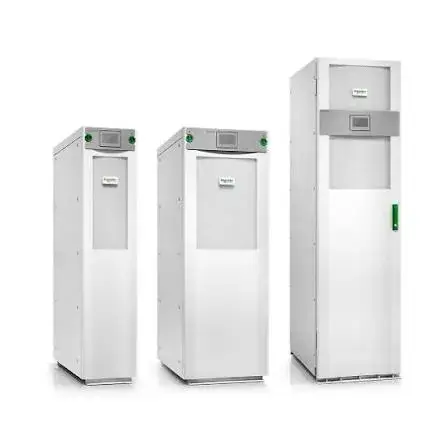
Schneider's stocked modular UPS at 10-150 kW, the named replacement for the Galaxy 3500, 5000 and 5500
This model is part of SecondWatt’s ups system research catalogue. Specifications and price observations are included where supported by sources. Equipment availability and commercial terms require confirmation.
Schneider Electric Galaxy VS dossier: 10-150 kW modular UPS, 99.3% eConversion, new-surplus and refurbished pricing at 300-406 USD per kW, inspection tips.
Galaxy VS is Schneider Electric's small-to-mid modular UPS, introduced in 2018 and rated 20 to 150 kW at 480 V, 10 to 150 kW at 400 V and 10 to 75 kW at 208 V, all at unity output power factor. Schneider names it as the stated replacement for the Galaxy 3500, Galaxy 5000 and Galaxy 5500 on all three legacy product-range pages, which makes it the destination for the largest small-three-phase legacy fleet in North America. Double conversion runs about 94 to 97% depending on load and voltage, eConversion reaches up to 99.3% and ECO mode 99.1 to 99.4%.
Unlike the rest of Schneider's Galaxy line, the VS is a stocked, channel-distributed product with published pricing at CDW, Insight, SHI and Matrix. A 50 kW frame scalable to 150 kW lists at 47,915.00 USD and sells at 31,787.15, shipping in one to two weeks. That is 958 USD per kW list against 636 street, and it caps what a used VS can command, because the used unit competes against a new alternative arriving inside a fortnight.
Genuine VS secondary supply exists but is thin and is mostly cancelled-order stock rather than decommissioned units. A new-surplus 30 kW frame sold at 12,180 USD (406 per kW), a refurbished 50 kW with new batteries at 14,991.23 (300 per kW), a 50 kW paired with a bypass panel listed at 19,999, and a new-surplus GVPM20KD module at 3,624 (181 per kW).
Why it matters
The VS is the only unit in the Galaxy line where a used buyer competes against a one-to-two week new alternative, and the pricing shows it. New-surplus at about 406 USD per kW against a new street price of about 636 is a 36% discount with batteries excluded on both sides, far shallower than the discounts legacy Galaxy frames take. Availability, not condition, is what compresses the spread.
Who buys it
Enterprise server rooms, healthcare facilities and small data halls in the 10 to 150 kW band, and the very large installed base of Galaxy 3500, 5000 and 5500 owners facing end-of-service-life dates in 2030 and 2031. Secondary buyers are mostly picking up cancelled-order frames, maintenance bypass cabinets, empty battery cabinets and power modules rather than complete takeouts.
Role in the data center
Room-level primary UPS for enterprise server rooms and small data halls, feeding the critical distribution board and paralleled to four units for capacity or three plus one for redundancy. It is Schneider's stated replacement path for retiring Galaxy 3500, 5000 and 5500 systems, so it usually lands in a footprint an older frame has just left.
Key specifications
| Rating range | 10-150 (20-150 at 480 V; 10-75 at 208 V) kW |
|---|---|
| Output power factor | 1.0 |
| Double conversion efficiency | about 94-97 % |
| eConversion efficiency | up to 99.3 % |
| Power modules | GVPM20KD 20 kW; GVPM50KD 50 kW (shared with Galaxy VL) |
| Parallel capability | 4 for capacity, 3+1 for redundancy units |
| Dimensions | 1485 x 521 x 847 (206-290 kg) mm |
| Internal battery type | Modular 9 Ah VRLA strings on B5 SKUs; no internal lithium option |
| External battery bus | 384-480 nominal (32-40 blocks), float 436-545 VDC |
| Standards | UL 1778 5th ed., UL 924 10th ed., IEC 62040-3:2021, ICC-ES AC 156 |
| New list price, 50 kW frame | 47,915.00 (958 USD per kW) USD |
| New street price, 50 kW frame | 31,787.15, ships in 1-2 weeks (636 USD per kW) USD |
| Observed new-surplus 30 kW | 12,180 (406 USD per kW, no batteries) USD |
| Observed refurbished 50 kW | 14,991.23 with new batteries (300 USD per kW) USD |
Technical summary
Ratings: 20-150 kW at 480 V; 10-150 kW at 400 V; 10-75 kW at 208 V, all at unity power factor. Load power factor tolerance: 0.7 leading to 0.7 lagging without derating at 208 V. Efficiency: about 94-97% double conversion; up to 99.3% eConversion; 99.1-99.4% ECO. Power modules: GVPM20KD (20 kW at 400 V) and GVPM50KD (50 kW at 400/480 V, 25 kW at 208 V). Parallel: up to 4 units for capacity, 3+1 for redundancy. Dimensions: 1485 x 521 x 847 mm; 206-290 kg by configuration. Batteries: internal modular 9 Ah VRLA strings on B5 SKUs; external VRLA, lithium-ion or NiCd. External battery bus: 32-40 blocks, 384-480 VDC nominal, float 436-545 VDC. Live Swap: power module replacement in any operating mode. Standards: UL 1778 5th ed.; UL 924 10th ed.; IEC 62040-3:2021; ICC-ES AC 156 seismic.
Major variations
Ratings run 20 to 150 kW at 480 V, 10 to 150 kW at 400 V and 10 to 75 kW at 208 V, all at unity output power factor. B5 SKUs carry internal modular 9 Ah VRLA strings expandable to five, and separate for-external-batteries SKUs take an external plant instead; lithium-ion is always an external cabinet and is never an internal string on this platform. Cabinets come in a standard height and a 1970 mm tall variant with different air filter kits. Power modules are the GVPM20KD at 20 kW on 400 V and the GVPM50KD at 50 kW on 400 and 480 V or 25 kW at 208 V, the latter shared with the Galaxy VL.
Configurations and options
The largest configuration split is internal against external batteries. B5 part numbers carry internal modular 9 Ah VRLA strings, and the digit in the SKU states how many are fitted against a maximum of five, while the for-external-batteries part numbers take an outboard plant instead. Lithium-ion is always an external cabinet on this platform and is never an internal string. Power module type follows the voltage, GVPM20KD at 20 kW on 400 V and GVPM50KD at 50 kW on 400 and 480 V or 25 kW on 208 V. Cabinets come in a standard height and a 1970 mm tall variant taking a different air filter kit, GVSOPT014 rather than GVSOPT001 or GVSOPT015. Maintenance bypass cabinets and classic battery cabinets are separate part numbers, a UL 924 emergency-lighting listing is available, and startup service level is written into the SKU.
Compatibility and dependencies
Rating tables are voltage specific: 10 to 75 kW at 208 V, 10 to 150 kW at 400 V and 20 to 150 kW at 480 V, all at unity output power factor, with the 208 V build tolerating a load power factor from 0.7 leading to 0.7 lagging without derating. An external battery plant runs 32 to 40 blocks at 384-480 VDC nominal, floating at 436-545 VDC. The GVPM50KD module is shared with the Galaxy VL at 400 and 480 V, which makes it the one part with a live cross-model market. Pairing the VS with Galaxy lithium-ion cabinets creates a UL 9540 energy storage system with its own document set, installation 990-55223 and operation 990-55224, and that system-level listing is what an authority reviews for permitting rather than the UPS listing alone. The cabinet is 1485 x 521 x 847 mm at 206-290 kg, carries an air filter reminder counter that must be reset after service, and parallels four ways.
Pricing and availability
Comparable secondary-market band: 300–406 USD per kW. Trend: stable Lead time, new: 1-2 weeks on stocked distributor SKUs; 20-32 weeks for engineered orders. Lead time, used or refurbished: 1-4 weeks from surplus and refurbishment dealers. Warranty, used: Gruber Power Services publishes a 1-year full replacement warranty on the refurbished Galaxy VS units it stocks..
Lifecycle and maintenance
Modular frames outlive their modules: cabinet, bus and static bypass run 15 years or more while the hot-swap power modules carry the fans and DC capacitors that wear, so the question is module hours and module count rather than cabinet age. A 1,500 kW ABB DPA system holds 30 module-level fan and capacitor sets. Eaton rates DC bus capacitors at 7 years of continuous duty and up to 10 in favourable conditions, and Vertiv field data gives 6 years for capacitors and 5-6 years or 40,000-50,000 hours for fans. Batteries turn over far faster, at 3-5 years for sealed VRLA and 12-15 for flooded cells, and spent lead-acid leaves as regulated waste through compliant recycling rather than resale. Eaton's 93PM service life extension program rebuilds the power train inside the existing shell in about 24 hours and resets another 10 years.
Thermal and emissions profile
UPS systems produce no combustion emissions, so the regulatory weight sits on the battery. The 2026 edition of NFPA 855 broadens detection to smoke, thermal-imaging and radiant-energy systems, mandates large-scale fire testing alongside UL 9540A to prove no propagation between adjacent units, and adds a staging exception for batteries held at or below 50% state of charge that matters directly to anyone moving lithium cabinets through a secondary market. Uptime Institute's 2026 outage analysis names lithium-ion batteries in UPS systems as a clear contributor to a gradual rise in major data center fires. Confirm UL 1973, UL 9540A and UL 9540 status on any lithium cabinet, then confirm what the authority having jurisdiction requires to requalify the room.
Common failure points
- Power module population — A frame sold on nameplate ships with fewer modules than the rating implies
- Module fans and capacitors — Consumables sit inside each module, so wear scales with module count not cabinet count
- Battery strings — VRLA capacity fades below 80% of nameplate and takes the ride-through with it
- Missing filler plates — Open slots break the cooling path and signal careless handling
- Live Swap entitlement — A frame without the Live Swap label must be bypassed for any module work
- Controls obsolescence — Controller and display boards reach end of life ahead of the power train
Inspection checklist
Module count: count populated slots against the frame rating; Eaton lists a 4 kVA 9PXM power module at 4,377 USD. Filler plates: Schneider's manual requires a module or filler plate in every slot on a 50 kW module bay. Module consumables: fans and capacitors live inside each module; a 1,500 kW DPA system carries 30 such sets. Live Swap label: verify the physical label; a Galaxy VS or VL without it must be bypassed, at 200 mm standoff. Module part numbers: confirm interchange; Schneider GVPM50KD is 50 kW at 400/480 V and 25 kW at 208 V. Battery age: sealed VRLA turns over at 3-5 years per Eaton lifecycle guidance; assume a full string past that. Battery capacity: reject any string below 80% of nameplate capacity under IEEE 1188 practice. Battery impedance: treat ohmic readings more than 20% above the commissioning baseline as an investigation trigger under IEEE 1188 field practice, then confirm against the battery manufacturer limit for the chemistry before condemning a cell.
Procurement channels
New units are broadly distributed and openly priced through CDW, Insight, SHI, Zones, Corporate Armor and Matrix. Secondary supply comes through Lenmark Industries on Surplus Record, Gruber Power Services, Critical Infrastructure Group and eBay, and skews toward new-surplus frames, bypass cabinets, empty battery cabinets, controllers and power modules.
Regional notes
Sold under both Schneider Electric and APC by Schneider Electric branding. UL builds carry UL 1778 fifth edition plus a UL 924 emergency-lighting listing and ICC-ES AC 156 seismic qualification at Sds 1.45 g and 2.00 g.