Schneider Electric Galaxy VX, 500-1500 kVA
Manufacturer: Schneider Electric
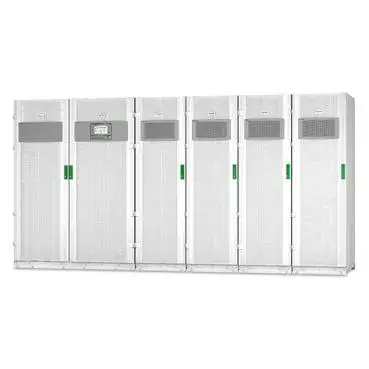
Schneider's megawatt-class UPS, still commercialized but one end-of-life bulletin away from a service-life clock
This model is part of SecondWatt’s ups system research catalogue. Specifications and price observations are included where supported by sources. Equipment availability and commercial terms require confirmation.
Schneider Electric Galaxy VX dossier: 500-1500 kVA, 96.5% double conversion, VXL succession, end-of-life watch items, and a used-unit inspection checklist.
Galaxy VX is Schneider Electric's 500 to 1500 kVA three-phase UPS, sold under both the Schneider and APC brands and still carrying commercialized lifecycle status on Schneider's own product-range page. It is not marked discontinued the way Galaxy VM, 7000, 5500, 5000 and PW are. Frame-level scalability lets capacity be added without full system replacement, N+1 redundant SKUs are available, and eConversion runs to about 99% while keeping the inverter active.
The succession chain is frequently stated wrongly. Galaxy VL does not replace the VX: VL is a lower power band at 200 to 500 kW that never overlapped it. The VX is being superseded from above by Galaxy VXL, announced in December 2024 at 500 to 1250 kW, and Schneider's own VXL page names the VX as its predecessor while benchmarking against it: VXL at 1.2 square metres against VX at 4.5, and VXL at 97.5% double conversion against a VX maximum of 96.5%.
No used or refurbished Galaxy VX carries a published price anywhere, and every published VX offer is a new-equipment quote page. A 500 to 1500 kVA UPS is a building-scale asset that comes out only when a data hall is gutted, and those units go back through Schneider or a national service integrator rather than a surplus marketplace. Expect VX supply after a formal end-of-life bulletin and the first wave of 2016 to 2020 retrofits, realistically 2028 to 2031.
Why it matters
The VX end-of-life bulletin is the single most valuable watch item in the Schneider line. Schneider's pattern is roughly a ten-year service tail after discontinuation, with Galaxy VM and Symmetra PX 250/500 both discontinued in September 2025 and covered to 2035. The precedent that matters more is Galaxy 5000, discontinued 2021 with end of service life in 2031 and no modernization path at all, which is what destroys residual value rather than the discontinuation itself.
Who buys it
Large data center, healthcare and industrial buyers specifying 500 kVA to 1.5 MW of conditioned power, usually as part of an engineered project rather than a stocked purchase. No used VX has appeared in a public channel, so today every VX buyer is a new-equipment buyer.
Role in the data center
Building-scale primary UPS for large data halls and campuses, specified as part of an engineered project rather than bought from stock. It occupies 4.5 square metres on the critical bus and always runs an external VRLA or lithium-ion battery plant, which at 500 to 1500 kVA can cost several times the UPS itself.
Key specifications
| Rating range | 500-1500 kVA |
|---|---|
| Double conversion efficiency | 96.5 maximum % |
| eConversion efficiency | up to about 99 % |
| Footprint | 4.5 square metres |
| Example N+1 SKU | GVX1250K1000GS: 1250 kVA frame delivering 1000 kVA N+1 at 480 V |
| Voltage families | 400 and 480 V |
| Battery configuration | External only; VRLA and lithium-ion |
| Lifecycle status | Commercialized; no end-of-life bulletin published as of August 2026 |
| Successor | Galaxy VXL, 500-1250 kW, announced December 2024 |
| Successor footprint comparison | 1.2 against the VX at 4.5; Schneider states a 70% space saving square metres |
| Class lead time | 30-48 (static UPS 500-1500 kVA) weeks |
| Comparable discontinuation precedent | Galaxy VM discontinued 09/2025 with service coverage to 2035 |
Technical summary
Rating range: 500-1500 kVA/kW, three-phase. Configuration: N+1 redundant SKUs available, for example a 1250 kVA frame delivering 1000 kVA N+1. Double conversion efficiency: 96.5% maximum, the figure Schneider states the VXL surpasses. EConversion: up to about 99% while keeping the inverter active. Footprint: 4.5 square metres, Schneider's own comparison basis for the VXL. Topology: frame-level scalability rather than hot-swap power modules. Voltage options: 400 V and 480 V SKU families. Battery: external only at this scale; VRLA and lithium-ion supported. Live Swap: not documented for the VX; the capability is published for VS, VL and VXL only. Lifecycle status: commercialized; Schneider has published no end-of-life bulletin as of August 2026.
Major variations
Two SKU families at 400 V and 480 V, with N+1 redundant configurations ordered as separate part numbers: GVX1250K1000GS is a 1250 kVA frame delivering 1000 kVA N+1 at 480 V. Capacity is added at frame level rather than by hot-swap power module, which is the structural difference against the Galaxy VS and VL. Batteries are external only at this scale, VRLA or lithium-ion. The Galaxy VXL at 500 to 1250 kW, announced in December 2024, is the successor from above; it uses 125 kW 3U Live Swap power modules and reaches about 99% in eConversion.
Configurations and options
Two SKU families cover 400 V and 480 V, and N+1 redundant configurations are ordered as distinct part numbers rather than set up on site: GVX1250K1000GS is a 1250 kVA frame delivering 1000 kVA in N+1, so the frame rating and the delivered rating differ on the same order line and a used listing quoting one is not quoting the other. Capacity is added at frame level rather than by hot-swap power module, which is the structural difference against the Galaxy VS and VL and the reason a VX cannot be scaled the way a modular machine can. Batteries are external, VRLA or lithium-ion, and the startup service level is written into the SKU. Schneider publishes no end-of-life bulletin for the VX as of September 2026, and the range page still reports commercialized status.
Compatibility and dependencies
At 500 to 1500 kVA the battery plant is external and can exceed the cost of the UPS several times over, so any price has to state whether it is cabinet-only. Battery compatibility needs confirming on the specific part number rather than the family: Schneider's own Galaxy lithium-ion SKU naming lists Galaxy VS, Galaxy VL, EPS 7000 and EPS 8000, while resellers describe the same cabinets as suited to the VX, so ask for the pairing in writing. Live Swap is documented for the VS, VL and VXL and not for the VX, so treat power-stage work as requiring a transfer to maintenance bypass or a shutdown. The frame occupies 4.5 sq m, which is Schneider's own comparison basis against the 1.2 sq m Galaxy VXL. The range page carries no public specification table, so input window, clearances and weight come from operation manual 990-5452N and installation manual 990-5810D for the rating in question.
Pricing and availability
Trend: rising Lead time, new: 30-48 weeks (static UPS 500-1500 kVA class benchmark). Lead time, used or refurbished: No used or refurbished unit listed as of August 2026. Warranty, used: 1-year typical from refurbishment dealers.
Lifecycle and maintenance
Static UPS cabinets serve roughly 15 years, the figure Mitsubishi publishes alongside a lifecycle-parts-or-replace decision at 10-12 years. The wear items are documented: Eaton rates DC bus capacitors at 7 years of continuous duty and up to 10 in favourable conditions, Riello puts capacitor service life at 10 years with replacement recommended between years 4 and 8, and Vertiv field data gives 6 years for capacitors and 5-6 years or 40,000-50,000 hours for cooling fans. Batteries turn over far faster, at 3-5 years for sealed VRLA and 12-15 for flooded cells, and spent lead-acid leaves as regulated waste through compliant recycling rather than resale. Service life extension programs rebuild the power train inside the original shell, which is why cabinets routinely outlive their electronics.
Thermal and emissions profile
UPS systems produce no combustion emissions, so the regulatory weight sits on the battery. The 2026 edition of NFPA 855 broadens detection to smoke, thermal-imaging and radiant-energy systems, mandates large-scale fire testing alongside UL 9540A to prove no propagation between adjacent units, and adds a staging exception for batteries held at or below 50% state of charge that matters directly to anyone moving lithium cabinets through a secondary market. Uptime Institute's 2026 outage analysis names lithium-ion batteries in UPS systems as a clear contributor to a gradual rise in major data center fires. Confirm UL 1973, UL 9540A and UL 9540 status on any lithium cabinet, then confirm what the authority having jurisdiction requires to requalify the room.
Common failure points
- Battery strings — VRLA capacity fades below 80% of nameplate and takes the ride-through with it
- DC bus capacitors — Silent open-circuit loss, or a short that pops and sprays electrolyte across adjacent boards
- Cooling fans — Overheating transfers the load to bypass and leaves it unprotected
- Air filters and dust — Restricted airflow raises internal temperature and shortens capacitor life
- Static bypass switch — Failure to transfer strands the load during maintenance or overload
- Controls obsolescence — Discontinued display and logic boards turn a routine repair into a scavenger hunt
Inspection checklist
Battery age: sealed VRLA turns over at 3-5 years per Eaton lifecycle guidance; assume a full string past that. Battery capacity: reject any string below 80% of nameplate capacity under IEEE 1188 practice. Battery impedance: treat ohmic readings more than 20% above the commissioning baseline as an investigation trigger under IEEE 1188 field practice, then confirm against the battery manufacturer limit for the chemistry before condemning a cell. Float voltage: verify 2.23-2.27 VPC at 25 degrees C; float current above 3x steady state flags thermal runaway. Intercell connectors: thermal image every joint; a delta above 5 degrees C against neighbors triggers a capacity test. DC bus capacitors: Eaton rates 7 years of continuous duty (10 optimal); Vertiv field data gives 6 years at 45,000-50,000 h. Cooling fans: Vertiv field data gives 5-6 years or 40,000-50,000 hours; listen for bearing noise at the intake. Air filters: pull every filter; a clogged element is the best single proxy for a cabinet that ran above 25 degrees C.
Procurement channels
Quote-only at every reseller that publishes the line, including Unified Power, UPSANDBATTERY, Nationwide Power, SecurePower and Concentric. No list price is published, and no VX frame, module or takeout appears in any surplus channel.
Regional notes
Sold under both Schneider Electric and APC by Schneider Electric branding, in 400 V and 480 V SKU families. Regional variance in parts support is real: a UK dealer describes the legacy Galaxy 5500 as obsolete while US end-of-service-life dates run later.