Simplex PowerStar-110 Load Bank
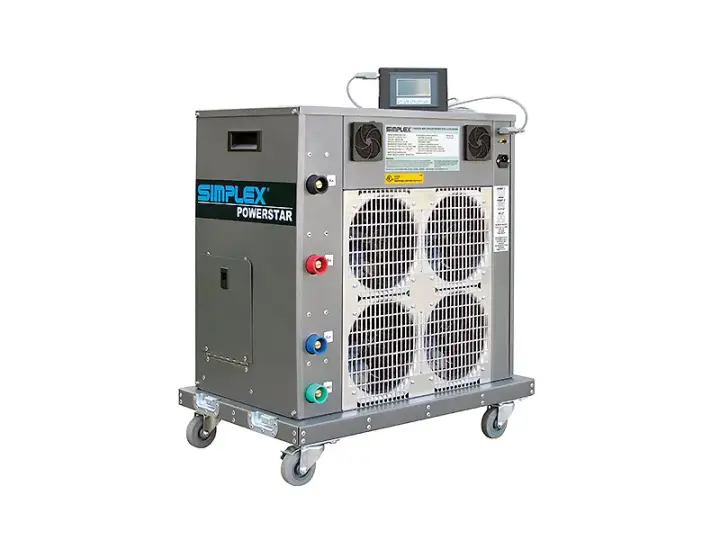
110 kW hand-portable resistive load bank with 5 kW step resolution and touchscreen control
Simplex PowerStar-110 Load Bank is one of 16 load banks tracked in the SecondWatt catalogue, each with specifications, lead times and indicative secondary-market pricing.
110 kW resistive, 5 kW steps, 480 V max, 125 lbs, UL Listed. Specs, inspection checklist, failure modes, and procurement notes for the Simplex PowerStar-110.
The Simplex PowerStar-110 is a self-contained, forced-air-cooled, resistive load bank rated at 110 kW nominal at unity power factor. It is manufactured by Simplex, Inc., headquartered at 5300 Rising Moon Rd, Springfield, IL 62711, a brand of TerraVest Industries, a TSX-listed Canadian diversified manufacturer. The TerraVest corporate site carries the Simplex logo hyperlinked to simplexdirect.com, and the Simplex site footer links back to terravestindustries.com. Simplex has operated under its own name since 1934, when Michael Debrey founded the company in Burlington, Iowa; the firm relocated to Springfield, Illinois in 1951 and introduced its first air-cooled load bank in 1961. The designation "PowerStar-110" appears hyphenated in the OEM's own brochure (document code PowerStar-1606-03.01). The live product page at simplexdirect.com/load-banks/small-portable/powerstar/details heads the product simply "PowerStar" and states "110KW nominal." The owner's manual (PowerStar_Manual-210608) gives "Capacity 110KW" in its General Specifications table. The number 110 is the kilowatt capacity rating, not a revision or part number. No separate OEM part number is assigned to the product unit; the manual carries no model number beyond the name itself. The unit is built around Simplex Powr-Web resistor elements, controlled by individual magnetic contactors on six discrete load steps: 5, 10, 20, 25, 50, and 110 kW. A hand-held touchscreen controller connects to the load bank via a supplied RS-232 network cable, enabling remote step selection and metering of voltage, current, frequency, and kilowatts. Up to 40 PowerStar units can be networked together, allowing aggregate capacity expansion without a larger chassis. The enclosure is UL Listed for the United States and Canada and is rated as a Type-1 enclosure. An aluminum slip-over cover with handles is supplied for transport. Electrically, the PowerStar-110 accepts all common AC voltages to 480 V maximum at 50 or 60 Hz, single-phase or three-phase. The brochure specifies 208–240 / 416–480 VAC three-phase 60 Hz, 190–220 / 380–460 VAC three-phase 50 Hz, and 110–240 VAC single-phase 50–60 Hz. Full-load current is published as 265 A at 240 V three-phase and 132 A at 480 V three-phase. Fan and control power require an external 115 VAC, single-phase, 60 Hz, 15 A service; control power draws 4 A of that circuit. A cooling arithmetic discrepancy exists in the OEM's published figures and must be understood before siting this unit. The manual states 2,400 CFM airflow and a nominal temperature rise of 110°F. At 110 kW of resistive dissipation (375,335 BTU/hr), the standard air-side formula (CFM = BTU/hr ÷ [1.08 × ΔT]) yields a required airflow of approximately 3,160 CFM to achieve a 110°F rise, or conversely, a temperature rise of approximately 145°F at 2,400 CFM — roughly 32% higher than the published figure. The OEM does not explain this gap; the 110°F rise may be quoted at a partial load step or at a different ambient condition. Buyers should treat the two figures as independently sourced data points rather than a consistent operating description. At the maximum published intake temperature of 125°F, a 145°F rise produces exhaust air near 270°F — a genuine siting constraint in a confined generator room or hot-aisle environment. The PowerStar-110 is a current product listed on Simplex's Small Portable category page alongside the Infinity, Swift-e, and Watt-Muncher. A Simplex label-assembly drawing (ASM-00004433) references both "Powerstar & Northstar" on a shared chassis, suggesting a NorthStar 150 (kW) sibling exists; however, no NorthStar model appears on any Simplex category page. Confirm the nameplate designation and capacity on any unit before purchase, particularly for units that may have been relabeled or cross-built on a shared frame.
Why it matters
The 5 kW step resolution is the specification that drives cross-shopping for UPS module testing: on a 110 kW unit that represents 4.5% granularity per step, which is adequate for module-level capacity testing but too coarse for fine transfer-point studies. The unit's ability to network up to 40 identical units provides a scaling path without a larger chassis, though the practical logistics of 40 hand-carried boxes and cabling make this better suited to a service depot than a field deployment. Unity power factor means all load is purely resistive; buyers needing to stress-test generator governors with reactive load must specify the Simplex Titan or a comparable inductive/capacitive unit. The Powr-Web resistor element design has no firmware and no power electronics, making aging and repair patterns predictable: contactors and the fan motor wear out well before the resistors do, which supports a liquid secondary market for used units.
Who buys it
Generator service contractors and independent commissioning agents are the primary buyers, using the PowerStar-110 to perform acceptance tests and load banks runs on small-to-mid-range standby generators before client handover. Facilities teams at hospitals, data centers, and commercial buildings purchase or rent the unit for periodic NFPA 110 generator exercising on smaller standby sets. UPS system integrators and battery-rundown testers value the 5 kW step resolution for module-level capacity verification. The 125 lb weight and caster-and-handle transport system make the unit a two-person carry rather than a rigged lift, which suits small service crews working without material-handling equipment.
Role in the data center
The PowerStar-110 is used for single UPS module capacity verification, battery-rundown testing, and small standby generator acceptance testing during data center commissioning and periodic maintenance. It is sized for edge sites, small colocation rooms, and branch-level load verification during fit-out rather than for full-facility generator testing, where a 1,000 kW or 1,500 kVA unit is the appropriate tool. NFPA 110 periodic generator exercising for small standby sets is a common recurring application. The 5 kW step granularity is adequate for module-level UPS work but too coarse for precise transfer-point characterization.
Key specifications
| Capacity | 110 kW (resistive, nominal) |
|---|---|
| Power Factor | 1.0 |
| Load Type | Resistive |
| Load Step Resolution | 5 kW |
| Available Load Steps | 5, 10, 20, 25, 50, 110 kW |
| Nominal Voltages | 240 / 480 V |
| Voltage Range Maximum | 480 V |
| Voltage (3-ph 60 Hz) | 208–240 / 416–480 VAC |
| Voltage (3-ph 50 Hz) | 190–220 / 380–460 VAC |
| Voltage (1-ph) | 110–240 VAC, 50–60 Hz |
| Frequency | 50 / 60 Hz |
| Full Load Amps at 240 V 3-ph | 265 A |
| Full Load Amps at 480 V 3-ph | 132 A |
| Width | 15 in |
| Height | 28.5 in |
| Depth | 26 in |
| Weight | 125 lbs |
| Airflow | 2,400 CFM |
| Cooling Method | Forced air, integral cooling fans |
| Max Air Intake Temperature | 125 °F |
| Nominal Temperature Rise (published) | 110 °F |
| Fan / Control Power | 115 VAC, 1-ph, 60 Hz, 15 A; control draws 4 A |
| Enclosure Rating | Type-1 |
| Power Connectors | Cam-Lok |
| Networking Capacity | Up to 40 units |
| Safety Listing | UL Listed, United States and Canada |
| Duty Rating | Continuous |
| Resistor Element Type | Simplex Powr-Web |
Technical summary
Capacity: 110 kW (resistive, nominal) Power Factor: 1.0 Load Type: Resistive only Load Step Resolution: 5 kW Available Load Steps: 5, 10, 20, 25, 50, 110 kW Nominal Voltages: 240 / 480 V Voltage Range: All common AC voltages to 480 V maximum, 50 or 60 Hz, single- or three-phase Voltage Detail (3-ph 60 Hz): 208–240 / 416–480 VAC Voltage Detail (3-ph 50 Hz): 190–220 / 380–460 VAC Voltage Detail (1-ph): 110–240 VAC, 50–60 Hz Frequency: 50 / 60 Hz Full Load Amps at 240 V 3-ph: 265 A Full Load Amps at 480 V 3-ph: 132 A Dimensions: 15 in W × 28.5 in H × 26 in D Weight: 125 lbs Airflow: 2,400 CFM Cooling: Forced air, integral cooling fans Max Air Intake Temperature: 125°F Nominal Temperature Rise (published): 110°F (see cooling arithmetic note in overview) Fan / Control Power Supply: External 115 VAC, 1-ph, 60 Hz, 15 A; control draws 4 A Enclosure Rating: Type-1 Power Connectors: Cam-Lok Controller: Hand-held touchscreen, RS-232 network cable Networking Capacity: Up to 40 units Resistor Element Type: Simplex Powr-Web Protection: Overtemperature, fan failure, overvoltage, branch circuit fuse, magnetic contactor control Duty Rating: Continuous Listing: UL Listed, United States and Canada Transport Cover: Aluminum slip-over cover with handles
Major variations
The PowerStar-110 handles single-phase and three-phase loads and both 50 Hz and 60 Hz frequencies through voltage-tap selection rather than through separate model codes. No weather-resistant or outdoor-rated variant is published for the PowerStar line; buyers requiring outdoor operation should confirm enclosure suitability before deployment. A Simplex label-assembly drawing references a shared chassis between the PowerStar and a "NorthStar 150," implying a 150 kW sibling, but NorthStar does not appear on any current Simplex category page; treat it as unconfirmed until Simplex is contacted directly.
Configurations and options
Published options include a vinyl transport cover and a shipping/storage container. The Auto-Jog feature for automated step-load sequencing is listed in the brochure. Networking of up to 40 units via RS-232 is supported for aggregate capacity scaling. Voltage selection covers single-phase and three-phase configurations at 50 Hz or 60 Hz without separate model codes.
Compatibility and dependencies
An external 115 VAC, single-phase, 60 Hz, 15 A utility circuit is required for fan and control power; the unit does not power its own controls from the load-bank source. Power connections are Cam-Lok; the source generator or UPS output must be cabled to match. The hand-held touchscreen controller and its RS-232 cable are supplied items — confirm both are present when buying a used unit, as units frequently resurface without the controller. Networking up to 40 units requires the RS-232 daisy-chain cabling specified in the manual.
Lifecycle and maintenance
Simplex publishes two maintenance intervals for the PowerStar-110. Before each operation: inspect air intake screens, fan chamber, and exhaust opening for obstructions; check all load branch fuses. Every 50 hours of use or every 6 months, whichever comes first: check the tightness of all electrical connections. No MTBF figure is published by Simplex for this model. The Powr-Web resistor elements contain no firmware or power electronics and are expected to outlast the magnetic contactors and fan motor, which are the wear items in service. Used units with intact elements but worn contactors or a failing fan motor are therefore reasonable candidates for refurbishment rather than replacement.
Thermal and emissions profile
No on-site combustion and no direct emissions. At 110 kW the unit rejects the full applied load as heat through its discharge; at this size the practical limit is the room, since 110 kW into an unventilated space will raise ambient quickly. Emissions during a test belong to the source under test.
Common failure points
- Cooling fan — Fault: Cooling Fan Failure — fan has stopped running; unit trips on overtemperature under load
- Magnetic contactor — A load step fails to pick up, chatters, or welds closed and will not shed load on command
- Powr-Web resistor element — One or more load steps draw no current; total metered kW reads below nameplate at the 110 kW step
- Branch circuit fuse — A load step is electrically dead but the element itself measures continuous
- Intake / exhaust temperature sensor — Fault: Intake Temp. Failure or Exhaust Temp. Failure with the unit cool to the touch
- Metering / PLC communication — Fault: Metering Fault — communication failure between PLC and meter; or Over/Under KW — metered load does not match expected load
- Overvoltage protection — Unit trips immediately on connection to the source
Inspection checklist
- Verify nameplate reads "PowerStar" and capacity is 110 kW — confirm against OEM brochure designation "PowerStar-110" before purchase.
- Meter Powr-Web element continuity across each of the six steps (5, 10, 20, 25, 50, 110 kW) at the Cam-Lok terminals; an open element shows as zero current on that step.
- Pull and inspect all branch circuit fuses for each of the six load steps; a blown fuse on a step whose element measures continuous is a separate, lower-cost repair.
- Apply 480 V three-phase load and verify full-load current reads 132 A (±5%) on all three phases at the 110 kW step; readings more than a few percent low indicate lost resistor elements.
- Apply 240 V three-phase load and verify full-load current reads 265 A (±5%) on all three phases at the 110 kW step.
- Energize all six steps individually via the hand-held touchscreen and confirm each picks up cleanly; listen for contactor chatter on each step.
- Inspect all magnetic contactor contacts for pitting or welding; a welded contactor cannot shed load on command — treat as a safety-critical defect.
- Confirm cooling fan runs immediately on application of external 115 VAC control power; time to steady-state airflow should be under 5 seconds.
- Verify fan rotation direction produces airflow through the unit from intake to exhaust, not reversed.
- Measure airflow at the exhaust; published design point is 2,400 CFM — a significantly lower reading indicates a blocked intake screen or a degraded fan motor.
- Inspect intake screen, louvers, and fan chamber for debris accumulation per the manual's pre-operation requirement.
- Verify intake temperature sensor reads within 2°F of ambient at rest; the manual identifies Intake Temp. Failure as a distinct fault code.
- Run the unit at full 110 kW load for 15 minutes and verify exhaust temperature sensor is active and reading; the manual identifies Exhaust Temp. Failure as a separate fault.
- Inspect all Cam-Lok connectors on all three phases and ground for burned, spread, or corroded contacts.
- Confirm hand-held touchscreen controller and RS-232 cable are present, undamaged, and display voltage, current, frequency, and kW during a loaded run.
Procurement channels
Simplex sells direct and through its own Rental Division (Houston, 800-637-8603); no distributor network or list pricing is published on the OEM's site. Simplex's rental page lists nine rental categories including portable load banks but publishes no rates; contact the Rental Division for quotes. Used units appear in data center decommissioning liquidation channels; the OEM's about page identifies data center operators including Microsoft, Apple, and Google as customers, suggesting decommissioned units re-enter the secondary market. No published transaction price for the PowerStar-110 exists as of August 2026.
Regional notes
Three-phase 50 Hz voltage support (190-220 / 380-460 VAC) is published in the brochure, but no CE mark or other European conformity declaration has been published for this model. Confirm European conformity documentation with the manufacturer before specifying the unit for an EU site.