Simplex Mars-HV
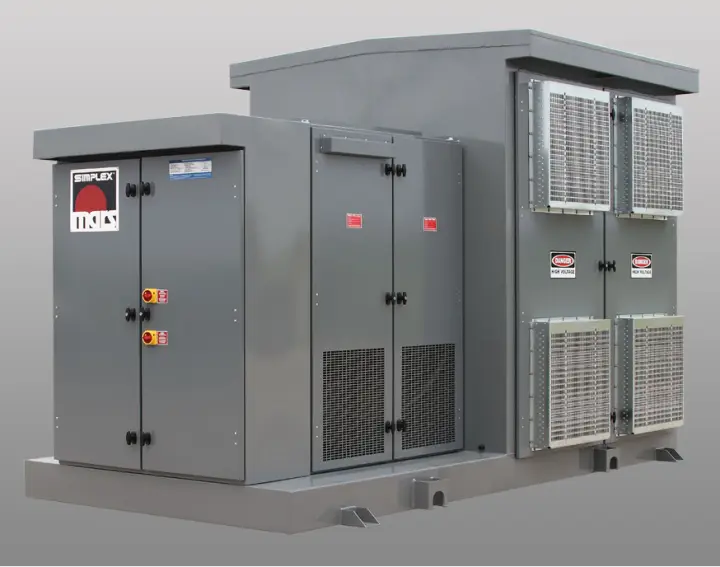
Simplex medium-voltage resistive load bank to 15 kV, 700 to 1,250 kW cell behind an on-board transformer
Simplex Mars-HV is one of 16 load banks tracked in the SecondWatt catalogue, each with specifications, lead times and indicative secondary-market pricing.
Simplex Mars-HV medium voltage load bank, 700 to 1,250 kW to 15 kV via on-board step-down transformer. Specs, inspection points and pricing status.
The Mars-HV is Simplex's medium-voltage stationary resistive load bank, marketed by Simplex as a medium voltage unit even though the primary rating reaches 15 kV. It exists because large campuses distribute at 4.16 kV or 13.8 kV and the switchgear under test terminates there, not at 480 V. The load cell is resistive, so the rating is kW at unity power factor. Simplex publishes typical primary options of 2,400 V, 3,300 V, 4,160 V, 13,200 V and 13,800 V, three-phase delta. The architecture is the single fact a buyer must get right. The Mars-HV is step-down, not direct connect: an on-board dry-type transformer takes a high-voltage delta three-wire primary to a 480 V wye four-wire secondary with grounded neutral, rated 700 to 1,200 kVA continuous duty with 220 C insulation and 150 C rise. The resistive elements themselves run at 480 V, so the 15 kV rating belongs to the transformer primary rather than to the resistors. Avtron's comparable 9200 is direct connect with no transformer in its specification, so the two are not interchangeable and should never be cross-shopped on rating alone. Step resolution is the Mars-HV's advantage over its own stablemates. Simplex publishes 50 kW standard with an optional 1-5-10-25 kW resolution, and 1 kW on a 700 kW cell is 0.14 percent of full scale. Cooling is forced air, vertical airflow with top exhaust, 24,000 CFM behind a 10 HP motor, in NEMA 3R power and control sections.
Why it matters
Testing a medium-voltage bus with a 480 V load bank means adding a rental transformer and a cable run to every campaign. The Mars-HV builds that transformer in and terminates on the switchgear itself. It also carries the finest published step in Simplex's stationary line at an optional 1 kW, which is 0.14 percent of a 700 kW cell, so one permanent install covers both generator loading and precise step work.
Who buys it
Operators whose testable bus is medium voltage rather than low voltage: data centre campuses, utilities, industrial plants and generator packagers distributing at 4.16 kV or 13.8 kV. They buy it to land a load directly on the medium-voltage switchgear without renting a step-down transformer or pulling a long low-voltage cable run. The optional 1 kW resolution also draws buyers who need fine step tests from the same permanent install.
Role in the data center
Testing the medium-voltage bus on a campus that distributes at 4.16 kV or 13.8 kV. The Mars-HV lands on that switchgear without a separate rental step-down transformer and without the long cable run a 480 V bank would need. It serves both roles from one permanent install. The 50 kW standard step is right for loading a generator through its rated points, and the optional 1 kW resolution at 0.14 percent of a 700 kW cell is fine enough for precise step tests during integrated systems testing.
Key specifications
| Rating type | Resistive only, kW at unity power factor |
|---|---|
| Load cell capacity, product page | 700 to 1,250 kW |
| Load cell capacity, brochure | 700 to 1,200 kW |
| Primary voltage ceiling | To 15 kV AC, three-phase delta kV |
| Typical primary options | 2,400 / 3,300 / 4,160 / 13,200 / 13,800 V |
| Connection architecture | On-board dry-type step-down transformer, not direct connect |
| Transformer rating | 700 to 1,200 continuous duty kVA |
| Transformer configuration | High-voltage delta three-wire primary to 480 V wye four-wire secondary, grounded neutral |
| Transformer insulation | 220 C insulation, 150 C rise C |
| Load section voltage | 480, three-phase, four-wire with grounded neutral V |
| Load step resolution | 50 standard, optional 1-5-10-25 kW |
| Frequency | 50 and 60 Hz |
| Cooling airflow | 24,000, vertical airflow with top exhaust CFM |
| Fan motor | 10, three-phase direct drive HP |
| Enclosure | NEMA 3R power section and NEMA 3R control section |
| Resistor elements | Powr-Web FeCrAl, ceramic-clad stainless steel through-rods, UL Recognized |
| Control system | Simplex D-Series digital load controller, PLC based, local or remote touchscreen |
| Control circuit voltage | 120 V |
Technical summary
Rating type: resistive only, kW at unity power factor. Load cell capacity: 700 to 1,250 kW per the product page, 700 to 1,200 kW per the brochure. Primary voltage: to 15 kV AC, three-phase delta; typical 2,400 / 3,300 / 4,160 / 13,200 / 13,800 V. Load section voltage: 480 V, three-phase, four-wire with grounded neutral. Connection: on-board dry-type step-down transformer, not direct connect. Transformer: 700 to 1,200 kVA continuous duty, 220 C insulation, 150 C rise. Load step: 50 kW standard, optional 1-5-10-25 kW resolution. Frequency: 50 and 60 Hz; control circuits at 120 V. Cooling: forced air, vertical airflow with top exhaust, 24,000 CFM, 10 HP. Enclosure: NEMA 3R power section and NEMA 3R control section. Elements: Powr-Web FeCrAl, ceramic-clad stainless steel through-rods, UL Recognized. Control: Simplex D-Series digital load controller, local or remote touchscreen.
Major variations
The Mars family splits by connection. Mars Version 2.0 is the low-voltage unit at 700 to 1,250 kW in discrete ratings of 700, 750, 800, 900, 1,000, 1,100, 1,200 and 1,250 kW, at 208 to 600 VAC three-phase three-wire, with 25 kW step resolution and a 10 HP fan moving 26,000 CFM. Mars-HV is the same load cell behind the medium-voltage step-down transformer. Note a step-resolution inconsistency inside the family. The low-voltage Mars V2.0 specification states 25 kW standard, while the Mars-HV brochure states 50 kW standard with 1-5-10-25 kW optional. Both are reported as published; neither should be assumed to carry across. Simplex applies the same step-down pattern one size up on the Saturn-HV, at 1,500 to 3,000 kW behind a 1,500 to 3,000 kVA transformer. Step-down is the Simplex house architecture for medium voltage rather than a Mars-HV quirk.
Configurations and options
The main published option is step resolution: 50 kW standard, or 1-5-10-25 kW. Control is the Simplex D-Series digital load controller with a local or remote touchscreen, which Simplex describes as standard across its entire stationary load bank line. The D-Series uses Modbus RTU over RS-485 or Ethernet with a colour TFT touch panel, and is network and IP capable so multiple control stations can be networked. Optional Auto-Test software adds automated testing with data acquisition, report generation and pass-fail results.
Compatibility and dependencies
The transformer primary must be specified to the site. Published options run 2,400, 3,300, 4,160, 13,200 and 13,800 V three-phase delta to a 15 kV ceiling, and a unit bought on the wrong tap is not repurposable without changing the transformer. The secondary is fixed at 480 V wye four-wire with a grounded neutral, so the load section, its contactors and its fusing are ordinary low-voltage components. Siting needs clearance for 24,000 CFM of vertical top-exhaust airflow, because recirculation into the intake derates the unit. Automatic load levelling depends on kW feedback from the metering package.
Pricing and availability
Trend: stable No Mars-HV price history exists to trend. Load banks above roughly 250 kW are sold entirely by quotation, and every dealer carrying the Mars-HV quotes contact for pricing as of August 2026. The medium-voltage segment is thinner still. As of August 2026 only one medium-voltage load bank of any make was listed at a published price, and it was reactive rather than resistive. Direct-connect and step-down medium-voltage units have a small installed base and few qualified buyers, and the resale that happens appears to run through negotiated channels that publish nothing. Lead time, new: Simplex's Quick Ship stock list tops out at the 700 kW Electra in stock and the 650 kW Neptune at 4 to 6 weeks, and the Mars-HV appears in neither tier, consistent with build to order. Quotations are firm for 60 days and delivery dates are estimates at issue. Non-standard equipment carries a minimum 10 percent non-refundable down payment plus 10 percent at engineering and 25 percent at production release.. Lead time, used or refurbished: Simplex's factory-certified used equipment list covers six models and does not include the Mars-HV, so there is no manufacturer refurbished route with a stated delivery time. Medium-voltage resale runs through negotiated channels that publish neither inventory nor delivery dates.. Warranty, new: 12 months from date of shipment from the factory, covering parts defective in material or workmanship under normal service. An optional two-year field service warranty runs 24 months with materials and labour by Simplex technicians, limited to the 48 contiguous states and excluding start-up services.. Warranty, used: The standard term runs from date of factory shipment, so a resold Mars-HV carries no manufacturer warranty unless separately negotiated. The transformer is the component most worth a condition warranty on a used purchase..
Lifecycle and maintenance
Simplex publishes no MTBF, no design life and no element life for the Mars-HV. Warranty is 12 months from factory shipment, with an optional 24-month field service warranty limited to the 48 contiguous states and excluding start-up services. Published maintenance is short and applies to the load section. Each operation: check intake, fan, cooling chamber and exhaust for obstruction, inspect blades for stress fractures, check branches for blown fuses or open resistors, and confirm the three line currents are essentially equal. Every 50 hours or 6 months: tighten all electrical connections and lubricate fan bearings. The transformer adds a maintenance burden Simplex does not schedule here, so treat its insulation testing as a separate programme. A 1,250 kW run held four hours moves 5,000 kWh through the elements at 24,000 CFM, and the transformer adds its own losses on top.
Thermal and emissions profile
No on-site combustion and no direct emissions. The 700–1,250 kW load cell rejects the full applied load as heat to atmosphere, with the on-board step-down transformer adding its own losses. Emissions during a test are those of the medium-voltage source under test; siting is governed by thermal clearance and 15 kV approach distances.
Common failure points
- Step-down transformer — Failure to energise, nuisance trips on closing, or a primary that does not match the site voltage
- Resistor elements — Output more than 5 percent below rated, or phase imbalance across A-B, B-C and C-A
- Cooling fan and overload relay — Fan failure or fan overload indicated, or the fan will not run
- Exhaust and intake temperature — High exhaust or high intake temperature during a run
- Thermocouples — Open thermocouple indicated on the D-Series display
- Metering and current transformers — Voltage zero or imbalanced, current zero, kW low or negative
- D-Series controller and HMI — Dark screen, PLC-prefixed errors, or a run-time SRAM checksum error
Inspection checklist
Transformer primary tap: confirm it matches the site, from the published 2,400, 3,300, 4,160, 13,200 and 13,800 V options up to a 15 kV ceiling. Transformer secondary: must be 480 V wye four-wire with a grounded neutral, and rated 700 to 1,200 kVA continuous duty. Transformer insulation condition: rated 220 C insulation with 150 C rise; a unit bought for the wrong primary is not repurposable without a transformer change. Phase-to-phase resistance: measure A-B, B-C and C-A on the 480 V load section; Simplex requires all 3 balanced. Delivered kW against nameplate: Simplex flags more than 5 percent below rated as a defect worth investigating. Voltage correction before judging output: kW rated multiplied by input volts over rated volts squared, applied at the 480 V secondary, not at the primary.
Procurement channels
New through Simplex and its distributors. SteadyPower carries the full Simplex line including Mars-HV 700-1250kW, publishes no figure, and quotes please call for current lead time. There is effectively no observable used channel for this model. USA Decommissioning, RH Power Inc. and Power Generation Enterprises carry no Mars-HV, and Simplex's own factory-certified used equipment list covers six models and does not include it.
Regional notes
Built in Springfield, Illinois and sold f.o.b. Springfield with the buyer paying freight, and storage charges accrue to the purchaser on material held past the original ship date. Both 50 Hz and 60 Hz are published, and the primary voltage options span common North American and international medium-voltage classes, so the unit is specifiable outside North America. The extended two-year field service warranty is limited to the 48 contiguous states.