Avtron 9200
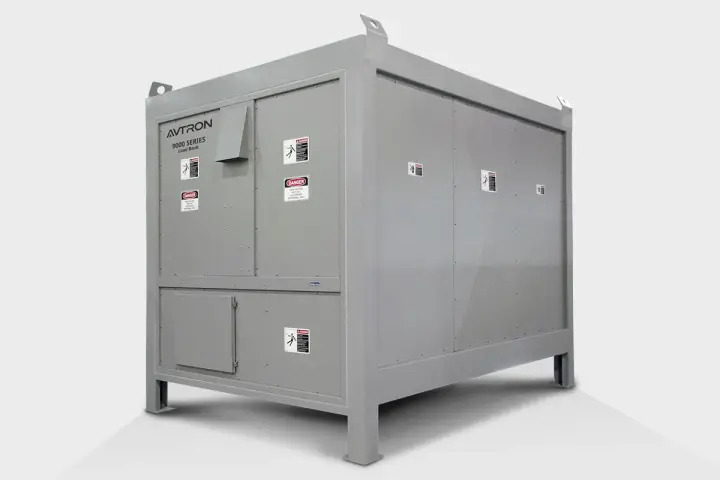
Direct-connect medium voltage resistive load bank, 1,000 to 3,500 kW at 4,160 to 13,800 V, no transformer
Avtron 9200 is one of 16 load banks tracked in the SecondWatt catalogue, each with specifications, lead times and indicative secondary-market pricing.
Avtron 9200 medium voltage load bank: 1,000 to 3,500 kW, 4,160 to 13,800 V, direct connect, 500 kW steps, inspection points and honest pricing.
The Avtron 9200 is a direct-connect medium voltage resistive load bank offered at 1,000, 2,000, 3,000 and 3,500 kW. Standard three-phase voltages are 4,160, 12,470, 13,200 and 13,800 V at 60 Hz. Its datasheet, publication 5535 revision G, opens by calling it a Direct Connect Medium Voltage load bank, and states that the elements are continuously rated at the specific voltage. The only transformer in the product is an optional step-down unit that supplies 120 V control power. That architecture is the purchase decision. A direct-connect unit lands on the medium voltage bus with no transformer in the test path, so the campaign loads the switchgear, cable and generator step-up as installed rather than a transformer the site does not own. The trade is that elements built for line potential cannot be re-tapped, so a 4,160 V machine stays a 4,160 V machine for life. One published conflict is worth knowing about. The 9000 Series brochure, publication 5556 revision F, tabulates the 9200 as step-down transformer, which contradicts the model datasheet, the live medium voltage category page and the no-transformer specification document that the product page itself links. The datasheet wins on specificity, currency and corroboration. Treat the brochure table as stale. Within the family the split is 9100, 9200 and 9700 direct connect against 9800 and 9950 transformer-coupled. Where a transformer is used at all it steps down from medium voltage to lower-voltage elements, never up. The 9200 is the entry point, so a buyer needing under 1,000 kW at medium voltage is pushed to the 9800.
Why it matters
A medium voltage load bank is a different purchase from a low voltage one, and the voltage class changes the machine rather than just the connection. Direct-connect elements are built for line potential, which keeps the transformer out of the test path and exercises the installed system as wired. It also means voltage is fixed at build, so secondary-market buyers must match nameplate voltage exactly rather than plan to re-tap.
Who buys it
Commissioning agents and EPCs loading 4,160 to 13,800 V switchgear during Level 4 and Level 5 integrated systems testing on data centre and utility projects. Industrial operators buy it as a permanently installed outdoor asset for periodic medium voltage exercise. Avtron also names factory production lines and test cells. Buyers who need fine step resolution for UPS acceptance work should be steered to low voltage units instead.
Role in the data center
Medium voltage source testing at the campus distribution tier rather than IT load simulation. Large sites distribute at 13.8 kV or 12.47 kV and both are standard 9200 voltages, so a direct-connect unit loads the medium voltage switchgear, cable and generator step-up as installed. The 500 kW step is the constraint: it resolves 14.3 percent of a 3,500 kW unit, which suits generator and bus loading and is far too coarse for UPS step work. Permanent outdoor installation also puts it in the periodic exercise duty that NFPA 110 drives, not only the commissioning campaign.
Key specifications
| Rating type | Resistive, kW at unity power factor |
|---|---|
| Standard capacities | 1,000 / 2,000 / 3,000 / 3,500 kW |
| Capacity range as marketed | 1 to 3.5 MW |
| Standard voltages | 4,160 / 12,470 / 13,200 / 13,800, three phase V |
| Connection arrangement | Direct connect medium voltage, no main load transformer |
| Frequency | 60 Hz |
| Load step resolution | 500 typical kW |
| Load tolerance | minus 0, plus 5 percent |
| Cooling airflow | approximately 20,000 per resistor stack CFM |
| Blower motor type | TEFC or TEAO, integral |
| Hot air discharge | Vertical |
| Control power supply | 120, 1 phase, 60 Hz, external V |
| Overall height and width | approximately 165 by 101 (4,191 by 2,565 mm) in |
| Ambient range | minus 20 to 120 F, minus 28 to 50 C |
| Standards compliance | NEMA, NEC and ANSI, quality system certified to ISO 9001 |
| Warranty, new | 24 months parts and labor |
Technical summary
Rating type: resistive, rated in kW at unity power factor, not kVA. Capacity: 1,000, 2,000, 3,000 and 3,500 kW standard ratings. Voltage: 4,160, 12,470, 13,200 and 13,800 V, three phase, medium voltage. Connection: direct connect, no main load transformer in the test path. Frequency: 60 Hz. Load step resolution: 500 kW typical. Load tolerance: minus 0, plus 5 percent. Cooling: approximately 20,000 CFM per resistor stack, TEFC or TEAO blower motor, vertical hot air discharge. Control power: 120 V, 1 phase, 60 Hz, with an optional step-down transformer for control power only. Enclosure: heavy gauge steel, baked polyester powder coat or two-part polyurethane, ANSI 61 gray. Ambient range: minus 20 F to 120 F, minus 28 C to 50 C. Warranty: 24 months parts and labor.
Major variations
Four standard capacities at 1,000, 2,000, 3,000 and 3,500 kW, crossed with four standard three-phase voltages at 4,160, 12,470, 13,200 and 13,800 V. Voltage is fixed at build because the elements are continuously rated at the specific voltage. Length and weight vary by capacity and voltage, and Avtron does not publish a per-rating table for either.
Configurations and options
Standard control is a remote manual 19 in rack panel carrying power on and off, blower start and stop, master load on and off, and individual load step switches. Options include a NEMA 4 type control panel enclosure and a step-down transformer that supplies the 120 V control circuit only. Avtron states the unit will interface with switchgear and a building management system, and can be operated from switchgear or generator rooms, which are vendor claims rather than verified integrations.
Compatibility and dependencies
Requires a separate 120 V, 1 phase, 60 Hz control supply that is independent of the medium voltage load connection. Nameplate voltage must match the bus exactly, since elements cannot be re-tapped. The unit is 60 Hz only in published material, so 50 Hz applications are not covered. A buyer-facing trap sits on the manufacturer side rather than the equipment side. Schneider Electric still lists the 9200 under legacy ASCO branding as a discontinued product while Avtron Power Solutions sells it as current, so an RFQ routed to the wrong entity dies quietly. Send medium voltage enquiries to Avtron Power Solutions.
Pricing and availability
Trend: stable No 9200 price history exists, so there is no five-year trend for this model. One category-level dynamic is worth carrying: used dollars per kW overlaps new dollars per kW in the 1.5 to 3 MW class, because new pricing scales down with size while used pricing does not. A buyer shopping a 2 MW machine can therefore find used asks above new list. That pattern comes from air-cooled low voltage units and may not hold at medium voltage. Lead time, new: The company maintains a stock load bank category, but no stock status or ship week is stated for the 9200.. Lead time, used or refurbished: No used 9200 is publicly listed as of August 2026, so no used lead time applies.. Warranty, new: 24 months parts and labor, per datasheet publication 5535 revision G.. Warranty, used: Confirm coverage, if any, with the seller before purchase..
Lifecycle and maintenance
Resistive elements carry no firmware and no power electronics, so the wear items are mechanical and dielectric: blower motors and bearings, load step contactors, and medium voltage insulation. Avtron publishes a 24 month parts and labor warranty on new units and issues a separate load bank storage requirements document for machines held out of service. Avtron publishes no MTBF, no service life and no maintenance interval for the 9200. The practical schedule is set by the medium voltage insulation rather than the elements, which routinely outlive the controls around them. A 3,500 kW run held four hours draws 14,000 kWh, rejected vertically to atmosphere on a permanent outdoor pad, with blower noise the audible addition at the property line.
Thermal and emissions profile
No on-site combustion and no direct emissions. Connecting directly at 4,160–13,800 V, the unit rejects its full 1–3.5 MW applied load as heat to atmosphere. Emissions during a test are those of the medium-voltage source under test; the siting constraints are thermal discharge clearance and medium-voltage approach boundaries rather than air permitting.
Common failure points
- Resistor element — A step no longer draws its rated kW and total load falls short of setpoint
- Blower motor and bearings — Thermal trip within minutes of loading, with airflow below the 20,000 CFM per stack figure
- Medium voltage insulators — Audible corona, carbon tracking on standoffs, ground fault on energisation
- Load step contactor — A step will not drop out and load stays applied after master load off
- Control power circuit — The unit is dead while medium voltage is present at the terminals
- Enclosure finish — Rust bloom on the ANSI 61 coating with water ingress at panel seams
Inspection checklist
Nameplate voltage: confirm 4,160, 12,470, 13,200 or 13,800 V, because elements are rated at the specific voltage and cannot be re-tapped. Nameplate capacity: confirm 1,000, 2,000, 3,000 or 3,500 kW, and that the rating is resistive kW rather than kVA. Insulation resistance: megger every resistor stack phase to ground at a test voltage suited to the 4,160 to 13,800 V class. Load tolerance: witness a step test and confirm the unit still holds minus 0, plus 5 percent. Step count: verify every step switches, roughly 7 steps on a 3,500 kW unit at 500 kW resolution. Blower motor: confirm a TEFC or TEAO frame and measure airflow against the 20,000 CFM per resistor stack figure. Discharge path: inspect the vertical hot air outlet and any bird screen for restriction or nesting. Control supply: confirm the 120 V, 1 phase, 60 Hz arrangement and whether the optional control transformer is fitted.
Procurement channels
New through Avtron Power Solutions and its distributors. Medium voltage units are engineered to the site voltage, so there is no meaningful shelf stock and no list price is published. There is effectively no used channel at this size. Data centre decommissioning lots are where large Avtron units surface, and Avtron 2000 Series lots have moved that way, but no used unit above 750 kW is publicly listed at any voltage. Rental is worth pricing against purchase. One published rate schedule, a New York OGS contract with United Rentals effective 2024-01-10, holds 7.58 dollars per kW per month flat from 600 to 1,250 kW and 9.61 at 2,500 kW.
Regional notes
North America only in published material, since the 9200 is 60 Hz and its standard voltages of 4,160, 12,470, 13,200 and 13,800 V are North American distribution classes. Compliance is stated as NEMA, NEC and ANSI with an ISO 9001 quality system, which is not the same as a listing by a nationally recognised testing laboratory. Avtron publishes no NRTL listing mark for this model.