Avtron 4900
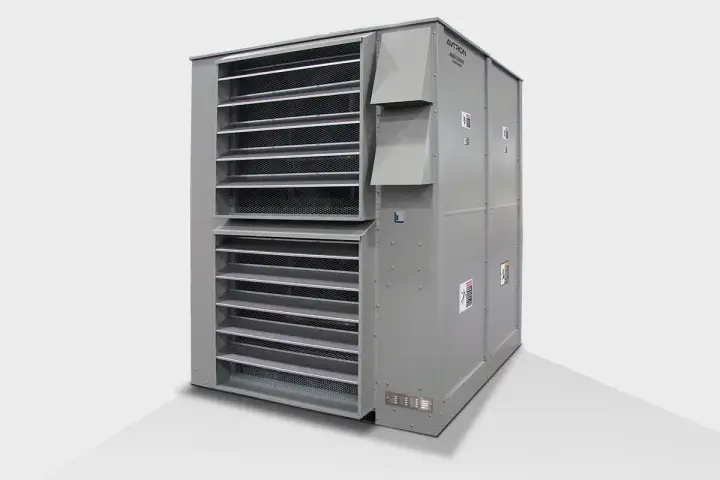
1,000 to 2,500 kW permanently installed outdoor resistive load bank in a NEMA 3R enclosure
Avtron 4900 is one of 16 load banks tracked in the SecondWatt catalogue, each with specifications, lead times and indicative secondary-market pricing.
Avtron 4900 permanent outdoor resistive load bank, 1,000 to 2,500 kW in NEMA 3R with 5 or 50 kW steps. Specs, inspection points and pricing context.
The Avtron 4900 is a permanently installed, outdoor, resistive load bank offered in five discrete ratings of 1,000, 1,500, 2,000, 2,250 and 2,500 kW. It is not a continuous capacity band, and quoting an intermediate figure would misstate what Avtron sells. Standard load step resolution is either 5 kW or 50 kW, chosen at the factory. That choice is the most consequential option on the model and cannot be changed in the field. It sits on the Cleveland platform alongside the 2905. Elements are helically wound chromium alloy Helidyne types on ceramic insulators with a -0, +5 percent load tolerance, the enclosure is heavy gauge aluminized steel to ASTM A463, and the unit is listed to UL 508A in a NEMA 3R enclosure. Specifications must never be carried across from the sheathed-element CE machines such as the 3020 and 3110. One gap deserves stating plainly. Avtron publishes a single dimension and weight set, 90 by 75 by 93 inches and approximately 3,600 lb, against all five ratings without saying which build it describes. A 2,500 kW bank carries two and a half times the element and contactor content of a 1,000 kW one, so one figure cannot describe both. Get the outline drawing for the specific rating being quoted before sizing a pad, a lift or a freight class.
Why it matters
This is the permanent half of the load bank market rather than the commissioning half. NEMA 3R construction and continuous full load operation outdoors let a facility exercise its generators on schedule without hiring equipment, and switchgear and BMS interfacing lets that test run automatically. The 5 kW versus 50 kW step choice is fixed at order time and defines what the asset can test for its whole life.
Who buys it
Data centre and hospital facilities teams, utilities, and any operator with a periodic generator testing obligation who would rather own a fixed asset than hire and cable a portable unit several times a year. Buyers who need to move the unit between sites, or who need finer than 5 kW resolution, should look at the 3110 or a portable instead.
Role in the data center
The permanently installed half of the two data centre load bank transactions, rather than a commissioning tool. It is the fixed asset a facility installs so it can exercise generators under load on a schedule without hiring a portable unit and cabling it in each time. NEMA 3R construction and continuous full load outdoor operation are the specifications that matter for that duty. A 2,000 kW two-hour annual test dissipates 4,000 kWh, rejected horizontally to atmosphere, so solar load, nearby hot equipment and exhaust entrainment all derate a boxed-in yard position.
Key specifications
| Capacity ratings offered | 1000, 1500, 2000, 2250, 2500 kW resistive at unity pf |
|---|---|
| Load step resolution | 5 or 50 kW, factory selected |
| Voltage and frequency options | 480-60, 600-60, 400-50 V-Hz, three phase |
| Load tolerance | -0, +5 percent |
| Element type | Helically wound chromium alloy Helidyne open coil on ceramic insulators |
| Cooling airflow | 46000 CFM, TEFC or TEAO motors |
| Enclosure rating | NEMA 3R permanent outdoor |
| Enclosure material | Heavy gauge aluminized steel to ASTM A463 stainless fasteners |
| Finish | 2.8 mils per coat, ANSI 61 gray polyester |
| Standard control | Manual 19 in rack mount panel master and individual step switches |
| Dimensions | 90 x 75 x 93 in, rating not specified by Avtron |
| Weight | 3600 lb, rating not specified by Avtron |
| Ambient range | -20 to 120 deg F (-28 to 50 deg C) |
| Safety listing | UL 508A listed |
| Warranty | 24 months parts and labor |
Technical summary
Capacity: five discrete ratings, 1,000 / 1,500 / 2,000 / 2,250 / 2,500 kW, resistive at unity pf (kW, not kVA). Load step resolution: 5 kW or 50 kW, factory selected and not field changeable. Voltage: 480 V 60 Hz, 600 V 60 Hz, 400 V 50 Hz per datasheet; product page lists 60 Hz only. Elements: helically wound chromium alloy Helidyne on ceramic insulators. Load tolerance: -0, +5 percent. Cooling: about 46,000 CFM from integral TEFC or TEAO motors, horizontal discharge. Control: manual 19 in rack panel, master and step switches; remote, switchgear and BMS options. Enclosure: NEMA 3R, aluminized steel to ASTM A463, ANSI 61 gray at 2.8 mils per coat. Safety: differential pressure switch, overtemperature switch, fuses on every load step. Dimensions and weight: 90 x 75 x 93 in, about 3,600 lb, not tied by Avtron to any rating. Ambient: -20 deg F to 120 deg F (-28 deg C to 50 deg C), permanent outdoor installation. Listing and warranty: UL 508A, NEMA, NEC and ANSI compliant, 24 month parts and labor.
Major variations
Five discrete capacity builds at 1,000, 1,500, 2,000, 2,250 and 2,500 kW, and three voltage and frequency builds at 480-60, 600-60 and 400-50. Note that the datasheet lists the 400 V 50 Hz option while the product page states 60 Hz only. The step resolution choice of 5 kW or 50 kW is a factory build option, not a field upgrade, and it is the variation with the largest effect on what the asset can test. Control options run from the standard manual 19 in rack panel up to remote operator controls, switchgear interfacing and building management system integration, with separate Avtron literature for Automatic Load Control and ADMS.
Configurations and options
Automatic Load Control and ADMS options add automated load following to the standard manual 19 in rack panel. Built-in forklift channels are standard for placement. Series siblings run 4100 at 50 to 150 kW, 4500 at 200 to 500 kW, 4600 at 500 to 1,250 kW, 4800 to 3,000 kW and 4950 at 2,500 to 5,000 kW. Control can also be taken from switchgear or a generator room with building management system interfacing, which is what lets a permanently installed bank take part in an automated monthly or annual test rather than needing an operator at the panel.
Compatibility and dependencies
Three phase at 480 V or 600 V 60 Hz, with 400 V 50 Hz shown on the datasheet only. The unit requires a permanent outdoor pad with clearance for approximately 46,000 CFM of intake and horizontal discharge, sited to avoid solar gain, nearby heat sources and recirculation of its own exhaust. Automated testing depends on the optional switchgear or BMS interface being specified at order.
Pricing and availability
Comparable secondary-market band: 49.78–70.54 $ per kW. Trend: stable Used dollars per kW overlaps new dollars per kW in the 1.5 to 3 MW class, which is where this model sits. New list pricing scales down with size to a 59.87 dollars per kW median in the 1,500 to 3,000 kW band, while used asks do not scale the same way and cluster higher per kW. A buyer shopping a 2 MW unit can therefore find used asks above new list. Treat any used 4900 offer as needing a fresh new-list quote beside it before it is judged. Lead time, new: The 4500, 4810 and 4820 do, including 5 units at 1,250 kW, 4 at 1,500 kW and 7 at 2,000 kW of the 4820. A buyer who needs fast delivery in this capacity class is therefore steered to the 4820 rather than the 4900.. Lead time, used or refurbished: Used units reach the market primarily through facility decommissioning; no lead time is published.. Warranty, new: 24 months parts and labor, per the pub 5521 rev D datasheet..
Lifecycle and maintenance
Avtron publishes no MTBF. Warranty is 24 month parts and labor. The platform is built for long outdoor life, with aluminized steel to ASTM A463, stainless fasteners and a specified 2.8 mil paint film, while the wear items are switching, sensing and fusing. Avtron's overheating guidance applies directly to a permanently sited outdoor unit and names high ambient temperature, high altitude, nearby hot equipment, high solar load and exhaust entrainment. Solar load and entrainment are the two site designers most often get wrong. No maintenance interval in months or running hours is published, only advice to inspect intake and exhaust screens and to use a qualified provider at the manufacturer's recommended frequency.
Thermal and emissions profile
No on-site combustion and no direct emissions. As a permanently installed outdoor unit rated 1,000–2,500 kW, it rejects the full applied load as heat vertically to atmosphere; the practical siting constraints are discharge clearance above the unit and separation from building air intakes and adjacent condensers, not air permitting. Emissions during a test are those of the standby generator being exercised.
Common failure points
- Helidyne element open circuit — A 5 kW or 50 kW step draws nothing and total capacity falls short of the -0, +5 percent band
- Load step fuse operation — An increment is silently missing
- Outdoor enclosure corrosion — Rust perforation and water ingress into the control section
- Blower motor failure — Overtemperature trip under load with airflow well below approximately 46,000 CFM
- Thermal protection switch failure — The unit loads with no airflow, or fails to trip when overheating
- Control interface obsolescence — The manual panel works but the BMS or switchgear interface no longer communicates
Inspection checklist
Nameplate: confirm which of the 5 discrete ratings applies: 1,000, 1,500, 2,000, 2,250 or 2,500 kW. Step resolution: confirm whether this is the 5 kW or 50 kW build, since at 1,000 kW that is 200 steps against 20 and cannot be changed. Load steps: exercise every step and log kW; all 3 voltage builds fuse every load step, so a blown step fuse hides as a missing increment. Load tolerance: measured total must fall within -0, +5 percent of nameplate, so 1,000 to 1,050 kW on a 1,000 kW unit. Helidyne elements: inspect helical coils for sag, distortion or coil-to-coil contact, since these are open live elements. Ceramic insulators: check every element support insulator for cracking and tracking. Blower motors: confirm the TEFC or TEAO motors run and together deliver approximately 46,000 CFM. Differential pressure switch: verify it proves airflow and inhibits load with the blower stopped.
Procurement channels
New through Avtron and its distributors as a build-to-order unit, with the 4820 the faster stocked alternative in the same class. Used supply comes mainly through decommissioning brokers rather than open marketplaces, because a permanent unit leaves service when the building does. The structural catch at this size is that used asks can exceed new list, so a new quote should always be pulled alongside a used offer.
Regional notes
Primarily North America, on 480 V or 600 V at 60 Hz with a UL 508A listing and NEMA, NEC and ANSI compliance. The datasheet also shows a 400 V 50 Hz build, though the product page states 60 Hz only, so confirm frequency with Avtron before specifying outside the Americas.