Simplex Atlas-Megawatt 1000 Load Bank
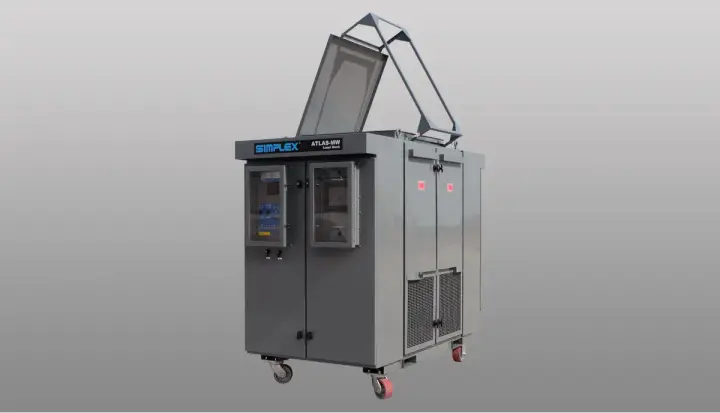
1,000 kW resistive portable load bank for commissioning and annual testing of megawatt-class standby generators
Simplex Atlas-Megawatt 1000 Load Bank is one of 16 load banks tracked in the SecondWatt catalogue, each with specifications, lead times and indicative secondary-market pricing.
Full spec dossier for the Simplex Atlas-Megawatt 1,000 kW resistive portable load bank: steps, voltage, airflow, failure modes, and inspection checklist.
The Simplex Atlas-Megawatt is a 1,000 kW resistive-only portable load bank manufactured by Simplex, Inc. of Springfield, Illinois, a brand within TerraVest Industries, a TSX-listed Canadian diversified manufacturer. The unit carries a PLC-based control system with an 8-inch color TFT touchscreen, MODBUS over RS-485 communications, and a digital power transducer with Ethernet — a control stack that positions it for integration into networked commissioning systems rather than standalone spot-testing. It is offered in two mechanically distinct but electrically identical variants: the base unit on 6-inch swivel and fixed casters with forklift channels and lifting eyes, and the Atlas-Megawatt Trailer on a DOT-compliant all-welded steel trailer with electric brakes, a breakaway battery, and a 2-5/16-inch ball or 3-inch pintle hitch. All electrical specifications — capacity, step resolution, voltage, frequency, airflow, fusing, cabling, and control architecture — are identical between the two variants; only the mobility chassis differs. The unit is resistive-only. It cannot generate reactive (kVAR) load by itself. The OEM's own brochure states that kVAR capability is available only 'when used with optional inductive load banks,' meaning an Atlas-Megawatt paired with a separate auxiliary inductive unit is required to simulate the mixed power-factor loads that a real data center presents to its standby generator or UPS. Buyers whose test specifications require a power factor below 1.0 must either specify that auxiliary inductive pairing at procurement or consider the Simplex Titan, which integrates resistive and inductive loading in a single frame. Loading resolution is 5 kW standard, with the product page listing 1, 5, 10, and 25 kW step options. On a 1,000 kW unit, the 5 kW standard step represents 0.5 percent granularity, and the 1 kW option represents 0.1 percent — sufficient for the smooth ramp profiles required by commissioning protocols. The 1,000 kW capacity at 240 V draws 2,404 A full load; at 480 V it draws 1,202 A. Voltage acceptance is dual-wound, covering 208–240 V and 416–480 V, and the unit is stated to operate 'at any voltage to 480 VAC maximum, single or 3-phase.' Frequency coverage is 50, 60, and 400 Hz, the last of which opens the unit to aviation ground-power and military applications beyond the data center segment. Cooling is forced-air via a 10 HP fan motor rated at 27,700 CFM. The OEM's brochure body text also states 26,000 CFM in one location, but the product page, the trailer product page, and the brochure's motor specification table all cite 27,700 CFM; 27,700 CFM is the figure Simplex publishes in three of its four documents and is the one to use. At 1,000 kW the heat rejection is approximately 3,412,000 BTU/hr; at 27,700 CFM that corresponds to a calculated air temperature rise of roughly 114°F through the element chamber. Screened cool air intakes on both sides of the unit and a 4.7-inch by 38.687-inch hot air exhaust opening are identified on the dimensional drawing. The malfunction detection system monitors fan failure, fan reversal, intake temperature, exhaust temperature, and overvoltage — fan reversal is explicitly listed, which reflects a real failure mode in units reassembled after field service. Resistive elements are Simplex's Powr-Web design in FeCrAl alloy with ceramic-clad stainless steel through-rods. The OEM publishes two temperature figures: a 1,080°F maximum operating temperature and a 1,920°F maximum continuous temperature rating for the material itself. The 1,080°F figure is the operating limit; the 1,920°F figure is the material's rated capability, not the permitted operating condition. Elements that show heavy scaling or discoloration on inspection have likely been operated above 1,080°F. Each 50 kW branch is protected by a set of current-limiting fuses rated 200 KAIC, 600 V. A 1,000 kW unit has 20 such branches. Simplex, Inc. was founded in 1934 in Burlington, Iowa and introduced its first air-cooled load bank in 1961. The company is headquartered at 5300 Rising Moon Rd, Springfield, Illinois 62711, operates manufacturing at three locations in Springfield across a 110,000-square-foot facility on 10 acres, and employs over 250 people. It holds ISO 9001:2015 certification and a UL listing under file number E151624. The company operates as a brand of TerraVest Industries; neither Simplex nor TerraVest publishes the acquisition date or terms. The Atlas-Megawatt is a current product with a full document set — brochure, dimensional drawing, and owner's manual — available on simplexdirect.com.
Why it matters
NFPA 110 requires annual load bank testing of standby generators that do not reach their rated load during monthly exercise runs — a condition that describes most modern data center generators, which sit at low utilization until a utility event. A 1,000 kW resistive load bank at 5 kW step resolution is the purpose-built instrument for that transaction on a megawatt-class generator. The Atlas-Megawatt's PLC control with MODBUS and Ethernet makes it compatible with the data-logging and remote-monitoring requirements that commissioning authorities having jurisdiction (AHJs) increasingly demand in their acceptance reports. Its portability — casters on the base unit, DOT-legal trailer on the trailer variant — allows a single unit to serve multiple facilities across a campus or region rather than being installed at a single site.
Who buys it
The primary buyers are commissioning agents and generator-service firms performing load bank testing of 750 kW to 1,250 kW class standby diesel generators at data centers, hospitals, utilities, and military installations. Rental fleet operators carry the Atlas-Megawatt as a core asset for the annual generator test market, where a single unit matches the nameplate of a common data center generator without ganging. Genset OEM field-service arms use the trailer variant to move between customer sites without a crane or flatbed. Aviation and military ground-power facilities are secondary buyers attracted by the 400 Hz rating. Buyers with reactive-load test requirements will typically pair the Atlas-Megawatt with a separate auxiliary inductive load bank or purchase the Simplex Titan instead.
Role in the data center
The Atlas-Megawatt's primary data center role is annual load bank testing of standby diesel generators in the 750 kW to 1,250 kW nameplate class, the most common single-generator size in Tier III and Tier IV facilities. NFPA 110 requires annual load bank testing of generators that do not achieve their rated load during monthly exercise runs; a single Atlas-Megawatt covers that test transaction without ganging units. For commissioning of new facilities, the trailer variant can be moved between multiple generator rooms or buildings across a campus, and the MODBUS and Ethernet communications feed test data into the commissioning report record. Larger facilities with multiple paralleled generators may gang two or more units; the 5 kW step and PLC control support coordinated ramp sequences. The unit is not used for UPS output testing at anything other than unity power factor; testing a UPS's reactive handling requires an inductive load bank in addition to or instead of the Atlas-Megawatt.
Key specifications
| Rated Capacity | 1,000 kW (resistive) |
|---|---|
| Load Type | Resistive only |
| Load Step Resolution (standard) | 5 kW |
| Load Step Resolution (options) | 1, 5, 10, 25 kW |
| Voltage (dual) | 208–240 / 416–480 V AC |
| Voltage Maximum | 480 V AC |
| Frequency | 50, 60, 400 Hz |
| Full Load Current at 240 V | 2,404 A |
| Full Load Current at 480 V | 1,202 A |
| Airflow (published) | 27,700 CFM |
| Fan Motor | 10 HP |
| Control Voltage | 230/460 V, 3-phase, 60 Hz, 20 A |
| Element Type | Powr-Web FeCrAl alloy, ceramic-clad stainless steel through-rods |
| Element Maximum Operating Temperature | 1,080 °F |
| Element Maximum Continuous Material Rating | 1,920 °F |
| Branch Fusing | Current-limiting, 200 KAIC, 600 V; one set per 50 kW branch |
| Number of 50 kW Branches | 20 |
| Control System | PLC-based with 8-inch color TFT touchscreen |
| Communications | MODBUS over RS-485; digital power transducer with Ethernet |
| Connection Cable Set | 12 ft |
| Dimensions (W x D x H) | 81 x 79 x 84 in |
| Weight | 2,500 lbs |
| Hot Air Exhaust Opening | 4.7 x 38.687 in |
| Casters (base unit) | 6-inch swivel and 6-inch fixed |
| UL File Number | E151624 |
| Quality System | ISO 9001:2015 |
| Trailer Hitch (trailer variant) | 2-5/16 in ball or 3 in pintle ring, adjustable in 2-inch increments |
| Trailer Brakes (trailer variant) | Electric driving brakes; mechanical parking brake; breakaway battery and switch |
| Power Wiring Insulation | 150°C XLP, color-coded |
| Control Wiring Insulation | 105°C, color-coded |
Technical summary
Rated Capacity: 1,000 kW (resistive only) Load Type: Resistive only; kVAR requires separate auxiliary inductive load bank Load Step Resolution (standard): 5 kW Load Step Resolution (options): 1, 5, 10, 25 kW Voltage: Dual voltage 208–240 V / 416–480 V AC; operational at any voltage to 480 V AC maximum, single or 3-phase Frequency: 50, 60, 400 Hz Full Load Current at 240 V: 2,404 A Full Load Current at 480 V: 1,202 A Cooling: Forced air, 27,700 CFM (the brochure body text also states 26,000 CFM; the product pages and the brochure motor table state 27,700 CFM) Fan Motor: 10 HP, 3-phase Control Voltage: 230/460 V, 3-phase, 60 Hz, 20 A Element Type: Powr-Web FeCrAl alloy, ceramic-clad stainless steel through-rods Element Maximum Operating Temperature: 1,080°F Element Maximum Continuous Material Rating: 1,920°F Branch Fusing: One set per 50 kW branch; current-limiting, 200 KAIC, 600 V Number of 50 kW Branches: 20 Control System: PLC-based with 8-inch color TFT touchscreen Communications: MODBUS over RS-485; digital power transducer with Ethernet Malfunction Detection: Fan failure, fan reversal, intake temperature, exhaust temperature, overvoltage Connection Cable Set: 12 ft Dimensions (base unit): 81 in W x 79 in D x 84 in H Weight (base unit): 2,500 lbs Hot Air Exhaust Opening: 4.7 in x 38.687 in Casters (base unit): 6-inch swivel and 6-inch fixed UL File Number: E151624 Quality System: ISO 9001:2015
Major variations
The Atlas-Megawatt is offered in two variants that are electrically identical but mechanically distinct. The base unit rides on 6-inch swivel and fixed casters with forklift channels and lifting eyes for short-distance repositioning and crane-assisted placement. The Atlas-Megawatt Trailer mounts the same electrical assembly on an extra-heavy-duty all-welded steel trailer with a steel deck, electric driving brakes, a mechanical parking brake, a breakaway battery and switch, 36-inch safety chains with hooks, DOT lighting and connector, and rear reflectors; it is hitch-compatible with a 2-5/16-inch ball or a 3-inch pintle ring, the latter adjustable in 2-inch increments, and meets all DOT requirements for highway use. An optional weather-resistant enclosure is available for both variants (referenced on the product pages and in drawing 211931). No electrical specifications differ between base and trailer variants.
Configurations and options
The OEM's brochure lists the following published options: weather-resistant enclosure, toggle switch control (in place of the touchscreen PLC), networking cables, remote extensions, AUTO-TEST software, Cam-Lok connections, and auxiliary inductive load banks. The auxiliary inductive option is the most consequential: it is the only path to reactive load capability, since the Atlas-Megawatt is resistive-only. The load step resolution can be specified at 1, 5, 10, or 25 kW; the standard is 5 kW. Cam-Lok connections are an option rather than standard, so confirm the connection standard on the nameplate and in the purchase agreement before ordering cable adapters.
Compatibility and dependencies
The Atlas-Megawatt accepts any AC voltage to 480 V AC maximum and operates at 50, 60, or 400 Hz; it is not rated above 480 V and cannot be connected to medium-voltage generators without a step-down transformer. Full-load current is 2,404 A at 240 V and 1,202 A at 480 V, which dictates the cable and connection infrastructure required at the generator terminals. The control circuit requires 230/460 V, 3-phase, 60 Hz at 20 A; verify this supply is available at the test site before mobilizing. MODBUS RS-485 and Ethernet communications require compatible data logging or building management system infrastructure if automated test reporting is required. Reactive load testing requires a separately procured Simplex auxiliary inductive load bank; the Atlas-Megawatt generates no kVAR on its own.
Lifecycle and maintenance
The OEM's owner's manual specifies a two-tier maintenance schedule. Before and during each operation: check air intake screens, louvers, fan, cooling chamber, and exhaust openings for obstructions; check all load branches for blown fuses or open resistors; verify the fan is spinning and air is exiting the exhaust vent; confirm all control switch positions and that the fan circuit breaker is in the Off position before starting. Periodically, at every 50 hours of use or 6 months, whichever comes first: conduct a full inspection as outlined in the manual, with primary inspection recommended as part of a 6-month maintenance schedule. No MTBF figure is published by the OEM. The manual does not contain torque specifications for lugs, insulation resistance test values, or temperature acceptance limits beyond the operational guidance above; buyers requiring NETA-style acceptance values for commissioning records will not find them in the OEM manual and should specify those values in their own test procedures. The Powr-Web element design is air-cooled and individually replaceable per 50 kW branch, which is the repair path that makes used units economically viable rather than scrap when one or two branches fail.
Thermal and emissions profile
No on-site combustion and no direct emissions. At 1,000 kW the portable unit rejects the full applied load as heat through forced-air discharge, so outdoor or well-ventilated placement is required and the discharge must be kept clear of generator radiators and building intakes. Emissions during a test are those of the megawatt-class generator being commissioned.
Common failure points
- Cooling fan / 10 HP motor — Malfunction system reports Fan Failure (fan not blowing air into element chamber) or fan blades not turning; exhaust temperature fault follows rapidly
- Branch contactor — A branch fails to pick up (lost load step) or welds closed and cannot be shed (commanded load does not drop)
- Powr-Web resistor element — A 50 kW branch drops out; total measured load reads low against 1,000 kW commanded
- Branch circuit fuse — One 50 kW branch is dead with the element measuring good on continuity
- Intake / exhaust temperature monitor — Malfunction system reports Intake Temp. Failure (blocked screen or ambient too high) or Exhaust Temp. Failure (fan stopped or exhaust space insufficient)
- Overvoltage protection — Malfunction system reports Over Voltage — load bank connected to too-high voltage source
- Trailer running gear (trailer variant) — Brake drag, flat breakaway battery, or inoperative DOT lighting discovered at roadside or on arrival at site
Inspection checklist
- Measure full-load current — verify 2,404 A at 240 V or 1,202 A at 480 V; readings below nameplate indicate lost elements
- Check Powr-Web element continuity across all 20 branches (1,000 kW ÷ 50 kW per branch = 20 branches); open elements are replaceable
- Inspect branch circuit fuses — one set per 50 kW branch, current-limiting type, 200 KAIC, 600 V rating; check all 20 sets
- Test fan motor — 10 HP, 3-phase; check bearing condition, measure current draw against nameplate, and megger the winding
- Verify fan rotation direction — malfunction detection system explicitly monitors fan reversal; a reversed fan overheats the element chamber rapidly
- Measure or estimate airflow against the published 27,700 CFM and inspect the 4.7 in x 38.687 in hot air exhaust opening for obstructions or damage
- Inspect both intake screens — drawing labels 'Screened Cool Air Intake, Both Sides'; both must be clear and undamaged to achieve rated airflow
- Examine element color and surface condition — Powr-Web maximum operating temperature is 1,080°F; heavy scaling or discoloration indicates sustained over-temperature operation
- Inspect contactor contacts on every 50 kW branch — contactors switch the full branch current and are the primary mechanical wear item at this duty cycle
- Torque-check every branch lug — the manual lists electrical connection tightness as a 50-hour / 6-month periodic task
- Power up the PLC and 8-inch TFT touchscreen — confirm the display illuminates, responds to touch, and can address all 20 load steps
- Verify MODBUS RS-485 communication and Ethernet power transducer connectivity — these drive the data logging that commissioning reports depend on
- Inspect the 12 ft connection cable set and any Cam-Lok terminations — confirm the set is complete and check for burned contacts or heat damage at the ferrules
- Check structure and mobility — 2,500 lbs on 6-inch casters; inspect caster mounts, forklift channel welds, and lifting eyes for distortion or cracking
- Trailer variant only — test electric brakes and mechanical parking brake, confirm breakaway battery holds charge, verify all DOT lighting functions, inspect 36-inch safety chains and hooks, and check hitch coupler wear on both the 2-5/16 in ball and 3 in pintle ring positions
Procurement channels
Simplex, Inc. sells direct and through authorized distributors; contact information and a rental inquiry form are available at simplexdirect.com. A rental program is listed at simplexdirect.com/rentals/, though no rates are published. Used units at this capacity tier move through data center decommissioning auctions and specialized power-equipment dealers; the Atlas-Megawatt class of 1,000 kW resistive load bank is exactly the asset type that appears in decommissioning lots alongside generator sets.
Regional notes
The Atlas-Megawatt is manufactured in Springfield, Illinois and the product pages and manual are in US English with US units. The 50 Hz rating and dual-voltage coverage to 480 V make the unit deployable in most international markets. The trailer variant is DOT-compliant for US highway use; international trailer regulatory compliance is not addressed in the OEM's documentation. No regional distribution restrictions are published.