Avtron LC20
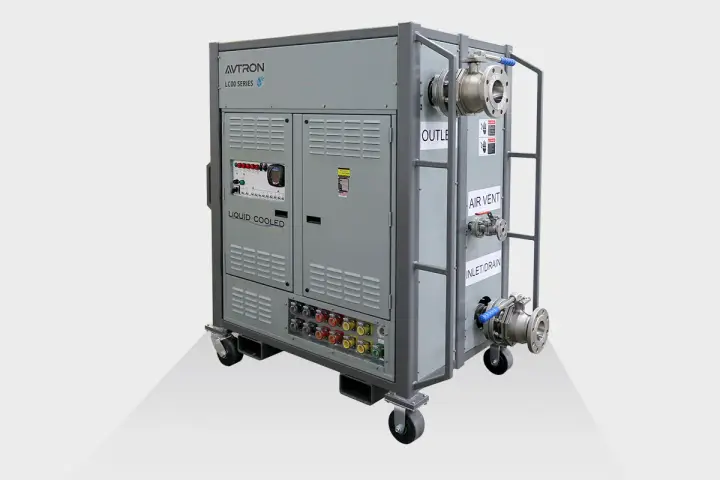
Liquid-cooled resistive load bank, 500 kW and 720 kW at 415 or 480 V, with 5 kW load steps
Avtron LC20 is one of 16 load banks tracked in the SecondWatt catalogue, each with specifications, lead times and indicative secondary-market pricing.
Avtron LC20 liquid cooled load bank: 500 and 720 kW, 415 or 480 V, 5 kW steps, 40 to 300 GPM, coolant loop details and honest pricing disclosure.
The Avtron LC20 is a resistive load bank that rejects its heat into a water loop instead of into the room. There is no blower and no hot air discharge, which is the whole point of the machine. It is offered at 720 kW at 480 V, derating to 540 kW at 415 V, and at 500 kW at 415 V, always three phase at 50 or 60 Hz. Load resolution is 5 kW, which is 100 times finer than the 500 kW step on Avtron's medium voltage units. The liquid side is what makes it unusual. Avtron's user manual instructs the installer to connect the load bank to the customer's unit under test using customer-supplied piping, hoses, fittings and valves. The load bank is therefore plumbed into the cooling plant that is itself being commissioned. So the LC20 does two jobs at once. On the electrical side it is a load on the generator, uninterruptible power supply or switchgear. On the hydraulic side it is a controllable heat source that stands in for a liquid-cooled rack which has not been installed yet. Buy the LC20 rather than the LC35 in North America. The LC20 is built to UL standards at 415 or 480 V, while the LC35 is built to CE standards at 400 or 415 V, and 480 V exists only on the LC20. Note that built to UL standards is a design-conformance claim and not a UL listing; the 720 kW manual cites only the National Electrical Code and OSHA.
Why it matters
A liquid-cooled data hall cannot be commissioned with air-cooled load banks alone. Coolant distribution units, pumps and heat rejection need a controllable heat load before any server is racked, and an air-cooled bank puts that heat in the room rather than in the loop. The LC20 supplies both the electrical load and the thermal load from one machine, which is why it belongs beside liquid cooling equipment rather than only beside generators.
Who buys it
Data centre commissioning agents and EPCs testing liquid cooling plant and electrical distribution on the same campaign, particularly on high-density builds where the racks arrive after the infrastructure. Avtron positions the unit for data centre commissioning and testing in its own material. The 5 kW step also suits uninterruptible power supply acceptance work that coarser generator load banks cannot resolve.
Role in the data center
This is the strongest data centre story in the category, because the LC20 is plumbed into the customer's cooling plant and acts as a controllable heat source while simultaneously loading the electrical system. It stands in for a liquid-cooled rack that has not arrived yet, so coolant distribution units, pumps, valves and heat rejection can be commissioned against a known thermal load before any server is installed.
Key specifications
| Rating type | Resistive, kW at unity power factor |
|---|---|
| Capacity, 480 V build | 720, derating to 540 at 415 V kW |
| Capacity, 415 V build | 500 kW |
| Voltage | 415 or 480, three phase V |
| Frequency | 50 or 60 Hz |
| Load step resolution | 5 kW |
| Coolant flow, 720 kW | 60 minimum to 300 maximum GPM |
| Coolant flow, 500 kW | 40 minimum to 300 maximum GPM |
| Maximum water outlet temperature | 180 F, 82.2 C |
| Maximum temperature change, pub 5561 data sheet | 85 F [29.4 C], as printed |
| Working and test pressure | 70 working, 105 test, relief valve at 125 PSIG PSI |
| Coolant connections | 4 in flange, 101.6 mm, inlet and outlet |
| Fluid volume, 720 kW | 102 gal, 386.1 litres |
| Weight, 720 kW | 3,393 full, 2,609 empty lb |
| Dimensions | 65 long by 39.5 wide by 74.5 high, 1,650 by 1,005 by 1,892 mm in |
| Enclosure | Heavy gauge aluminized steel per ASTM A463, welded frame, heavy-duty castors |
Technical summary
Rating type: resistive, rated in kW at unity power factor, not kVA. Capacity: 720 kW at 480 V, derating to 540 kW at 415 V; 500 kW at 415 V. Voltage: 415 or 480 V, three phase, low voltage. Frequency: 50 or 60 Hz. Load step resolution: 5 kW. Coolant flow: 60 to 300 GPM on the 720 kW unit, 40 to 300 GPM on the 500 kW unit. Temperature limits: 180 F maximum water outlet, 85 F maximum temperature change. Pressure: 70 PSI working, 105 PSI test, relief valve set at 125 PSIG. Connections: 4 in flanged inlet and outlet. Fluid volume and weight, 720 kW: 102 gal, 3,393 lb full and 2,609 lb empty. Wetted materials: corrosion resistant stainless steel piping and tanks, fully drainable. Networking: controller supports up to 250 liquid or air-cooled load banks. One published conversion does not hold. The data sheet prints the maximum temperature change as 85 F [29.4 C], but a change of 85 F is 47.2 C, since 85 divided by 1.8 is 47.2. The 29.4 C figure is 85 F converted as an absolute temperature rather than as a difference, so size the loop from the 85 F figure.
Major variations
Two ratings with separate documentation. The 500 kW unit runs at 415 V and flows 40 to 300 GPM, while the 720 kW unit runs at 480 V, derates to 540 kW at 415 V and flows 60 to 300 GPM. Each has its own outline drawing, user manual and voltage-specific spares kit. The CE sibling is the LC35 at 400 or 415 V and 500 kW only.
Configurations and options
The unit ships on heavy-duty castors within a welded aluminized steel frame, and a separate transportation base is offered as an accessory. Control is through Avtron's networked controller, which supports up to 250 liquid or air-cooled load banks on one network, and the product page links an RxMS LB View interface manual. Spares kits are ordered against the 415 V or 480 V build rather than the model as a whole.
Compatibility and dependencies
The coolant loop is customer-supplied. Avtron's manual instructs the installer to connect the load bank to the customer's unit under test using customer-supplied piping, hoses, fittings and valves, through 4 in flanges, so the site provides circulation, isolation and heat rejection. Coolant type is never specified, which is the single largest gap in the published data. The only fluid constraints given are that the flow meter requires liquid with conductivity above 20 microsiemens per cm and that inlet temperatures above 140 F damage it. A high-purity or deionised loop sits well below that conductivity floor, so any buyer on such a loop should confirm flow metering with Avtron before purchase.
Pricing and availability
Trend: stable No LC20 price history exists, and no liquid-cooled load bank of any make is publicly priced, so there is no five-year trend. The product is too recent for a five-year series to exist at all: the 720 kW variant's user manual and outline drawing both carry 2026 dates. Air-cooled dollars per kW are not a valid reference for this machine. Lead time, new: Voltage-specific spares kits are catalogued for 415 V and 480 V, which implies stocked consumables, but no ship week is stated for the machine.. Lead time, used or refurbished: No used LC20 is publicly listed; secondary market for the 720 kW variant is unlikely to have formed given its 2026 introduction.. Warranty, new: Avtron does not publish a warranty term in the LC20 datasheet or user manual; confirm the term on quotation..
Lifecycle and maintenance
The wear profile is hydraulic rather than mechanical, because there is no blower and no airflow path to foul. Maintenance centres on coolant chemistry, the 102 gal fill and drain cycle, flow meter health and relief valve testing. The manual specifies flushing with clean purified water until all residual liquid has been purged, and voltage-specific spares kits exist for 415 V and 480 V builds. Avtron publishes no MTBF, no service life and no maintenance interval for the LC20. Winter lay-up discipline matters more than run hours, since a full tank left to freeze ends the machine. All 720 kW leaves through the water loop rather than into the room, so the run exercises the heat rejection path as well as the electrical system, and there is no blower noise.
Thermal and emissions profile
No on-site combustion and no direct emissions, and — unlike an air-cooled bank — no hot-air discharge into the room. The 500 kW (415 V) or 720 kW (480 V) applied load is rejected into the coolant loop, which means the heat lands on the facility cooling plant rather than the surrounding air. That is the point of the unit during liquid-cooling commissioning, but it also means the loop must be able to accept the full test load before the test starts.
Common failure points
- Flow meter — No flow reading or a false low-flow trip during loading
- Coolant flow loss — Alarm below 60 GPM with outlet temperature climbing toward the 180 F limit
- Stainless piping and tanks — Weeping at joints, coolant loss and pressure decay below the 70 PSI working figure
- Resistor element — A 5 kW step draws nothing and total load falls short of setpoint
- Freeze damage in storage — Split tubing or a cracked tank discovered on first fill after winter storage
- Relief valve — No lift at 125 PSIG, or weeping well below the setting
- Controller network — The unit drops off a multi-bank test while others keep running
Inspection checklist
Nameplate rating: confirm 500 kW at 415 V or 720 kW at 480 V, and that a 720 kW unit derates to 540 kW at 415 V. Load resolution: verify the 5 kW step actually resolves across the full range rather than only at the low end. Hydrostatic test: pressure test to the 105 PSI test figure, against a 70 PSI working pressure. Relief valve: confirm it is set at 125 PSIG and carries a current test tag. Coolant connections: inspect the 4 in inlet and outlet flanges and the inlet flanged ball valve for corrosion. Flow range: verify flow across 60 to 300 GPM on a 720 kW unit, or 40 to 300 GPM on a 500 kW unit. Flow alarms: confirm the alarms trigger below 60 GPM and above 300 GPM as designed. Flow meter fluid: the meter needs liquid above 20 microsiemens per cm, so confirm it reads on the intended coolant.
Procurement channels
New through Avtron Power Solutions and its distributors, with no published list price for this model. Spares are ordered by voltage build rather than by model. The used channel is effectively empty. Liquid-cooled units are a small share of the installed base and the 720 kW variant is documented only from 2026, so resale supply has had little time to form. Data centre decommissioning lots are the likeliest first source when it does. Published load bank rental rates cover air-cooled low voltage units and do not apply to a liquid-cooled machine.
Regional notes
North America is the LC20's market, and it is the reason to build this model rather than the LC35. The LC20 is built to UL standards at 415 or 480 V, while the LC35 is built to CE standards at 400 or 415 V, and 480 V is offered only on the LC20. Built to UL standards is a design-conformance claim rather than a listing by a nationally recognised testing laboratory, and the 720 kW user manual references only the National Electrical Code and OSHA, with no UL listing mark cited. The datasheet states compliance with NEMA, NEC and ANSI standards.