Avtron 7700
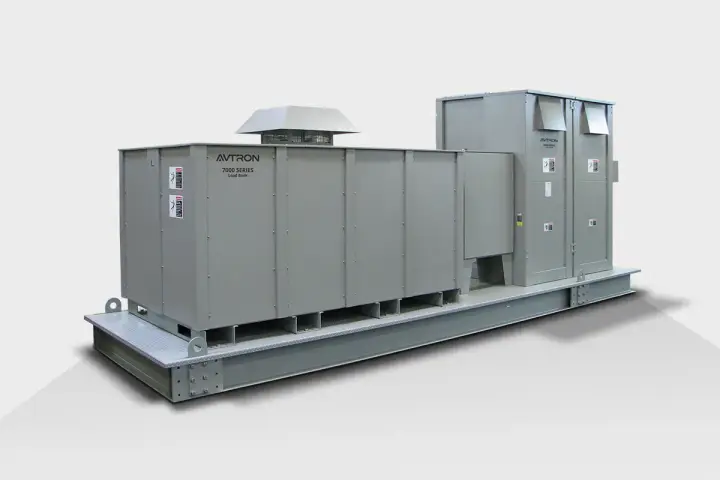
Skid-mounted resistive-inductive load bank, 937.5 to 3,125 kVA at 0.8 pf, so 2,500 kW real at the ceiling
Avtron 7700 is one of 16 load banks tracked in the SecondWatt catalogue, each with specifications, lead times and indicative secondary-market pricing.
Avtron 7700 resistive-inductive load bank, 937.5 to 3,125 kVA at 0.8 pf, 480/600 V, 6.25 kVA steps. Skid-mount specs, inspection points and pricing.
The Avtron 7700 is a resistive-inductive load bank rated in kVA at 0.8 power factor, not in kW. At its 3,125 kVA ceiling that is 2,500 kW of real load plus 1,875 kVAR of lagging reactive load. Applying both together is what makes it an alternator testing instrument rather than an engine testing instrument, because it forces the excitation system and the automatic voltage regulator to work. Permanent skid mount is the primary configuration. Avtron's product page lists mounting as permanent skid mount and describes the unit as designed for permanent or mobile outdoor applications, while the pub 5531 rev D data sheet specifies outdoor installation on a concrete pad, structural base or trailer. It is not a portable product in the sense the suitcase-style 2000 Series units are, and the single-point top-entry cable connection reflects a fixed installation. Step resolution is 5 kW and 3.75 kVAr, which is exactly 6.25 kVA at 0.8 pf and gives 500 steps at 3,125 kVA. That resolves 0.2 percent of full scale, five times finer than the resistive 4950. The gap on this model is dimensional. Avtron publishes length and weight only as dependent on capacity, and the outline drawing directs the reader to consult the factory, so a foundation and a lift cannot be planned from published data.
Why it matters
A resistive bank proves an engine can make kilowatts. The 7700 proves the alternator, exciter and voltage regulator behave under lagging load, which is the failure mode that surfaces during a real outage rather than during a resistive test. Its 6.25 kVA step resolves 0.2 percent of full scale, fine enough to walk load up in controlled increments and hold intermediate points during an acceptance run.
Who buys it
Generator OEMs, packagers, commissioning agents and data centre owners running Level 4 and Level 5 acceptance testing on plant they intend to keep testing. Applying 0.8 pf lagging load exposes voltage dip and recovery on step load and reveals reactive load-sharing errors between paralleled sets that a resistive-only bank cannot see. Buyers who need the same capability shipped between sites should look at the containerised 8300 or 8400 instead.
Role in the data center
Permanent generator exercise at real power factor, plus Level 4 and Level 5 integrated systems testing on sites that have installed their own test capability rather than renting one. The 0.2 percent step is used to walk load in controlled increments and hold intermediate points. Avtron does not name the 7700 in either March 2026 data centre brochure, giving that slot to the containerised 8400, which is a positioning choice about shippability rather than a statement about capability.
Key specifications
| Rated capacity | 937.5 to 3,125 kVA at 0.8 pf |
|---|---|
| Real component at 3,125 kVA | 2,500 kW (computed, 3,125 x 0.8) |
| Reactive component at 3,125 kVA | 1,875 kVAR (computed, 3,125 x 0.6) |
| Load step resolution | 5 kW / 3.75 kVAr, equal to 6.25 kVA at 0.8 pf |
| Load steps at 3,125 kVA | 500 steps (3,125 / 6.25) |
| Voltage | 480 / 600 V three phase |
| Line current at 3,125 kVA, 480 V | 3,759 A (computed, 3,125,000 / (1.732 x 480)) |
| Control circuit | 120 V single phase 60 Hz |
| Frequency | 60 Hz per product page |
| Airflow | approximately 20,000 CFM per resistor stack |
| Width variants | 76.00 and 97.25 in (1930.40 and 2470.15 mm) |
| Reactive section length shown on drawing | 116 in |
| Mounting | Permanent skid mount concrete pad, structural base or trailer |
| Connection | Single point connection box top entry of load cables |
| Ambient range | -20 to 120 deg F (-28 to 50 deg C) |
| Length and weight | Published only as dependent on capacity no figure given by Avtron |
Technical summary
Capacity: 937.5 to 3,125 kVA at 0.8 power factor, not kW. Components at 3,125 kVA: 2,500 kW real plus 1,875 kVAR lagging (computed from 0.8 pf). Load step resolution: 5 kW and 3.75 kVAr, equal to 6.25 kVA at 0.8 pf, giving 500 steps at full rating. Voltage: 480 or 600 V three phase; control circuit 120 V single phase 60 Hz. Frequency: 60 Hz on the product page; the 7000 Series brochure lists 50 and 60 Hz. Airflow: approximately 20,000 CFM per resistor stack, TEFC or TEAO motors, vertical discharge. Mounting: permanent skid mount; concrete pad, structural base or trailer. Connection: single point connection box with top entry of load cables. Width: two published variants at 76.00 in (1930.40 mm) and 97.25 in (2470.15 mm). Construction: heavy gauge steel skid, aluminized steel enclosure, gray ANSI 61 powder coat. Ambient: -20 deg F to 120 deg F (-28 deg C to 50 deg C).
Major variations
The 7700 is built from resistive bays plus a separate reactive section, and the outline drawing's title block shows a two bay resistive unit with a 116 in reactive unit while noting other rated units are available. That modular bay count is why the data sheet gives length and weight as dependent on capacity, and why two widths are published at 76.00 in and 97.25 in. Mounting varies between a permanent skid on a concrete pad, a structural base, and a trailer. Voltage is ordered as 480 or 600 V. Control ranges from a remote manual panel with power, blower and load switches to automatic and digital options and SIGMA 2.
Configurations and options
A remote manual control panel is standard, with optional automatic and digital controls and SIGMA 2. The SIGMA platform supports non-unity power factor tests when several banks are networked, which is how a resistive-only bank and a reactive bank get combined on one job. Avtron notes that custom designs may be available and publishes a standing aluminized steel construction document covering the corrosion package.
Compatibility and dependencies
Low voltage only at 480 or 600 V, with a 120 V single phase 60 Hz control circuit that needs its own supply and fusing. At 3,125 kVA and 480 V the tie is roughly 3,759 A. Load cables enter the single point connection box from the top, so the cable route must approach from above and the gland area must be weather-sealed. Foundation and rigging cannot be planned from published data, because Avtron gives length and weight only as dependent on capacity and directs the reader to the factory. Require a job-specific outline drawing before committing to a pad design, a trailer or a crane.
Pricing and availability
Comparable secondary-market band: 49.78–70.54 $ per kW of real component. Trend: stable No price series exists for this model. The resistive-reactive class has no published price at any condition tier. The often-quoted 40 to 80 percent premium of resistive-reactive over resistive traces to a single dealer marketing page and is not independently corroborated. Lead time, new: No 7700 appears on Avtron's stock list, and SteadyPower publishes no lead time for it or for any other resistive-reactive unit in its catalogue. The data sheet gives length and weight as dependent on capacity and the outline drawing says consult factory, both of which indicate a made-to-order product.. Lead time, used or refurbished: No used 7700 listed on any secondary market channel as of August 2026.. Warranty, new: Avtron publishes 24 month parts and labor on sibling models, so confirm in writing at order..
Lifecycle and maintenance
Avtron publishes no MTBF, design life or maintenance interval table for the 7700. The pub 5531 rev D data sheet publishes ambient limits and construction rather than service life, and Avtron hosts no 7700 user manual in its document library. Two structural points do hold. The enclosure is aluminized steel with a baked polyester powder coat rated -20 deg F to 120 deg F and designed for permanent outdoor installation, so it is the decades-long part. The reactive section adds a wear and test path the resistive-only 4000 Series has no equivalent for, and power factor accuracy is the parameter that degrades first. Avtron sells model-specific spares kits as a standing product line. Only the real component draws fuel: at 3,125 kVA and 0.8 pf that is 2,500 kW, so a four-hour run draws 10,000 kWh while the 1,875 kVAR loads the alternator without adding net energy.
Thermal and emissions profile
No on-site combustion and no direct emissions. On a resistive-inductive unit only the real-power component becomes heat: at 937.5–3,125 kVA and 0.8 power factor the resistive section rejects roughly 750–2,500 kW thermally, while the inductive section circulates reactive power and dissipates only its own winding and core losses. Emissions during a test are those of the alternator or generator under test.
Common failure points
- Reactor and inductive section — Achieved power factor drifts off 0.8 while the kW component reads correct
- Load contactors — A step fails to pick up, or load reads short by an exact multiple of 6.25 kVA
- Resistive elements — Phase imbalance at a fixed step, or a kW component short of the 0.8 pf value the kVA rating implies
- Cooling fans and bearings — Over-temperature trip, reduced airflow, or rising motor current across successive runs
- Single point connection box — Insulation resistance falling at the incoming terminals only, tracking marks, corrosion inside the box
- Control system generation — The unit cannot be networked with newer SIGMA 2 banks, or the hand-held will not connect
- Skid and enclosure corrosion — Rust at the skid base frame and fastener heads, powder coat lifting
Inspection checklist
Rating unit on the nameplate: confirm the plate reads kVA at 0.8 pf and not kW, since 3,125 kVA is 2,500 kW plus 1,875 kVAR and is often miscatalogued. Reactive section present: the 7700 is built as resistive bays plus a separate reactive unit of 116 in published length, so verify that section exists and is wired. Step resolution: prove the 5 kW and 3.75 kVAr step switches, which is 500 steps at 3,125 kVA and 150 steps at 937.5 kVA. Power factor accuracy: load the bank at 3 or more points and measure achieved power factor against 0.8, since inductor taps drift and shorted turns shift it. Reactor insulation: megger the inductive section separately from the resistive section, because the two age differently and a shared test hides an inductor fault.
Procurement channels
New through Avtron and its distributors, all quote-only for this class. SteadyPower carries the resistive-reactive line and publishes no price for any of it, in contrast to the 24 resistive builds it prices openly. Global Power Supply and Curtis Power Solutions both list Avtron stationary product without prices. The used channel is effectively absent at this size and load type. Used load bank listings are concentrated under 250 kW and none exceeds 750 kW as of August 2026. Rental exists as an alternative, since United Rentals catalogues 1,800 kVA and 3,700 kVA resistive-reactive units that bracket the 7700's range, but publishes no rate on its website.
Regional notes
The product page publishes 60 Hz at 480 or 600 V, which is North American practice, while the 7000 Series brochure lists 50 and 60 Hz across the series. No NRTL listing file number is published. Confirm frequency, voltage and listing on the nameplate for any project outside North America.